
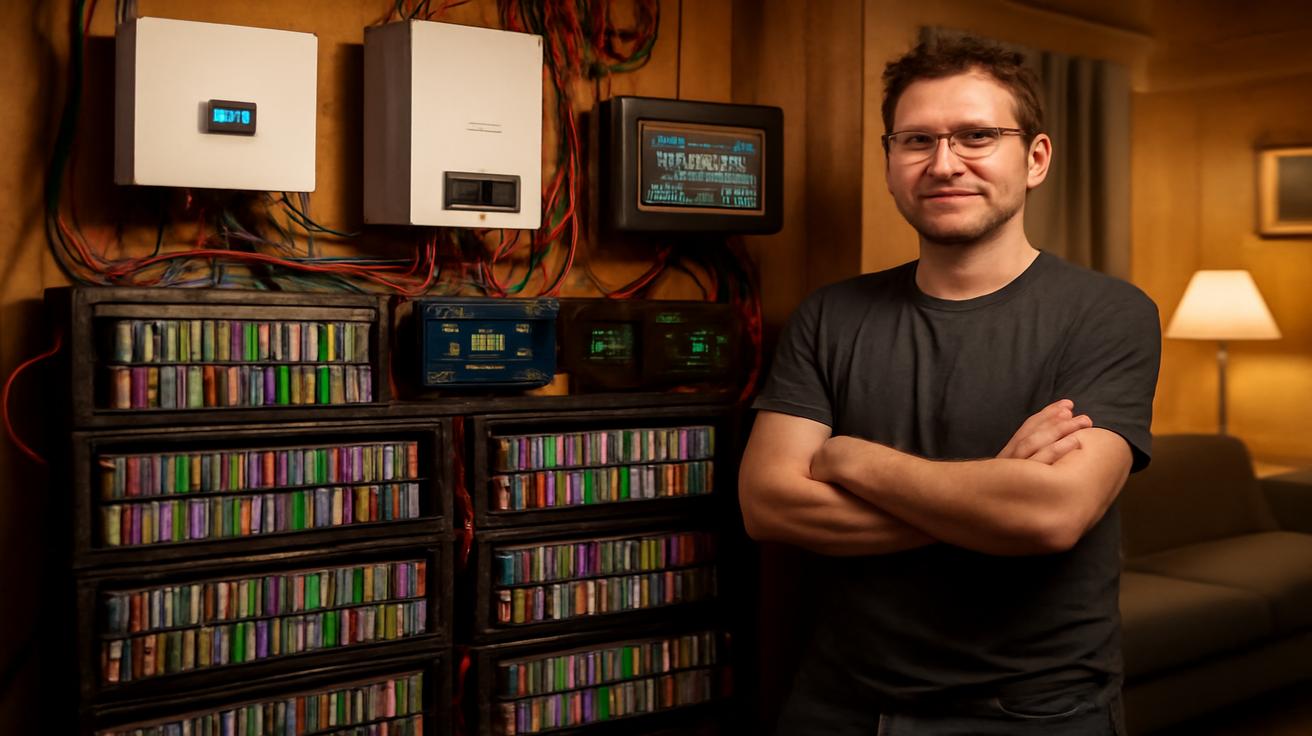
The first time he cracked open a dead laptop battery, the silence in the garage felt loud. Rain ticked on the corrugated roof, the smell of warm dust and engine oil hung in the air, and a single desk lamp cast a hard circle of light on the workbench. Lined up in front of him were a handful of discarded battery packs—ugly, plastic, and supposedly useless. He took a breath, slid the screwdriver into a seam, and pried. The shell snapped open with a sharp pop, and inside lay what would quietly transform his home.
Small, neat cylinders. Dozens of them. 18650 lithium-ion cells: the same kind used in electric cars, power tools, and expensive flashlights. Inside a “dead” battery pack, most of these cells were still very much alive—just abandoned.
Today, more than a decade later, he has collected over 650 of those rescued cells. Together, they hum softly in the corner of his house, out of sight but very much at work, quietly powering lights, a fridge, computers, fans, and the evening tea. While most people plug into an invisible grid and never think twice about where the electricity comes from, he knows every volt and wire by sight and by feel. His power isn’t anonymous. It has a story.
The Day the Lights Went Out—and Didn’t Come Back
This story didn’t begin with a love of electronics. It began with a blackout.
It was one of those muggy summer evenings when the air settles into a kind of heavy stillness. Ceiling fan spinning lazily, laptop warm against his knees, he was halfway through an online film when the world abruptly clicked into darkness. The fan sighed to a stop. The laptop screen snapped to black. An instant hush fell over the house—a quiet so sudden it felt like pressure on the ears.
He waited. Blackouts weren’t unusual. A few minutes, maybe an hour, then the grid would cough back to life. He lit a candle and watched the wax pool around the wick. The minutes grew longer. Night deepened. The neighbors’ houses were equally dark, the whole street a silhouette. Somewhere in the distance, a generator rattled awake in a stuttering, gasoline cough. Not his. He hated the sound of them: harsh, impatient, always begging for fuel.
The power didn’t come back that night. Or the next day. When it finally did, something had changed. The blackout hadn’t just taken away the lights; it had pulled back the curtain on how vulnerable his home really was. He realized he had no idea how any of it worked—only that, when the grid failed, his life shrank to the radius of a candle.
He decided that was the last time a random outage would dictate his comfort. Somehow, he would make his own power. The problem was, he had almost no money.
Where Other People Saw Trash
The turning point came in the most ordinary of places: an office recycling bin. He was visiting a friend who worked in IT. Against one wall sat a box labeled “E-waste,” filled with tangled cords, cracked keyboards, and a tangle of plastic bricks. On top lay a handful of chunky, gray battery packs—the kind you’d slide into the bottom of an old corporate laptop.
“Those dead?” he asked.
“Yeah,” his friend said. “Battery health shot. They don’t hold charge. Going to recycling.”
The word “dead” stuck in his mind. Dead… or just dismissed? He’d been reading forums about DIY solar systems, and again and again one phrase popped up, tucked away in comment sections: laptop 18650 cells. People were salvaging them from old packs, testing them, and building homemade energy storage. It sounded just crazy enough to work.
“Can I take a few?” he asked.
His friend shrugged. “If you want that junk, be my guest.”
He walked away with five battery packs balanced in his arms and an odd, buzzing sense that he was carrying something much stranger than garbage.
The Quiet Ritual of Cracking, Testing, Sorting
For months, his evenings took on a new rhythm. Dinner. Dishes. Then the small, satisfying violence of prying open battery packs in the garage.
The blister-packs were stubborn. Some surrendered easily with a twist of the screwdriver; others fought back, cracking like bones. Inside, nestled in rows, were the cylindrical cells, taped and spot-welded together. He clipped the nickel strips, freed each cell, and lined them up like little metal soldiers.
The process was careful and repetitive. It had to be.
First came the initial voltage reading: anything near zero was likely unsafe or dead. Then a slow charge with a dedicated lithium-ion charger. He watched them like a hawk, fingertips hovering above them to catch the earliest sign of warmth. If a cell heated up too much, it was exiled to the “danger” pile and later taken to proper disposal.
Once charged, each cell was discharged through a device that measured its capacity—how much energy it could store compared to the label stamped on its side. The numbers became a kind of language. A 2200mAh cell that still delivered 2000 was a little champion. A cell dropping out at 900mAh went into the “maybe later” box.
He bought cheap testers, burned them out, bought better ones. He learned how to listen with his hands: good cells stayed cool and steady; bad ones turned hot or dropped voltage like a stone. Over time, patterns emerged. Certain brands were reliable, others almost always trash. Packs from businesses that replaced laptops every two years were goldmines. Packs dragged through five years of daily use were graveyards.
The work was slow, almost meditative. The pile grew. Ten cells. Thirty. A hundred. He stored them in neatly labeled trays: 2000–2200mAh, 2200–2400mAh, and so on. Each one had once been part of a laptop that helped someone write reports, apply for jobs, watch late-night movies—small human stories buried inside their charge–discharge cycles.
From Handfuls of Cells to a Beating Heart
The day he decided to turn his growing collection into a home battery bank, the idea still felt quietly insane. Powering some LED lights was one thing. Powering a home—even a modest one—seemed like something only companies and experts could do.
But by then, he had another teacher besides the internet: the cells themselves. Hundreds of them, patiently waiting in plastic trays.
Designing a Battery Bank from Castoffs
He started small. First, a single 12-volt pack to power lights. He wired groups of cells in parallel to add capacity, then connected those groups in series to raise the voltage. Spot-welding nickel strips across the cell ends, he slowly constructed what looked like a block of industrial Lego—green and blue sleeves pressed close, held in honeycomb grids.
He wrapped the pack with fishpaper and heat-shrink, then introduced the unsung hero of the whole system: the Battery Management System, or BMS. It was a small board with a tangle of balance wires, a kind of electronic shepherd that keeps all the cells in line—no overcharging, no over-discharging, no one cell racing ahead or falling dangerously behind.
The first night he flipped the switch and his living room lights glowed, not from the grid but from that homemade pack on the table, he just stood there and watched the bulbs. The light was exactly the same, but the feeling wasn’t. It felt like the difference between eating at a restaurant and cooking your own first truly satisfying meal.
Over the next year, he kept collecting. More cells. More packs. Better testing gear. He added solar panels to the roof—a patchwork of mismatched modules, some bought second-hand, some on discount. Wires snaked down into an inverter that turned the battery’s DC into household AC. Bit by bit, the temporary setup turned permanent.
His tiny experiment grew into the beating heart of the house.
The Numbers Behind the Magic
Like any quiet miracle, this one is rooted in math. Rough math, but math nonetheless.
To understand what he’d built, he started summarizing the system in a simple table he kept taped near the battery bank. It looked something like this:
| Component | Details |
|---|---|
| Number of cells | 650+ salvaged 18650 lithium-ion cells |
| Average cell capacity | 2000–2200 mAh per cell (tested, usable) |
| Total energy storage | Approx. 4–5 kWh, depending on configuration and aging |
| System voltage | Predominantly 24V bank feeding an inverter |
| Primary energy source | Rooftop solar panels (varied wattage), with optional grid backup |
| Usage | Lighting, laptop/phone charging, fridge, fans, networking gear, and essential appliances |
The exact numbers shifted over the years as he added and retired cells, but the principle stayed the same: take what others call waste, test it carefully, and combine it into something that can carry real weight.
On a good sunny day, the panels charge the battery bank to full and still have room to run the house in real time. At sunset, the batteries take over; a pool of daylight stored in metal and chemicals and quiet intention.
Living with Your Power, Not Just Using It
Once you stop relying on the grid, you start paying attention to things most people never notice. In his home, electricity isn’t invisible; it’s a daily relationship.
On clear mornings, he wakes with a kind of weather-sense. He glances at the sky not just to know if he needs an umbrella, but to guess how much energy the day will hand him. High, crisp blue? Run the washing machine, maybe bake something, charge every device at once. Hazy, low clouds and a stubborn drizzle? Time to prioritize: the fridge stays, the lights stay, but vacuuming might wait.
The rhythm of the house softens into the rhythm of the sun. Long summer evenings feel especially generous: the panels soak up light until late, the battery meter ticks up, and the fans waft warm air while the inverter hums softly in its corner.
In the rare times the batteries dip lower than he likes—after several dark days in a row—he doesn’t treat it as a failure. It’s information. It nudges him to run fewer things at once, to think about which comforts are essential and which are simply habits.
Most visitors never notice any of this. They come in, flip a switch, and the lights obey, just as they do everywhere else. Only if they step into the storage room will they see the dense lattice of green and gray cells, the orderly cables, the screens with their trickle of numbers: volts, amps, watts, percentage. A wall of rescued energy quietly doing its job.
What Ten Years of Laptop Batteries Teach You
About Waste
Each of those 650 cells had a manufacturer’s life story written into it: a number of charge cycles before being considered “end of life.” But in practice, most were retired early. A laptop battery pack might be flagged as “bad” because one or two cells inside had failed, dragging down the whole pack. The rest—sometimes 60–80% of the original capacity—was still there.
On a global scale, that means mountains of lithium-ion cells, deemed unfit for laptops but perfectly serviceable for gentler duties. In a laptop, you expect sharp performance: fast charging, long run time, high current draws. In a home battery, the demands can be softer: slower charge and discharge, more predictable schedules, careful monitoring. It’s like retiring a racing horse to pull a light cart at a walking pace; the capacity is still useful, just in a different context.
About Independence
Over ten years, his system has ridden out storms, heatwaves, and long, meandering outages. When the grid flickers and dies, neighbors head out to the shops for candles. Some drag noisy generators onto balconies. In his home, a relay clicks, the inverter keeps purring, and the lights don’t even blink.
There’s a special kind of quiet satisfaction in boiling water for tea during a blackout, listening to the night go still outside while your own house remains gently, defiantly bright.
About Respect for Risk
Lithium-ion cells are not toys. He learned this early, long before his bank grew to hundreds of cells. Mishandling them—shorting them, overcharging, puncturing—can be dangerous. Stories of battery fires and runaway thermal reactions are not urban myths; they’re hard physics.
So alongside the slow pride of building came a deep, disciplined respect. He installed fuses to keep any single failure from cascading. He used flame-retardant materials, metal enclosures where possible, clear labeling. He checked temperatures regularly, logged pack behavior over months, then years. Any cell that behaved strangely was pulled, no questions asked.
There’s a paradox in working with risk: done properly, it can make you calmer, more careful, not more fearful. The bank has become not just a power source, but a reminder that technology and responsibility must share the same table.
About Community
The story isn’t solitary. Over time, he started getting those messages: “Hey, I heard you do something with old batteries… can you use these?” Friends, neighbors, a local repair shop, even a school IT department began setting aside their “dead” laptop packs, knowing they wouldn’t end up in a landfill just yet.
Sometimes he passes on what he’s learned. A neighbor wants a small backup system just for a modem and a lamp. A relative wants to understand solar before committing to a commercial installation. Each time, the advice begins the same way: start small, learn the chemistry, respect the danger, and remember that every watt-hour you don’t waste is power you don’t have to generate.
The House That Runs on Stories
At night, when the house is quiet and the only sound is the fridge humming and a distant dog barking, he sometimes walks over to the battery bank and just stands there. In the dim glow of the monitoring screen, the cells sit motionless, yet full of motion he can’t see—ions drifting, chemical reactions balancing, tiny synchronized dances of energy.
More than 650 of them, each plucked from a different corner of the world: an office in the city, a college library, an airport lounge, a bedroom where someone wrote their thesis, a kitchen table where a parent paid bills. Machines remember nothing of the people who used them, but somehow, he feels that using these cells again is a quiet way of honoring that invisible labor.
His home is not “off-grid” in the heroic, wilderness sense. There are still wires to the outside world. The system is imperfect, evolving, mortal like anything else. Cells age. Panels degrade. Inverters fail and get replaced. But the principle is solid and simple: you don’t have to accept the default. Power doesn’t have to be an anonymous service delivered through hidden cables and opaque bills. It can be a relationship—messy, hands-on, deeply satisfying.
And somewhere inside that relationship is a simple truth you can feel every time a light turns on: the story could have been different. Those laptop batteries could have been shredded, melted down, or buried. Instead, for more than ten years, they’ve been waking up with the sun and going to sleep with the stars, keeping one home quietly alive.
Frequently Asked Questions
Is it really safe to power a home with old laptop batteries?
It can be done safely, but only with proper knowledge and precautions. Salvaged cells must be thoroughly tested, grouped by similar capacity and health, protected by a high-quality Battery Management System, and installed with fuses and appropriate wiring. Poorly built packs can be dangerous and are not recommended for beginners without extensive research and careful practice.
How long do these reused laptop cells last in a home battery bank?
Laptop cells that still have good capacity and are treated gently—never overcharged or deeply discharged, and kept cool—can last several more years in a low-stress home battery role. Exact lifespans vary, but many DIY users see 5–10 years of additional use, especially when starting with higher-quality cells and conservative charge/discharge settings.
Can a system like this power an entire house all the time?
It depends on the house’s energy use and the size of the battery bank and solar array. A few kilowatt-hours of storage, like in this story, can comfortably handle essentials: lighting, electronics, networking gear, a fridge, and fans. High-consumption appliances such as electric ovens, air conditioners, and electric heaters usually require a much larger system or selective use.
Where do people usually find old laptop batteries to reuse?
Common sources include office IT departments, repair shops, friends and family upgrading laptops, schools, and e-waste collection events. Any collected packs must still be evaluated carefully; not all will contain usable cells, and some will be too degraded or unsafe to repurpose.
Is this approach environmentally friendly, or just shifting the problem?
Reusing laptop cells extends their useful life and delays the need for energy-intensive recycling or disposal, which is generally positive. However, it doesn’t replace the need for proper end-of-life recycling. The most sustainable approach combines careful reuse, responsible disposal of failed cells, and reduced overall energy consumption.
Can someone with no electronics background build a similar system?
Not immediately. It’s possible to learn, but doing so safely takes time, patience, and study. Many people start with small, low-voltage projects, learn basic electronics and safety, and only later attempt larger home systems. Buying a certified commercial home battery system is often safer and more practical for those who don’t want to dive deeply into the technical details.








Leave a Comment