
The trail is empty except for the sound of your footsteps and the wind creasing through dry leaves. You notice the rhythm of your breath, the slow unfurling of your shoulders as if someone has quietly opened a window inside your chest. Out here, alone, the world seems to soften. Your thoughts line up instead of crash into one another. Later, when you’re back among people—at a dinner, in a meeting, even sitting on a couch with friends—that loose, easy feeling tightens again. The volume rises, outside and inside. You laugh in the right places, you nod, you listen, you care. But somewhere underneath, there’s a small longing: to be back on that empty trail, hearing only your own footsteps and the wind.
Why Some Minds Breathe Easier in Silence
There’s a particular kind of calm that arrives only in solitude. It’s not the dramatic, cinematic kind of aloneness—no cabin in the mountains or remote island required. It might be the fifteen minutes in your car after work, engine off in the dusk. The slow ritual of making coffee before anyone else wakes up. The walk around the block with your phone left face down on the counter.
Psychologists sometimes talk about internal regulation—the way we use our own thoughts, sensations, and quiet rituals to manage emotion and stress. For some people, that internal system is their primary home base. They steady themselves from the inside out. Other people regulate more through co-regulation—drawing calm, validation, and emotional balance from the presence and responses of others.
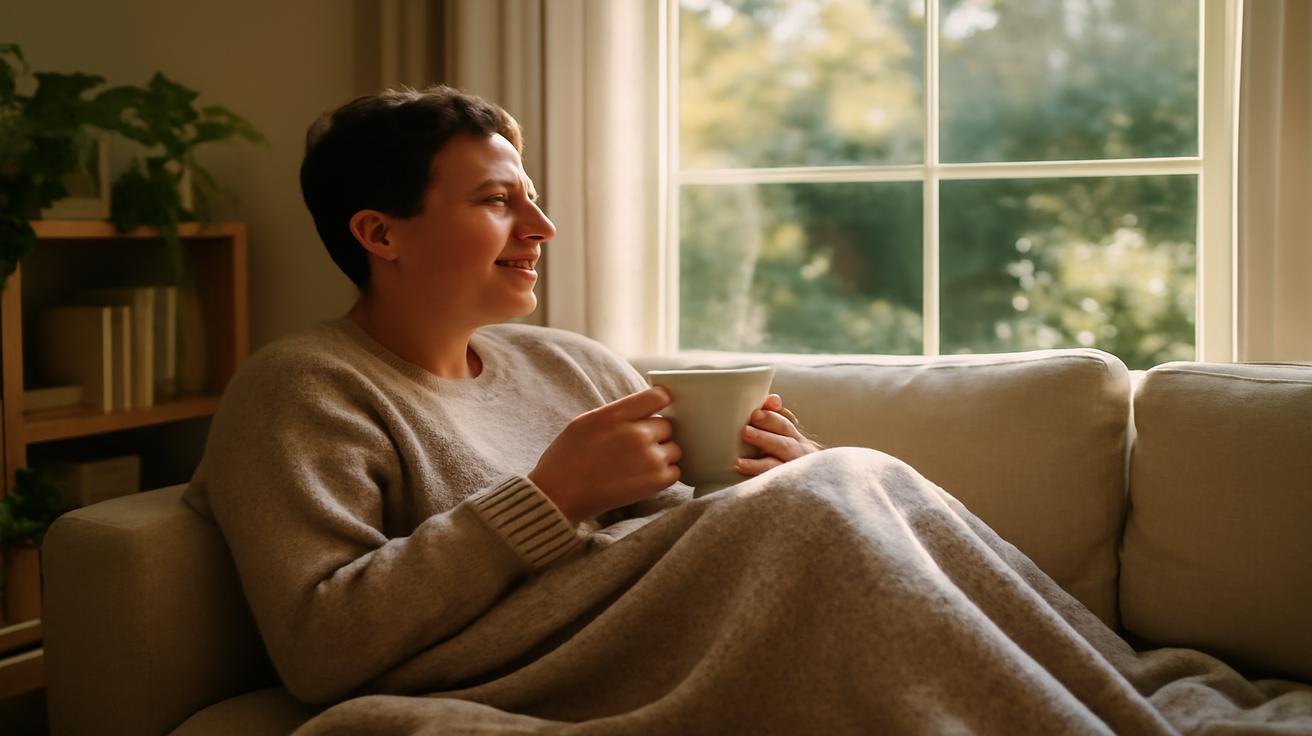
If you feel calmer alone than with others, it doesn’t automatically mean you’re antisocial, broken, or destined to live in a cabin with a suspiciously large collection of tea and blankets. It may simply mean your nervous system has learned that the safest, most predictable place to land is inside yourself.
Think about what happens when you’re truly alone. The subtle pressure of eyes—real or imagined—lifts. You’re no longer monitoring facial expressions, searching for signs of boredom, irritation, or approval. That invisible second job of “being a person among other people” disappears. The part of your brain that’s constantly scanning the social horizon for storms can rest.
Inside that rest, something important happens: the nervous system rebalances. Heart rate slows. Muscles unclench. Attention drifts from “How am I being perceived?” to “What do I actually feel?” That shift—from external monitoring to internal noticing—is one of the core signatures of internal regulation.
The Introvert Myth—and What’s Really Going On
It’s tempting to file this whole experience under a single label: introvert. And yes, introversion plays a role. But the story is more textured than that.
Introversion is about where you recharge. Extroverts often refuel through social interaction; introverts tend to refuel through solitude or low-stimulation environments. But internal regulation digs deeper than social preference. It’s about how you calm your own system and what your history has taught you is safe.
Maybe you grew up in a house where the mood changed without warning—a slammed cabinet, a sharp tone, a silence stretched too tight. You might have learned to read the air before you walked into a room. Over time, that hyper-vigilance can become automatic. Being with others, even kind people, asks your nervous system to stay on duty: watching, interpreting, predicting. Alone, the job is smaller. The air is clearer.
Or maybe you were the “good listener,” the friend who always held the stories and secrets, the one whose shoulder caught everyone else’s tears. You learned to dial down your own needs to make space for others. Of course it feels calmer to be alone: you finally get to stop shrinking yourself to fit the emotional needs of the room.
For others, neurodivergence quietly shapes this landscape. If you’re sensitive to noise, expression, or subtle shifts in tone, a casual group conversation can feel like trying to track three radio stations at once. Your brain works harder just to participate. Solitude removes that extra processing load. It’s not that you don’t like people; it’s that your nervous system is paying triple for every interaction.
The Nervous System’s Quiet Preferences
Underneath the stories and labels, your body has opinions. It remembers. It decides, often before your conscious mind, what feels safe enough to relax in.
Here are a few inner signals that often show up for people who regulate best alone:
- A sense of relief when plans are canceled, even with people you truly like.
- Feeling oddly tired after social events that were “fine” on the surface.
- Needing long stretches of recovery time between gatherings or meetings.
- Noticing your thoughts feel clearer and kinder when you’re by yourself.
- Feeling more authentically “you” in your own company than in groups.
None of these point to a character flaw. They point to a nervous system that is telling you, in its own language, “I regulate best when I have room. When incoming signals are fewer. When I can hear myself again.”
Internal Regulation: The Art of Being Your Own Harbor
Psychologically, internal regulation is the process of using inner tools—thoughts, body awareness, imagination, and self-soothing practices—to move through difficult feelings. It’s the difference between needing someone else to say, “You’re okay,” and being able to feel your way to “I’m okay” from the inside.
Picture your inner world as a harbor. External regulation is like relying on other ships to circle you, block the waves, and keep you steady. Internal regulation is learning to lower your own anchor, adjust your own sails, repair your own small leaks when the weather turns.
This doesn’t mean doing everything alone or rejecting help. It means having an internal base camp to come back to—especially when the social weather is rough.
Some people develop strong internal regulation early. Maybe they escaped into books, drawing, daydreams, or nature when the outer world felt overwhelming. The forest path, the sketchbook, the familiar playlist on loop—they all became rooms inside the self where emotions could settle.
Over years, patterns like these can become a quiet but powerful skill set:
- Noticing and naming your emotional state (“I’m overwhelmed,” “I’m overstimulated,” “I’m lonely but need quiet, not a crowd”).
- Finding sensory anchors, like the feel of warm water, the weight of a blanket, or the rhythm of a walk.
- Using inner dialogue that’s steady rather than punishing.
- Allowing feelings to move through without making them a social performance.
When you’re with others, this same system is still there, but it can get drowned out by the volume of external input: voices, expectations, timing, unspoken rules. Alone, you can hear the quieter instruments again.
Alone vs. Lonely: A Subtle but Crucial Line
Feeling calmer alone isn’t the same as wanting to live your life in isolation. They’re different states, often confused in a culture that equates “social” with “healthy.”
Aloneness is a physical or emotional state of being with yourself. It can be nourishing, neutral, or painful, depending on context. Loneliness is the ache of disconnection—of not feeling seen, chosen, or understood, even if you’re surrounded by people.
Many people who regulate best alone know a specific ache: being lonely in groups. You might be at a party, hearing laughter, clinking glasses, the hum of overlapping stories, and still feel like you’re behind a pane of glass. The conversation skips along the surface while your inner life stands deeper and quieter, waiting for someone who speaks its language.
In those moments, solitude can actually be kinder. To be alone and honest feels better than being together and unseen. Your nervous system knows this. It recognizes the mismatch and quietly votes for the forest path, the solo drive, the closed door and the open notebook.
The Subtle Pressure of Being “On”
Most social spaces come with an unwritten dress code for behavior. Smile. React on time. Don’t let silence linger too long. Ask questions. Be interested, but not too intense. Share, but not too much. For many people, this invisible choreography feels natural. For others, it feels like holding a yoga pose ten minutes too long—doable, but exhausting.
That exhaustion isn’t imaginary. The brain’s social circuitry is energy-hungry. It monitors tone of voice, micro-expressions, timing, topic shifts. It keeps a running simulation of how your words might land. It cross-references memory: When I said something like this before, did people laugh? Did the moment go flat? Should I soften this? Am I talking too much?
Layer in any additional sensitivity—like social anxiety, past criticism, perfectionism, or a history of being shamed for “saying the wrong thing”—and socializing becomes less like a casual swim and more like treading water with a smile.
This is why the quiet of being alone can feel medicinal. No longer “on,” you can soften your facial expressions, let your mind wander off-script, and move at your own pace. Your internal regulation can take up the full room, no longer negotiating with external feedback.
A Quick Look at Internal vs External Regulation
The contrast between how we calm down alone versus with others can be surprisingly clear when we map it. Here’s a simple overview:
| Aspect | Internal Regulation (Alone) | External Regulation (With Others) |
|---|---|---|
| Source of Calm | Your own thoughts, routines, and body cues | Others’ presence, words, touch, and reactions |
| Primary Focus | Inner world: sensations, reflections, imagination | Outer world: social cues, conversation, shared activity |
| Energy Effect | Often recharging, especially in low-stimulation settings | Can be uplifting or draining, depending on context |
| Risk | Over-isolation, getting lost in rumination | Over-dependence on others for validation or soothing |
| Strength | Self-reliance, deep reflection, creative insight | Connection, shared regulation, perspective-taking |
Ideally, we can move between these modes—anchored in ourselves, but open to others. For those who feel most at ease alone, the task isn’t to “fix” that preference, but to understand it well enough that it doesn’t quietly run your life from the shadows.
Honoring the Calm Without Hiding Inside It
There’s a deep relief in realizing: preferring your own company doesn’t automatically make you a hermit-in-training. It makes you someone whose nervous system has particular settings—and those settings can be worked with, not wrestled into submission.
The goal isn’t to force yourself into high-stimulation, high-exposure social experiences because “that’s what normal people do.” It’s to design a life that respects your need for internal regulation while still including the nourishment of human connection.
That might look like:
- Scheduling social time like a hike, with rest days on either side.
- Choosing smaller gatherings over big ones when possible.
- Leaving events before you’re utterly depleted, instead of pushing to the bitter end.
- Letting close friends know that if you disappear for a bit, it’s usually about recharge, not rejection.
- Weaving solitude into your day rather than saving it only for when you’re burned out.
As you do this, notice how your inner world responds. When solitude is intentional, not just an emergency escape, it shifts from hiding place to habitat. You choose it before you desperately need it. You return to others from a place of groundedness rather than panic.
Making Peace With Your Inner Landscape
There’s a quiet bravery in admitting: “I feel safer and calmer alone.” It can feel like confessing that you’re out of step with the buzz of the world. But in many ways, this is one of the most human truths there is. Underneath our social selves, each of us is a single awareness moving through time, trying to make sense of what we feel.
Psychology doesn’t treat your preference for solitude as a moral issue. It treats it as information. Your nervous system has learned something—about stimulation, about safety, about the cost of constantly performing your own likable version. That learning can be updated, gently, over time. But it doesn’t need to be erased.
You’re allowed to like the sound of your own footsteps on an empty trail. You’re allowed to feel your shoulders drop in an empty room. You’re allowed to need to come home to yourself before you can show up fully for anyone else.
Internal regulation, at its heart, is the art of befriending that home. Of arranging the furniture of your days so that solitude isn’t a symptom of failure, but a conscious, steadying part of how you move through the world.
You may always feel a little calmer alone than with others. That’s okay. Let that calm be a teacher, not a verdict. Let it show you the pace, the spaces, and the kinds of connection that let your nervous system breathe. And from that quieter place, you might find that being with others feels less like leaving yourself and more like bringing yourself along.
Frequently Asked Questions
Is it unhealthy that I prefer being alone most of the time?
Not necessarily. Preferring solitude is not inherently unhealthy. It becomes a concern when isolation starts to increase your distress—if you feel trapped, deeply lonely, or unable to reach out even when you want to. The key question is: does your alone time feel mostly nourishing and chosen, or mostly heavy and forced?
How do I tell if I’m introverted or just anxious around people?
Introversion usually means socializing drains your energy, even when you enjoy it, and solitude restores you. Social anxiety adds a layer of fear or worry about being judged or rejected. You can be introverted without anxiety, anxious without being introverted, or a mix of both. Pay attention to whether your main feeling around others is “tired” or “afraid.”
Can I improve my ability to feel calm around others?
Yes. You can gradually build comfort by choosing low-pressure settings, spending time with people who feel emotionally safe, and noticing your body cues before you reach overwhelm. Practices like slow breathing, grounding (feeling your feet, your seat, your breath), and setting time limits for social events can all help your nervous system stay regulated with others.
Why do I feel lonelier in groups than when I’m actually alone?
Feeling unseen or misunderstood in a group highlights the gap between your inner world and what’s happening around you. That mismatch can intensify loneliness. When you’re alone by choice, your outer and inner states often match more closely, which can feel strangely less lonely, even without people around.
How can I explain this to friends and family without hurting them?
You can frame it as a difference in wiring, not a verdict on them. For example: “I recharge best on my own, so if I take space it’s not because I don’t care about you. It just helps me show up as my best self.” Being specific—like suggesting shorter visits or more one-on-one time—can reassure them that you’re choosing balance, not rejection.







Leave a Comment