
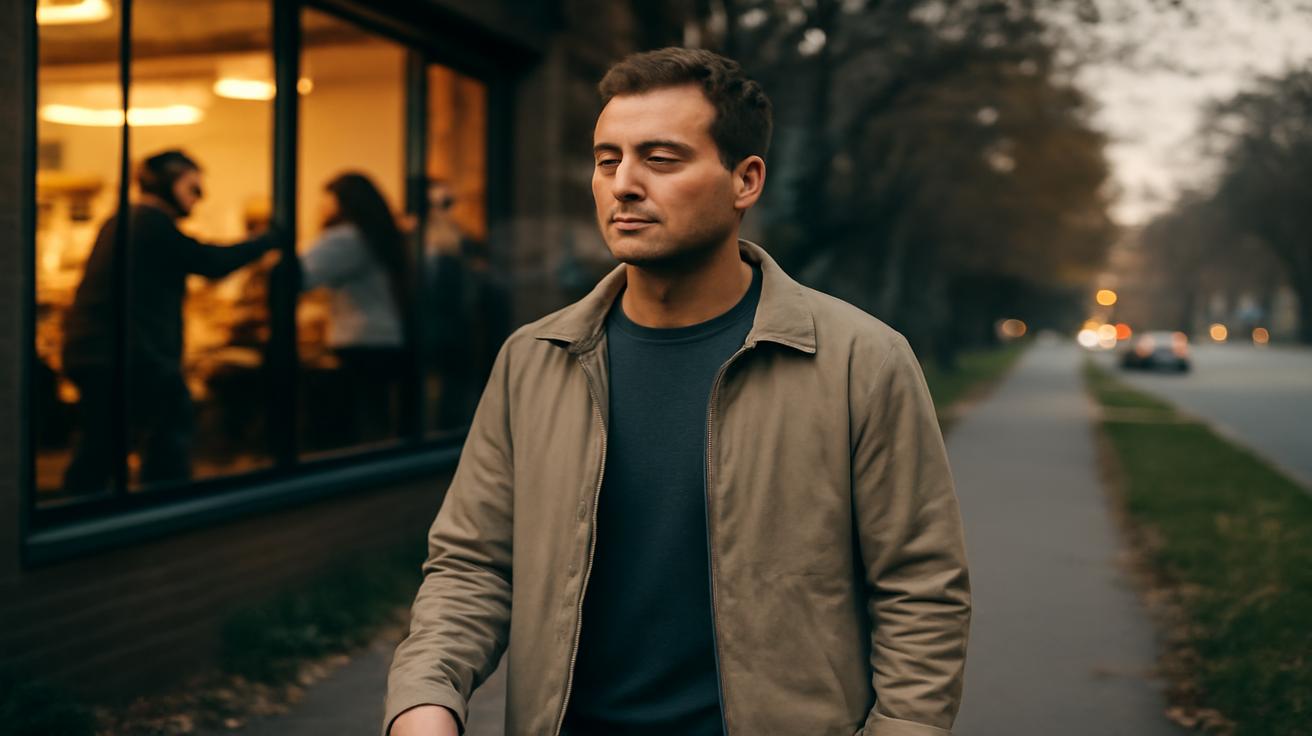
The first time I noticed it, I was standing in my kitchen, staring at my phone, heart thudding in that dull, relentless way that doesn’t feel dramatic enough to be a panic attack but refuses to be ignored. One message. One conversation. One tiny digital thread that had somehow knotted up my whole body. I put the phone down. I stepped back. Literally—just three slow steps until my back pressed against the opposite counter. And something shifted. The screen was smaller from here, quieter. My breathing found a slower rhythm, like my lungs had been waiting for those few extra inches of space to remember what to do.
Why Distance Feels Like a Deep Breath
Maybe you’ve felt it too. You leave a crowded room and find yourself exhaling in the hallway. You walk away from a tough conversation and, halfway down the street, your shoulders finally drop from around your ears. You put your laptop in another room and watch, almost as if from afar, as the stress residue loosens its grip.
It feels a little magical, this way space can calm us. But psychology has a surprisingly grounded explanation: our brains and bodies are constantly in negotiation with distance. The space between you and a person, a screen, a memory, or even a thought shapes how intensely you feel and how easily you can regulate yourself.
We talk a lot about emotional boundaries in metaphors—“I need space,” “You’re too close,” “That hit too near the bone.” But beneath the language, there’s something literal happening. Physical distance, visual distance, even imagined distance can pull us out of emotional overdrive and into a place where feelings are still present, but no longer overwhelming.
Psychologists call some of this psychological distancing: small mental shifts that change how close an experience feels in your mind. When we combine this with actual physical space—standing back, walking away, zooming out, stepping outdoors—we give our nervous system room to recalibrate. It’s not avoidance. It’s regulation. And your body, quietly, knows the difference.
The Brain’s Quiet Trick: How Space Regulates Emotion
Imagine you’re right up against a painting in a gallery—nose almost touching the canvas. Up close, all you can see is texture and color. No composition, no story, just chaos. That’s what emotional immersion feels like. Your brain is pressed against the moment, flooded by detail: the tone of someone’s voice, the sting of a word, the glow of a notification.
Now imagine taking several steps back. The same painting, the same colors, but suddenly there is structure. You can see how the shadows and highlights relate. The chaos becomes context. That “stepping back” is what psychological distance does for your emotions.
Our brains use space to organize experience. When something feels close—happening here, now, to me—it lights up systems associated with threat, urgency, and action. Fight or flight. Fix it or flee it. When it feels a little farther away—happening there, then, to a version of me—it shifts into narrative, reflection, perspective. Same memory, new vantage point.
The fascinating part? You don’t always need a different time or place to do this. You can create that “distance” from inside your own mind. It’s why a walk around the block, a deep breath facing a window, or even a slight shift in how you talk to yourself (“you” instead of “I”) can make something feel less consuming without making it less real.
In that way, calm doesn’t come from pretending the feeling isn’t there. It comes from changing your seat in the theater, moving a few rows back so the sound is clear, the view is wide, and you’re not drowning in the front row’s intensity.
When Space Stops Feelings from Owning You
Picture a conversation that spun out of control. Voices were raised, words landed like sharp stones, and now your mind keeps replaying the scene like it’s on an endless loop. In that replay, you’re right back at the table, heart racing, jaw tight. Your brain has pulled the moment into the present tense: we’re here again, it insists. Act now. Defend. Attack. Retreat.
Psychological distancing asks a small but profoundly regulating question: What if this scene were across the room instead of inside my chest?
Therapists often help people do this intentionally: Imagine watching the argument on a screen, or reading it in a book, or hearing a friend describe it. You’re not denying that you were there. You’re giving yourself the option to be both participant and observer. And in that dual role, something crucial becomes possible: choice.
This distance is not cold detachment. It’s a form of kindness. Emotions are like weather—you’re not meant to live under constant thunderclouds. By stepping back, you don’t tell the storm it’s wrong; you tell yourself you don’t have to stand directly under it while it passes.
Nature’s Lesson: The Space Beyond the Door
There is a particular quiet that lives just outside—on the other side of the front door, two streets beyond your usual route, beneath a tree you never quite notice until you’re upset. Nature has always been a masterclass in regulation through space, even if we didn’t have the words for it.
Think of the last time you walked away from a screen and into something green or open. Maybe it was a park edge, a narrow trail, a small patch of sunlight on a city sidewalk. The world did not resolve your problems, but the edges softened. The catastrophic what-ifs, which minutes before had been packed tightly against your skull, started to loosen and drift.
Our nervous systems evolved in wide landscapes. Open horizons, moving water, the small reliable pattern of leaves, soil, sky—they send signals of safety so old and deep we often miss them consciously. Being outdoors creates enough physical distance from the triggers of modern life—phones, desks, crowded rooms—that our inner alarms can afford to dial down.
It isn’t that trees hold answers, but that trees—and fields and birdsong and long shadows—change the ratio of input. Your body receives more signals that say watch, breathe, observe and fewer that scream react, respond, reply now. You’re still the same person with the same life, but the proximity to stress shifts. Space enters the system, and with it, a kind of quiet recalibration.
Micro-Distances: The Tiny Moves That Change Everything
We tend to think regulation requires big gestures: week-long retreats, cross-country hikes, long breaks from everything. But our minds respond to tiny distances too—small, almost invisible adjustments that change how close something feels.
Here are some of those micro-distances, held up to the light:
- Stepping back from your screen: Not just metaphorically. Physically placing your phone across the room or closing your laptop lid adds a slice of space that can dilute urgency. A message becomes words on a device, not a demand pressed against your face.
- Changing your angle: Turning your chair to face a window, standing in a doorway, walking to the end of your street—small shifts interrupt the mental tunnel and invite a wider frame.
- Rephrasing your thoughts: Saying, “You’re feeling overwhelmed” instead of “I’m overwhelmed” creates a subtle observer stance. It’s the difference between being the storm and watching one approach on the horizon.
- Zooming out in time: Asking, “How will I see this in one week? One year?” does not erase your feelings. It wraps them in context.
- Borrowing someone else’s vantage point: Imagining how you’d describe this day to a friend, or how your older self might talk to your current self, builds a bridge to a wider perspective.
None of these remove the emotion. They change its distance—turning a wave that’s crashing over your head into one you can watch from the shore, feet still wet, heart still involved, but lungs no longer full of water.
When Space Feels Like Avoidance (And When It Isn’t)
There’s a delicate line between helpful distance and numbing disconnection. You step away from the conversation to breathe versus you disappear from hard conversations entirely. You go for a walk to clear your head versus you never return to what hurts. The difference isn’t just behavior; it’s intention.
Healthy distance says, I am stepping back so I can stay with this, more wisely. Avoidance says, If I get far enough away, maybe this won’t exist. The first keeps the thread of connection intact—you and the feeling, you and the other person, you and the challenge. The second tries to cut it altogether.
Psychologically, regulation through space works best when we pair it with gentle return. You walk. You breathe. You widen your view. Then, from that steadier ground, you ask: What is one small thing I can do next?
Distance lays out the pieces of the puzzle so they’re not pressed against your skin. But you’re still at the table, still willing to look, touch, arrange. Space becomes a tool for staying—not escaping—in a way you can survive.
A Table of Tiny Distances You Can Try
These practices are small enough to fit into an ordinary day, but each one offers a way to regulate by shifting space—physical, mental, or emotional.
| Type of Distance | Simple Practice | What It Can Help With |
|---|---|---|
| Physical space | Put your phone in another room for 10–15 minutes and sit near a window or step outside. | Reducing urgency, calming digital stress. |
| Visual distance | Look around and name five things at least three meters away from you. | Grounding, panic or worry spirals. |
| Temporal distance | Ask, “How will I remember this week a year from now?” and write a few sentences. | Perspective on setbacks, softening perfectionism. |
| Linguistic distance | Speak to yourself in the second person: “You’re doing your best. You can pause.” | Self-criticism, emotional overwhelm. |
| Relational distance | Tell someone, “I need ten minutes to clear my head, then I want to keep talking.” | Conflict, boundary-setting without disconnecting. |
Each of these is a way of saying to your nervous system: We are not trapped right up against this. There is room to move, to breathe, to choose.
The Psychology of “Far Enough”: Finding Your Own Radius
Not everyone needs the same amount of distance to feel calmer. For some, a few deep breaths facing a doorway are enough to stop the mental spinning. For others, it takes a walk around the block, a drive with the windows down, or a weekend away from the usual noise. Your personal “regulation radius” is shaped by temperament, history, nervous system sensitivity, and what you’ve had to survive.
Some people grew up in spaces where closeness always meant conflict, where every room felt crowded even when it was physically empty. For them, distance may feel like safety, but also like loneliness. Others were taught that stepping away is abandonment, that regulation is selfish, that staying in the heat of the moment is proof of love or strength. For them, even a few quiet minutes alone can stir guilt.
Psychology doesn’t offer a single prescription, only a gentle suggestion: experiment and listen. Notice how you feel when you’re pressed close—too close—to a problem, a person, a screen. Notice what happens when you back up three steps, ten steps, across town, or only in your mind. Where does your breath return? Where does your jaw unclench? Where do your thoughts regain their edges and stop merging into a blur?
Trust those clues. They are your body’s way of mapping how much space you need to stay present without being consumed. Calm doesn’t always mean empty of feeling. Often, it means: the feelings are here, and I still have room to be myself alongside them.
Letting Space Be a Teacher, Not a Wall
If you pay attention, you can start to sense when your inner world is asking for distance. It’s there in the urge to step onto a balcony at a crowded gathering, to walk the long way home, to put your phone face down and just stare at the ceiling for a while. These aren’t always signs of fragility. Sometimes, they’re early warning lights: Your system is full. Please create space.
When we honor that request, we give ourselves a chance to participate in life with more honesty and less reactivity. We walk back into the room a little more able to listen. We open the message a little more able to respond instead of react. We revisit the memory a little more able to learn from it rather than drown in it.
Distance, handled gently, becomes a rhythm: close enough to care, far enough to breathe. You step in, you step back, like the tide working the edge of the shore. Not abandoning, not clinging. Staying with yourself the whole time.
Some days, that might look like curling up on the far end of the couch instead of right in the middle of the conversation. Other days, it might be a long walk beneath bare branches, where your worries thin out as the horizon stretches. Or it might simply be a question whispered to yourself in the middle of everything: If I took three steps back from this—really back—what would I see that I can’t see from here?
Often, the answer isn’t dramatic. It’s something like: This hurts, but it’s not everything. Or: This feels urgent, but it isn’t all of who I am. And in that slight shift, that barely perceptible widening, calm begins—not as the absence of storms, but as the presence of space around them.
FAQs
Why do I feel calmer when I physically walk away from a situation?
Walking away adds literal distance between you and the trigger—whether that’s a person, a screen, or a place. Your brain interprets that space as reduced threat, which helps your nervous system exit “fight or flight” mode. Movement, changes in light, temperature, and sound all signal a different context, making it easier to shift from reacting to reflecting.
Is needing space the same as avoiding my problems?
Not necessarily. Needing space becomes avoidance when you use it to permanently escape or refuse to engage. It becomes healthy regulation when you use it temporarily to calm your body and mind so you can return to the situation more grounded, thoughtful, and present.
Can psychological distancing make me emotionally numb?
It can, if it’s overused or used defensively. Helpful distancing lets you feel your emotions with a bit more perspective; numbing tries to erase or bury them. If you notice you rarely feel anything strongly or you’re disconnected from your own life, that may be a sign you’re using distance to protect yourself in ways that deserve gentle attention, possibly with professional support.
How can I practice healthy distance in relationships without pushing people away?
Communicate clearly and specifically. Instead of disappearing, say, “I’m feeling overwhelmed. I need a short break to calm down, but I want to keep talking after that.” This keeps connection intact while still honoring your need for space. Pair taking distance with a clear plan to reconnect.
What if I can’t leave the stressful situation physically?
You can use inner forms of distance: slow your breathing, look at objects farther away, mentally imagine watching the situation on a screen, or speak to yourself in the second person (“You can get through this”). These small shifts can create enough psychological space to reduce overwhelm even when you’re physically stuck where you are.





Leave a Comment