
The truck pulls up before sunrise, air brakes sighing in the cool half-dark. A thin mist hangs over the edge of the Australian suburb, softening the harsh outlines of cranes and scaffolding. Somewhere, a kookaburra cackles from a gum tree, mocking the racket of machinery that’s about to begin. On the back of the truck, the drum of a concrete mixer turns slowly, a dull, patient rotation, like a heartbeat of the modern world. Workers in hi-vis vests move in, boots crunching on gravel, and the familiar, chalky smell of concrete dust floats into the morning air.
It’s an ordinary scene on an ordinary building site—except for one uncomfortable fact: humanity now produces so much concrete that, on average, we pour around 952 tonnes of it every single second. It’s the most used human-made material on Earth after water, the invisible skeleton of our cities, roads, ports, dams, and homes. And it comes with a heavy, mostly hidden cost. Every spin of the mixer drum, every pale grey slab, every overpass and tower block, carries with it an invisible plume of carbon dioxide.
But this morning, on a research site not far from an Australian university campus, what’s sloshing around inside that drum is different. It’s still grey, still gritty, still destined to harden into something that will outlive most of the people who pour it. Yet there’s a story here that starts far from the quarry and the kiln—with waste, with ash, with carbon that might otherwise drift up into the sky—and with a group of engineers who believe that the world’s most ordinary material can be remade into something extraordinary.
The Heavy Secret Behind Everyday Concrete
If concrete had a personality, it would be modest, unshowy, the quiet workhorse holding up the world while steel and glass take the glory. Yet inside that modest veneer lies a climate heavyweight. At the heart of concrete is cement—the powder that binds sand, gravel, and stone together. Cement production alone is responsible for roughly 7–8% of global CO₂ emissions. That’s more than the entire aviation industry, more than all shipping, more than most countries.
It starts with limestone, which is mostly calcium carbonate. In massive kilns that roar at temperatures above 1,400°C, limestone is “calcined”—chemically transformed into lime, releasing carbon dioxide as it breaks apart. Fuel burned to maintain those infernal temperatures adds more emissions. By the time a single tonne of cement is produced, roughly an equal tonne of CO₂ has been released into the air.
When you scale that up to the level of human civilisation, you reach that staggering figure: 952 tonnes of concrete every second. Picture a column of trucks, stretching from one horizon to the other, each one pouring and pouring and pouring, day and night. It’s the sound of progress, yes—but also the slow drumbeat of a warming world.
And yet, we’re not about to stop building roads, hospitals, railways, housing, and seawalls any time soon. The twenty-first century is as much an age of infrastructure as it is an age of information. So the question nagging at engineers, policymakers, and increasingly, ordinary citizens is painfully clear: if we cannot live without concrete, can we learn to live with a different kind of it?
Inside the Australian Concrete Lab
Walk into a materials lab at an Australian university and the romance of nature gives way to a different kind of beauty: stacks of cylindrical concrete samples, each one tagged with codes and dates; hydraulic presses waiting to crush them; the faint gritty scent of wetted cement paste. There is precision here, and patience. Some of these samples will be tested today. Others will sit quietly for weeks or months, slowly hardening in controlled humidity rooms until they are ready to reveal their secrets.
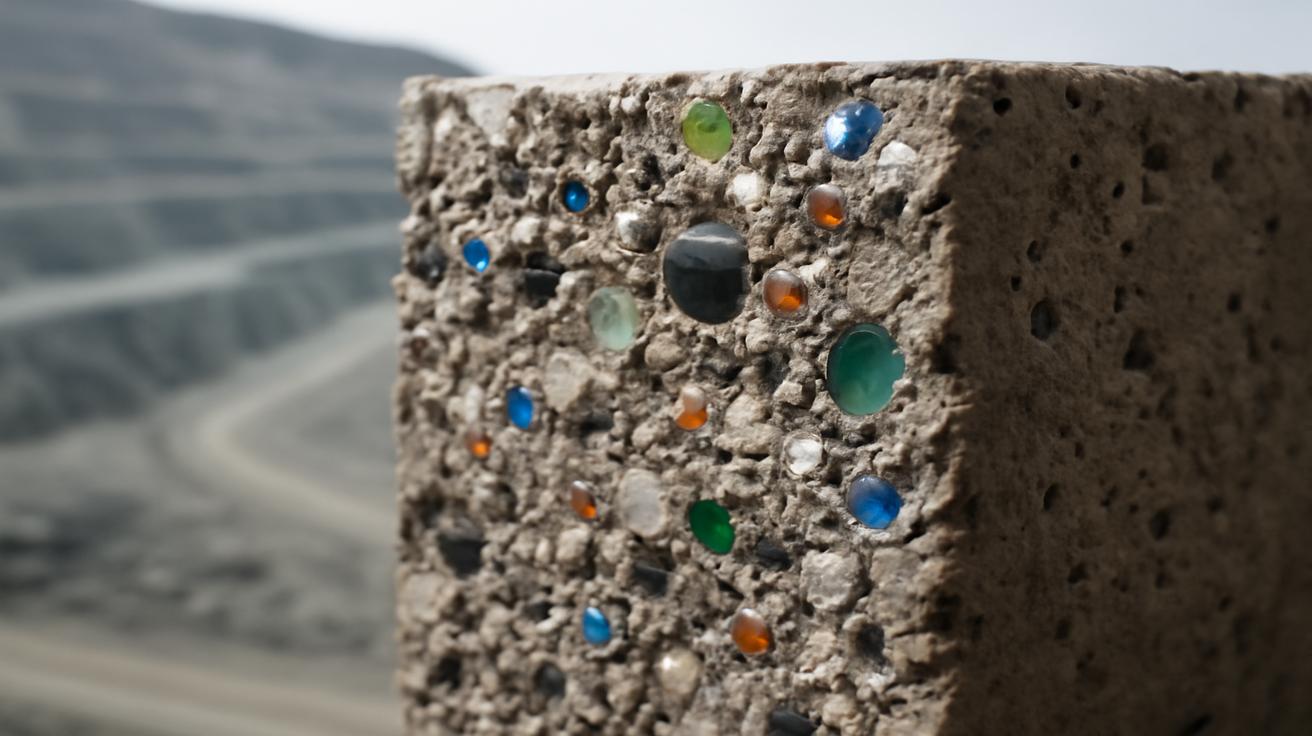
In a corner, a researcher pours a mixture that looks unremarkable: the same grey blend you might see on any building site. But this one tells a different story. Instead of relying entirely on traditional Portland cement, it is packed with industrial by-products—fly ash from coal-fired power plants, slag from steelmaking, even finely ground glass that once glittered in bottles and windows. Some mixes use “geopolymers,” alternative binders that rely on the chemistry of aluminosilicate materials instead of calcined limestone. Others are infused with tiny amounts of captured CO₂ that mineralise inside the concrete itself.
To a visitor, it might feel like tinkering at the edges of something immovable. But the numbers tell another side of the tale. By replacing a large portion of cement with these supplementary materials, Australian teams have cut the embodied carbon of concrete by 30, 40, even more than 50% in some formulations—while matching or exceeding the performance of traditional mixes.
One researcher runs a hand over a cured block, as if greeting an old friend. “This,” they say, “is where waste becomes infrastructure.” It’s waste that would otherwise be landfilled, or emissions that would otherwise seep into the air. Instead, it’s hardened into something that can hold up a bridge, a building, or a seawall against decades of waves and weather.
From Ash and Slag to Stone
Most people never see fly ash. It’s the powdery residue captured from the flue gas of coal-fired power stations—once a symbol of dirty energy, now a surprisingly useful ingredient. Properly treated and ground, fly ash can react with the calcium hydroxide produced when cement hydrates, forming additional binding compounds. The result: concrete that may gain strength more slowly, but often ends up denser and more durable.
Slag tells a similar story. Born as a by-product of iron and steelmaking, slag can be ground into a powder and used as a cement replacement, particularly in large, heavily stressed structures. It often improves resistance to chemical attack and reduces permeability—good news for structures battered by seawater or de-icing salts.
In many Australian mixes, fly ash and slag now make up 30–70% of the binder material, sharply cutting the cement content without compromising performance. The very things once seen as detritus of an industrial age become the skeleton of a low-carbon future.
Capturing Carbon in Stone
An even more intriguing frontier involves the concrete itself becoming a carbon sponge. “Carbon-cured” concretes inject CO₂ into the mix during production, where it reacts with calcium ions to form stable carbonate minerals. Instead of drifting skyward, that portion of CO₂ ends up locked away inside the stone.
It’s not a miracle cure. The total amount of carbon captured in this way is modest compared with the emissions of cement production. But layered on top of cement-replacement strategies, new curing techniques, and better design, it nudges the carbon balance further in the right direction. Every little bit, combined and scaled, becomes less little.
When Concrete Starts to Tell a Different Story
Australia has become a quiet test bed for these low-carbon concretes. The country’s engineers live in a land of big distances, corrosive salt air, brutal sunlight, and the looming challenge of sea-level rise. It’s also a place where infrastructure is constantly being expanded and renewed—rail links between growing suburbs, new bridges, flood defences, data centres, and ports.
Over the last decade, government agencies, construction firms, and research institutions have begun to specify mixes that use high proportions of supplementary cementitious materials. Some municipal projects now require a certain percentage of low-carbon concrete. Bridges, pavements, precast elements, even sections of major urban developments have quietly become proving grounds for these new blends.
It doesn’t make headlines in the way that solar farms do, or electric vehicles gliding silently down city streets. But the climate impact is substantial because the baseline is so enormous. When billions of tonnes are involved, shaving off 30–50% of the emissions per cubic metre is not just a neat engineering trick—it’s a tectonic shift in how we build.
The sweetness of this story lies in its ordinariness. A commuter drives over a bridge on their way to work, unaware the concrete beneath their tyres was mixed with slag from a distant furnace. A child plays in the courtyard of a new school, its foundations partially made from coal ash and captured carbon, the ghost of a smokestack turned into something solid, useful, enduring. No one notices that the concrete is a slightly different shade of grey. It just works. It just lasts.
How Low-Carbon Concrete Compares
To understand the shift, it helps to see how low-carbon concretes stack up against the old standard.
| Property | Traditional Portland Concrete | Australian Low-Carbon Concrete |
|---|---|---|
| Typical Binder Composition | 90–100% Portland cement | 30–70% fly ash/slag/geopolymers + reduced cement |
| Approx. CO₂ per m³ | High (baseline) | Up to ~30–60% lower, depending on mix |
| Early Strength Gain | Fast | Often slower; can be optimised with mix design |
| Long-Term Durability | Good, but vulnerable to some chemical attacks | Often improved resistance to chlorides, sulphates, and cracking |
| Use of Industrial Waste | Minimal | High, turning waste streams into resources |
For the engineers, this isn’t just a chart; it’s an evolving playbook. Tweak one ingredient, and the curing time changes. Introduce a new industrial by-product, and you have to learn its quirks: how it reacts in heat, in cold, in humidity, in the salt-laden winds that roll off the Pacific. But as the field matures, the experiments are turning into reliable recipes, and the recipes are finding their way into specifications, contracts, and building codes.
The Human Side of a Cleaner Concrete
Behind every clever mix design, there are decisions that take place far from the lab. On site, project managers worry about schedules, contractors worry about reliability, and everyone worries about cost. Concrete pours are unforgiving. Once the trucks arrive and the slump is checked, there’s no pausing the clock. If a batch sets too slowly, a project might be delayed; if it cracks or underperforms, reputations—and sometimes lives—are on the line.
That’s why one of the great quiet achievements of Australia’s low-carbon concrete movement has been trust-building. Demonstration projects have given way to mainstream adoption, one successful bridge deck and retaining wall at a time. Testing regimes have become more sophisticated, modelling long-term behaviour under extreme conditions. Standards bodies have updated guidelines to make it easier for public-sector clients to specify these alternatives.
In conversations with construction crews, the shift is almost invisible. What matters most is that the mix arrives as promised, flows the way it should, and hits the strength targets on schedule. If those boxes are ticked, the fact that the binder contains fly ash or slag, or has been cured with injected CO₂, quickly becomes just another line in the paperwork.
Yet something else begins to stir too—a sense that the tools of the trade are not fixed, that the palette of materials is expanding. An older engineer might recall the days when high-volume fly ash concretes were seen as risky, exotic. Today, young graduates step into offices where low-carbon mixes are part of the normal menu of options. The culture of building shifts, almost imperceptibly, towards asking not just “Can we build it?” but “How can we build it with less harm?”
When Waste Streams Become Lifelines
There’s another human layer woven into this story: the workers at coal power stations and steel plants whose livelihoods have long been seen as incompatible with a low-carbon future. In some Australian regions, the use of fly ash and slag in concrete offers a different narrative, at least in the near term. What was once a symbol of pollution becomes a feedstock for cleaner infrastructure.
By pulling valuable material out of waste streams, these concrete technologies create a kind of circular economy for heavy industry. They don’t erase the need to transition away from fossil fuels—but they do soften the edges of that change, by turning legacies of past emissions into ingredients for a more resilient built environment.
Why 952 Tonnes a Second Still Matters
Even as these innovations spread, that global figure—952 tonnes of concrete produced every second—hangs in the air like a question mark. Is it possible to truly green a material that we use in such enormous quantities? Or are we patching cracks in a dam that will eventually give way under the rising pressure of climate change?
The honest answer is that cleaner concrete is necessary but not sufficient. It’s one powerful lever among many that need to be pulled simultaneously. We can design buildings that use less material by being smarter with structure. We can retrofit and reuse existing buildings instead of demolishing them at the first sign of age. Cities can rethink roads, car parks, and overbuilt highways. Some architects are turning to timber, engineered bamboo, and other bio-based materials for parts of their structures, leaving concrete to do what it does best: foundations, cores, and long-span elements that must resist fire and time.
But as long as we are a species that builds, the question of how we build will remain central. If the world continues to urbanise, to reconstruct after floods and fires, to expand transit and renewable energy networks, we will be pouring concrete in vast volumes for decades to come. That’s why the solutions emerging from Australian labs and job sites are so quietly radical. They do not ask us to stop building. They ask us to build differently—to fold the weight of our environmental conscience into the very bones of our structures.
A Future Written in Stone
Imagine standing in a city a few decades from now. The skyline might not look dramatically different at a glance: towers of glass and steel, rail lines weaving through the suburbs, seawalls bracing against higher tides. But if you could see the carbon history of every building—etched like tree rings into its concrete—you would notice a sharp bend in the curve. Somewhere in the early twenty-first century, the embodied emissions suddenly drop. Cement becomes only one of several binders. Ash, slag, calcined clays, recycled aggregates, and captured CO₂ all share the load.
Maybe you walk along a harbour promenade whose foundations were poured with a mix first trialled in a dusty Australian lab. Children ride scooters along the path, oblivious to the chemistry beneath their wheels. A plaque on a nearby bridge might mention that it used “low-carbon materials,” but most passersby don’t stop to read. The concrete has done its job: to be solid, silent, and strong, fading into the background of daily life.
In that world, 952 tonnes a second might still be an astonishing number. But what those tonnes are made of—and how much of the sky they burden—will have changed. The story of concrete will no longer be just a tale of limestone and smokestacks, but of ingenuity, persistence, and the surprising generosity of waste transformed into structure.
Back on that early morning site, as the Australian sun finally clears the horizon, the workers guide the pump hose into position. The grey river begins to flow, filling the formwork with a soft, steady roar. As it settles and vibrates and slowly, invisibly, begins to harden, it carries with it a new kind of promise: that the most ordinary material in the modern world can also be one of the quiet heroes of its repair.
Frequently Asked Questions
What makes concrete such a big climate problem?
The main issue is cement, the binding ingredient in concrete. Its production requires extremely high kiln temperatures and a chemical reaction that releases large amounts of CO₂ from limestone. Because we use so much concrete globally, these emissions add up to about 7–8% of total global CO₂.
How is Australian low-carbon concrete different?
Australian researchers and industry partners replace a significant portion of traditional cement with industrial by-products like fly ash and slag, and sometimes with geopolymers. Some mixes also incorporate captured CO₂ during curing. The result is similar or better performance with much lower embodied carbon.
Is low-carbon concrete as strong and durable as normal concrete?
Yes, when properly designed. Many low-carbon concretes gain strength more slowly at first but often match or exceed the long-term strength and durability of traditional mixes. In some cases, they offer better resistance to harsh environments, such as marine exposure or chemical attack.
Can this cleaner concrete be used in all types of construction?
It’s already being used in a wide range of applications—foundations, bridges, pavements, precast elements, and large infrastructure projects. Some highly specialised structures may still require tailored mix designs, but the usable range is expanding rapidly as experience and standards grow.
Does low-carbon concrete completely solve concrete’s climate impact?
No. It significantly reduces emissions but does not eliminate them. To truly address concrete’s climate impact, low-carbon mixes need to be combined with smarter design, material efficiency, reuse and retrofitting of existing buildings, and broader shifts in how and what we build.




Leave a Comment