
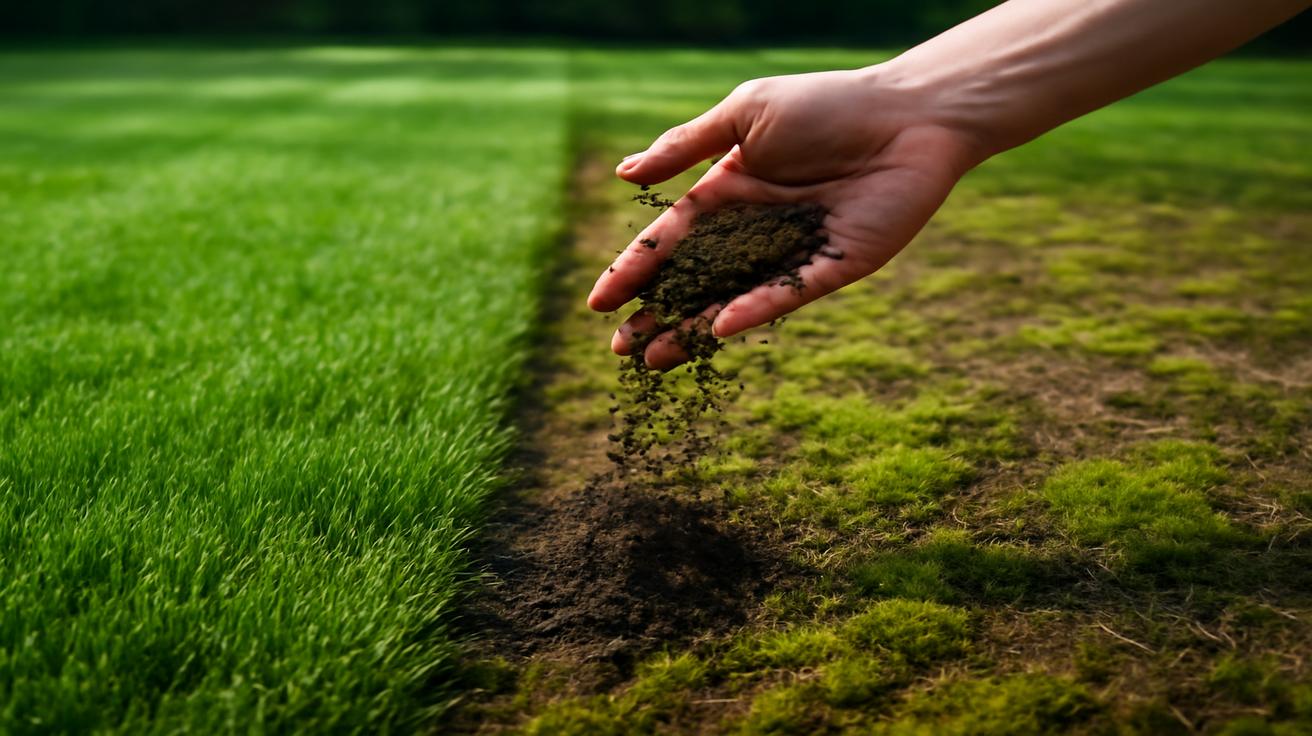
The first time you notice it, you might not even mind. The lawn is damp from an overnight drizzle, the air smells like rain and soil, and there—between the blades of grass—spreads a soft, velvety green. Moss. It looks peaceful, almost magical, like something that belongs on the floor of an old forest. But as the months go by, the green velvet thickens, the grass thins, and suddenly your lawn feels more like a sponge than a meadow. When you walk across it, your shoes sink in with a silent squish. Bare patches appear. The lawn that once felt bright and open now looks tired, shaded, and strangely quiet. That’s usually the moment you start wondering: How do I get rid of this moss—naturally, and for good—without turning my garden into a chemistry experiment?
Understanding Why Moss Chose Your Lawn
Before you pull, rake, or sprinkle anything, pause in the middle of your yard and just look. Moss isn’t a random invader. It’s a messenger. It shows up where grass struggles and where the environment quietly tilts in its favor.
Bend down and touch it. Moss is cool, damp, and springy because it thrives in conditions that grass finds exhausting: shade, compacted soil, poor drainage, low fertility, and low pH. Where the lawn says, “I can’t keep up,” moss replies, “I’ll happily take over.”
Rather than treating moss like the enemy, treat it like a diagnostic tool. Wherever you see thick moss, imagine a subtle signpost sticking out of the ground saying: Too wet here. Or: Not enough sun. Or: Soil is too acidic and compacted.
Natural moss removal isn’t about nuking the moss and hoping for the best. It’s about listening, adjusting, and then slowly rebuilding an environment where grass can reclaim its space. That’s the difference between a quick fix and a lasting change.
Step One: Read the Lawn Like a Landscape Detective
Assess Light, Moisture, and Airflow
Walk the lawn slowly. Notice where the moss is thickest. Is it hugging the north side of the house? Nestled under a canopy of trees? Pooling at the bottom of a gentle slope?
These locations hold clues:
- Shady corners usually point to excessive shade and slow-drying soil.
- Low areas hint at poor drainage or compacted soil that doesn’t let water escape.
- Along fences or under hedges might suggest poor airflow and lingering moisture.
Feel the ground with your foot. Is it spongy and wet long after rain? Or hard and slick like a beaten-down path? A lawn that doesn’t breathe well above or below the surface gently invites moss to settle in.
Test the Soil—Quietly, Honestly
Natural lawn care starts in the unseen world beneath your feet. If you want to remove moss effectively, you have to understand that world.
A simple soil test kit will tell you three things that matter deeply to moss:
- pH (acidity) – Moss tends to love more acidic environments, often below pH 6.0.
- Nutrient levels – Low nitrogen and poor fertility make grass tired and patchy.
- Organic matter – Too little and the soil is lifeless; too much, poorly decomposed, and it can stay soggy.
What you’re really asking is: Is this a place where grass can thrive if I help it? Once you know the answer, every step you take becomes more deliberate, more natural, and far more effective.
Step Two: Remove Moss by Hand—But Do It Kindly
The Art of Raking Without Wrecking the Lawn
There is something strangely satisfying about raking moss. The tines of the rake catch that thick green carpet and peel it away like felt from a table. Each pull reveals bare soil, old roots, and the promise of a reset. But this is also the most vulnerable moment for your lawn.
Choose a cool, dry day when the soil is only slightly moist—damp enough that the moss lifts easily but not muddy enough to tear up the ground. A simple spring-tine rake or a dedicated dethatching rake works beautifully. Start gently, pulling the rake toward you in short, firm strokes. You’re not tilling. You’re lifting.
As the moss comes up in soft, tangled clumps, pile it into a wheelbarrow. You can compost it if you maintain a hot, active compost pile; otherwise, it’s best disposed of, not just tossed in a shady corner where it might take root again.
After raking, the lawn may look worse before it looks better—patchy, raw, even a little wounded. That’s normal. You’ve cleared the surface; now the healing can begin. Moss removal is only the first chapter. The real story is what you do next.
A Simple Comparison of Moss Removal Methods
When you’re tempted by “quick-kill” sprays, it helps to see how natural methods stack up against chemical shortcuts:
| Method | How It Works | Pros | Cons |
|---|---|---|---|
| Hand raking | Physically lifts moss from the surface | No chemicals, immediate results, precise | Labor-intensive, may expose bare soil |
| Aeration and overseeding | Improves soil, strengthens grass to outcompete moss | Long-term solution, healthier lawn ecosystem | Slower results, requires planning and patience |
| Chemical moss killers | Burn or desiccate moss tissue | Fast visual results | Can harm soil life, may stain, moss often returns |
| Natural soil correction | Removes conditions moss prefers (acidity, shade, compaction) | Addresses the root cause, sustainable | Requires consistent effort and observation |
Step Three: Change the Conditions, Change the Story
Light: Let the Lawn Breathe in Sun
Stand where the moss is thickest and look up. Often the answer is hanging over your head in the form of branches, dense shrubs, or tall fences casting long, cool shadows.
You don’t have to strip a tree bare to help your lawn. Sometimes a careful thinning—removing a few low limbs, opening the canopy slightly—allows more dappled light to reach the grass. Trim hedges a bit higher, allow more sky to peek through between shrubs, and keep fence lines from becoming solid walls of shade and moisture.
There’s a quiet balance here: honoring the beauty of your trees while giving the lawn enough light to photosynthesize, thicken, and slowly crowd out moss.
Water and Drainage: From Soggy to Steady
Moss loves stillness—especially in water. If your lawn holds puddles like a shallow bowl after every rainfall, the message is clear.
- Adjust your watering habits. Water deeply but infrequently, ideally early in the morning, so the surface can dry during the day.
- Improve surface drainage. In small low spots, lightly top-dress with a sandy compost mix and reseed. On slopes, avoid heavy watering that washes soil downhill.
- Consider subtle grading fixes. Sometimes even a small reshaping of soil can guide excess water away from areas where moss is thriving.
When water moves and drains instead of sitting, moss loses one of its greatest allies.
Soil: Loosen, Sweeten, and Feed
Now you return to that quiet, powerful layer below the grass roots. Correcting soil naturally is less dramatic than spraying a moss killer, but it’s also where the real transformation happens.
- Aerate compacted areas. Use a core aerator to pull small plugs from the ground, opening channels for air, water, and roots. The lawn feels different underfoot afterward—less like a mat, more like a living sponge.
- Amend the pH if needed. If your soil test shows it’s too acidic, apply a natural lime product according to recommendations. You’re not aiming to punish moss but to create a pH where grass grows stronger and moss feels less at home.
- Feed the soil, not just the grass. Apply a slow-release, organic lawn fertilizer or a thin dressing of screened compost. Microorganisms wake up. Earthworms return. Grass roots deepen. And over time, moss finds fewer gaps to colonize.
Moss removal is physical; moss prevention is ecological. Change the soil, and you change what can thrive there.
Step Four: Help Grass Reclaim Its Territory
Overseeding: Quietly Repainting the Canvas
After raking out moss, your lawn looks exposed, but that bareness is actually an invitation. If you leave it empty, the wind, birds, and weather will decide what grows there next. If you overseed, you decide.
Choose grass varieties that suit your conditions, especially in areas that will always be a bit shady:
- Fine fescues for cooler, shadier spots.
- Shade-tolerant blends designed for partial sun gardens.
- Locally adapted mixes that match your region’s climate.
Lightly loosen the top layer of soil with a rake, sprinkle seed evenly, and press it into contact with the soil (a simple walk across the area can do the trick). Keep it gently moist until it germinates—never waterlogged, never bone-dry. New grass seedlings are like tiny promises; they ask for patience and consistency more than anything else.
Natural Feeding and Mowing Habits
Once new grass establishes, shift your habits toward what a natural, resilient lawn prefers:
- Mow a bit higher. Taller grass (within reason) shades the soil, slows evaporation, and makes it harder for moss spores to find bare patches.
- Leave finely chopped clippings. They return nutrients to the soil instead of stripping them away in yard waste bags.
- Fertilize gently and organically. Instead of big, synthetic nitrogen blasts, use slow, natural sources that build soil health over time.
With each season, your lawn can become a place where grass thickens, roots deepen, and moss struggles to find room.
When to Make Peace with Moss
Redefining “Perfect” in the Garden
Sometimes the most natural solution isn’t to fight moss everywhere, but to decide where it belongs and where it doesn’t. Not all spaces need to be a green carpet of uniform grass. Under deep, ancient trees where sunlight grazes the ground only in fleeting moments, moss can actually be a graceful ally.
In those quiet corners, moss can form a soft, living tapestry that needs almost no mowing, no fertilizer, and no complaint. It muffles sound, invites close inspection, and rewards you on misty mornings when droplets cling to its tiny, intricate stems.
You might choose, consciously, to let moss stay:
- In a shaded, rarely used section beneath a large tree.
- Along stone paths, where it adds a sense of age and continuity.
- On steep banks where grass has always struggled and erosion is a concern.
The key is intention. Remove moss naturally where you want an active, sunlit lawn for play and gathering. Accept or even encourage it where the conditions whisper “forest floor” more than “picnic blanket.” This is how a garden moves from conflict to harmony—by listening to what each space wants to be.
Frequently Asked Questions
Will moss go away on its own if I just fertilize the lawn?
Not usually. Fertilizer alone doesn’t fix shade, compaction, drainage, or acidity. In fact, over-fertilizing can stress the grass and worsen the problem. You need a combination of soil improvement, better light and drainage, and overseeding to truly shift the balance away from moss.
Is vinegar a safe, natural way to kill moss in my lawn?
Vinegar can burn moss, but it can also damage grass and nearby plants. On paving stones or gravel paths, careful spot treatment might work, but it’s not ideal for a living lawn. It still doesn’t solve the underlying conditions that allowed moss to spread in the first place.
How long does it take to see results after removing moss naturally?
You’ll see immediate visual change after raking, but full recovery—thicker grass and less moss—often takes one to two growing seasons. Aeration, soil correction, and overseeding need time. Think in seasons, not days, and you’ll be much happier with the outcome.
Can I compost the moss I rake up?
You can, but only if your compost system heats up well and is turned regularly. High temperatures help break down moss and reduce the chance of it re-establishing. If your compost is cool and slow, it may be safer to dispose of moss separately instead of returning it directly to the garden.
What if my lawn is mostly shade—should I keep fighting moss there?
If more than half the day is dense shade, you may always be working against nature. In those areas, consider shifting to shade-loving groundcovers, mulched beds, or even a deliberate moss garden. Save your lawn efforts for areas that receive enough light for grass to truly thrive.







Leave a Comment