
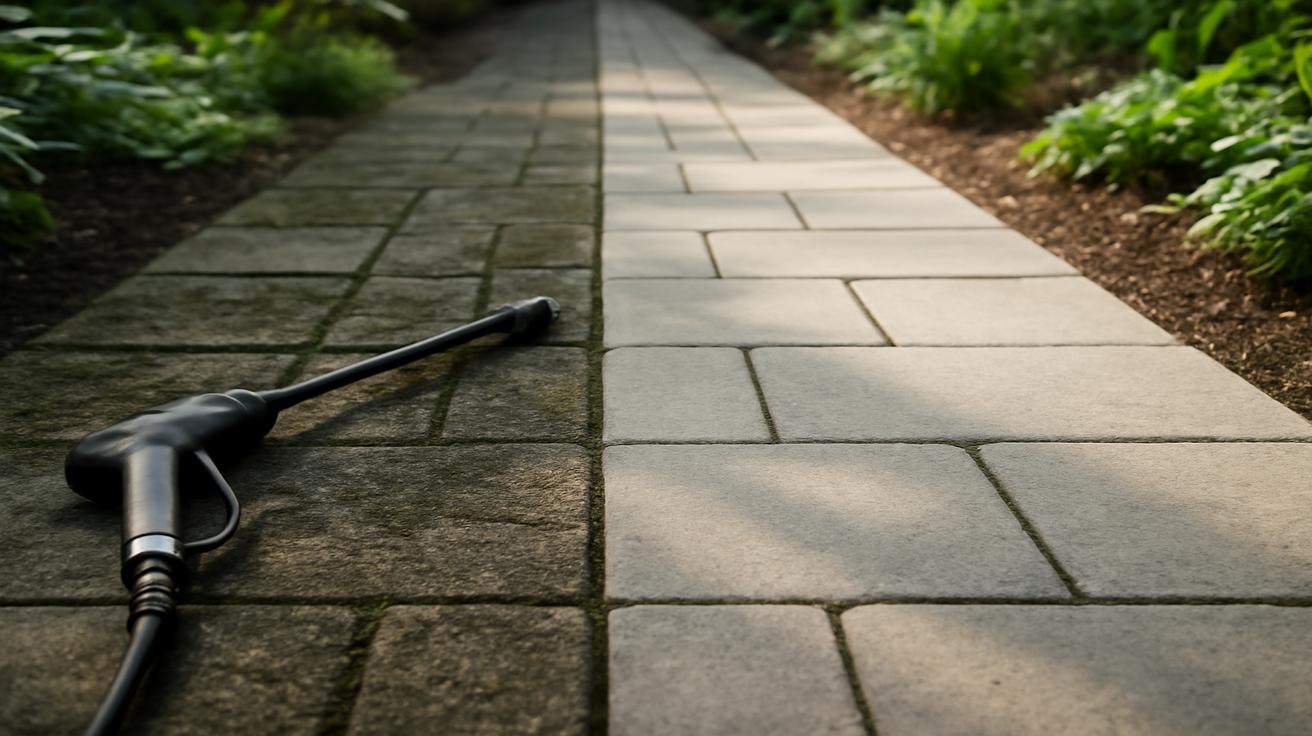
The first time you really notice it is never in winter. It sneaks up on you in spring, on one of those rare mornings when the sky is suddenly, suspiciously blue and the air smells faintly of warmth. You step outside, mug in hand, ready to reclaim the patio as your own after months of rain and darkness — and there it is. The slabs that were once a soft sandy grey are now dull and blackened, slick with algae, dotted with moss, edged with stubborn green lines between each stone. The garden path looks less like a place to wander and more like the opening scene of a nature documentary about slow, inevitable decay.
You stand there, toes curling inside your shoes, thinking of pressure washers, scrubbing brushes, and all the hours you don’t have. You imagine the endless bending, the chemical smell, the soaked clothes, the ache in your shoulders. You picture yourself typing “how to clean black patio” into a search bar and sinking into a vortex of adverts for gadgets you don’t want to buy.
But here’s the quiet secret seasoned gardeners and laid-back house-proud people eventually discover: cleaning a blackened patio and murky garden paths does not have to be hard. It does not have to eat your weekend or your wallet. And it absolutely does not have to strip away the quiet, mossy soul of an outdoor space turned wild over winter. With a few simple methods, a bit of patience, and almost no elbow grease, you can coax those stones back to life — and you can even enjoy the process.
The Slow Morning Method: Let Time Do the Heavy Lifting
Start by doing almost nothing. Truly. Put the pressure washer fantasy back in the shed of your mind for a moment. Your first job is not to attack the grime but to understand it.
Walk slowly across your patio or garden path, maybe barefoot if the weather allows, and feel where it’s slicker underfoot. These are the algae-rich zones, the places where shade and standing water conspired over winter. Look for the green fringe in the joints between slabs, the fluff of moss creeping up the sides, the dark stains where pots once sat like ring marks on a much-loved wooden table.
Now bring out your quiet, low-effort allies: a stiff outdoor broom and a bucket of plain water. No detergent yet, no drama. Just sweep. Long, lazy strokes. This simple brushing does more than it looks like. It breaks the first bond between the surface grime and the stone, loosens sand and soil that are feeding moss in the cracks, and instantly makes everything look slightly less abandoned.
While you sweep, rinse the worst patches with water from a watering can or a hose on a gentle setting. Imagine you’re not “cleaning” yet, you’re just waking the patio up after a long sleep. You’ll be surprised how much lighter the slabs look already, even before the proper cleaning begins.
The Quiet Chemistry of the Kitchen Cupboard
Once the surface dirt is gone, it’s tempting to race straight to harsh chemicals or hire a machine that sounds like a small jet engine, but there’s another way. Some of the most effective patio cleaners live quietly in your kitchen, labelled for other jobs.
The classic gentle hero is white vinegar. There’s something deeply satisfying about using such a simple, unshowy ingredient to undo months of grime. Vinegar works because it’s mildly acidic: strong enough to trouble algae and mold, weak enough to leave most stone types unfazed when used correctly. It’s also cheap, widely available, and doesn’t leave your garden smelling like a chemical plant.
For general blackening from algae and mildew, mix roughly one part white vinegar with one part water in a watering can or a large bucket. If your slabs are very dirty, tip the ratio closer to vinegar. You don’t need to be surgical here; this is garden alchemy, not laboratory-grade measurement.
Pour or lightly sprinkle the mixture over your patio and paths, concentrating on the darkest areas. You’re not trying to flood the space, just wet the surface thoroughly. Then — and this is the key to minimal effort — you walk away. Give the vinegar mixture at least an hour to work. On a cool, dry day, you can leave it even longer. Think of it as a slow, invisible time-lapse of tiny reactions loosening the grip of years of grime.
If the smell worries you, it fades fast. And in the mild tang in the air there’s an odd sense of comfort, a signal that something gentle but determined is happening out there while you’re inside making tea.
The Soft Scrub That Feels Almost Like Cheating
When you return, the patio won’t be magically pristine, but it will be looser somehow — the surface grime slightly raised, the darkest stains softened at the edges. This is where the “almost no effort” part truly shines.
Take your stiff broom again, or a long-handled deck brush if you have one, and sweep as if you’re just tidying up, not scrubbing for dear life. The broom glides more easily now. The bristles bite into a softened surface, pushing aside algae that would have clung on stubbornly an hour ago.
If you hit a particularly dark patch, a few firm strokes usually do the trick. You’re working with the reaction that’s already happened, not fighting solid, undisturbed grime. It’s the difference between trying to chisel ice off a windscreen and brushing away melting slush. The job feels smaller, lighter, almost indulgent. You’re outside in the daylight, moving gently, watching your garden reappear beneath your feet.
Finish with a rinse — just a hose, a watering can, or even a bucket or two of clean water. As the water sheets off the slabs and paths, you see the real transformation. The stones are still themselves, not unnaturally bright or bleached, but the dull, suffocating blackness has lifted. Their original character returns: the faint speckles in the concrete, the fine grain of natural stone, the gentle mismatch of color you once liked enough to choose.
When the Gaps Turn to Jungle: Dealing with Moss and Weeds
Even with a cleaner surface, the joints between slabs and along the edges of the path can cling stubbornly to their miniature jungles. Those thin lines of moss and opportunistic weeds are both charming and treacherous, turning steps slick and making everything look more overgrown than it really is.
The usual image of dealing with them involves kneeling, prying, scraping, and a growing sense of resentment. Yet most of the time, you don’t need to get down on your hands and knees. The simplest tool is still that same faithful broom — only this time, you tilt it. Run the side of the bristles along the joints as you sweep. You’ll be stunned at how much moss balls up and lifts away now that it’s been wet and weakened by your earlier cleaning.
For the stubborn clumps clinging on in damp shade, you can nudge them out with a simple, narrow hand tool like an old butter knife or a flat-headed screwdriver, preferably with a long handle if bending is a problem. You don’t need to dig deep or strip the joints to bare sand, just break the roots’ authority.
If you want to give nature a nudge without strong chemicals, a sprinkling of dry baking soda on the damp moss can quietly work overnight. It disrupts the conditions moss loves, particularly on slightly acidic surfaces. The next day, a quick sweep often lifts away what was once a small, green empire.
A Simple Comparison of Low-Effort Methods
Different patios and paths respond differently depending on material and condition. Here’s a compact comparison of gentle methods that tend to work well with minimal effort:
| Method | Best For | Effort Level | Notes |
|---|---|---|---|
| Water + stiff broom | Light dirt, loose debris | Very low | Ideal first step; safe for all surfaces. |
| Vinegar + water | Blackening, algae, mild staining | Low | Avoid on delicate or limestone surfaces; test first. |
| Baking soda (dry) | Moss in joints, small patches | Very low | Sprinkle, leave, then sweep away next day. |
| Mild dish soap + water | General grime, greasy spots | Low | Use sparingly; rinse well to protect soil life. |
| Gentle pressure hose (no lance) | Rinsing, final brightening | Low–medium | Avoid blasting joints or soft stone. |
The Art of Doing Just Enough (and No More)
Part of the magic of low-effort cleaning lies in changing what “clean” even means outdoors. A patio is not a kitchen counter. It lives outside, under weather and birds and drifting leaves. Trying to make it spotless is not only exhausting, it’s slightly at odds with its purpose. Patios and paths are meant to sit softly between the house and the wildness beyond, not flash like a car showroom.
So instead of declaring war on every speck of moss or every faint shadow of black, aim for “safe, inviting, and cared for.” That means no dangerously slippery slime, no heavy mats of algae, no thickets of weeds in the joints. But the gentle scattering of moss tucked against a north-facing wall? The trace of green in a corner where the ferns lean down? Those can stay, if you let them. They are not dirt; they are character.
This shift in mindset is also where the real effort-saving happens. If you don’t demand absolute perfection, you don’t need to do absolute work. A light, regular sweep. An occasional vinegar wash on the worst patches. A moment here and there to flick out new weeds while they’re tiny instead of waiting until they wave at you. It turns maintenance into a series of small, almost absent-minded gestures rather than a dreaded annual siege.
Choosing Your Moments Wisely
If you want the biggest result for the least work, pay attention to timing. A grey, still day is ideal for the vinegar treatment: not too hot, so it doesn’t evaporate instantly; not pouring with rain, so it doesn’t wash away before it works. Early morning or late afternoon tend to be peaceful times to sweep and rinse, when light is kind and the garden feels like it belongs to you alone.
Instead of blocking out an entire Saturday, try breaking the job into three or four small rituals over a week: one for sweeping, one for applying your chosen cleaner, one for a light scrub and rinse, and a final check to pull any newly loosened moss. Each session can be short, almost casual. You’ll still get that jaw-dropping “before and after” at the end, without the heavy, aching sense of having battled every stone by hand.
Listening to the Stone: Respecting Different Surfaces
Not all patios and paths are created equal. A set of old, weathered sandstone flags behaves very differently from sleek modern concrete pavers or rustic brick. If you want to stay firmly in the “almost no effort” zone, it pays to give your surfaces a moment of attention before you douse them in anything at all.
Concrete slabs are generally forgiving. They tolerate vinegar in modest doses, simple detergents, and the attentions of a stiff broom. Natural stone asks for a little more courtesy. Limestone and some delicate sandstone, for example, can react badly with acids like vinegar, developing pale marks or roughened patches. If you’re not sure what you’re dealing with, test your chosen method in a discreet corner first: a small splash, a short wait, a quick rinse. If the color and texture stay the same, you’re usually safe.
Brick paths often welcome a simple regime: sweep, lightly wash with a mild soapy solution, and rinse. The slight unevenness that makes them charming also means they can hold pockets of dirt and moss, but the same principle holds — let the water and time do as much of the work as possible before you lift a hand.
Whatever the material, be gentle with jet washers, if you use them at all. It’s easy to blast away not just grime but the very surface of your stone, or the sand that holds your paving in place. If you do reach for one, treat it more like a hose with energy than a cutting tool: keep the pressure moderate, the lance moving, and avoid firing directly into joints and edges.
Staying Ahead with Barely Any Effort
Once you’ve coaxed your patio and paths back from their winter blackness, keeping them clear becomes almost suspiciously easy. The heavy lifting is done; now it’s about light touches.
Make a habit of a quick sweep whenever you notice leaves starting to gather. It’s astonishing how much algae feeds on the fine, decomposing dust left behind by rotting leaves and soil. Break that chain and you slow down the blackening cycle before it even begins. A simple two-minute brush can save you an hour of cleaning months later.
After a week of heavy rain, take a quick walk across your paths and flagstones. Notice where the water lingers, forming shallow puddles that will later become algae mats. If you can, nudge a slab slightly, clear a blocked drain, or lift a bit of soil that’s piled up against an edge. These tiny corrections help the water move on instead of sitting and inviting trouble.
Once or twice a year, perhaps at the turn of spring and again in early autumn, repeat the quiet vinegar wash or your chosen gentle cleaner. Think of it not as “doing the patio” but as part of putting the garden to bed or waking it up. A light, regular rhythm is far easier than dramatic rescues every few years.
Letting the Garden Invite You Back Out
In the end, the real point of cleaning a blackened patio or a murky garden path is not the cleaning itself. It’s the invitation that follows. When the slabs are no longer slick with algae, when your feet can follow the winding path without a cautious shuffle, the garden feels closer. You’re more likely to carry your morning mug outside, more willing to step out at dusk to listen to the blackbirds, more inclined to notice the tiny movements of the season under your feet.
And all of that can come from a handful of simple tools — a broom, a bucket, a bottle of vinegar, a little baking soda — plus a new way of approaching the task. No frantic scrubbing. No roaring machinery. No toxic fumes. Just patient, almost lazy methods that quietly, reliably work.
The next time you open the back door after a string of wet months and see that creeping blackness, you won’t feel defeated. You’ll know that with a few unhurried steps, a little quiet chemistry, and a willingness to do just enough and no more, you can bring the stone back into conversation with the sky again. Your patio and paths don’t need to be perfect. They just need to be ready for you.
FAQ
How often should I clean my patio and garden paths?
For most gardens, a light clean twice a year — in early spring and early autumn — is enough. In between, occasional sweeping and spot-treating any slippery or very dark patches keeps everything safe and welcoming with minimal effort.
Is vinegar safe for all patio surfaces?
No. Vinegar can damage some natural stones, especially limestone and certain sandstones. Always test a small, hidden area first. If you notice any lightening, roughness, or chalky residue, avoid vinegar and stick to plain water with a mild, pH-neutral soap.
Will these methods harm my plants or lawn?
Used sensibly, they’re generally gentle. Avoid drenching soil or plant roots with vinegar or soapy water. Apply treatments directly to the stone, use only what you need, and rinse so runoff is diluted before it reaches beds or lawn.
Do I really not need a pressure washer?
You can usually manage without one, especially if you clean a little and often. A pressure washer can be helpful for very large or neglected areas, but it’s easy to damage joints and soft stone. If you use one, keep the pressure low to moderate and avoid blasting directly into gaps.
What can I do to stop the blackening from coming back so quickly?
Regular sweeping, clearing leaves promptly, improving drainage where water pools, and giving the surface an occasional gentle wash all slow regrowth dramatically. The aim is to reduce the damp, shaded, nutrient-rich conditions that algae and moss love.
Is a little moss or algae always bad?
Not necessarily. Thin, dry moss in corners or along shaded edges can add charm and doesn’t have to be removed. Focus on anything slippery underfoot or heavily blackened; those are the areas that need attention for safety and comfort.
Can I use dish soap instead of vinegar?
Yes, a small amount of mild, biodegradable dish soap in a bucket of warm water can help lift greasy or general grime. Use sparingly, scrub lightly with a broom, and rinse well so residues don’t build up in soil or drains.






Leave a Comment