
The knock on my door came just after dusk, in that thin blue hour when the day is tired but not yet willing to surrender. I remember because the kettle had just clicked off and the radio was softly hissing out some half-familiar jazz. When I opened the door, the hallway light carved a halo around Mrs. Alvarez, our upstairs neighbor, and behind her stood a woman I had never seen before, clutching a sleepy child to her hip.
The stranger’s hair was damp with the misty rain that had been falling all afternoon, and her sneakers were muddy, the laces untied. The child’s head drooped against her shoulder, a little hand clutching a plastic dinosaur, the green tail sticking into his mother’s collarbone. He blinked at me once, solemnly, then let his eyelids fall again.
“I’m so sorry to bother you,” Mrs. Alvarez began, one hand on the stranger’s arm. “This is Lena. She just moved into 2B. She… well, her car got towed and she doesn’t have groceries yet and the bus stop’s not running tonight with the roadwork. I told her you might have some extra soup or something?”
The woman—Lena—opened her mouth to speak, then closed it again, cheeks flushing under the fluorescent glare. Her free hand twisted the strap of a diaper bag that looked like it had already lived three lives. I could smell the rain on their clothes, that metallic scent of wet pavement and exhaust and damp cotton. My apartment behind me smelled of chamomile tea and roasted garlic.
“Of course,” I said, before my brain had a chance to calculate or hesitate. “Come in. I’ve got more soup than I need.” And with that tiny, reckless permission, I stepped aside, completely unaware that I had just opened the door to a story that would snake its way through the whole building, tugging on everyone’s sense of who deserves what, and from whom.
The Night of the Soup
Lena perched on the edge of my couch like it might reject her if she leaned back too far. The little boy—Eli, she said his name was—had woken up enough to accept a bowl of soup with both hands, slurping it thoughtfully while his eyes roamed around the room. I gave him a piece of bread, and he tore it into careful crumbs, as if rationing out each bite for later.
Outside, the rain stitched silver lines down the window. Inside, the living room glowed with that soft amber light that always makes things feel slightly more tender than they really are. I brought Lena a mug of tea, watched her fingers wrap around it like they were grateful for the heat.
“You just moved in?” I asked.
She nodded, blowing on the tea. “Yesterday. I thought I’d have time today to get to the store, but…” She laughed, but it was tired and frayed. “I parked where the sign was covered by a branch, apparently. Towed. Three hundred dollars I definitely don’t have.”
Her story unspooled in the gentle, cautious way that people tell the truth when they’re not sure yet if you will weaponize it. She had left an apartment across town after the landlord raised the rent beyond what she could manage on her job at the pharmacy. The child’s father was “not in the picture,” which she said quickly, like a line she’d delivered many times. She was behind on two bills, the car was old and temperamental, and she’d taken the cheaper unit here because the ad said “family friendly.”
“I didn’t realize,” she said, looking around at the building’s aging charm—the crown moldings, the creaky floors—that “family friendly” here meant something closer to “we allow children” than “we support them.”
Her lips quirked up, but her eyes didn’t follow. It wasn’t a request for pity, exactly. It was more like she was laying out the facts on the coffee table between us, a forensic display of how one small unraveling stitches into the next: rent hike, longer commute, towed car, empty pantry.
Behind us, the old pipes in the wall rattled to life. Somewhere above, a toilet flushed. The building was an orchestra of other people’s needs.
“I can spot you some groceries,” I heard myself say. “Or at least drive you to the late-night store. It’s not far.”
Her entire face softened, shoulders dropping an inch. “I couldn’t ask you to…”
“You didn’t,” I said. “I offered.”
It felt simple in that moment. Soup. A car ride. Maybe a bag of rice and some eggs. It was the kind of neighborly kindness my grandmother would have practiced without ceremony. No social media, no discourse, just “you need this, I have extra, here.”
The thing about simple kindness, though, is that in a world where everyone’s keeping score of their own wounds, even the smallest gesture can look like favoritism.
The Whisper in the Stairwell
By the next morning, the hallway outside my door was buzzing with a different kind of weather. You could feel it—like static in the air. Doors opened a crack and closed again. Two floors down, someone vacuumed aggressively. The building had a low-level hum, the kind it got whenever there was a new tenant, or the landlord put up one of those “reminder” notes about noise after 10 p.m.
I didn’t realize any of this at first. I was just taking out the recycling when I nearly bumped into Greg from 4A, our unofficial hallway commentator, his earbuds dangling, a folded grocery flyer in his hand.
“So,” he said, stretching out the word. “New neighbor’s already making the rounds, huh?”
“You met Lena?” I asked.
“Not exactly.” He leaned against the stair rail like a man settling in for a story. “Heard she was knocking on doors last night. Asking for help. Kind of fast, if you ask me. Some of us have been here for years and never asked for a thing.”
The way he said “a thing” made me think of the late rent notices that occasionally peeked from under his door, and the way he once strong-armed the landlord into replacing his broken fridge. But that didn’t fit the pose he was striking now.
“She didn’t ask,” I said. “Mrs. Alvarez brought her by. Her car got towed, and she has a little kid. I had extra soup.” I meant it as a low-key explanation, but heard, even as I spoke, how defensive it sounded.
Greg shrugged. “Hey, if you want to play charity, that’s your business. Just saying—some of us are struggling too, you know? But we don’t go door-to-door acting like refugees.”
The word hung in the air, heavy and sour. I watched it land on the metal banister, nestle into the chipped paint, seep into the carpet.
That afternoon, at the mailboxes, I overheard snippets of conversation: “single mom…”, “they always know how to get sympathy…”, “what about my medical bills?” A neighbor I barely knew from 1C caught my eye and said, half-joking, “Hey, if you’re giving out soup, I could use some. My student loans are killing me.”
The thing is, everyone in our building had a story. The young couple in 5D juggling a newborn and two jobs. The retired teacher on the second floor whose pension didn’t keep up with inflation. The grad student living on grant money and instant noodles. This was a house made of thin walls and quiet struggles.
But something about Lena’s visible need—her damp hair, the sleepy toddler, the towed car—had flipped a switch. It had made invisible need feel overlooked. And once that switch was flipped, my little pot of soup was no longer just soup. It was a spotlight.
The Subtle Scorekeeping
In the weeks that followed, generosity in our building became something watched and weighed. When I gave Lena a ride to the clinic for Eli’s check-up, I caught the tight-lipped glance from Rosemary in 3C, who had once tearfully told me about her arthritis making bus rides agonizing. When I helped carry Lena’s new secondhand crib up the stairs, I heard someone mutter, “Must be nice to have a personal assistant.”
I started to notice how kindness, in this small ecosystem, was being tallied like points. Who brought cookies to the holiday potluck? Who watered whose plants when they were out of town? Who had once loaned someone $20 “just until Friday” and was still, months later, waiting to be repaid?
There was a quiet, collective belief that everyone here was barely keeping their head above water. Any help given to someone else felt, somehow, like help withheld from you. Sharing the lifeboat seat meant someone else might be left in the waves.
One evening, I found this dynamic captured almost perfectly on the community WhatsApp group. It started when someone posted that a package had been stolen from the lobby again. The thread quickly morphed into complaints about how certain people “take advantage”—of the building, of kindness, of loopholes.
“Some folks always have a crisis,” one message read. “Car trouble, babysitter issues, late paychecks. Funny how it’s never the ones who actually work hard who need handouts.”
No names were mentioned, but the timing was obvious. Lena’s second paycheck from the pharmacy had been delayed, and she’d asked if anyone had extra baby formula to spare for the week. Three people had chimed in with offers. Ten others had said nothing publicly, then privately messaged me to ask if she was “for real” or “playing the victim card.”
The Day the Building Chose Sides
The real scandal—if you could call it that—broke open on a Tuesday morning, bright and flawless outside, air crisp as a new sheet of paper. I had just sat down with my coffee when a commotion erupted in the hallway: raised voices, the clatter of something dropped.
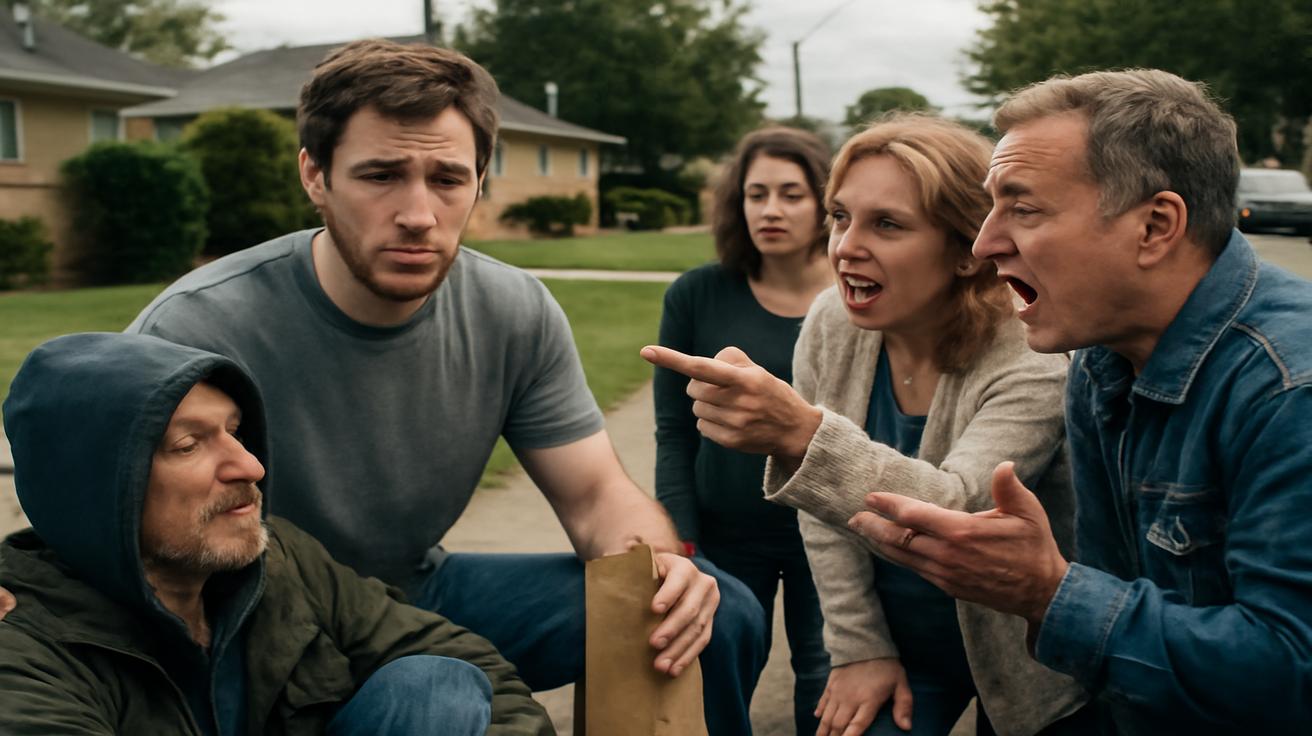
I opened my door to see Lena, eyes red, standing across from Mrs. Peters from 5B, who was known for her floral dresses, her meticulously trimmed balcony plants, and her unshakable beliefs about right and wrong.
“I’m not asking for special treatment,” Lena was saying, her voice tremoring at the edges. “I just wanted to know if someone could watch Eli for an hour while I go to the appointment. I don’t have childcare yet.”
“And I am saying,” replied Mrs. Peters, each word enunciated like a scolding metronome, “that this is not a daycare. We all have our problems. Do you see me going door to door every time my arthritis flares up, asking people to mop my floors?”
“You have a husband,” Lena snapped, then immediately winced, as if the words had come out sharper than she’d intended. “Sorry. I just mean—you have someone.”
“And you made your choices,” Mrs. Peters shot back. “You chose to have a child. You chose to move here. Now you expect the whole building to rearrange itself around your emergencies?”
Neighbors’ doors were cracked open all along the hallway. A few people stepped out, hovering like wary birds. I saw sympathy flicker across some faces, irritation across others. Everyone, it seemed, had preexisting beliefs about who does or does not “deserve” the village.
“I’ve had emergencies too,” came a voice from behind me—Greg from 4A, arms folded. “Lost my job last year. Didn’t see anyone rushing to my door with casseroles. Guess I should’ve had a cute kid handy.”
The building’s tension, simmering for weeks, finally boiled over. It wasn’t just about childcare anymore, or soup, or a towed car. It was about all the invisible ledgers people carried inside: favors given and not returned, pain endured without acknowledgment, help needed but never offered.
“I worked forty years,” Mrs. Peters declared. “No one ever bailed me out. I sucked it up.”
“Good for you,” Lena said, tears finally spilling over. “But not everyone makes it just because they’re tough. Sometimes they get help. Sometimes they don’t. I’m just asking, not demanding.”
“Feels like demanding when it keeps happening,” someone murmured from the back.
I found my own voice without quite meaning to. “We’re all acting like there’s a rationed amount of care,” I said, stepping forward. “Like if she gets some, you lose some. That’s not how this works. We’re neighbors, not competitors.”
“Easy for you to say,” Greg said. “You’re the one everyone likes. You’ve got the extra time, the extra car, the extra soup. You get to feel generous. The rest of us are just trying not to drown.”
There it was, naked and undeniable: the resentment at the heart of it. Helping Lena, to them, wasn’t just about her. It was about what they didn’t have—time, energy, money, stability—and the fear that their own struggles weren’t visible enough to be “help-worthy.”
When Everyone’s a Victim in Their Own Story
After that hallway confrontation, the building warmed into factions, like snow melting into separate streams. Some quietly doubled down on helping Lena: watching Eli for an hour here and there, slipping grocery store gift cards under her door anonymously. Others made a point of loudly refusing.
“Sorry, I don’t enable,” I overheard someone say, when she asked for change for the laundry machine. “I have to look out for myself first.”
On the surface, that made sense. Of course people needed to protect their own fragile lives. But underneath it, something more complicated was happening. Every person I spoke with eventually circled back to the same refrain:
- “Where was this kind of help when I needed it?”
- “Why does she get sympathy and I didn’t?”
- “I’ve been through worse and no one cared.”
It was as if everyone in the building was walking around with their worst day cupped in their hands, holding it out for comparison. Trauma and hardship had become a kind of currency, a battered coin passed back and forth: who had it the hardest, who had survived the most without breaking, who was owed more for what they’d silently borne.
In this unspoken contest of suffering, Lena’s very visible needs made her suspect. If she spoke of them, she was “seeking attention.” If she didn’t, she was “hiding something.” Either way, there was always a hint of accusation: Why is your hurt more important than mine?
What no one seemed able to say out loud was the simplest, rawest truth: “I wish someone had helped me like that when I needed it.”
It’s unsettling to admit you were abandoned when you should have been held. It’s easier to call someone else unworthy than to grieve the tenderness you never received.
A Table, a Tangle of Stories
One night, exhausted by the constant hum of comparison, I sat at my kitchen table and tried to map it all out. Each neighbor, each story, each need. It looked, in the end, less like a hierarchy and more like a knot.
| Neighbor | Visible Story | Hidden Weight |
|---|---|---|
| Lena (2B) | Single mom, new, asking for help | Housing insecurity, no support network |
| Greg (4A) | Sarcastic, “self-reliant” | Job loss, pride, fear of failure |
| Mrs. Peters (5B) | Tough, rule-following retiree | Chronic pain, worked without safety nets |
| Rosemary (3C) | Quiet, keeps to herself | Loneliness, mobility issues |
| Me | “Generous,” has a car, has time | Guilt, fear of not doing enough |
Looking at the table, it was suddenly obvious: we were all, in some way, building our identities around our pain. Each of us had, at some point, been hurt, overworked, overlooked, or left behind. Each of us was, in some corner of our mind, the protagonist of a story where we’d been wronged.
In that kind of world, kindness doesn’t land as a simple good. It lands like a judgment. If I help you, it implies you are in greater need than me. If you receive more help than I do, it whispers that maybe my suffering doesn’t count as much after all.
And if I never got the help I needed when I was at my lowest, watching someone else receive it can feel like salt poured into an old, unhealed wound.
Choosing to Help Anyway
The building never held a grand intervention. There was no dramatic reconciliation in the hallway, no moment when everyone finally saw each other clearly and put down their ledgers. Real life isn’t that tidy.
Instead, what happened was smaller, quieter.
A week after the argument, I saw Mrs. Peters kneeling with Eli in the lobby, pointing out the names on the mailboxes, tracing each letter with his finger. “That’s a P,” she was saying, the edges of her voice softened. She caught my eye, straightened her back, and said briskly, “Someone’s got to teach him his letters.”
One evening, I passed by Greg’s door and heard laughter from inside, a cartoon theme song drifting through the wall. Later, Lena mentioned casually, “Yeah, he watched Eli for an hour while I went to the laundromat. Said he needed ‘noise practice’ before his nieces visit.” She said it like it was no big deal, but her smile gave her away.
Small truces, born not from epiphanies, but from everyday proximity. The longer you share walls with someone, the harder it becomes to keep them flattened into a caricature.
As for me, I kept driving Lena to the store sometimes. I kept making too much soup on purpose. But I also found myself checking my own impulses—was I helping from love, or out of a need to feel like “the good one”? Was I able to give without secretly expecting gratitude or moral high ground in return?
I started offering rides to the clinic in the group chat, not just to Lena, but to anyone who might need them: “I’m going at 3 p.m. Thursday, two spots in the car if someone wants to tag along.” I brought extra muffins to the lobby sometimes and left them with a note: “For whoever needs a small kindness today.”
Some days, they were gone within an hour. Some days, they sat untouched. Either way, they were there: a quiet, open invitation that didn’t ask anyone to prove they deserved it.
What We Owe Each Other
Months later, when the whole scandal had settled into memory, a new tenant moved in. A young man with headphones, boxes of books, and a chipped coffee table. On his first night, he knocked on my door to ask if I knew which laundry machines still worked. His eyes darted between our doors, the dim stairwell, the peeling paint.
“Welcome to the circus,” I almost said. Instead, I told him which machines were least likely to eat his quarters and pointed him to the community chat.
After I closed the door, I thought about the question that had quietly threaded its way through our building ever since that first bowl of soup: who really deserves help?
Is it the one who asks the most? The one who asks the least? The one whose crisis is easiest to sympathize with? The one who suffered silently for years? The one who never recovered? The one who “tried hard enough”?
The more I chewed on it, the more I suspected we’d been asking the wrong question.
Maybe the better question isn’t who deserves help, but what kind of community we become when we insist on measuring deserts at all. When every pain is weighed against another like some cosmic competition. When every act of kindness has to pass through a filter of worthiness before it leaves our hands.
In a world where everyone feels like a victim of something—of a bad economy, of broken families, of illness, of systemic injustice, of pure bad luck—it’s tempting to believe that there’s not enough care to go around. That if I soften for you, there will be nothing left for me.
But I’ve watched how my building slowly, awkwardly, haltingly started to prove that instinct wrong. Not with grand gestures, but with tiny, almost embarrassed acts: shared rides, borrowed sugar, a text that says, “Hey, heard you had a rough week. Need anything?”
Kindness didn’t fix our bills or heal our chronic pain or erase past neglect. It didn’t erase the fact that some people really had been left to fend for themselves when they shouldn’t have been.
What it did do, in its small way, was shift the story from “why them and not me?” to “maybe there’s enough care here for both of us, even if it’s imperfect and late.”
The last time I saw Lena before she moved to a place closer to her new job, Eli ran down the hall to show me his new backpack. “For school!” he yelled, words tumbling out. “Ms. Pee-turs say I’m ready.”
Behind him, Mrs. Peters stood with her arms crossed, watching him fondly, pretending not to. When our eyes met, she said, gruff but honest, “He’s a good kid. Just needed a few… extra hands.”
I thought about that first night, the soup and the rain and the way the whole building had turned it into a referendum on fairness. I thought about how easily our own hurts can warp the sightline between us and someone else’s need.
“Most of us,” I said, more to myself than anyone, “do.”
FAQ
Why did a small act of kindness cause such a big reaction in the neighborhood?
Because many residents were already carrying their own unacknowledged struggles. Seeing visible help given to one person triggered comparisons and old hurts, making people feel that their own pain had been overlooked.
Is it wrong to feel resentful when others receive help?
It’s a very human reaction, especially if you went through hard times without support. The key is recognizing that feeling without letting it turn into cruelty or a refusal to help anyone else.
How can communities avoid turning kindness into a competition?
By normalizing mutual aid—offering support openly to anyone who might need it, without demanding proof of worthiness. Small, consistent gestures for many people help reduce the sense of favoritism.
What’s the difference between enabling and helping?
Helping supports someone’s capacity to stand on their own over time, while enabling repeatedly shields them from the consequences of harmful patterns. In the story, most of the help (rides, food, childcare) was about short-term stability, not fueling self-destruction.
How can I practice kindness without feeling used or obligated?
Set clear boundaries: decide what you can genuinely offer without resentment. Give freely within those limits, and don’t tie your kindness to expectations of gratitude, payback, or moral superiority.








Leave a Comment