
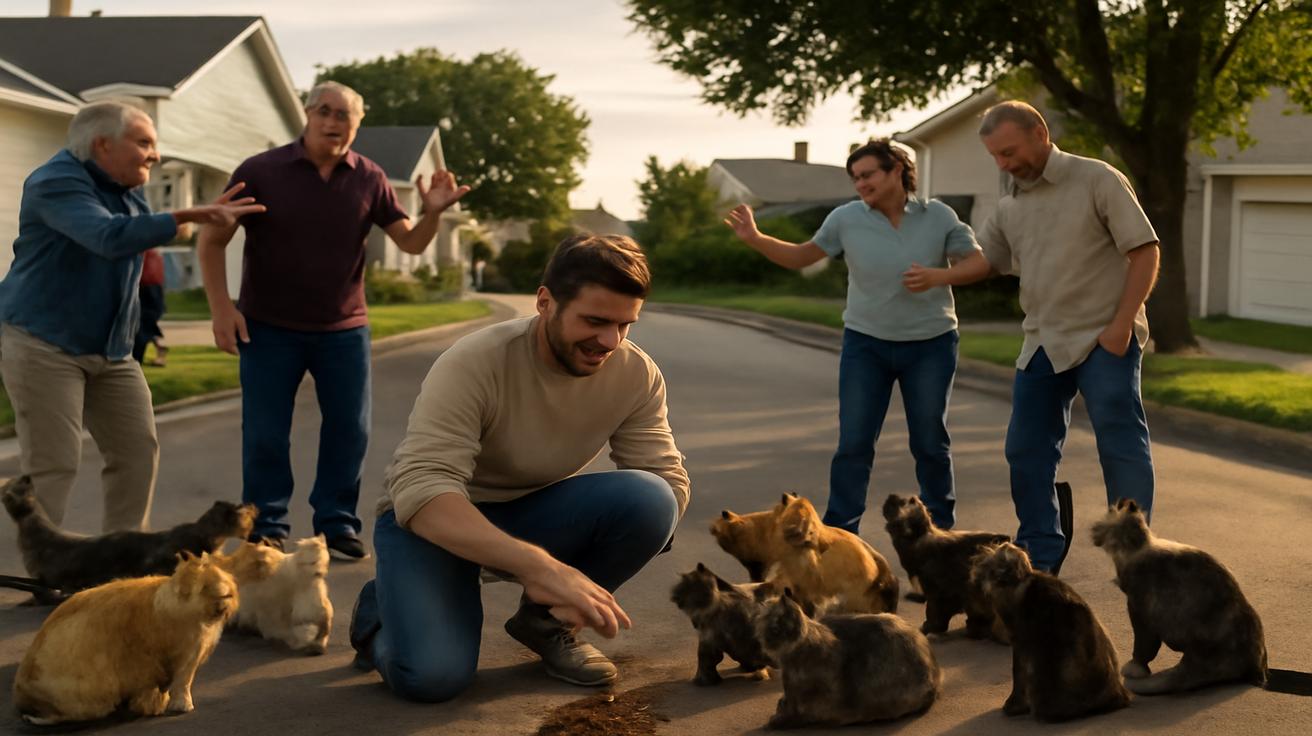
On a cool October evening, just as the streetlights flickered on and the sky turned the soft bruised purple of early night, the first bowl appeared. It sat on the edge of the cul-de-sac, gleaming silver under the lamppost, filled to the brim with dry cat food. A single tabby, ribs faintly visible beneath its dull coat, crept forward, sniffed, then began to eat. Curtains twitched. Porch lights blinked on. Dogs barked behind fences. And without a single word exchanged, a quiet neighborhood drew its first invisible battle line.
The Woman With the Bowls
Her name was Marlene, though most people on the street just called her “the cat lady” under their breath. She lived in the corner house with the blue shutters and the overflowing flower boxes, the one that smelled like basil and laundry detergent when the wind blew right. For years, no one paid much attention to her beyond the occasional wave or holiday card. She was the kind of neighbor who put your packages in a plastic bin when it rained and returned your trash cans to the side of your house after pickup. Quiet, polite, unremarkable.
The cats, she said, started with just one: a small black female with a torn ear that showed up after a thunderstorm. The cat hid under Marlene’s azaleas, eyes glowing yellow between the branches. Marlene watched her for days, leaving out scraps of chicken or a saucer of milk, coaxing her closer. Eventually, the cat let her touch its head, just once, a shy nudging press of fur against human fingers. That was all it took. A simple moment of connection, as fragile and fleeting as a match strike.
The black cat was not alone for long. Two lanky adolescents appeared the next week, sleek and wary. Then an orange tom with a battered face and a limp. Then three tiny kittens, still round with baby fat, chasing each other’s tails under parked cars. Within a month, there were more than a dozen cats weaving through the bushes, slipping under fences, materializing like ghosts at the edges of lawns. Every night, Marlene went out at dusk with bowls and kibble and wet food, murmuring to them as if they were her own children come home late for dinner.
For a little while, it was almost charming. Kids pointed them out on walks: “Look, Mommy, that one has a half tail!” Some neighbors smiled when they saw the cats sunning themselves on warm pavement or playing in piles of fallen leaves. A few tossed leftover chicken bones or opened a can of tuna and set it carefully on the porch. The street felt alive in a new way, like a storybook village with its own small, wild mystery.
But the charm didn’t last.
The First Complaints: Poop, Paws, and Pawprints on Cars
It started with the poop, as these things so often do. Little piles in flower beds. Soft, smelly landmines in the perfectly manicured lawn of the house with the “No Dogs” sign staked firmly by the walkway. Someone stepped in it on their way to work one morning, tracking it into the car. Someone else found cat feces scattered in the sandbox in their backyard, half-buried under plastic shovels and toy trucks.
Then came the noise. Yowling at midnight—piercing, drawn-out shrieks as unneutered males fought for territory and mates. Neighbors jolted awake to the sound of animals battling in the darkness, claws slicing the quiet. Porch motion lights flared on in sequence down the block like falling dominoes. Cats chased cats across roofs, knocking over potted plants, rattling loose shingles. Babies woke up crying. The next morning, the group chat lit up.
Because every modern neighborhood has one, of course: a digital town square where missing packages, suspicious cars, and “Who left this old couch by the corner?” are hashed out with the intensity of a city council meeting. In this neighborhood, it was a messaging app thread called “Oakview Neighbors.” Most of the time, it was full of lost dog alerts, bake sale reminders, and the occasional passive-aggressive complaint about fireworks.
Now it had a new subject: cats.
When Care Turns Into Conflict
“Does anyone know who keeps feeding all these cats?” one message read, accompanied by a blurry photo of a white cat perched on a car hood, claws dug into the paint.
“My kids can’t use their sandbox anymore,” another neighbor wrote. “It’s disgusting. Something needs to be done.”
“They’re just hungry, poor things,” came the first reply in defense. “Would you rather they starve?”
From that moment, the conversation split, clean and sharp. On one side were the defenders, many of them animal lovers who saw the cats as vulnerable lives in need of protection. On the other side were residents who saw only scratched cars, trampled gardens, and a growing health hazard on their doorstep.
In the center of the storm was Marlene, still gently setting down bowls each evening, still greeting the cats by name. She read the messages in the chat, her hands trembling slightly as the words blurred. “Irresponsible.” “Health risk.” “Selfish.” No one mentioned her by name at first, but she knew. The bowls had not been subtle. Neither had her affection.
For days, she hovered over her phone, typing and deleting responses. She wrote, “I’m only trying to help,” then erased it. She wrote, “I’ve started talking to a rescue group,” then erased that too. Some part of her wanted to stay invisible, to keep her kindness quiet and private. Another part bristled with anger: why did everyone care more about lawns and car paint than about living, breathing creatures?
It wasn’t just about the cats anymore. It was about who got to define “being a good neighbor.”
Fear of Disease and the Invisible Line Between Wild and Domestic
At the school bus stop, parents started swapping stories of what they’d read online. Toxoplasmosis from cat feces. Fleas that could infest homes. Parasites. Ringworm. Rabies. The word “disease” began to hang in the air, heavy and sticky, coating every mention of the strays with a layer of dread.
Were stray cats actually dangerous? That question didn’t have a simple answer, and nuance rarely thrives in heated neighborhood group chats. Health agencies warn that feral cats can carry parasites and diseases; at the same time, many managed cat colonies are vaccinated and pose minimal risk. But in the cul-de-sac, it didn’t matter what the statistics said. What mattered was that a tabby had started sleeping under one family’s deck and their dog came away with fleas the next week. What mattered was the toddler who picked up a clump of damp sand from the sandbox and later came in with filthy hands. Fear doesn’t deal in complex charts and carefully weighted risk. It deals in images and stories.
As if on cue, one neighbor, Mark, printed out a stack of articles about feral cats and public health. He handed them out door-to-door like grim pamphlets, highlighting passages about fecal contamination and rabies exposure. Next door, another neighbor, Priya, countered with printouts about Trap-Neuter-Return programs, their success in reducing feral cat populations and disease spread. Those with time to spare read both and came away conflicted. Many just heard the headlines, folded them into their existing bias, and carried on.
Amid all this, the cats did what cats have always done. They slipped through fences, climbed trees, hunted mice in the shadows of garden sheds. They lay on sun-warmed pavement, stretched like discarded scarves, unaware that their lives had been turned into arguments, that their presence was now a symbol—of compassion for some, of threat for others.
How One Problem Becomes Everyone’s Problem
The neighborhood, once a lazy braid of small talk and shared trash day reminders, was pulling apart into strands. These conflicts are rarely just about the issue at hand; they surface deeper questions about who gets to make choices that affect everyone else.
A stranger feeding a cat in an alley is one thing. A neighbor feeding a dozen cats near your child’s play space is another. The bowls didn’t just nourish the animals; they concentrated them. What was once an occasional shadow at the edge of the yard became a regular presence. Cats sat on porch railings, stared through glass doors, darted across driveways. Now they were not abstract street creatures—they were personal.
And here lay the rub. A single act of mercy—putting food down for a hungry cat—carried ripple effects far beyond that quiet moment. The cats bred. They staked out territory. They imprinted on that patch of sidewalk as the place where food appears like clockwork. Compassion for one life became a burden distributed across many others, whether they agreed to shoulder it or not.
For the ones like Marlene, the responsibility felt moral, almost sacred. For others, it felt unwanted, imposed. In that tension, neighbor turned against neighbor.
Friendships Fractured at the Curb
The first real fight happened on a Sunday morning, thick with the smell of fresh-cut grass and gasoline. The air vibrated with lawnmowers and leaf blowers. Birds scolded from power lines. And in front of house number twelve, two women stood facing each other, arms crossed.
“I’m asking you nicely,” said one, a young mother named Elise, her voice tight with the brittle edge of exhaustion. Her toddler clung to her leg, thumb jammed in his mouth. “Please stop feeding them. They’re all over my yard now. My son plays out here.”
“You think I like that they’re strays?” said Marlene, clutching her empty metal bowl like a shield. “I’m trying to do right by them. They didn’t ask to be dumped here. They’re just… here.”
“They’re here because you give them food,” Elise snapped. “You’re making it worse. They’re fighting outside our windows at night. My husband had to take his car to get buffed because of the scratches.”
“It’s not that simple,” replied Marlene. “If I stop feeding them, they’ll roam further. They’ll dig in everyone’s trash. They’ll suffer. I’m not going to just stand by and watch them starve.”
A garage door opened down the block. Another neighbor stepped outside, drawn by voices. Then another. Within minutes, what started as a tense conversation had an audience. Some shifted uncomfortably, not wanting to get involved. Others watched with barely concealed interest, arms folded, deciding whose side they were on.
Lines that had once seemed so solid—between “the nice neighbor with the herbs” and “the woman who lets her kids draw chalk murals on the sidewalk”—were suddenly smeared. People remembered favors done and words spoken, but they also remembered who had rolled their eyes in the group chat, who had used words like “irresponsible” or “cruel.”
It would have been easier, perhaps, if someone had been clearly in the wrong. If someone had kicked a cat or thrown stones, or if someone had stood defiantly in the street declaring, “I don’t care what any of you think.” But these were not villains. These were people who waved at each other from driveways, who brought casseroles when someone was sick, who swapped cookie recipes. And yet their shared space, once so comfortable and familiar, had warped into a fragile truce line crisscrossed with pawprints.
Counting Costs: Compassion, Control, and Consequences
Weeks turned into months. The neighborhood found itself caught in a weary stalemate. Some nights, the group chat was quiet. Others, it exploded after someone posted a video of a cat walking along the hood of a newly washed car or digging in a flower bed. The same arguments surfaced, hardened now like old scar tissue.
In quiet moments, a question hung over everything: how did an act meant to ease suffering lead here—to brittle friendships, anxious parents, sharp words mumbled over hedges?
Part of the answer lay in a simple, uncomfortable truth: compassion isn’t weightless. It has mass, and someone has to carry it. To feed a stray cat is to accept a piece of responsibility for its life. To do so in shared space is, in some way, to volunteer your neighbors as co-carriers, whether they consent or not. It’s not just the bowl of food—it’s the kittens that come next spring, the late-night fights, the health concerns, the calls to animal control.
None of this makes the cats less deserving of care. It simply acknowledges that in the tight weave of a neighborhood, kindness isn’t a closed loop. It spreads like water through cracked pavement, seeping into places we never meant it to go.
| Perspective | Main Concern | What They Wish Others Understood |
|---|---|---|
| Cat Caregivers (like Marlene) | Preventing suffering, hunger, and neglect of animals | “I’m not trying to cause problems. I just can’t ignore living beings in distress.” |
| Parents of Young Children | Health risks, litter boxes turning into contaminated play spaces | “I’m not heartless. I just have to protect my kids first.” |
| Homeowners Focused on Property | Damage to gardens, cars, and outdoor furniture; noise and mess | “I work hard for this place. I shouldn’t have to sacrifice it for a problem I didn’t create.” |
| Quiet Observers | Keeping peace, avoiding escalating conflict | “I wish we could talk about this without tearing each other apart.” |
In that table of perspectives, you might recognize yourself. Maybe you’ve been the person who sneaks food to the shy calico under the stairs, whispering, “There you go, sweetheart.” Or maybe you’ve opened your blinds at 2 a.m., furious, as another shriek sliced through the night outside your baby’s room. Maybe you’ve been both, at different points in your life.
What Happens When the Authorities Arrive
Eventually, the thing everyone knew would happen did. Someone called animal control.
No one admitted to being the one to make the call, though plenty suspected each other. A white truck rolled slowly into the neighborhood one morning, quiet as a held breath. Two officers stepped out, calm and practiced, carrying humane traps and clipboards.
They talked to residents, nodding as they listened: yes, the noise, yes, the feces, yes, the property damage. Then they moved on to the cats, setting wire cages baited with food along the alleyways and behind sheds. The cats, creatures of habit, followed their noses and curiosity.
That night, the neighborhood listened to a new sound: metal doors clanging shut with a clean, final snap.
Some residents felt relief. The problem—if not solved, at least shifted. Others felt a hollow guilt watching the truck return the next day, cages shuddering softly. No one knew for sure what would happen to the cats, and the officers’ words about “shelter capacity” and “best possible outcome” felt thin and formal.
Marlene watched from her front steps, arms wrapped around herself against a chill that had nothing to do with the weather. When an officer approached her, he was gentle but firm. They talked about feeding bans, about how unregulated food sources could lead to overpopulation. He mentioned local groups that might help with Trap-Neuter-Return instead of simple removal. His voice was kind, but beneath it hummed the machinery of policy, liability, and limited resources.
That night, she did not set out any bowls. The porch light stayed off. The sidewalk where the cats usually gathered was bare, just a strip of concrete cooling in the dark. From inside her house, she thought she heard a faint meow, then another, then silence.
The group chat, for once, had little to say.
Learning to Share a Street (With Each Other, If Not With Cats)
Weeks later, the neighborhood felt different—not better or worse, exactly, but changed, like a room after a long argument. The silence had its own texture. There were fewer cats now. A few still slipped through the hedges, ear-tipped and wary, their presence a sign that some had been trapped, neutered, and returned rather than removed entirely. The nights were quieter. The sandbox stayed cleaner. Gardens began to recover.
But something else had been altered too. Conversations at the mailbox were more careful, as if everyone had suddenly realized how easily ordinary kindness can rub raw against other people’s fears and boundaries. Some neighbors avoided eye contact when they passed; others overcompensated with extra-bright smiles, as though they could plaster over the memory of old arguments with a single gust of cheerfulness.
It’s tempting to look for a neat ending here, a clear moral. Maybe: “Don’t feed stray cats.” Or: “Always stand up for animals, no matter what.” But the truth, like those cats slipping between yards, is more elusive.
Feeding a stray animal is, at its core, an instinctive act. You see need, you respond. It feels simple. Yet in the tight-knit ecology of a neighborhood, that gesture intersects with a dozen other lives and priorities. What feels like quiet goodness on your porch can feel like threat on someone else’s deck. There’s no way around that friction except through it—through talking, listening, and facing the messy tangle of consequences together.
Some time after the animal control truck stopped coming, a small meeting took place in the community center down the road. A rescue volunteer came to talk about managed colonies, about how to humanely trap, neuter, vaccinate, and release cats so they no longer breed yet can live out their lives with less suffering and less impact. A handful of neighbors attended, enough to fill the first two rows of metal folding chairs. Among them sat Marlene and Elise, not side by side, but close enough to trade a tentative nod.
They listened to explanations about ear-tipped cats and vaccination schedules. They heard stories of neighborhoods that had found a middle path: no more open buffets on sidewalks, but designated feeding times and caretakers; no unchecked breeding, but coordinated spay-neuter efforts. No perfect harmony, but fewer late-night fights, fewer kittens born into hard lives, fewer grudges simmering over neatly trimmed hedges.
Afterward, as chairs scraped and people drifted toward the door, they found themselves standing by the same refreshment table, awkward among the coffee cups and cookie crumbs.
“I didn’t realize…” began Elise, then trailed off.
“I didn’t either,” said Marlene quietly. “I just thought… if I didn’t help them, no one would.”
“I know,” said Elise. “I just… I see my kid eating dirt half the time, and my brain goes straight to worst-case scenario.”
They stood in that tender, fragile space for a moment—between apology and defense, between resentment and understanding. It wasn’t friendship, not yet. But it was something else: the faint, necessary recognition that the street doesn’t belong to any one person or cause or species. It belongs to all of them, entangled.
On another October evening, long after that first bowl of food, the streetlights come on again. A single tabby crosses the road, ear tipped, coat glossier now. There’s no buffet on the corner anymore, no clatter of multiple bowls. Instead, somewhere behind a fence, at a set time agreed upon by a tiny coalition of neighbors, a small dish appears briefly, then disappears. A compromise, imperfect and evolving, but a step.
Feeding stray cats, it turns out, isn’t just about cats. It’s about how we share space and responsibility. It’s about how far our compassion extends, and where it collides with other people’s fears. It’s about learning, slowly and sometimes painfully, that kindness isn’t only what we do, but how we do it—and who we’re willing to invite into the conversation when our private acts spill out onto a public street.
Frequently Asked Questions
Is it always wrong to feed stray or feral cats?
Not necessarily. Feeding can be part of a responsible approach if it is paired with spay/neuter, vaccination, and coordination with neighbors or local rescue groups. Problems usually arise when feeding is unstructured, attracts more cats, and doesn’t address breeding or health concerns.
What is Trap-Neuter-Return (TNR), and why do people recommend it?
Trap-Neuter-Return is a method where free-roaming cats are humanely trapped, spayed or neutered, vaccinated, and then returned to their territory. This stabilizes or reduces the population over time, reduces fighting and yowling, and can lower disease risk, while avoiding a constant cycle of new kittens being born.
How can I talk to a neighbor who is feeding stray cats without starting a fight?
Choose a calm moment, speak in person if possible, and focus on shared concerns rather than accusations. Use “I” statements (“I’m worried about my kids playing where they go to the bathroom”) and pair concerns with openness to solutions (“Could we talk about a way to help the cats and keep the yard safe?”).
Are stray cats really a health risk to humans?
They can be, depending on local conditions and whether they are vaccinated or dewormed. Feces can carry parasites, and fleas can spread to pets. However, managed colonies with TNR and vaccination are generally much lower risk. The key is management, cleanliness, and preventing overpopulation.
What should a neighborhood do if stray cats are causing conflict?
Communities can organize a small group of residents to work with local rescues or animal control on a TNR plan, set agreed-upon feeding guidelines (times, locations, cleanup), and keep open communication channels. The goal is to balance compassion for the animals with respect for everyone’s health, sleep, and shared spaces.






Leave a Comment