
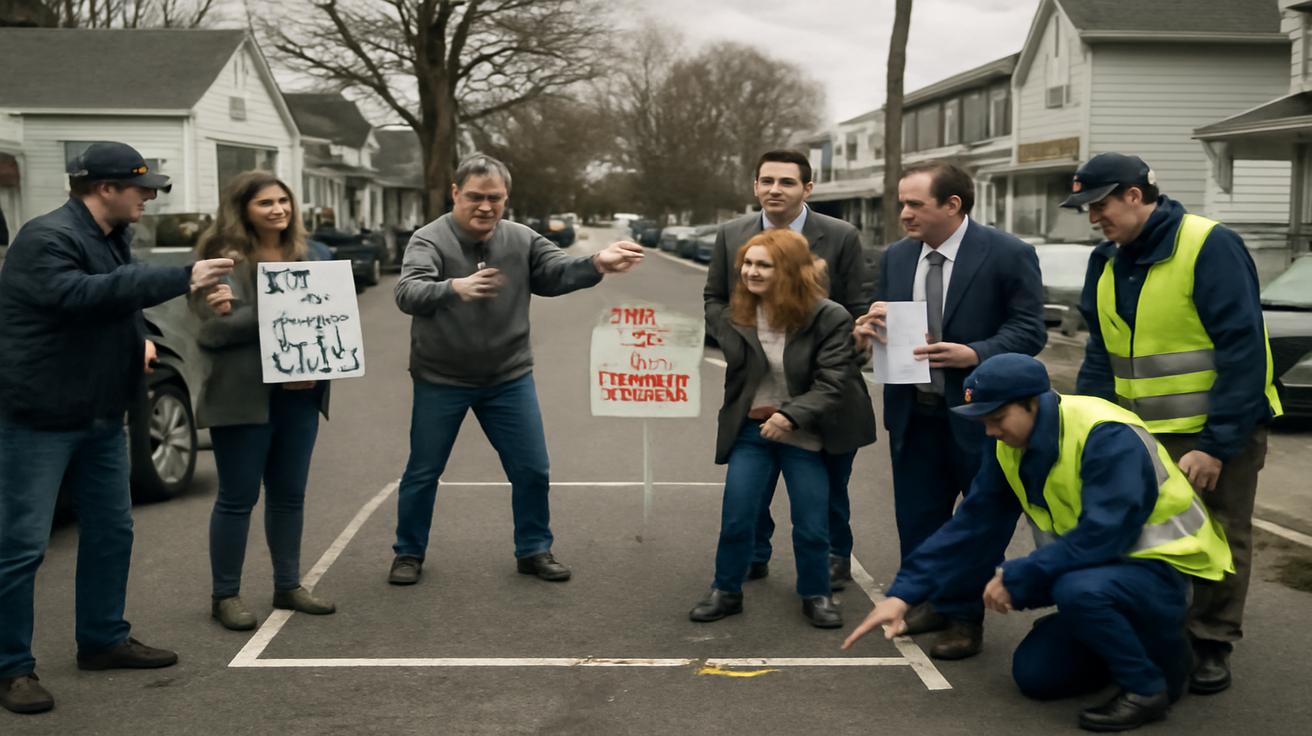
On an ordinary Tuesday in late spring, the first handwritten note appeared under the windshield wiper of a silver Honda Civic. By the time the sun went down, that wrinkled scrap of paper would have set off a chain of arguments, petitions, late-night meetings, and one surprisingly dramatic neighborhood standoff that left everyone asking the same unsettling question: where does private ownership end and the public good begin—especially on a street that feels like home?
The Space Everyone Saw, but No One Really Noticed
The parking spot in question wasn’t special. It wasn’t marked. It wasn’t even particularly convenient—wedged between a maple tree and a fire hydrant on a quiet block of Marigold Lane, a tree-lined residential street two bus stops away from downtown. The asphalt there was cracked, with a faint ghost of an old yellow curb line half-erased by time and weather.
Everyone on Marigold Lane knew the rhythm of parking. Mornings were easy: a few empty spaces padded the curbs like slack in a rope. By evening, especially on Thursdays when the corner café hosted open-mic night, those spaces tightened up. People circled a few extra times. Engines idled. Quiet curses fogged up the air.
No one said it out loud, but the neighbors had an unspoken mental map of what belonged to who. Mrs. Alvarez tended to park in front of the hydrangeas by her front walk. The young couple in the blue bungalow favored the space under the streetlamp. The retired math teacher, Mr. Hawthorne, liked the wide spot near the fire hydrant—the very spot under which the Civic now sat with that note pressed against its windshield.
In the note’s shaky blue ink, five words were underlined twice: “This is a RESIDENT spot.”
The First Spark: A Note, a Knock, a Line in the Asphalt
The Civic belonged to Tara, a nurse who rented the attic studio over the old brick duplex on the corner. She worked double shifts at the hospital, and by the time she got home most nights, the street was already a patchwork of overlapping bumpers and tight squeezes. If she found any open curb within half a block, she took it. That night, the spot by the hydrant was all that remained.
She found the note the next morning. Her first reaction was confusion; her second, annoyance. “Resident?” she muttered to herself, standing there, scrubs half untucked, hair still smelling faintly of antiseptic and coffee. “What do they think I am?”
Later that week, the same note reappeared. Same spot. Same car. Only this time, the underlining had carved halfway through the paper, as if whoever wrote it had been pressing their pen like a stake into the asphalt.
Tara didn’t like conflict. But she also didn’t like being told she didn’t belong on a public street. So she did what people do now when something feels off: she posted a photo of the note online. The caption was short and sharp: “Since when do people own the street in front of their house?”
The response was immediate and polarized. Some of her friends chimed in with solidarity; others told stories of similar “territorial neighbors” who used traffic cones, trash cans, even lawn chairs to claim curb space. A few people chimed in from her own city: “Looks like Marigold Lane is getting spicy.”
That night, as porch lights blinked on and cicadas buzzed in the dark, someone knocked on Tara’s door.
The Man with the Ruler
Mr. Hawthorne held a yellow measuring tape like a badge of office. He was polite, but his jaw was set.
“You’re the one with the silver Honda?” he asked, glancing over her shoulder as if the car might be lurking in the hallway.
“I am,” Tara said carefully. “Is this about the notes?”
He exhaled through his nose, a slow, precise sound. “This block has had an understanding for years. We’re homeowners. We pay the property taxes. We maintain the frontages, shovel snow, sweep leaves. There’s an… etiquette.” He paused. “You’re a renter. I understand. But residents who’ve invested in this street have priority.”
The word “invested” hung between them like a measuring line.
“I also live here,” Tara said. “I pay rent. I work nights. And last I checked, this is public street parking.”
He frowned, visibly wrestling with the difference between legal fact and emotional territory. “Technically,” he conceded, “yes. But practically, we treat the space in front of our houses as ours.”
“Then why isn’t there a sign?” she asked.
“Because we shouldn’t need one.”
He turned and left, his tape measure dangling, the metal tip scraping lightly along the walkway like a tiny, unsheathed sword.
Lines on Paper, Lines in People’s Heads
To understand how that single space turned into a battle, you have to understand how much of modern neighborhood life exists in the gap between laws and expectations. On paper, the rules are simple: the city owns the street; curbside parking is a shared resource, first-come, first-served, unless posted otherwise. In people’s minds, however, the story is far messier.
By the following week, the quiet tension on Marigold Lane had thickened. The silver Honda kept parking near the hydrant. New notes appeared, angrier and less polite. One accused Tara of “disrespecting those who built this neighborhood.” Another called her “transient,” a word that clanged in her chest.
Then the plastic cones appeared.
They stood there one afternoon like two small orange soldiers guarding the prized patch of curb. Between them, a laminated sheet flapped in the breeze: “Reserved for Residents – Do Not Move.”
Tara took a photo, heart pounding, and walked them back up the block. One went on her landlord’s porch. The other, she dropped off at Mr. Hawthorne’s front steps with a Post-it: “The city owns the street, remember?”
It might have ended there, with bickering and annoyance and a chilly ceasefire. But someone, maybe Tara, maybe a watching neighbor, maybe a friend from across town, posted the cone photo to a local community group.
That’s when the spark hit a much larger pile of dry leaves.
When the Street Went Public
The comments came in waves. Some treated the story as a joke—typical neighbor drama, good for a quick scroll and a chuckle. But threaded through the jokes was something sharper: resentment, anxiety, a sense that this argument wasn’t just about a parking space. It was about who gets to feel at home in a city that’s changing block by block.
“Homeowners always think they own the sidewalk too,” wrote one renter.
“If you don’t like it, buy a house,” shot back another commenter.
“I pay more in taxes than your landlord probably does,” countered someone else.
Within days, the post spilled into the physical world. People who didn’t live on Marigold Lane began driving by, rubbernecking for cones and handwritten notes. One afternoon, a bicyclist stopped to take a picture of the curb and shook his head, muttering loud enough for a nearby porch to hear, “This is why we can’t have nice things.”
It wasn’t just about neighbors now. It was about property rights, public access, and that invisible line between “mine” and “ours” that runs through every street in every city.
The Neighborhood Meeting: War in Folding Chairs
The official neighborhood association hadn’t drawn a crowd in months. Agendas usually leaned toward tree-planting initiatives, block-party planning, and light grumbling about trash pickup schedules. But the week the parking fight hit the community forum, the meeting room at the local elementary school filled up fast.
Rows of metal folding chairs scraped and clanged as people shuffled in, carrying reusable water bottles, reusable grudges. On the whiteboard at the front of the room, someone had written: “Agenda Item #3: Curb Use and Parking Etiquette.” Someone else had crossed out “Etiquette” and written “Rights.”
Tara sat near the back, palms damp. Across the room, Mr. Hawthorne sat bolt-upright, hands folded over a manila folder thick with printed-out city ordinances, or so everyone assumed.
| Viewpoint | Core Belief | Main Concern |
|---|---|---|
| Homeowners | Investment in property should grant informal priority on the curb. | Losing convenience and control after years of stability. |
| Renters | Public street means equal right to access, regardless of ownership. | Being treated as temporary or second-class residents. |
| Planners/Officials | Streets serve the whole city, not just one block. | Balancing fairness, mobility, and limited curb space. |
When the parking item came up, the air felt suddenly heavier.
“We’ve had a gentleman’s agreement on this street for thirty years,” one long-time resident began, her voice quivering but resolute. “We’ve respected each other’s space. We shovel each other out. We don’t crowd.”
“That ‘gentleman’s agreement’ never included the people who rent here,” someone replied. “We were never asked. We were just… expected to know?”
A man in a blazer cleared his throat and stood. He introduced himself as a representative from the city’s transportation department, invited at the last minute after the online uproar. He spoke the clipped language of policy, but his eyes showed fatigue, the look of someone who’d had this conversation on other blocks, over other contested pieces of curb.
“Legally,” he said, “no one owns the public right-of-way in front of their house. Not the pavement, not the curb, not the street trees. The city maintains it, and it’s meant for shared use. That includes on-street parking.”
“But we pay taxes,” came a voice from the front row.
“Everyone pays taxes,” the man in the blazer replied gently. “Directly or indirectly. The question is how we share something scarce and valuable.”
Someone mentioned putting in permit parking. Another suggested restricting overnight spots to residents only—though what “resident” meant, and whether renters counted, quickly became its own sub-argument. A third person floated the idea of eliminating parking on one side of the street to create a wider sidewalk and more trees; the room buzzed like a disturbed hive.
When Tara finally spoke, her voice surprised even her.
“I patch people up all night,” she said. “I come home exhausted. I circle the block like everyone else. And every time I park in what is legally a public space, I find a note telling me I don’t belong. You want to talk about rights? Let’s talk about who you picture when you imagine the ‘we’ in ‘our street.’”
The room went quiet, but it was a brittle quiet, crisscrossed with invisible lines of loyalty and suspicion.
The Street as a Living Room
Part of what made that silence so charged is that, for many people in the room, the street outside their home felt less like infrastructure and more like an extension of their living room. It was where their kids had learned to ride bikes, where block parties spilled into dusk, where chalk lines traced out hopscotch squares every spring. They didn’t own the asphalt, not on paper, but their memories clung to it like roots.
Yet for others—the newer arrivals, the renters, the people who worked long hours or multiple jobs—the street was not a backyard but a threshold. It was the thin, contested in-between space between the life they were building and the place they left each morning to keep that life afloat.
So when someone put out cones or demanded deference based on years lived or deeds held, it wasn’t just about cars. It was a claim about who truly belonged in the story of the neighborhood.
Escalation: Chalk, Cameras, and a Visit from the City
The morning after the neighborhood meeting, someone drew a white chalk line along the edge of the disputed parking space. In careful letters, they labeled it: “COMMUNITY PROPERTY.” A few hours later, another hand added beneath it: “RESPECT GOES BOTH WAYS.”
A small bouquet of dandelions appeared beside the hydrant. No one admitted to placing them there.
But just as the chalk and flowers suggested the possibility of softening, another current surged in the opposite direction. A doorbell camera caught someone lifting one of the old cones from a neighbor’s yard and tossing it into the back of their trunk. A different camera, two houses down, recorded a scraping sound late at night—a key dragged across the side of a parked SUV. No one could prove who did it, but the damage was done. Paranoia seeped under doors.
The city, sensing something volatile, sent a small team out one bright, brittle morning: a parking enforcement officer, a planner in a reflective vest, and someone from community outreach clutching a clipboard like a shield. They walked the length of Marigold Lane, counting cars, measuring curb cuts, making notes.
By afternoon, new signs had appeared at either end of the block: “2-HOUR PARKING, 8AM–8PM, EXCEPT BY PERMIT.”
“So we’re punishing everyone?” a neighbor grumbled, watching the crew drill metal into concrete.
“We’re trying to balance access,” the enforcement officer said. “This block is close to downtown. People have been using it like a free commuter lot. Permits help prioritize actual residents—owners and renters.”
Permits, however, came with fees. For some households, it was a manageable nuisance; for others, it was one more line in a budget already written in pencil. And still, the original question lingered: did paying for a permit make the curb feel more like a purchased commodity, or simply reinforce that it was shared infrastructure administered by the city?
A Small But Telling Victory
At first, the permit program seemed like a bureaucratic compromise that satisfied no one. Some homeowners felt their long-unspoken priority had been diluted; some renters bristled at having to pay to park near where they slept. But then something unexpected happened.
At the next association meeting, a motion was proposed to use any surplus from permit fees earmarked for the neighborhood—small as it was—to improve the street itself. Not just for cars, but for people.
Ideas poured out, tentative at first, then bolder: a bench under the maple tree where the disputed parking spot used to stretch, a bike rack by the corner café, planters along the sidewalk, a small curbside garden carved out from a little-used section of asphalt.
“If the street is truly ours,” someone said, “then let’s treat it like more than a place to store our vehicles.”
Even Mr. Hawthorne nodded at that. He didn’t give up arguing for what he called “reasonable front-of-house consideration,” but something in his stance softened as he imagined a bench where he could sit and watch the sunset flare off the car windows.
Who Really Owns the Street?
The argument that began with an angry note and a coveted parking spot didn’t end with a tidy resolution. Real life rarely does. On Marigold Lane, new tensions would flare and old ones would subside. People would move in and move out. Someone would paint their house a color the neighbors disliked. A new family would arrive with two cars and no driveway. The city might one day paint a bike lane where a row of parking used to be and start the whole debate all over again.
But the block would never again be able to pretend that the street was just background scenery, a neutral stage on which private lives unfolded. They had looked too closely now at what that strip of asphalt meant.
Legally, they knew: the street belongs to the public. Financially, it is funded—imperfectly, unevenly—by everyone who lives, works, and spends in the city. Physically, it is shaped by planners, engineers, and political decisions made in rooms far from Marigold Lane. Emotionally, though, the street is owned by whoever is willing to fight for their idea of what it should be.
For some, that ownership takes the form of traffic cones and angry notes and a fierce defense of convenience. For others, it looks like late-night walks along cracked sidewalks, quiet acts of making-do, and a determination not to be edged out of public space by private entitlement.
Maybe the better question isn’t “who owns the street?” but “who is the street for?” Cars, yes. But also kids on scooters, neighbors in lawn chairs on hot evenings, the barista biking to the café before dawn, the nurse stumbling home after a long shift, the retired teacher measuring out his days in how many times he crosses from front door to curb.
On Marigold Lane, the war over a parking space made that question impossible to ignore. It turned the street from something taken for granted into something seen, argued over, even cared for.
And if there was a quiet victory buried in all that friction, it was this: people began to speak of “our street” less as a strip of personal frontage and more as a shared landscape they were actively, sometimes painfully, learning how to co-manage.
On some evenings now, you can walk past the maple tree and see the tiniest hint of what that shared future might look like. There’s a new bench, slightly scuffed already, where a couple of kids kick their legs and share a bag of chips. Beside it, a little patch of curbside garden pushes marigolds through a square of former asphalt—the flowers’ orange heads bobbing gently when a car glides into the once-disputed space nearby.
The silver Honda still parks there sometimes. No one leaves notes anymore.
Frequently Asked Questions
Do homeowners legally own the parking space in front of their house?
No. In most cities, the street and curb are part of the public right-of-way, owned and managed by the municipality. Unless a space is clearly marked (for example, as a driveway, a loading zone, a disabled parking spot, or a permitted reserved space), it is first-come, first-served for the public.
Can neighbors use cones or chairs to “reserve” a spot?
Generally, no. Placing objects in the public right-of-way to claim a parking space is usually against local regulations and can be treated as obstruction. Some cities make informal exceptions during snow emergencies, but outside of those cases, the curb is not supposed to be privately reserved without official authorization.
What about residential permit parking—does that mean the street is private?
Residential permits do not make a street private. They are a tool cities use to prioritize parking for people who actually live in the area, especially near busy commercial districts or transit hubs. The space is still public; permits simply control who can park there and when.
Why do parking disputes feel so personal?
Because streets are more than infrastructure—they’re emotional and social spaces. People often see the curb in front of their home as part of their territory, even when it isn’t legally. Memories, routines, and a sense of security get wrapped up in those few meters of asphalt, turning small conflicts into symbolic battles over respect, belonging, and control.
How can neighborhoods reduce conflict over parking and curb space?
Clear communication and shared expectations help. Neighborhood meetings, transparent rules, and inclusive decision-making—where renters and homeowners are both at the table—can ease tensions. Some communities also rethink how they use curb space altogether, adding things like bike parking, greenery, or seating so the street serves more than just parked cars, and begins to feel like a shared place instead of a battlefield.






Leave a Comment