
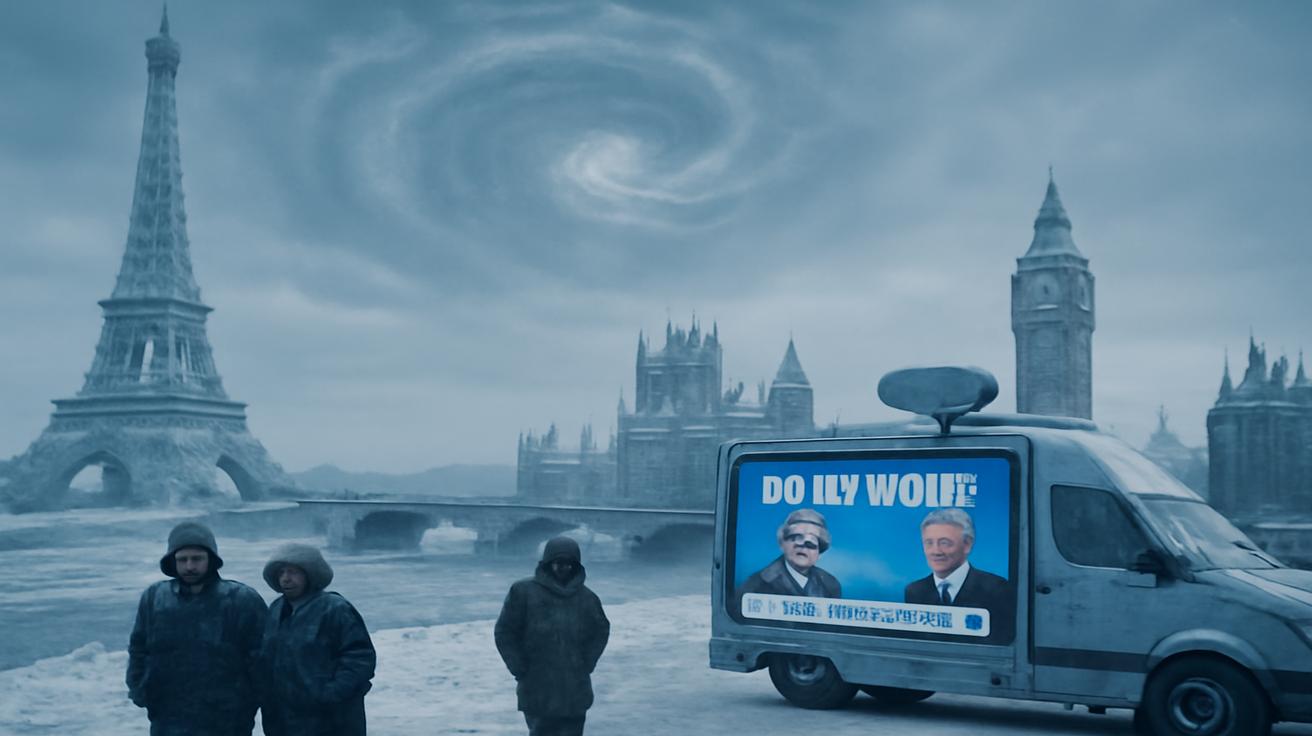
The forecast maps look almost unreal at first glance—a bruise-colored swirl of blue and violet settling over Europe like ink spilled from the Arctic sky. Numbers flash in the corners: –18°C, –22°C, –30°C with windchill. Somewhere, a commentator calls it a “historic polar vortex event,” the kind you tell your grandchildren about, the kind that carves itself into memory in the brittle shape of frozen pipes and white-out mornings. Somewhere else, another voice says it’s “just winter,” that this is how the planet breathes, expands, contracts, exhales cold over the continents in slow, rhythmic cycles.
And there, between those two versions of the story—one framed by climate crisis, the other by long, slow history—Europe waits for February.
When the Sky Breaks Open
On a damp grey morning in Berlin, late January, the city feels like it’s holding its breath. The air is cool but not yet truly cold, the kind that lets you get away with a thin jacket and a pretence that winter is almost over. On the radio, though, a different mood is building. Meteorologists are talking about the stratosphere, about sudden stratospheric warming, about a “disrupted polar vortex” that could spill Arctic air south within days.
If you could see it from above, the polar vortex would look like a vast spinning crown of wind, usually caged neatly over the Arctic, high in the stratosphere. In a normal winter it behaves like a well-trained storm, circling the pole and keeping the deepest cold locked up near the top of the world. But this winter, satellites show something stranger. The vortex is wobbling, then tearing, like a spinning top losing balance. Warm air from lower latitudes is punching upward, heating the stratosphere, and—counterintuitively—breaking open the gate that holds the cold in place.
On social media feeds, exaggerated animations race from phone to phone: icy plumes sliding like a ghostly avalanche over Scandinavia, Germany, France, the Balkans. Forecasters talk about the cold “loading the gun” in the north before it “pulls the trigger” over the continent. In Stockholm, parents eye their children’s snow boots, deciding whether it’s time to buy a bigger size. In Madrid, people scroll through long-range forecasts in disbelief, trying to imagine their mild, citrus-scented city under a sheet of Arctic glass.
The language of the coming freeze is oddly intimate—“Arctic outbreak,” “polar plunge,” “vortex collapse”—as if the atmosphere itself is having a breakdown. Yet above the drama of headlines, the physical reality is stark and simple: air is moving, and it is about to move in a way that Europe hasn’t seen in years.
The Anatomy of a February Freeze
The forecast models agree more than they disagree: February is stacking up to be brutal. Blocking high-pressure systems are projected to lock into place over Greenland and the North Atlantic, deflecting the normal conveyor belt of milder Atlantic storms. Instead of bringing rain and slushy warmth, the jet stream buckles and slides, letting Siberian and Arctic air push westward and southward like a slow-motion avalanche.
For the average person, “historic polar vortex event” doesn’t mean much until you stand outdoors and feel it in your teeth. It means the kind of cold that stings the inside of your nostrils, that turns your breath to glittering fog. The kind that creeps in through the gaps in old window frames and makes radiators feel pathetic. In the north, where winters are already demanding, the numbers are still shocking: –25°C in rural Sweden, –30°C in parts of Finland, windchills that shove even the hardiest people indoors.
But this time, the cold isn’t expected to stop there. Forecast ensembles hint at a deep freeze spilling into Central and Western Europe, places more used to rain than razor-edged air. Nighttime lows sinking to –10°C or lower in Germany, Poland, and the Czech Republic. Paris brushing against –8°C. Even the normally temperate British Isles flirting with temperatures cold enough to freeze burst pipes in uninsulated homes.
With all this anticipation swirling around, Europe begins to prepare in its own fragmented, improvisational way. Municipal workers check salt stores and grit spreaders. Energy traders stare anxiously at gas storage graphs. Shopkeepers quietly stack extra blankets at the front of their displays. Somewhere in the Alps, ski resort owners are eyeing the charts with a mix of dread and gritty hope: bitter cold can bring good snow, but only if the moisture cooperates.
The Blame Game: Nature or a Planet on Edge?
As the February freeze looms larger, a more abstract kind of storm gathers over Europe’s public conversation. The question is simple: is this just one more extreme in the timeless rollercoaster of winter, or is it another symptom of a climate unknowingly rewiring itself?
The polar vortex itself is not new. Historical records, ice cores, and proxy data tell us the Arctic has always had these whirling high-altitude winds. Sudden stratospheric warming events—the technical name for the disruption currently unraveling above the pole—have been documented since the mid-20th century. The legendary “Beast from the East” in 2018 was such an event. So was the bitter winter of 1962–63, remembered across Britain and northern Europe as a white, relentless season that froze rivers and stitched snowdrifts to the windowsills.
Meteorologist after meteorologist steps forward to remind the public: “Cold spells still happen in a warming world.” They pull out long-term temperature graphs showing that, despite occasional brutal winters, Europe’s average winter temperatures have climbed steadily, like a slow tide rising around an old pier.
Yet beneath the reassurance lies a more complicated possibility. Some climate scientists argue that rapid Arctic warming—the so-called Arctic amplification—is stretching and weakening the polar vortex, making it more prone to the sorts of wobbles and collapses that send bitter cold crashing south. In other words, global warming could be rearranging the choreography of winter, redistributing extremes rather than erasing them.
A Climate Mystery Written in Wind
In a small office lit by the glow of computer monitors, a climate researcher scrolls through decades of atmospheric data. Lines wiggle across her screen: jet stream positions, Arctic sea ice extent, stratospheric temperatures. It looks almost like music notation, the silent soundtrack of the upper air.
Some studies suggest a pattern: as the Arctic warms more than twice as fast as the global average, the temperature contrast between the pole and the mid-latitudes shrinks. This gradient is what powers the jet stream and helps anchor the polar vortex. Weaken that contrast, the theory goes, and the jet stream can become more wavy and sluggish, allowing cold Arctic air to spill south more often and for longer. A once-tight ring of wind begins to look more like a lopsided spiral.
But not all data align neatly with this storyline. Other research points out that the link between Arctic warming and mid-latitude cold extremes is inconsistent, waxing and waning over different decades. Climate models—the mathematical crystal balls that simulate Earth’s future—also disagree. Some show more polar vortex disruptions in a warmer world; others suggest fewer, with extreme cold events fading as global temperatures continue to climb.
Ask a roomful of experts whether this February’s looming freeze is “because of climate change,” and you won’t get a simple yes or no. You’ll hear words like “influenced,” “modulated,” “consistent with,” or “statistically ambiguous.” You’ll hear them frame it this way: climate change loads the dice, but it does not script every roll.
In the public sphere, nuance often melts faster than snow in a warm front. A historic freeze seems to offer ammunition to climate skeptics (“If the planet is warming, why am I freezing?”) and climate advocates (“Look how weird and extreme everything has become.”) Yet the reality is quietly more unsettling: a world that is, on average, warming can still produce pockets of devastating cold—perhaps even more erratically than before.
Europe on Thin Ice: Life Under a Polar Plunge
Beyond the debate, February will arrive the same way it always does: night falling early, frost feathering the corners of car windows, the smell of woodsmoke and hot metal coming from overtaxed heaters. In the space of a week, the rhythm of daily life can be jolted by a polar vortex event.
In the countryside of eastern Poland, the cold hits like a quiet hammer. The first night, the air hardens and grows strangely still. By dawn, every sound is smaller and sharper: the crunch of boots on snow, the crack of a frozen twig, the stutter of an old tractor that doesn’t want to start. Chickens refuse to leave their coop. Dogs paw nervously at ice where yesterday there was slush.
In cities, the freeze arrives as inconvenience, then hazard. Commuters stand hunched at tram stops, scarves pulled up over noses, phone screens fogged by breaths. Icy pavements turn every short walk into a dance of caution. Hospitals brace for an uptick in broken wrists and hips. Homeless shelters overflow; outreach workers patrol dark streets, urging people out of doorways and underpasses into whatever warmth can be found.
The cold threads itself invisibly through systems built under the assumption of milder winters. Trains fall behind schedule as points freeze. Electricity grids strain under a surge of heaters and electric radiators. In homes with gas boilers, the faint hiss of the flame becomes the soundtrack of survival. In poorly insulated flats—from Lisbon to Ljubljana—the walls themselves start to radiate chill.
For many, the memory of the 2021 Texas freeze flickers in the back of the mind: a modern region throttled by cold it wasn’t built to handle. Europe’s infrastructure is generally more cold-ready, but it also carries the weight of old buildings, aging grids, and an energy landscape reshaped by recent geopolitical tension.
Energy, Anxiety, and the Cost of Staying Warm
As thermometers plunge, one of the clearest impacts of a historic polar vortex event plays out quietly in living rooms and bank accounts. Heating is energy, and energy is money.
Natural gas consumption spikes first, then electricity. Nations that rely heavily on imported fuel feel an immediate pinch. Storage tanks that looked comfortably full in November now seem precariously small in the face of a multi-week Arctic siege. Energy ministers step in front of microphones, assuring the public there is “no cause for panic,” while privately calculating worst-case scenarios.
For families living near the financial edge, the calculus is more intimate. How long can we run the space heater in the children’s room? Can we seal the draft under the front door with towels? Should we close off one room entirely and live in the others like a small, improvised cave of warmth? The cold has a way of magnifying inequality; old houses in wealthy neighborhoods add another layer of insulation, while drafty social housing blocks trap their residents in a constant, shivering compromise.
All of this unfolds against the backdrop of a continent trying to decarbonize, to kick its habit of fossil fuels even as brutal cold snaps make those fuels feel irreplaceably reliable. In the dim glow of early-evening news, solar panels sit under a dusting of snow and wind turbines claw at a sluggish, frigid air mass that doesn’t always blow when it’s needed most.
| Region | Typical Feb Average | Projected Vortex Low | Key Concern |
|---|---|---|---|
| Scandinavia | –5°C to –10°C | –25°C or lower | Infrastructure stress, extreme windchill |
| Central Europe | –2°C to +4°C | –10°C to –15°C | Energy demand, transport disruption |
| Western Europe | 0°C to +7°C | –5°C to –8°C | Frozen pipes, vulnerable populations |
| Southern Europe | +5°C to +12°C | –2°C to +3°C | Agriculture losses, unprepared buildings |
Nature’s Memory and Our Short Attention Spans
In a small village in northern Italy, an older man stands in his doorway, watching his breath cloud the air. “We’ve seen winters like this,” he insists, thinking back to his childhood, to drifts that swallowed fences and weeks of school closures. Memory is slippery like that; our personal archives of weather are full of gaps and exaggerations, yet they anchor us. They tell us what is “normal,” even as that normal shifts underneath us.
The Earth’s climate system has its own memory, encoded not in stories but in tree rings, glacier layers, and sediment cores pulled from lake bottoms and ocean floors. These records show swings between colder and warmer centuries, pendulums of regional climate shaped by volcanic eruptions, solar cycles, and the slow dance of ocean currents.
To a climate scientist, this February’s polar vortex chaos is one note in a long, intricate song. They can point to famous cold winters in Europe’s past: the late 17th-century freeze-ups of the Little Ice Age, the Thames in London turned to an icy fairground; the 1985 cold wave that plunged much of the continent into days of sub-zero temperatures; the early 2010s when repeated cold spells seemed to contradict the headlines of global warming.
Yet even within this deep-time context, something now feels different in the rhythm of the seasons. Extreme heat records are falling far more often than cold records. Summer heatwaves are growing more intense and more deadly. Glaciers retreat year after year, leaving behind raw, fresh rock that no human foot has stepped on before. Against this background, a single historic freeze does not disprove a warming trend; instead, it presses an uncomfortable question: how does a reshaped climate express itself through cold as well as heat?
Between Fear and Wonder
Somewhere in rural France, a child wakes early during the February freeze and runs to the window. Overnight, the world has transformed: hedges sugar-coated in frost, the sky a delicate, blushing grey, every surface sparkling as if the planet has been dusted with glass. The cold is dangerous, but it is also quietly magnificent.
In moments like this, before the day’s news feeds light up with energy price alerts and travel warnings, the polar vortex is simply weather—raw, elemental, humbling. Breath freezes into tiny clouds; distant sounds carry strangely far; even the usual smell of the street is replaced by something clean and metallic. It’s a sensory reminder that we live at the mercy of forces we cannot negotiate with or postpone.
Fear and wonder have always paired uneasily in our response to wild weather. Storms, floods, heatwaves, brutal freezes: they inspire a mix of awe and threat. In a climate-changed world, that mix feels sharper. Each extreme event is no longer just a story about today but part of a bigger, uneasy narrative about tomorrow.
What This Freeze Is Really Telling Us
By the time February loosens its grip, Europe will bear the marks of the polar vortex event in a thousand small, tangible ways: cracked roads, insurance claims for burst pipes, spikes in winter mortality statistics, new records in meteorological archives. There will be stories of hardship and also of unexpected community—neighbours sharing blankets and soup, strangers pushing stranded cars out of snowbanks, volunteers checking on elderly residents in tower blocks grown too cold.
When the thaw comes—and it always does—it will arrive almost rudely. Snow will sag and rot, turning to slush at the edges. Icicles will drip themselves to nothing. The air will shift from knifing to merely damp. People will peel off one layer of clothing, then another, relearning the joy of standing outside without flinching.
The arguments over climate change versus natural cycles will outlast the snowbanks. Some experts will publish careful analyses showing how this event fits or doesn’t fit into emerging patterns. Others will caution against overinterpreting a single winter, however historic. The media will move on to the next story.
But for anyone who lived through it, this February freeze will become part of a more personal data set: a memory of a time when Europe felt briefly like the edge of Siberia, when the simple act of stepping outside became an encounter with something raw and unforgiving.
Perhaps that is the quiet lesson of the polar vortex, whatever its exact cause: we are not separate from the atmosphere; we are inside it, every moment of our lives. We have changed its composition with our factories and exhaust pipes, nudged its balances, tilted its probabilities. Yet we are still vulnerable to its moods, whether they come as crushing heat or as a blue, crystalline cold that seeps into the bones of a whole continent.
In the end, the February freeze is not nature “fighting back” or “proving a point.” It is the atmosphere doing what it has always done: moving energy around a spinning, tilted planet in complex, beautiful, and sometimes brutal patterns. What has changed is us—our numbers, our infrastructure, our expectations of stability. As Europe steps shivering into this historic polar vortex chaos, the deeper question isn’t just why it is happening, but how prepared we are to live in a world where the boundaries of “normal” weather keep shifting, and where every breath of icy air or stifling heat carries a faint echo of a planet in transition.
Frequently Asked Questions
What exactly is the polar vortex?
The polar vortex is a large area of low pressure and cold air surrounding the Earth’s poles, located high in the stratosphere. It spins counterclockwise and usually keeps the coldest air locked near the Arctic in winter. When it weakens or becomes distorted, lobes of that cold air can spill south into Europe, North America, or Asia, leading to severe cold spells.
Is this historic February freeze caused by climate change?
Scientists are cautious. The polar vortex and sudden stratospheric warming events are natural features of the climate system and have occurred long before human-driven climate change. However, some research suggests that rapid Arctic warming may be making the vortex more unstable, potentially increasing the odds of such disruptions. It’s more accurate to say climate change may influence the likelihood and behavior of these events rather than directly “cause” a single cold spell.
How can winters be so cold if the planet is warming?
Global warming refers to the long-term rise in average global temperatures, not the disappearance of cold weather. A warmer world can still produce intense regional cold spells, especially when atmospheric circulation patterns shift. What we observe over decades is that heat records are increasing much faster than cold records, even though strong winter outbreaks can still occur.
How should people and cities prepare for a polar vortex event?
Preparation ranges from the personal to the systemic. Individuals can insulate homes, check heating systems, stock basic supplies, and look out for vulnerable neighbours. Cities and governments can ensure adequate shelter capacity for homeless populations, secure energy supplies, maintain transport and power infrastructure for extreme cold, and communicate clear safety guidance about travel, heating, and frostbite risks.
Will polar vortex events become more common in the future?
The science is not settled. Some studies and climate models suggest that as the Arctic warms, certain types of polar vortex disruptions could become more frequent or persistent, leading to more mid-latitude cold extremes. Other models show the opposite trend, with fewer such events as overall temperatures rise. Researchers are actively studying these dynamics, and our understanding is still evolving.



Leave a Comment