
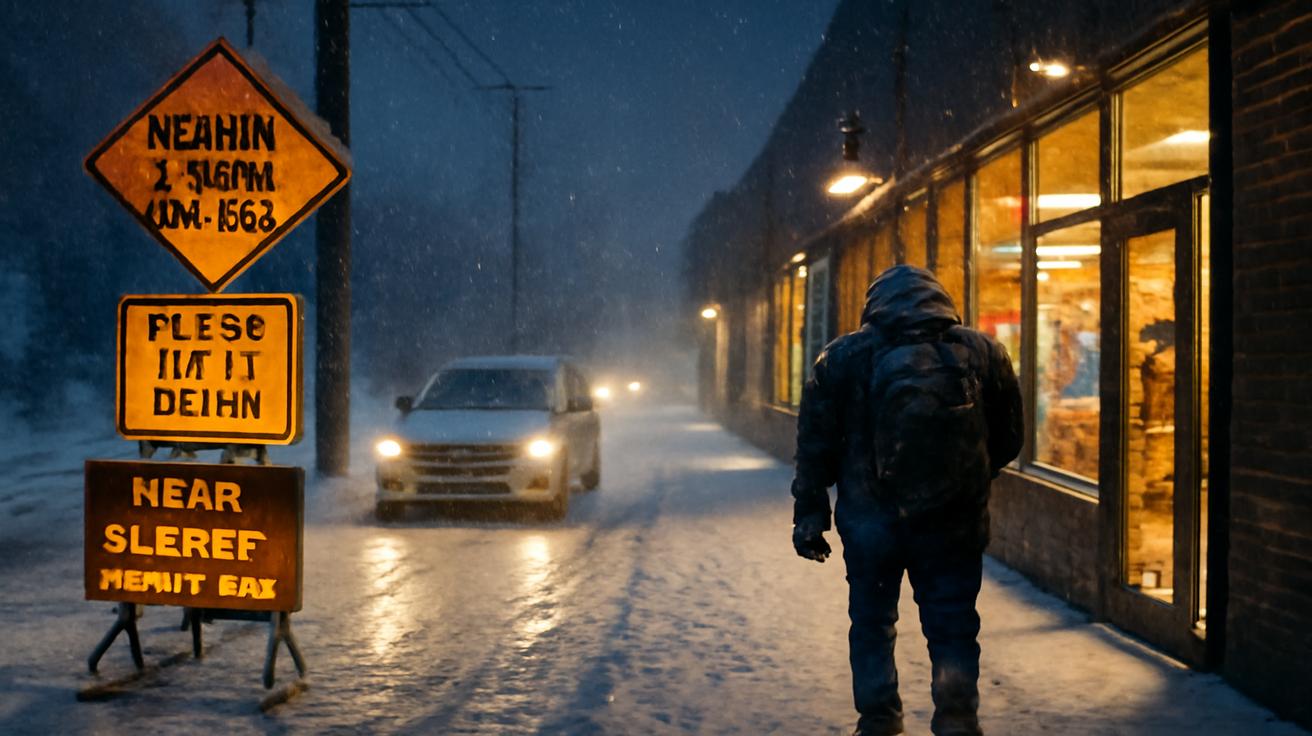
The snow begins as a rumor, drifting through the town well before the first flake has the courage to fall. It’s in the way people speak in shorter sentences at the grocery store, in the way the sky dims just a little earlier than usual, in the almost electric stillness of the air. By mid-afternoon, phones are buzzing on kitchen counters and office desks: weather alerts, school notifications, a familiar red banner at the bottom of the local news app—“Heavy snow set to begin tonight.”
The Quiet Before the Whiteout
By early evening, the town feels like it’s holding its breath.
The clouds have thickened into a solid mass of steel gray, low enough to touch the tops of the old church steeple and the tired antennae on the apartment block at the edge of town. The air smells faintly of iron and cold river water, that peculiar scent that precedes a proper winter storm. Streetlights flicker on in a row, halos blooming against the sky, despite the clock insisting it’s still daytime.
At the edge of Main Street, an electronic highway sign blinks its amber warning into the misty dusk: “WINTER STORM WARNING – AVOID TRAVEL AFTER 8 PM.” The letters look almost apologetic. Radio stations repeat the same careful phrasing: “Authorities urge drivers to stay home tonight as conditions deteriorate.” Snowplows are already lined up in a gravel lot near the public works building, orange hulks idling and snorting exhaust into the chill, awaiting their long night’s work.
Inside cars idling at intersections, people tap their thumbs on steering wheels, weighing the same questions. Can I make it home before it starts? Do I really need to pick this up tonight? Should I cancel tomorrow’s plans? The storm is still just a promise, but everyone seems to be rearranging their mental furniture to make space for it.
When Warnings Collide with Routines
Across town, the language around the storm takes on a different flavor.
“We’ll be open regular hours tomorrow,” a sandwich board outside a coffee shop announces, the chalk letters stubbornly cheerful. A manager in a chain clothing store clicks through corporate emails, reading the directive that’s come down from several states away: “Maintain normal operations where safely possible.” In a back office above a small hardware store, the owner leans over a cluttered desk and mutters, “If we close for every storm they predict, we might as well shut down for the whole winter.”
There is an invisible tug-of-war playing out between voices of caution and voices of continuity. On one side, state police and local emergency managers are urging restraint, asking people to stay home, to treat the forecasted snow—heavy, wet, wind-driven—as the serious hazard it promises to be. On the other, businesses large and small are calculating lost revenue, missed deliveries, wages that won’t be earned, and customers who might not come back.
Outside a supermarket, a teenager in a thin store-issued vest gathers carts while checking his phone. A new alert pops up: “Travel could be dangerous to impossible overnight.” He shoves a row of carts toward the entrance, glances up at the sky, and wonders if the bus home will even make it up the hill later. Inside, his manager is taping a printed sign to the break room wall: “Staff scheduled for tomorrow: plan to arrive on time unless you hear otherwise.” Both messages are true, and both are, in their own way, impossible.
The Sound of Decision-Making
The storm hasn’t started yet, but in living rooms and kitchens, the first flurries are already falling in the form of decisions.
A mother hunches over the dining table with her laptop, listening to a press conference echo from her phone. The county sheriff’s voice is calm but firm: “If you don’t absolutely need to be on the roads tonight, don’t be.” She glances at tomorrow’s calendar—an in-person meeting she can’t afford to miss, a shift at the grocery store for her older son, an orthodontist appointment already rescheduled twice. Outside, the wind rattles the bare branches against the window, a skeletal tapping that makes the room feel smaller.
In the next neighborhood over, a small business owner is having a different conversation with herself. She looks around her nearly empty yoga studio—pale wood floors, plants drooping a little in the dry air, a bowl of incense sticks by the front desk. January is usually when people come back, making quiet promises to themselves on padded mats. A snow day tomorrow means another set of cancellations, another trickle in an already thin month.
“We’ll do online classes if we have to,” she decides, flipping on a ring light and adjusting her laptop. “We’ll adapt.” But she still sends a group text to her instructors: “Stay home if it looks bad. We’ll figure it out.” In her mind, the line between courage and pragmatism is as blurry as the edge of the approaching storm.
The First Flakes and the Last-Minute Rush
By the time the first real flakes start to fall, fat and deliberate, the town has accelerated into a kind of organized panic.
The parking lot at the last open gas station on Route 9 is a mess of headlights and exhaust, cars parked at odd angles, people darting in and out in bulky coats. Inside, beneath buzzing fluorescent lights, a short line curls down the snack aisle as customers clutch windshield washer fluid, batteries, and cheap gloves that probably won’t last the season. A handwritten sign by the register announces, “Chains sold out.”
At the supermarket down the road, the logic of human anxiety is visible in what’s left on the shelves. The bread aisle is a skeleton of scattered crumbs and confused loaves—seeded rye, an obscure gluten-free brand, and a few hotdog buns no one seems to want. Milk is a sea of emptiness punctuated by a stubborn row of buttermilk quarts. People cradle cartons of eggs like fragile promises, balancing them against bags of salt and oranges.
Near the windows, the view outside keeps dissolving. At first, it’s just a dusting on the parked cars, like a thin coat of powdered sugar. A few minutes later, wind begins to herd the flakes into purposeful swirls, soft drifts appearing in the corners and along the median. The plows haven’t come through yet, but already the blacktop is taking on that dull gray slickness that makes every step more careful.
| Time | Expected Conditions | Authority Advice | Typical Business Response |
|---|---|---|---|
| 6–8 PM | Light snow beginning, temps dropping | Prepare vehicles, limit non-essential trips | Remain fully open, encourage last-minute shopping |
| 8 PM–Midnight | Snow intensifying, reduced visibility | Avoid travel if possible | Shorten hours, skeleton staff closing stores |
| Midnight–6 AM | Heaviest snowfall, hazardous roads | Stay off the roads; emergency travel only | Closed, but planning next-day operations remotely |
| 6–10 AM (Next Day) | Blowing snow, ongoing cleanup | Delay commuting, check latest advisories | Delayed opening; pressure to reopen “normally” |
Back on Main Street, the last buses of the evening hiss to a halt, headlights smeared into blurs by the swirling white. Riders stamp their feet on the rubber mat at the door, bringing in little storms of their own. The driver repeats the same line at every stop: “If you don’t have to go back out later, don’t.” People nod, but their lives don’t always obey the weather.
Plows, Patrols, and the People in Between
While most residents are deciding whether to hunker down or soldier on, a different group is lacing up boots and double-checking gear.
In the public works garage, a veteran plow driver runs a practiced hand along the edge of his blade, feeling for burrs he doesn’t want to meet at three in the morning. The radio in the corner crackles with updated snowfall estimates, but he pays more attention to the map on the wall, crisscrossed with bright marker lines that outline his route. To him, a forecast of “six to ten inches” translates into hours, passes, gallons of diesel, and thermoses of lukewarm coffee.
At the state police barracks, troopers crowd around a large screen showing radar loops: the storm swelling and darkening like an ink stain, moving inevitably their way. The watch commander taps a finger on the map. “Once it starts sticking, we focus on the main arteries. Call in what you see. If it’s not an emergency, we’re asking people to stay home. But you know they won’t all listen.” Heads nod around the room. The snow might be unpredictable, but human behavior, in many ways, is not.
And in the medical center across town, overnight nurses and ER doctors park their cars in the furthest corner of the lot, knowing they might not move again until noon tomorrow. Some have extra clothes in duffel bags slung over their shoulders, prepared to sleep in cots if they have to. They have heard the advice to avoid travel too, but they are the ones people count on when that advice is ignored—or simply impossible to follow.
Business as (Almost) Usual
Meanwhile, in offices and storefronts, the language of the storm bends around phrases like “productivity” and “continuity.”
In a glass-walled conference room at a regional headquarters, a group of managers debates tomorrow’s staffing plan while the storm builds outside their windows like an argument given form. “We have to respect the state advisory,” one says, tapping a printed bulletin from the Department of Transportation. Another counters, “But this is our busiest quarter. We can’t just go dark every time the forecast looks dramatic.” They settle on a compromise: the office will open late, but employees are “expected to make every reasonable effort to attend.” Reasonable, in this context, is as slippery as the roads will soon be.
Small businesses, without the cushion of corporate policies or deep reserves, improvise on the fly. A baker preps dough in the predawn hours, hoping the power doesn’t flicker. A corner store owner calls her one part-time employee and insists, “Don’t come in tomorrow; I’ll handle it myself if I can get here.” She knows every hour her doors stay open matters. She also knows a car in a ditch can make those hours meaningless.
There is a quiet bravery in these choices, and also a deep vulnerability. Somewhere between the bright certainty of a highway warning sign and the optimistic flick of an “Open” sign on a snowy morning lies a shared, unspoken question: How much risk feels acceptable when it’s spread across a whole community?
The Night the Storm Finds Its Voice
By full dark, the storm has stopped being a forecast and become a presence.
The snow that began as cautious powder has grown heavy, wet, and insistent. It clings to every surface, softening sharp edges, draping phone lines and tree limbs in sagging white. Wind gusts twist down side streets like invisible animals, roaring around corners, picking up loose snow and flinging it sideways across the road in thick, blinding sheets.
From inside warm houses, the view is almost hypnotic. Streetlights shine through the swirling flakes, turning the world into a snow globe shaken too hard. The sound outside is muffled, a hushed roar punctuated by the occasional clank of a passing plow or the faint, stressed creak of bending branches. In this cocooned quiet, people refresh radar maps and scroll through social media, watching their town disappear under a moving veil of blue and purple on their screens and a deeper, more tangible white at their windows.
On the roads that authorities begged people to avoid, a few stubborn headlights still cut through the storm—delivery drivers finishing routes, night-shift workers crawling toward clock-in times, someone who decided they really could beat the worst of it. Tires spin futilely at icy intersections. Hazard lights blink like tiny beacons in the swirling dark. For every stranded car, there is usually someone answering a phone in the dispatch center, a trooper putting on gloves, a tow driver coaxing an engine to life.
Morning After, New Questions
By dawn, the storm has left its signature.
Driveways vanish into pristine, ankle-deep blankets. Cars look like soft, lumpy animals nestled along the curb, their colors erased. The world is quiet in that particular way only a heavy snowfall can orchestrate—a stillness that feels almost reverent. Yet beneath the powder, the roads tell a harsher story: compacted snow frozen into ruts, black ice lurking in the shaded dips, wind-driven drifts blocking narrow lanes.
Phones light up with overlapping messages. Schools: “Closed.” The city: “Travel advisory remains in effect; only essential trips recommended.” A chain restaurant: “We are open for normal hours today!” A small café: “Delayed opening; stay safe, we’ll see you soon.” Each notification sketches a different version of “normal.”
Parents rearrange their workdays once again. Some can log in remotely, pajama-clad children shuffling behind them with hot chocolate moustaches. Others do not have that luxury. For the nurse who worked overnight, “normal” is finishing charting and then wondering if her compact sedan will even leave the hospital lot. For the grocery clerk, it’s pulling on boots and hoping the bus is running after all that.
Living Between Warnings and Necessities
As the sun pries its way through thinning clouds, the town begins slowly, cautiously, to move again.
Plows scrape past, pushing tall, grimy walls of snow against driveways as quickly as homeowners can shovel them out. Salt spreads like gray confetti along intersections, hissing quietly as it bites into the ice. The main roads improve first, veins reopening, while side streets stay stubbornly treacherous a while longer.
The message from authorities hasn’t changed much: “If you can stay home, stay home.” But the reality in many homes is that staying in is not an option that pays the bills. So the day becomes a mosaic of personal calculations. The barista who decides her little hatchback isn’t up to the hill and calls in, voice shaking with equal parts fear and guilt. The delivery driver who shrugs, checks his tires, and heads out, relying on repetition and muscle memory to keep him out of the snowbanks. The store owner who unlocks the door, even if fewer than a dozen people will step inside all day, because that’s what she does. That’s survival, too.
In a way, storms like this one expose the fragile geography of obligation—who is allowed to heed the warnings and who is required, by necessity or by expectation, to drive straight through them. The snow does not discriminate, but the impact of decisions made long before the first flake fell is suddenly traced in white along the roads.
Yet amid the tension, there is another thread running quietly through the town: a neighbor’s snowblower cleared across two property lines; a bag of groceries dropped on the porch of an older resident who shouldn’t be out walking on ice; a boss who says, “Don’t risk it, we’ll make it work.” Heavy snow, for all its disruptions, also reveals how tightly or loosely we hold one another when the world slows down.
FAQs About Heavy Snow, Travel Warnings, and Business Operations
Why do authorities urge drivers to stay home during heavy snow?
Driving during heavy snow dramatically increases the risk of accidents due to reduced visibility, slick roads, and the unpredictability of other drivers. Emergency responders and plow crews also need clearer roads to work efficiently. When people stay home, it reduces crashes, frees up critical resources, and speeds up the overall cleanup.
If businesses stay open, is it really unsafe to drive?
Yes, both can be true at the same time. A business may remain open for financial or operational reasons, but road conditions can still be hazardous. Safety decisions should be based on official weather and road advisories, your vehicle, your driving experience, and the specific conditions in your area—not just whether a store has its lights on.
What should I do if I must drive during a heavy snowstorm?
If travel is truly unavoidable, reduce your speed, increase following distance, keep headlights on, and avoid sudden braking or sharp turns. Carry an emergency kit with blankets, water, snacks, a flashlight, and a phone charger. Let someone know your route and expected arrival time, and stick to main roads that are more likely to be plowed.
How do small businesses decide whether to close for a storm?
Small businesses balance safety, financial pressure, staff availability, and customer needs. They consider local advisories, the severity of the forecast, and whether employees and customers can reasonably travel. Many opt for reduced hours or delayed openings as a compromise between protecting people and maintaining income.
What can communities do to better handle these conflicting pressures?
Communities can improve by offering flexible work options, supporting paid sick and emergency leave, communicating clear and consistent advisories, and fostering a culture that values safety over “toughing it out.” On an individual level, checking on neighbors, sharing rides when safe, and respecting travel warnings all help lighten the burden a storm brings.




Leave a Comment