
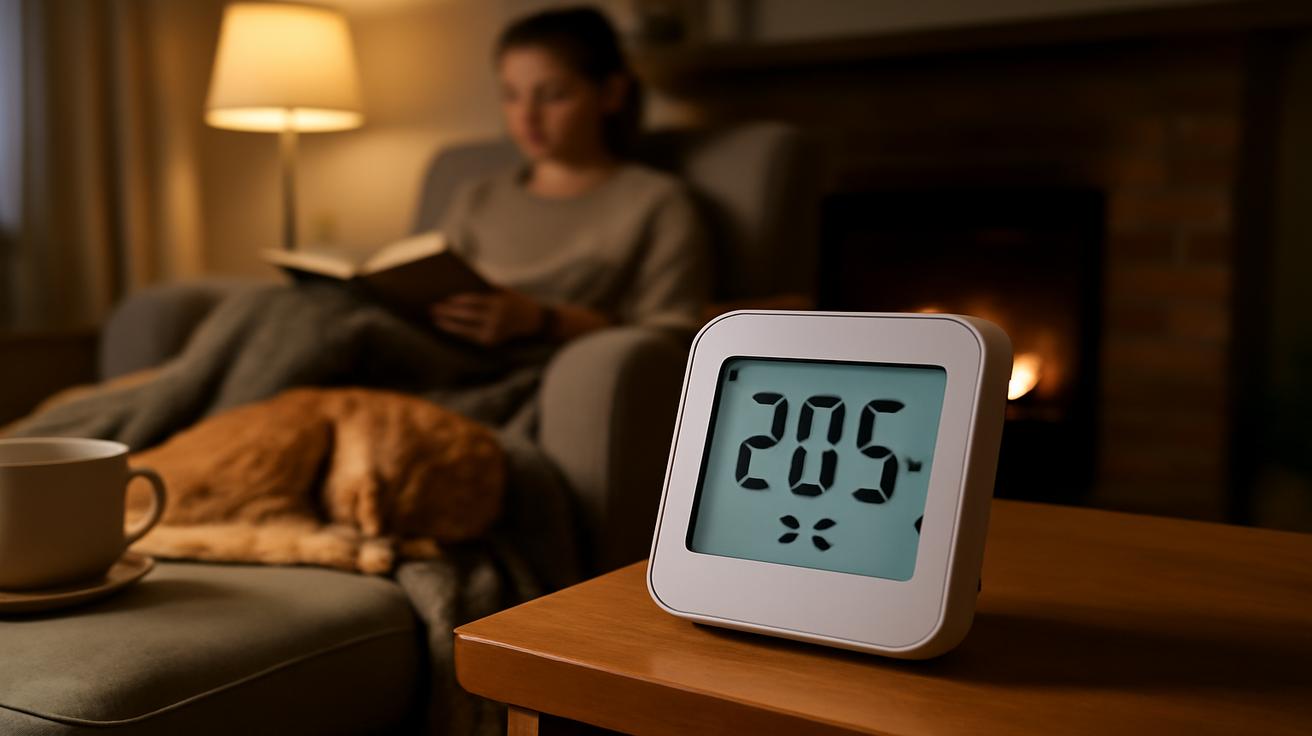
The first cold night of the year arrives quietly. A thin film of frost on the car windscreen, a pale sky that never quite wakes up, the air inside your home holding a faint, surprising bite. You pad into the kitchen, wrap your hands around the kettle, and pause in front of the thermostat. For years, perhaps, your fingers have hovered around the familiar number: 19 °C. A small act of virtue, a nod to energy-saving guides and stern winter campaigns. Nineteen felt almost like a moral temperature—frugal, responsible, grown-up.
But this winter, something feels different. The chill seems to get into your bones more quickly. You’ve heard friends admit they gave in and turned the dial up. You’ve read that 19 °C might no longer be the magic number it was once claimed to be. Your thumb hesitates, then nudges the control higher. Twenty? Twenty-one? Somewhere between comfort, cost, and conscience, a new normal is slowly taking shape.
The Old 19 °C Rule: A Temperature with a Story
The 19 °C rule has been passed around like a well-worn household myth, often presented as a scientific decree. But it’s more of a cultural relic than a universal truth.
Back in the mid to late 20th century, when heating systems were simpler, homes leakier, and energy crises cast long shadows over daily life, governments and health organizations in various countries began promoting “reasonable” indoor temperatures to cut fuel use. Many settled on 18–19 °C as a sensible living-room target: warm enough for most healthy adults when dressed in layers, cool enough to save substantial energy compared with earlier decades when 21–22 °C was common in better-off households.
That guidance stuck. Over time, 19 °C migrated from public campaigns into family lore. It slipped into news pieces, energy leaflets, and green living blogs. It sounded precise, almost clinical—like a prescription for good behavior. If you wanted to be efficient, pragmatic, maybe a little stoic, you dialed your thermostat down to 19 °C and boasted about it.
But three big things have changed since then: our homes, our bodies, and our climate. And together, they’re rewriting the script on what “ideal” indoor warmth means.
The New Comfort Zone: What Experts Now Recommend
Ask a modern building physicist, a public health specialist, and a sleep researcher what temperature they recommend, and you won’t get a single number. But you will hear a very clear message: 19 °C as a blanket rule is too rigid—and for many people, too cold.
Today, many experts are converging on a slightly higher comfort band for daytime living spaces, especially in well-insulated homes:
- Daytime living areas: typically 20–22 °C for most healthy adults.
- Bedrooms at night: a bit cooler, around 17–19 °C for good sleep, with adequate bedding.
Instead of one number that rules the whole home, there’s growing support for zoned comfort—different temperatures for different rooms and times of day. A living room where you sit still for hours might need to be warmer than a kitchen where you’re moving about, or a hallway you only cross through.
At the heart of this shift is a simple realization: we don’t just inhabit buildings; buildings inhabit us. Our metabolism, age, health, activity level, and even our mood respond to indoor climate. A temperature that feels pleasantly invigorating to a young adult can feel punishingly cold to an older person or someone with a chronic health condition.
Why 20–22 °C Often Makes More Sense
A number of public-health agencies now emphasize that indoor temperatures below about 18 °C for prolonged periods are associated with increased risks of respiratory infections, cardiovascular strain, and damp-related issues like mold. For older adults, babies, and people with circulatory or respiratory conditions, that risk threshold can effectively creep higher.
So, while 19 °C may still be perfectly fine for a healthy, active person in winter clothes, it’s no longer being held up as the gold standard. A living room at 20–22 °C offers a safer, more broadly comfortable zone for a household that might include grandparents, children, or people working long hours at a desk.
Think of it this way: a modest nudge upwards—from 19 °C to 20 or 21 °C—can mean the difference between enduring the cold and actually thriving through winter.
Our Bodies Are Part of the Equation
Imagine visiting three homes on a January evening. In the first, a young couple jogs back from the park, cheeks flush, and they’re perfectly happy at 19 °C, sipping tea in thick hoodies and socks. In the second, a retired woman sits reading, her movements slow, her circulation not what it once was; at 19 °C, she feels that dull ache in her hands, the creeping stiffness that follows her to bed. In the third home, a child with asthma coughs in the corner of a too-cool, slightly damp living room, where windows mist and corners bloom with unseen spores.
The thermostat number is the same. The experience is not.
Age slows our metabolism and reduces our ability to regulate body temperature. Certain medications affect circulation. Chronic illnesses—from thyroid disorders to heart disease—change how warmth feels and how much we need. For many such people, the old 19 °C advice quietly ignored the cost of shivering: extra strain on the body, disturbed sleep, more colds, more hospital visits.
Modern guidance tries to account for these differences. It leans toward warmth as a form of prevention, not indulgence. This doesn’t mean blasting the heating indiscriminately, but rather recognizing that blanket frugality can be a false economy if the hidden price is poorer health.
The Hidden Health Costs of Being Too Cold
Spending long stretches in under-heated rooms can:
- Increase blood pressure as the body constricts blood vessels to conserve heat.
- Worsen symptoms of arthritis and joint pain.
- Aggravate respiratory issues in damp or poorly ventilated spaces.
- Disrupt sleep, leaving you more fatigued and less resilient.
For someone on the edge of vulnerability—an older adult, a newborn, or someone recovering from illness—that extra couple of degrees can be the difference between stable comfort and a slow slide into health complications.
Comfort vs. Carbon: Balancing Warmth and the Planet
Of course, there’s another presence in every heated room that we rarely see but often feel: the climate. Each degree you add to your thermostat typically adds around 6–10% to your heating energy use, depending on your home and system. Over a long winter, that’s not trivial—for your wallet or for emissions.
This is where the conversation becomes more nuanced than simply “turn it up” or “tough it out.” Instead of clinging to 19 °C or racing to 23 °C, many experts suggest thinking in terms of smart warmth. Warmer where it matters, cooler where it doesn’t. Better building performance, smarter controls, and targeted comfort rather than blanket overheating.
A helpful way to see the trade-offs is in simple terms:
| Scenario | Typical Day Temp | Comfort | Energy Use* |
|---|---|---|---|
| Old “19 °C everywhere” rule | 19 °C all day | Cool, may be too cold for vulnerable people | Baseline (100%) |
| Modern comfort band | 20–21 °C in living areas, cooler in bedrooms | Comfortable for most, healthier long term | ~5–15% higher |
| Smart zoned heating | 20–22 °C where used, 16–18 °C elsewhere | High comfort where needed | Similar to or slightly above baseline |
*Energy use values are indicative; actual figures depend on home insulation, system efficiency, and climate.
The interesting thing: by heating selectively, you can often enjoy the new recommended comfort levels without a dramatic increase in overall energy use. It’s less about a single magic number, and more about how you reach it.
From Guilt to Strategy
Instead of feeling guilty for wanting 21 °C in the room where you spend your evenings, the emerging guidance invites you to ask better questions:
- Can I improve insulation or seal drafts so that 20–21 °C requires less energy?
- Can I lower temperatures in unused rooms without affecting comfort?
- Can I use programmable thermostats to match heating more closely to my schedule?
In this way, your thermostat becomes less of a confession booth and more of a tool—a way to tune your environment to your actual life, not to an abstract rule from the 1970s.
Designing Your Own “Just-Right” Winter Climate
Step back for a moment and imagine your ideal winter day at home. You wake up without dreading the cold floor. The shower steam feels luxurious, not necessary for thawing frozen limbs. You sit down to work and your fingers dance comfortably over the keyboard instead of stiffening. Evening arrives and the sofa calls you into a pocket of cozy light and warmth, while the rest of the house hums quietly at a cooler, energy-sensible level.
This is what many experts are guiding us toward: personalized thermal comfort. It’s not about chasing constant, uniform warmth, but finding rhythms and zones that match how you actually live.
A few principles can help you sketch your own plan:
- Living spaces in use: Aim for around 20–22 °C during the hours you’re actually there.
- Bedrooms: Slightly cooler—17–19 °C—combined with warm bedding and perhaps a hot water bottle, often leads to deeper sleep.
- Rarely used rooms: Keep them cooler, but not so cold that they become damp or cause pipes to freeze—usually 15–17 °C is a reasonable lower bound in cold climates.
The transition away from the old 19 °C rule leaves you with more freedom—and more responsibility. No one can hand you your perfect number. Instead, you listen: to your body, to your household, to the quiet messages of condensation on the windows or a persistent chill in the bones.
Listening to Your Home
Your house talks, if you know where to look:
- Cold corners and damp patches may be signs that certain rooms are under-heated or under-insulated.
- Frequent colds or coughs in winter might hint that your living space is a little too cool, especially for children or older adults.
- Endless, stuffy air is a clue that you might be overheating without adequate ventilation.
By combining the new recommended ranges with these subtle clues, you can shape a winter environment that’s protective without being wasteful, warm without being excessive.
Warming Up to a New Rule of Thumb
Perhaps the most liberating part of this shift is that it invites you to retire the myth of a single virtuous temperature. Instead, you’re encouraged to hold a more nuanced rule of thumb in mind:
Keep regularly used spaces around 20–22 °C, sleep spaces a little cooler, and never let your home slide into long, cold stretches below about 18 °C—especially if someone in the household is vulnerable.
In other words, the 19 °C rule isn’t simply “wrong”; it’s incomplete. It captured a moment in time, a particular anxiety about energy, and turned it into a one-size-fits-all answer. Today, as we try to steer a course between climate responsibility, rising bills, and human wellbeing, our answers have become more flexible, more human.
On that next frosty morning, when you stand before the thermostat, thumb hovering, you might remember this: warmth is not an indulgence; it’s part of how we stay well, think clearly, and grow old with less pain. Your job is not to worship a number, but to steward your home’s climate with care—for yourself, your loved ones, and the world outside your window.
You turn the dial. Maybe it stops at 20 °C, maybe 21. The boiler rumbles awake. Somewhere in the walls, hot water begins its quiet circuit. And as the air softens around you, you’re not breaking a rule. You’re writing a new one.
Frequently Asked Questions
Is 19 °C still acceptable for some people?
Yes. For healthy, active adults who dress warmly and are comfortable at 19 °C, that temperature can still be fine. The newer recommendations mainly highlight that 19 °C may be too cold for many older adults, babies, and people with certain health conditions. Comfort and health, not a fixed rule, should guide you.
What indoor temperature do experts generally recommend now?
Many experts suggest around 20–22 °C for main living areas during the day and early evening, and roughly 17–19 °C for bedrooms at night. These ranges balance comfort, health, and energy use for most households.
Does increasing the thermostat by 1 °C use a lot more energy?
Raising your set temperature by 1 °C often increases heating energy use by around 6–10%, though this varies by home and system. You can offset this by improving insulation, sealing drafts, and using zoned or programmable heating so you’re only warming spaces when you need them.
How can I stay comfortable without huge heating bills?
Focus on zoned heating (warming only the rooms you use), insulation and draft-proofing, and smart controls that match heating to your routine. Combine slightly higher room temperatures where you spend time with warm clothing, blankets, and good bedding, rather than overheating the entire house.
What about people who are older or have health conditions?
For older adults, babies, and people with heart, lung, or circulation problems, it’s generally safer to keep living spaces closer to the 20–22 °C range and avoid letting rooms fall below about 18 °C for long periods. A slightly warmer home can significantly reduce health risks for vulnerable people.








Leave a Comment