
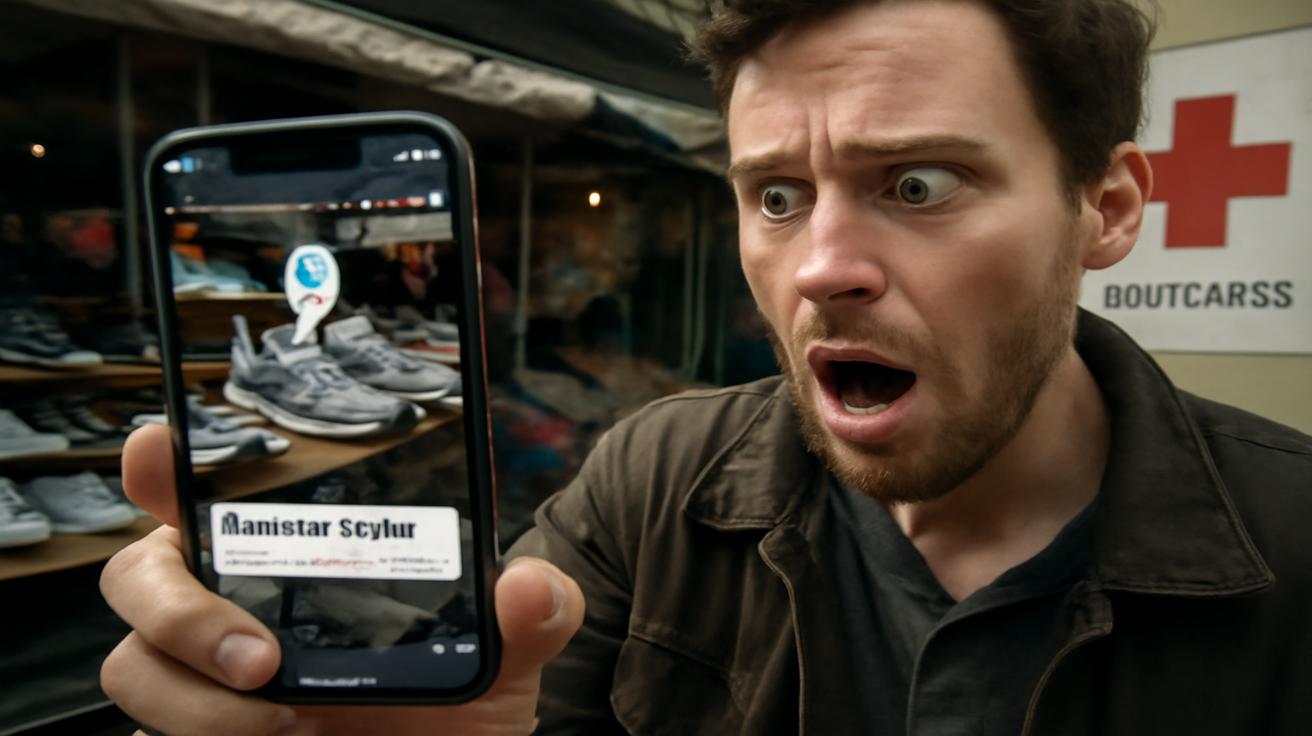
The box looked small on his kitchen table, which made what it carried feel even bigger. A pair of nearly new running shoes—white mesh, one scuff on the left toe, soles barely worn—waited beside a palm-sized silver disk. Outside, late-summer heat pressed against the windows, the kind that made the city pulse and shimmer. Inside, he peeled the backing off an adhesive pocket, slid the AirTag inside, and pressed it deep into the sneaker’s insole. It sank with a soft, secretive sound. This had started as a tiny experiment. By the end, it would pull one of the world’s most trusted humanitarian organizations into an uncomfortable light.
The Quiet Suspicion Behind a Simple Donation
He didn’t start out as an investigator. He started as a donor, the kind who saves their better clothes for “when I finally take a bag over to the charity drop-off.” The kind who believes—wants to believe—that the old T-shirts and barely used shoes will land on the feet of someone who really needs them. That some invisible thread stretches from his hallway closet right into the life of a stranger in trouble.
But over the years, he’d heard the rumors pile up like unopened mail. Stories of donation bins feeding resale markets instead of relief programs. Tales of items meant for disaster zones appearing in thrift shops a few miles away—or on online classifieds. None of it felt provable, and yet the doubt sat there, whispering.
One evening, hunched over his laptop with a lukewarm mug of tea, he read a story about people hiding tracking devices in luggage, watching their lost bags travel the world in defiance of airline “we can’t locate it” claims. His eyes kept returning to one line: “The tag doesn’t lie; it just pings.” The idea arrived quietly then, slipping in around his frustration and curiosity. If you could track a suitcase, why not track a donation?
He chose the Red Cross almost instinctively. It was familiar, almost iconic—red and white boxes at blood drives, volunteers in bright vests, a logo that shows up on the news whenever something catastrophic happens. If there was any organization that should be beyond suspicion, it was this one. And maybe, he thought, this little experiment would prove once and for all that his skepticism was misplaced, that the system worked the way the website photos suggested: clean, linear, virtuous.
The sneakers had been a gift, worn a handful of times before he admitted they just didn’t fit right. Perfect for someone who needed sturdy shoes more than he needed a third pair in the closet. He cleaned them, removed the original insole, and pressed the AirTag inside a slim pouch he’d ordered just for this. The insole went back in with a gentle curve of foam. When he slipped a hand inside afterward, he couldn’t feel anything unusual. It was just a shoe again.
He named the device in his phone: “RedCrossSneakers.” The words glowed benignly on the screen. Then he sealed the box, wrote the address of a widely advertised Red Cross collection point, and walked it down the block to the drop-off center—a folding table under a canopy, flanked by volunteers amid stacks of cardboard.
The Journey Begins—and Takes a Strange Turn
The volunteer who took the box smiled the way people do when they’ve been on their feet too long but still want to be kind. “These look great,” she said after a quick peek. He nodded, mumbled something about hoping they’d help someone, and walked away faster than he meant to, a small knot of guilt in his chest. He hadn’t told her. He hadn’t told anyone. But then again, he thought, you don’t warn a thermometer that it’s about to be placed under someone’s tongue. You just ask it to tell the truth.
By the time he reached home, the AirTag had already pinged: still at the donation table, bouncing around within a small cluster of devices on his map—phones, smartwatches, the invisible hum of the city’s connected life. Through the evening, he checked half-distractedly, pausing between emails and a streaming show. The dot stayed still.
It moved the next morning.
The sneakers traveled first to a local warehouse, an address that made sense when he zoomed in on the satellite view: a long, low building with roll-up doors and palettes stacked like giant Lego bricks around the loading bays. He imagined the box sliding along a conveyor belt, passing under fluorescent lights, scanned by handheld devices wielded by people on tight schedules. Somewhere in there, he wanted to believe, someone would sort: disaster relief shipment, community outreach, local support.
The AirTag stayed in that warehouse for three days. It didn’t worry him at first. Logistics take time. Trucks don’t run on hope; they run on fuel and timetables and paperwork. Still, by the fourth day, curiosity had fully settled in. On the sixth day, the dot blinked into motion again, leaving the warehouse and heading—of all directions—toward the outskirts of an industrial district he’d never visited.
It stopped behind a chain-link fence, in a lot filled not with relief trucks but with unmarked cargo vans and a scattering of parked cars. The building’s name on the map was unfamiliar. A few more taps showed its business category: “Textile and clothing wholesaler.” He stared at the description for a long minute.
When Relief, Resale, and Reality Collide
There is a particular feeling when your assumptions start to fray. It doesn’t arrive all at once, like a plot twist in a movie. It seeps in through the cracks of what you thought you knew.
He zoomed closer. A corrugated metal roof, a patch of gravel. No banners announcing humanitarian missions, no volunteers in bright vests. He checked again that he hadn’t misread the marker. The address on his screen did not match anything on the Red Cross donation flyers he’d seen around town. The AirTag, for all its simplicity, was extremely clear: the sneakers were here, not at a shelter, not on their way to survivors of a storm or a fire.
At first, he tried to give it the benefit of the doubt. Maybe this wholesaler worked with charities, offering bulk processing. Maybe the map was slightly off. Maybe, maybe, maybe. The word repeated like a metronome as he refreshed the app, as if repetition could weld trust and data back together.
Curiosity edged into something sharper. On the eighth day, the sneakers moved again, a slow crawl across town to a different address—this time, unmistakably, a secondhand clothing store. A single-location shop, the kind with overflowing racks and handwritten sale signs in the window. He suddenly saw the sneakers, perched on a shelf with a paper tag looped through the laces, waiting for someone to buy them with a handful of crumpled bills.
He could have left it there, filed under “disappointing but not shocking” and moved on. But the Red Cross name meant something. Its iconic promises, its bold statements about transparency and humanitarian mission—those weren’t abstract slogans. They were the reason people set up blood drives in school gyms, the reason they mailed checks after hurricanes, the reason he had chosen that particular logo when he boxed the sneakers.
Instead of letting the notification history fade, he took screenshots. A simple breadcrumb trail: drop-off point, warehouse, wholesaler, resale shop. A four-step transformation of “donation for people in crisis” into “commodity in a commercial chain.”
The AirTag Meets the Red Cross
His email to the organization started politely. He described the donation, the AirTag, the route. He attached the screenshots and asked, as plainly as he could: “Can you explain how my donated sneakers ended up at a clothing wholesaler and then a thrift shop, rather than being distributed directly to people in need?”
He didn’t expect a quick answer. Large organizations move slowly, like ships turning in shallow water. Still, the reply arrived within a week, addressed formally and threaded through with the kind of careful language that feels both professional and deeply rehearsed.
First, there were the thank-yous—for his generosity, for his concern, for his engagement. Then came the explanation.
Not all donated goods, the email said, can be used directly in disaster zones or specific relief efforts. Storage space is limited; needs are highly variable. Managing mountains of donated items can actually slow down emergency response. In many cases, it is more efficient and effective, the organization wrote, to convert in-kind donations like clothing and shoes into cash by selling them to textile recyclers or wholesalers. Those funds, they emphasized, support core Red Cross programs: shelter, food, medical care, long-term recovery.
Reading the response, he found himself caught between understanding and discomfort. The logic was there. Shipping a random assortment of used shoes across continents is expensive and often impractical. Humanitarian logistics experts have been warning for years that well-intentioned but poorly targeted donations can clog supply chains—those heaps of winter coats that arrive in tropical disaster zones, or high heels in earthquake camps.
But there was also what the email did not say. Nowhere in the message—or on the general donation literature he’d seen—had the Red Cross clearly stated: “Some of your donated goods will likely be sold on the secondary market to fund our operations.” The public image leaned heavily on direct aid, on images of blankets, meals, and care packages pulled straight from the bins of generosity to the hands of survivors.
What Transparency Really Feels Like
He read the email again, this time as a story rather than a statement. On one side stood the donor, looking at his old sneakers and imagining them on the feet of a man standing in a flooded street or a woman walking through the hallway of a temporary shelter. On the other side stood the organization, grappling with budgets and warehouses and the brutal arithmetic of disaster response.
Between them lay a gap. Not of values, maybe, but of narrative.
The AirTag had illuminated that gap in a way that policy documents rarely can. Each ping on his phone translated the institutional reality into something tangible, almost intimate. The route told him: your sneakers became inventory, then commodity, then merchandise. The organization’s explanation told him: and that’s how we turned them into cash to keep helping, even if the journey wasn’t what you pictured.
He sat with that for days, alternating between irritation and reluctant empathy. There was nothing inherently immoral about funding programs through resale. Thrift stores and textile recyclers served their own communities. Workers got paid along the way. The question that gnawed at him wasn’t, “Is this allowed?” but “Why wasn’t I told clearly from the start?”
He went back to the Red Cross website, scrolling through donation pages. There were lists of items requested, broad but non-specific promises about helping those in need, and a heavy emphasis on monetary donations as the most flexible form of support. He noticed now how often the language for physical goods was fuzzy, how rarely it spelled out destination and process the way the AirTag had.
His small experiment had revealed something he suspected many insiders already knew and accepted: that the path from donor to recipient rarely follows the straight, shining road shown in fundraising campaigns. It loops and branches, moving through warehouses, contracts, and ledgers. Sometimes, his sneakers whispered from their digital trail, it even passes through a price tag.
A Data Point in a Larger Pattern
When he finally shared his story—first with friends, then on a local forum, and eventually with a small community of tech-savvy donors—it landed in a world already primed with similar unease. Others had tracked suitcases, moving boxes, even lost pets. A few had quietly slipped trackers into clothing and furniture destined for other charities. Some routes ended at shelters and community centers, just as the donors had hoped. Others joined his sneakers in a parallel market of resale and recycling.
The responses to his post were a mix of indignation and weary pragmatism. “They lied,” one commenter wrote, furious that “helping people” had apparently meant “helping an organization’s budget.” Another replied, “Would you rather the stuff sit unused in a warehouse? Selling it for cash that funds nurses and cots isn’t evil.” A third voice cut across the argument: “Why is this the first time I’m hearing that donations might be sold?”
He kept thinking about that third voice. Underneath all the debate about right and wrong lay a simpler, quieter demand: tell me the truth about what will happen to the things I give you. Not the glossy version, not the camera-ready few minutes, but the full story, including the parts that run through barcodes and invoices rather than handshakes and hugs.
| Stage | What Donors Imagine | What Often Happens in Reality |
|---|---|---|
| Drop-off | Item moves quickly toward a person in crisis. | Item waits in local collection with many others. |
| Sorting | Volunteers match items directly to specific needs. | Staff assess usability, volume, and storage limits. |
| Distribution | Goods are shipped or handed straight to survivors. | Only a fraction goes to direct relief; the rest is redirected. |
| Redirection | Rarely pictured. | Surplus items are sold or recycled to generate funds. |
| Impact | Help equals goods in someone’s hands. | Help may be indirect: cash from resale funds other programs. |
The Red Cross, for its part, responded again when he pressed the issue of disclosure. In their follow-up, they acknowledged that many donors imagine a more straightforward path from box to beneficiary. They explained that their public materials focus on outcomes—shelter provided, meals served, lives supported—rather than the precise mechanics behind how each pair of shoes or jacket gets translated into those outcomes.
The email included a line that lodged itself in his thoughts: “Our responsibility is to use every donation—monetary or material—in the most effective way possible, even if that looks different than what some donors envision.” It was honest, in its way. But it also skirted the heart of his concern: consent shaped by clarity.
What We Give, What We Expect, and What Comes Next
In the weeks that followed, he found his own habits shifting. For disaster relief, he began giving money directly, choosing specific funds over generic goods. When he had clothing or shoes to pass along, he started looking closer to home—mutual aid groups, local shelters, community closets where volunteers could say, with more certainty, “This will stay in this neighborhood,” or “We do resell part of this, and here’s why.”
He didn’t stop respecting the Red Cross. He did stop idealizing it.
The AirTag, long since removed from the sneakers—he eventually walked into that thrift store, found them there, and bought them back partly out of sheer curiosity—sat now in a dish by his front door. Its tiny, indifferent eye had forced a massive organization to explain itself, not because of a scandal splashed across headlines, but because one person wanted to know whether his gift had landed where he believed it would.
In a way, the device had done something very human: it had asked for a story that matched the facts.
The lesson wasn’t that the Red Cross was secretly villainous, or that secondary markets were inherently wrong. It was simpler and stranger than that. In an age where we can follow a package across oceans, trace the path of our ride-share driver down to the intersection, and see our grocery delivery creep along our street in real time, the old abstractions of charity start to chafe. “Trust us” is harder to swallow when a tiny plastic circle can quietly report, “Here. This is where your trust actually went.”
He still donates. He still believes in relief and recovery and the stubborn, necessary work of showing up after disaster. But now, before he gives, he looks for organizations willing to say upfront, “Some of what you give us becomes something else before it becomes help.” He’s learned that the most humane thing a charity can offer isn’t perfectly linear logistics; it’s the dignity of an honest map.
The sneakers, for their part, have finally found their purpose. After their brief career as evidence, he gave them—this time directly—to a neighbor organizing a clothing swap for newly arrived families. No tracking. No experiment. Just a hand-to-hand exchange in a school gym that smelled faintly of crayons and floor polish, where kids ran past in socked feet and adults sifted through piles with quiet, serious faces.
He watched a teenager try the shoes on, stand, and test the bounce. A nod. They fit. In that moment, the journey of this particular pair ended far more closely to the way he’d always imagined it: simple, visible, and real. No AirTag could improve on that.
FAQ
Why would a charity like the Red Cross sell donated items instead of giving them directly to people in need?
Large organizations often receive far more physical goods than they can store, ship, or match to actual needs. Selling surplus or unsuitable items to wholesalers or recyclers can be a practical way to convert those goods into flexible funds that support shelters, food, medical supplies, and other services more efficiently than shipping random items into disaster zones.
Is it wrong for charities to resell donated goods?
Reselling donated goods is not inherently wrong, and in many cases it’s an accepted part of funding humanitarian work. The ethical concern usually centers on transparency: donors should clearly understand that resale is a possibility so they can decide whether they’re comfortable with that use of their gift.
How can I find out what happens to my donations?
You can ask organizations directly—by email, phone, or at collection points—how they handle clothing, shoes, and other items. Look for clear, specific answers about sorting, storage, resale, recycling, and direct distribution. Groups that are comfortable with their processes are usually willing to explain them in plain language.
What is the most effective way to help during disasters?
Monetary donations are often the most effective because they allow relief organizations to buy exactly what is needed, when and where it’s needed, often in bulk and close to the affected area. Physical donations can still be useful, especially when requested for specific local needs, but they are more logistically complex and can sometimes slow response efforts.
Should I stop donating used items to large organizations?
Not necessarily. Instead, decide what matters most to you. If you care primarily that your gift supports relief work in any form, donating goods that may be resold can still be meaningful. If you want items to stay in your community or go directly to individuals, consider local shelters, mutual aid groups, or community closets where distribution paths are shorter and more visible.








Leave a Comment