
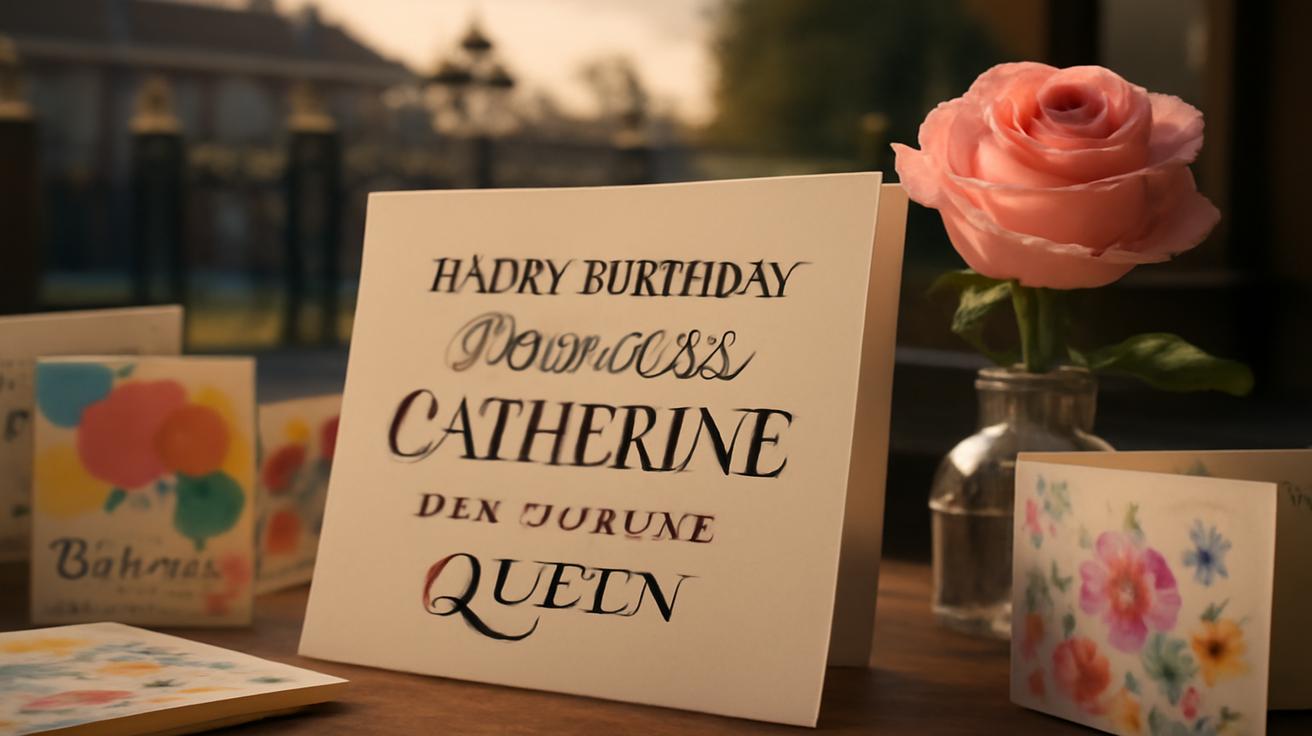
The winter light over London always feels a little softer in January, as if it, too, is pausing to take stock of the year ahead. This year, that light seems to fall with particular tenderness over Kensington and Windsor, over the quiet spaces where a woman who never quite asked for the spotlight now stands closer than ever to the centre of it. Happy Birthday, Princess Catherine — our future queen, our reluctant modern icon, our quietly steadfast compass in a country that keeps changing around her.
A Birthday Wrapped in Public Fascination
There is a distinct hum in the air whenever her birthday comes around now — a blend of royal watchers, casual admirers, critics, and the simply curious. It feels different from the birthdays of other royals. Part of it is timing: Catherine came of age as a public figure in the age of camera phones and social media scrolls, of instantaneous reaction and relentless commentary. We have watched her walk into this life, not as a distant, untouchable princess, but as a young woman in a borrowed dress leaving a London flat, shielding her eyes from flashbulbs.
And yet, even as the world leaned closer, trying to read her like a headline, she remained oddly, intriguingly intact — composed, reserved, but never cold; poised, but never stiff. The fascination today is less about the girl-who-married-a-prince and more about the woman who will one day wear a crown, navigating motherhood, duty, and a thousand unspoken expectations with the same measured grace that has become her hallmark.
On this birthday, the public’s attention feels amplified. Every new photograph is examined for clues: How is she? Is she tired? Is she thriving? How is she carrying the weight of what’s to come? The country, and much of the world beyond it, seems intent on mapping its anxieties and hopes onto one figure who rarely complains, rarely reveals too much, but continues to show up — school run in the morning, state banquet in the evening, a carefully chosen suit and a steady smile between.
The Long Walk from Berkshire to Buckingham
To understand why this birthday feels so momentous, you have to rewind to a smaller, quieter England. Think of the lanes of Berkshire, hedgerows heavy with summer, a young girl racing through fields, ponytail flicking behind her as she runs. Before the crowds, before the fascinators and formal portraits, Catherine Middleton was every inch the girl-next-door — except, crucially, she never quite stayed next door.
In university halls and on windswept Scottish hills at St Andrews, she began a transformation that played out in real time. One moment, she was “Kate,” the girlfriend in boot-cut jeans and a university hoodie, lugging shopping bags back to a shared flat. The next, she was a silhouette on the front page, captured at fashion shows and rugby matches, headlines crowded around her like so many unanswered questions. Would she stay? Would he propose? Could she possibly want this kind of life?
To most of us, the answer would have been an easy no. But Catherine’s yes, when it finally came, was both startling and steady. The engagement photos told their own story: two people who looked, quite simply, like they liked each other. There was romance, of course — the sapphire ring catching the light — but there was also the faint suggestion of something else: partnership, patience, and a kind of quiet strategic courage. She seemed to understand, even then, that this life would ask everything of her.
Looking back now, that university girl jogging across a misty Scottish quad seems worlds away from the woman standing on the Buckingham Palace balcony in jewel-toned gowns. Yet the connect-the-dots line between them is clearer than we think. The same steadiness, the same reserve, the same willingness to listen more than she speaks — all of it was there long before the tiaras.
The Making of a Modern Consort
Over the years, Catherine has undertaken a kind of soft revolution — not through sweeping speeches or bold public clashes, but through persistence and focus. There is a quiet tension in watching her work: a princess in tailored coat dresses stepping into school halls that smell faintly of poster paint and floor polish, sitting cross-legged with toddlers, talking to exhausted parents and teachers about something that rarely makes front-page news: early childhood.
In a world that often demands immediacy and spectacle, her chosen cause is almost stubbornly long-term. Early years work doesn’t yield quick political wins or viral soundbites; its results are measured in decades, in the trajectory of a single child who feels seen and supported. Catherine keeps going back to this space, like a gardener returning to the same patch of soil, trusting that one day the quiet work will show.
Yet even as she zeroes in on early childhood development, she inhabits all the other roles required of her with a kind of layered ease. One day she is at a hospital ward, mask on, eyes crinkling as she listens to nurses describe the long nights. The next, she is resplendent in heirloom jewels at a state banquet, the embodiment of continuity and tradition. Later, she is back in trainers at a charity sports day, laughing as a gust of wind tries to steal her ponytail.
The contrast is not just visual; it is emotional. In a single week she can carry the grief of a nation at a remembrance service and the nervous excitement of a child launching a school project. The public watches this with a fascination that goes beyond fashion and formality. It is the puzzle of a woman who has become the still point in a spinning royal world — calm, unhurried, impossibly consistent.
| Aspect | Early Years as Duchess | Today, as Future Queen |
|---|---|---|
| Public Image | “Commoner turned princess,” fashion fascination, shyness in public speaking. | Grounded stateswoman-in-waiting, confident speeches, trusted presence in national moments. |
| Primary Focus | Broad charity support, learning the ropes of royal duty. | Strategic emphasis on early childhood, mental health, and family well-being. |
| Role in the Family | Newlywed duchess, supporting Prince William’s path. | Anchor for a young royal core, visible mother of a future king. |
| Public Engagement Style | Carefully choreographed, relatively infrequent appearances. | More relaxed, hands-on visits; comfortable leading initiatives and conversations. |
Life Under the Magnifying Glass
“Unprecedented public fascination” sounds clinical, almost academic, until you remember that we are talking about a real person’s daily existence. Imagine stepping outside knowing that every angle of your posture, every flick of your hair, every faint crease of concern near your eyes might be frozen, zoomed in, debated. The dress you choose is no longer just a dress; it is a message. The way you comfort your child on the palace balcony might become a looping social media clip, captioned and recaptioned by people who have never heard your unguarded laugh.
Catherine has grown into this reality in front of us. Early on, her shyness at the microphone was evident — those slight hesitations, the careful adherence to prepared notes. Over the years, that changed. She didn’t morph into a theatrical orator, but rather into a thoughtful, measured speaker who knows when to pause, when to look up, when to strip a sentence back to its essentials. The fascination followed every step: analysts commented on her body language, stylists decoded her wardrobe, commentators poured over the subtext of every speech.
It would have been easy to harden under that glare, to become either brittle or performative. Instead, Catherine chose a narrower, more difficult path: she remained available but not overexposed, engaged but not performative. There are no spontaneous, chaotic livestreams from behind palace walls, no oversharing memoirs. She lets the public see just enough to trust her — a hand guiding Prince Louis’s shoulders, a conspiratorial grin shared with Princess Charlotte, a sidelong glance with William that speaks of private jokes — but not enough to devour her.
In an age that demands total access and instant authenticity, this restraint is almost radical. It is also, perhaps, why the fascination intensifies. We are not used to not knowing everything. The gaps in what she shares create their own gravitational pull.
The Princess, the Mother, the Quiet Center
Birthdays, especially for public figures, can feel like staged performances. But it’s easy to imagine Catherine’s ideal celebration as something far more ordinary: a breakfast table strewn with cereal bowls and handmade cards, the slightly lopsided drawings of crowns and castles from three children still half in their pyjamas. Somewhere, there’s likely a cake — perhaps a bit wonky at the edges, because busy mothers, even royal ones, know that “good enough” tastes just as sweet as perfection.
Her motherhood has been one of the most humanizing parts of her story. We have watched her crouch down to eye level with her children on the palace balcony, smoothing a stray lock of hair, correcting a grip on a tiny flag. We’ve seen those moments where she is less “Her Royal Highness” and more “Mum,” whispering a quick word to calm an overexcited child, or laughing helplessly when a small hand waves a bit too enthusiastically at a solemn occasion.
This is not the motherhood of curated, filtered perfection; it is the real, slightly chaotic version that millions of parents recognize. The school runs in trainers and ponytail, the small scoldings and gentle reassurances, the juggling of diaries and childcare and duty. The difference is that her version unfolds with the entire world watching, narrating, forming opinions.
And yet, through all that scrutiny, there is a persistent sense of normalcy at the edges. The family photographs in countryside fields, the muddy boots, the stories of baking with the children — they tether her, and by extension the monarchy, to something recognizably human. Her birthday, then, becomes not just a royal milestone, but a marker in the life of a working mother who is also, improbably, a future queen.
Tradition, Transformation, and the Crown Ahead
The idea of Queen Catherine, once an abstract, distant notion, is starting to feel real. You can see it in the subtle shifts: the more formal portraits, the increased weight of the jewels she wears at state functions, the growing confidence in her solo engagements. There is a sense that she is rehearsing not theatrics, but depth — stepping into the long shadow of queens consort before her while maintaining a distinctly 21st-century sensibility.
She will not rule in her own right as Elizabeth II did, but the role of consort has always held its own quiet power. It is the power of influence and example, of soft diplomacy and human connection. It is also the power of symbolism: what it means to see a woman who began life far from palaces now standing at the heart of an ancient institution, unflustered, unhurried, a bridge between centuries.
Catherine’s brand of modernity is not loud or flashy. It is there in the way she repeats outfits without apology, in her focus on mental health and early development, in the way she listens more than she speaks on visits. It is in the careful balance between duty and warmth, between privacy and presence. As the monarchy navigates a world that often questions its relevance, her steady evolution may prove one of its quietest but strongest assets.
On this birthday, the weight of what lies ahead is impossible to ignore. There will be more scrutiny, more expectation, more ceremonial layers added to her life. But if the past years are any indication, she will continue to move forward as she always has: one thoughtful step at a time, shoulders relaxed, eyes level, feet firmly on the ground, even when the world around her feels like it’s spinning faster than ever.
Happy Birthday, in the Soft Winter Light
Somewhere behind palace walls, the day itself is probably a patchwork of the ordinary and the extraordinary. There may be formal photographs, a quiet lunch, a small moment on a balcony where the cold air bites her cheeks just as it does everyone else’s. Perhaps later there is a firelit room, a circle of family voices, the gentle chaos of wrapping paper and laughter.
Outside, the country watches from bus stops and living rooms, from scrolling phones on morning commutes. Some will raise a glass; others will simply glance at a photograph in passing, noting a new dress or a familiar smile. But whether with deep affection, casual curiosity, or even scepticism, the gaze rests on her all the same.
Happy Birthday, Princess Catherine — to the girl who ran across Berkshire fields and the woman who now walks, unhurried, towards a throne she will never sit on but will help uphold. To the mother who juggles packed lunches with palace receptions. To the princess who rarely offers us drama, but consistently offers us something rarer: steadiness.
In this soft winter light, between the old year and the new, she stands as both a mirror and a promise — reflecting a country still working out who it wants to be, and quietly promising that, however noisy the world becomes, there will be at least one figure at the centre of it all who knows the value of patience, of persistence, and of showing up with grace.
Frequently Asked Questions
Why is there so much public fascination with Princess Catherine?
The fascination stems from the way her life bridges the ordinary and the extraordinary. She entered the royal family from a non-aristocratic background, grew up under intense media scrutiny, and has gradually become a central, stabilizing figure in the monarchy. Her blend of relatability, reserve, and growing authority creates an ongoing story people feel invested in.
How has Princess Catherine’s role changed over the years?
She began as a new duchess learning royal protocol and supporting a wide range of charities. Over time she has sharpened her focus, especially on early childhood development and mental health, taken on more prominent solo engagements, and become a key representative of the Crown at national and international events. Her role now clearly reflects preparation for her future as queen consort.
What causes does Princess Catherine focus on most?
Her primary emphasis is on the early years of childhood, from pregnancy to age five, and how those years shape long-term mental and physical health. She also supports broader mental health work, family support initiatives, and projects encouraging outdoor activity and community connection for young people.
How does she balance public duty with being a mother?
From what is visible, she and Prince William prioritize as normal a childhood as possible for their children, fitting royal duties around school terms and family routines. You often see her doing school runs, scheduling engagements nearby, and protecting the children’s private time while still involving them gradually in public life.
What kind of queen consort is Princess Catherine expected to be?
If her current trajectory continues, she is likely to be a thoughtful, steady queen consort, emphasizing long-term social issues over quick wins, using her platform for quiet but sustained advocacy, and embodying a modern, more relatable image of royal life while still respecting tradition and formality.







Leave a Comment