
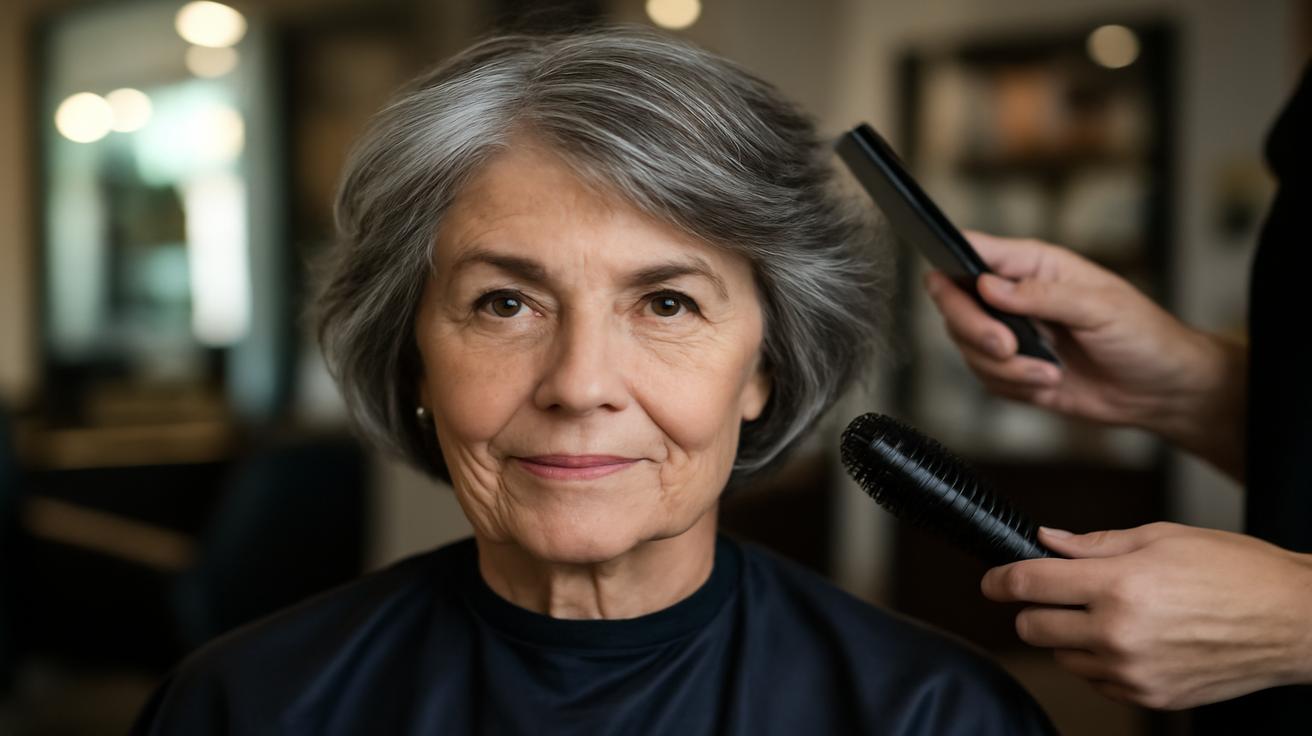
The woman in the salon chair was somewhere north of sixty, somewhere south of admitting it. Her silver-brown hair spilled down the cape as the stylist circled her like a hawk, comb poised. Around them, the salon hummed with the familiar soundtrack of blow dryers, soft gossip, and the rustle of fashion magazines promising “The One Cut That Takes Ten Years Off.” The woman’s voice was light but carried something sharper underneath. “Nothing too… old,” she said. “But nothing that screams I’m trying to be 30 either.”
The stylist laughed politely, but you could see it in the mirror: that tiny pause when the word “youthful” drifts into the room and suddenly everyone is pretending it’s just about hair. Past sixty, every snip can feel like a decision about how visible you’re allowed to be. And in that space, between the cape and the mirror, a quiet battle plays out—between cuts marketed as “fresh” and the fear of looking like you’re fighting a war that was never yours to win.
The Myth of the “Age-Defying” Haircut
Walk into almost any salon and say the phrase “I want something youthful,” and stylists will reach into a familiar grab bag of recommendations: the layered bob, the feathered pixie, the soft fringe, the chin-length shag. These cuts are treated almost like prescription medicine. Got fine hair? Try this. Worried about your jawline? Try that. Terrified of seeming “old”? Don’t worry, we have a look for that, too.
Let’s be honest: the hair industry has learned to weaponize age. Ads show women “over 50” tossing glossy waves like they’re about to sprint onto a beach with a surfboard. Stylists whisper the magic words—“lifts your face,” “softens lines,” “takes ten years off”—and suddenly you’re no longer getting a haircut; you’re negotiating with time itself.
But if you listen to women actually wearing those cuts, you hear something very different. Some love their so-called age-defying styles. Others quietly call them what they feel like: a costume. A mask that says, “Don’t worry, I’m not really this old.” And that’s where this brutal ranking begins—not with which cuts are technically “flattering,” but with a sharper question: which ones honor your face, your years, and your life… and which ones just try to erase them?
A Brutal Ranking: From Trying-Too-Hard to Effortlessly Alive
7. The Helmet Bob: When Polished Turns Plastic
From the front, the helmet bob gleams with promise: smooth, rounded, not a hair out of place. From the side, it’s stiff as armor. You’ve seen it before—hair cut to exactly one length, curled under in a uniform arc, sprayed into submission. It’s the default salon suggestion for “professional, refined, and not too long.” And on some, it can be striking.
But on many women over 60, the helmet bob does something unkind. It freezes. It strips away movement and replaces it with precision so sharp it can look like a protective shell. It’s the style that whispers, “I care, but I’m also afraid.” Afraid of frizz, of strange bends, of any sign that hair—like the woman wearing it—might have its own texture, history, and wild streak.
Stylists sometimes insist it’s “timeless” and “face-lifting.” Critics—often the women who’ve worn it for years—call it what it feels like: a cut that screams, “I still go for color appointments every four weeks and I know the name of every anti-aging product.” Polished can be beautiful. But when a style stops moving with you and starts sitting on you, it’s less youthful than it is museum-ready.
6. The Over-Feathered, Over-Foiled Layer Explosion
This cut is the spiritual descendant of 80s shampoos ads: layers on layers, bangs that swoop like they’re starring in their own storyline, and highlights so bright they could guide small aircraft. For some women, this is pure joy. For others, it becomes exhausting theater.
Stylists adore calling this “youthful” because movement and light—two things our hair naturally tends to lose over time—are built into the design. But here’s the catch: when every layer flips, and every strand is striped, the effect can go from lively to frantic. Instead of drawing attention to your eyes or your smile, it turns your whole head into a busy project that demands maintenance, time, and an arsenal of products.
This is the cut often recommended with lines like, “You’ll feel young again!” But youth isn’t just chaos and volume—it’s ease. When a hairstyle requires daily blowouts, round brushes, serums, and the stamina of a 25-year-old just to look “effortless,” it starts to feel like a costume you put on for the outside world and rip off as soon as you get home.
5. The “Baby” Bangs Compromise
Somewhere in the great salon debate about bangs and aging, an uneasy compromise was born: the short, wispy “baby” fringe. The promise is seductive—soft little bangs that skim the forehead, hide a few lines, and add “playfulness.” Done right, they truly can look airy and artistic, especially on women whose hair likes to fall forward anyway.
But stylists often overlook one key reality: mature hair doesn’t always behave like its younger self. Baby bangs on hair that’s thinning, cowlicked, or fragile can separate into accidental little spikes. Instead of looking French and nonchalant, they can veer into anxious and uneven. More than a few women over 60 quietly admit they’ve spent months trying to grow out “light, playful” bangs that made them feel like they were wearing someone else’s forehead.
There’s also a psychological twist. When bangs are added mainly to hide or distract from lines, they become less about expression and more about concealment. There’s nothing wrong with softening features—it’s your face, your choice—but when the main goal is to pretend skin hasn’t changed, you can end up in a strange space: neither fully owning your age nor fully comfortable in the disguise.
The Cuts That Start to Breathe
4. The Classic Chin-to-Shoulder Bob (With Actual Movement)
When stylists talk about “youthful” hair for women over 60, this one shows up again and again: a bob that doesn’t sit like a helmet, that allows for some wave or bend, and that doesn’t fight your texture every morning. This is where we start leaving the desperation zone and walking into something better: air.
The magic of this cut isn’t that it shaves years off your face; it’s that it stops screaming about them. It frames instead of hides. With a soft angle around the jaw, a few strategically placed layers, and maybe some gentle face-framing pieces, this length can make silver strands glow or give fine, dyed hair some much-needed shape.
The danger, of course, is that stylists sometimes overdo it—too many layers, too much texturizing, too much product. But when it’s done with restraint, this bob doesn’t pretend you’re thirty. It says, “Here I am. I’m still moving.” The hair grazes your neck, swings when you turn your head, and requires just enough styling to feel intentional without becoming a full-time job.
3. The Grown-Out, Intentionally Imperfect Shag
If there’s a quiet revolution happening in hair after 60, it lives here: in the loose, gently broken-up shag that isn’t cut to death. Not the razor-thin “rockstar” shag of youth, but a softer, lived-in version that respects thinning spots and changing texture. This is a style that actually honors the way hair wants to age: a little less dense, a little more unpredictable, full of bends and surprising curves.
Women who choose this cut tend to speak about it differently. They talk about “freedom,” about not needing to blow-dry perfectly, about embracing their hair’s new wave pattern instead of flattening it into submission. A good shag uses layers not as camouflage but as a way to let hair fall into new stories—pieces that flick back at the temple, curls that gather at the nape, soft chaos around the neckline.
Does it look “youthful”? In the most honest sense, yes—because it moves. Because it reflects personality instead of panicking about age. There’s a kind of sensual bravery in saying, “My hair doesn’t have to behave. It just has to feel like mine.” That authenticity reads younger than any rigid anti-aging strategy ever could.
The Cuts That Stop Negotiating with Time
2. The Soft, Grown-Out Pixie That Refuses to Apologize
Not the spiky, over-gelled pixie that sits like wet feathers and screams, “I’m edgy! I swear!” but the softer, longer version—cropped at the nape, fuller at the crown, with enough length on top to push back, muss up, or tuck behind a glasses frame. This pixie doesn’t try to be punk or precious. It just tries to be honest.
There’s something quietly radical about cutting your hair short after 60 and not treating it as a surrender. For decades, “older women” were told short hair was simply what you did—as if long hair passed some invisible expiration date. Then came the backlash: women clung to length as proof they hadn’t slipped into invisibility.
The modern, grown-out pixie is less about rules and more about clarity. You see the face fully—its lines, its stories, its angles. You see the neck, the jaw, the shape of a life lived out loud. And the women who wear this cut and love it tend to say the same thing: “I feel lighter.” Lighter not just in ounces of hair, but in obligation. Maintenance shrinks. Drama recedes. Personality steps up.
Is it always “youthful”? Not exactly. It’s something better: it makes age irrelevant. It doesn’t ask, “How old do I look?” It asks, “Do I look like myself?” And when the answer is yes, the effect is more vibrant than any anti-wrinkle cream could ever manage.
1. The Long, Silver-True Mane (in Whatever Shape It Chooses)
At the top of this brutal ranking stands the style that both stylists and marketing teams have historically tried to talk women out of: long, natural—often silver—hair past 60. For years it was coded as letting yourself “go.” As if abandoning dye and scissors meant abandoning care. And yet, when you see a woman with a well-kept, long, silver mane walking down the street, something in you turns to look.
This isn’t about fairy-tale length or magazine perfection. It might be mid-back. It might be just below the shoulders. It might be partly wavy, partly straight, a little wild at the ends. It might be tied into a loose low bun with wisps escaping around the ears. What makes it utterly, arrestingly youthful isn’t the length itself. It’s the refusal to disguise.
Silver hair catches light in a way dyed hair often can’t. It glows under overcast skies, shimmers under streetlamps, and shifts in tone from pewter to white to soft frost depending on the day. When it’s healthy—trimmed now and then, gently conditioned, allowed to move freely—it sends a very specific message: I have not disappeared. I am not done. I am not pretending to be younger. I am simply here, as I am, and I am not hiding.
This is, ironically, the one style many stylists still label as “aging” even as strangers stop women on sidewalks to say, “Your hair is beautiful.” The disconnect lies in what we’ve been taught to fear. We were told for so long that gray equals old, and old equals less. In reality, the women who embrace their silver often look more alive—not despite the gray, but because they are no longer at war with it.
A Quick Look at Styles: Desperate vs. Alive
Here’s a compact comparison to help you see the difference between cuts that tend to feel like age-hiding armor and ones that usually read as genuinely vibrant:
| Hairstyle | How Stylists Sell It | How It Often Feels |
|---|---|---|
| Helmet Bob | “Polished, lifts the face” | Stiff, over-managed, slightly anxious |
| Heavy Layered & Foiled | “So much movement, looks younger” | High-maintenance, can feel like a costume |
| Baby Bangs | “Playful, hides forehead lines” | Tricky to style, sometimes reads as forced |
| Soft Chin-to-Shoulder Bob | “Fresh, face-framing” | Easy, modern, flattering without drama |
| Imperfect Shag | “Textured, cool, modern” | Relaxed, expressive, works with real texture |
| Soft Grown-Out Pixie | “Chic, easy, shows off features” | Liberating, confident, unapologetic |
| Long, Silver-True Hair | “Bold, statement look” | Authentic, luminous, quietly powerful |
What Stylists Don’t Always Say Out Loud
Some stylists are beautifully honest. They’ll look at your hair, your lifestyle, and your expression, then help you find something that doesn’t fight who you are. Others are still trained in a subtle, persistent bias: that the highest compliment for a woman over 60 is “You look so young!”—as if there’s nothing better you could possibly want.
That’s why you’ll hear phrases like, “We’ll soften this,” or “We’ll draw attention away from that,” far more often than, “What do you love about your face right now?” The language of fixing, hiding, minimizing is everywhere. And after decades of hearing it, it’s easy to walk into the salon already apologizing for the changes in your hair.
But there’s another way to sit in that chair. You can say: I want movement. I want ease. I want a cut that looks good on day three, not just the hour after I leave here. I want my silver to shine. I want my curls to remain curls. I want my hair to look like it belongs to a woman who has seen some things and is still very much in the game.
The most “youthful” thing you can bring into a salon after 60 is not a photo of a 28-year-old influencer. It’s a willingness to be seen as you are—and to ask for a style that supports that, instead of disguising it.
Choosing a Cut That Respects Your Life, Not Just Your Age
Forget the rankings for a moment. Forget what’s supposedly flattering for your “age group.” Stand in front of a mirror the way you might stand at the edge of the ocean: without flinching. Notice what’s really there. The curve of your neck. The way your hair falls when you do absolutely nothing to it. The texture you’ve been fighting for years. The color that keeps trying to peek through the dye.
Then ask some very simple, very radical questions:
- What’s the least I’m willing to do to my hair every morning?
- What three words do I want my hair to say about me? (Adventurous? Grounded? Elegant? Wild?)
- What part of my face do I actually love—and want to highlight?
- Am I coloring or cutting to please myself, or to calm someone else’s fears about aging?
Once you have those answers, most of the “desperate” styles fall away on their own. A helmet bob doesn’t make sense for someone who craves softness and movement. Heavy foil work feels wrong if you want low maintenance and honesty. Baby bangs look less tempting when you remember you actually like the way your forehead crinkles when you laugh.
And suddenly, the question is no longer, “How can I look younger?” It becomes, “How can my hair be in conversation with my life right now?” A soft bob that skims your shoulders as you walk the dog at sunrise. A silver shag that blows across your face as you lean out over the railing of a ferry. A pixie you can ruffle dry with your hands before biking to meet friends. Long hair you twist into a knot while you knead bread or plant tomatoes.
What looks “desperate” on a woman over 60 isn’t gray, or short, or long. It’s only this: hair that’s trying to live in a decade that’s gone, instead of the one you’re in. Hair that refuses to move, or grow, or soften. Hair that’s terrified of its own reflection.
And what looks youthful, in the truest sense of the word, is hair that is alive to the present moment—and so are you.
FAQ: Hairstyles After 60
Is there an age when women should stop having long hair?
No. There is no expiration date on length. The only real questions are: Is your hair healthy enough to be long? Does it fit your lifestyle? Does it feel like you? If the answer is yes, you can wear it as long as you like—at 30, 60, or 90.
Does short hair always make you look younger after 60?
Not necessarily. Short hair can look sharp and energetic, but if the cut is too severe, overly styled, or doesn’t suit your features, it can actually age you. The right short cut is about softness, proportion, and movement—not just losing inches.
Should I stop coloring my hair when I turn 60?
Only if you want to. Some women feel powerful with their natural silver or white, others love rich chocolate or copper tones well into their seventies and beyond. The key question is whether coloring feels like expression or obligation. If it’s the latter, it might be time to experiment with growing it out.
What’s the most low-maintenance “youthful” style for fine, thinning hair?
A soft, slightly layered bob around the jaw to collarbone is often ideal. It gives structure without needing heavy styling and can work with air-drying, light blow-drying, or a quick pass of a round brush. Avoid over-layering, which can make fine hair look even thinner.
How can I talk to my stylist about avoiding “trying-too-hard” styles?
Use clear, feeling-based language. Say things like, “I don’t want a cut that looks stiff or overly styled. I want movement and ease. I’d rather look vibrant than younger.” Bring photos of women around your age whose hair feels authentic, not just glamorous. A good stylist will listen more to your lifestyle and comfort than your birthday.






Leave a Comment