
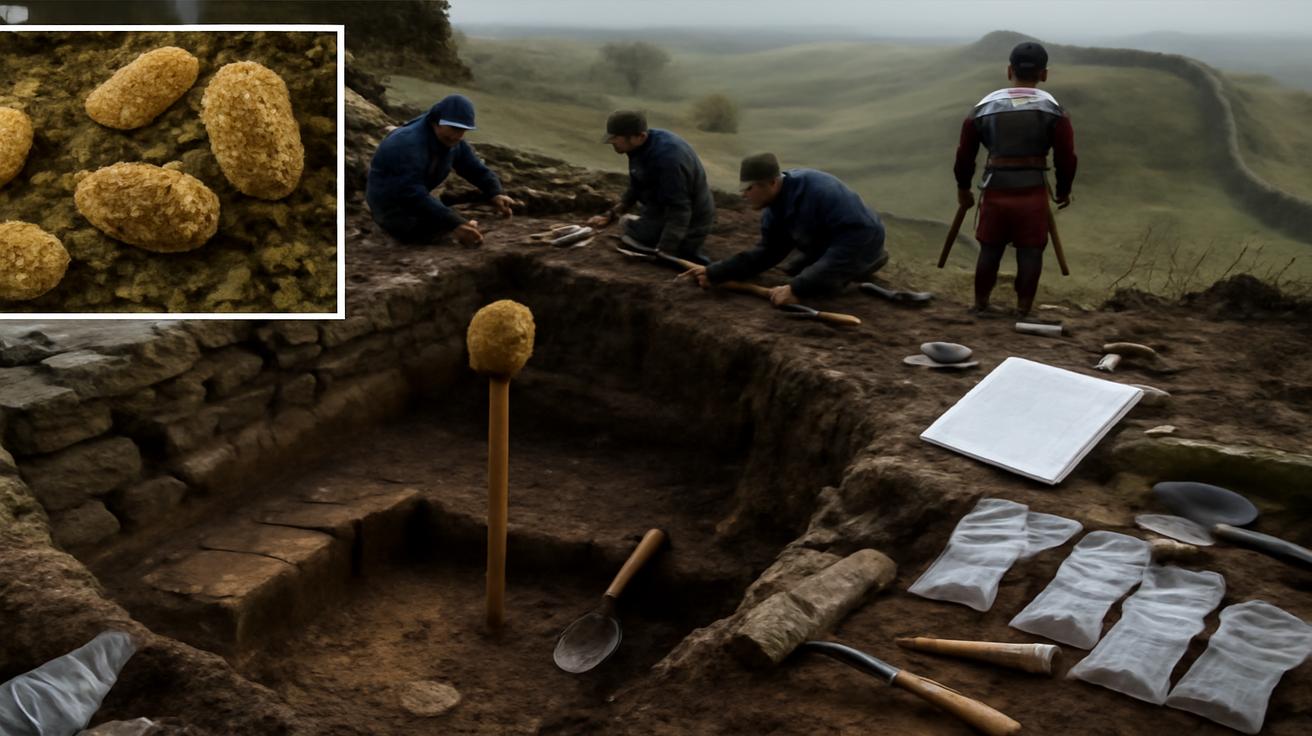
The wind hits first. It slides over the Northumberland moor like a cold hand, fingering the heather, rushing unbroken across the open ground until it slams into the stone spine of Hadrian’s Wall. You stand there—coat zipped, camera ready—staring at this famous line of rock that once sliced an empire from the unknown. It feels heroic, somehow. Clean. Simple. A wall against chaos. A story you’ve heard since childhood: disciplined legionaries, gleaming armor, sharp order in a wild land of mist and tribes and danger.
But what if that story is wrong? Not the wall itself; that’s very real under your boots. The myth wrapped around it, though—the clean heroism, the stoic soldiers, the tidy border between civilization and barbarism—that, it turns out, is full of holes. Or, more specifically, full of worms.
Cracks in the Heroic Story
For decades, guidebooks and school textbooks sold a particular image of Hadrian’s Wall: a masterpiece of Roman engineering, manned by tough, professional soldiers who brought Roman order to the unruly north. It was a frontier of empire, the last gasp of civilization before the wild unknown. You see it in oil paintings and museum dioramas—gleaming helmets, perfect formations, a wall that feels more like a monument than a workplace.
Archaeologists, though, have been quietly rewriting that story, trowelful by trowelful. Behind the tourist-friendly reconstruction at places like Housesteads or Birdoswald, behind the stone barracks and orderly forts, lies something far messier. The most devastating blows to the old heroic narrative didn’t come from swords or dismantled stones. They came from tiny, silent witnesses buried in ancient latrines.
Under microscopes in modern labs, soil samples from Roman toilets along the Wall have revealed an unexpected horror show: parasite eggs, and a lot of them. Whipworm. Roundworm. Potentially tapeworm. Tiny, oval ghosts of living things that once lodged in the guts of legionaries and camp followers. A wall we once imagined as a symbol of iron discipline now looks, up close, like a corridor of bad sanitation and constant, grinding discomfort.
Latines, Worms, and the Smell of Reality
Imagine walking through a fort along Hadrian’s Wall almost 1,900 years ago. The romanticized version smells of woodsmoke, leather, maybe a whiff of roasting meat from the commander’s kitchen. But the real version? It stinks.
Fort latrines were communal—a row of stone benches over running water, if you were lucky, or a pit oven and drainage channel. Soldiers sat side by side, no privacy, doing what everyone does and rarely likes to discuss. The latrine at Housesteads Fort, now a neat, ankle-high ruin, becomes something quite different when you remember that archaeologists scraped its sediments and found them teeming with parasite eggs.
These eggs don’t rot or vanish. They endure, fossilized in dirt that once washed from intestinal tracts. Under the microscope, they are clear, chilling evidence: those disciplined soldiers, the supposed best of the empire, were living and working in conditions that left their bodies under siege from within. Their uniforms might have been inspected. Their swords might have gleamed. Their guts were another story.
This is more than a gross detail; it’s a direct challenge to the old storytelling habit of brushing aside bodily discomfort in favor of valor. Heroism is easier to imagine when your heroes don’t spend half the night doubled over with cramps, or dealing with chronic fatigue from constant infection. Yet that’s exactly what parasites do: steal nutrients, drain energy, make you weak in a place where weakness could be fatal.
A Frontier of Mud, Not Marble
The heroic Wall of postcards and documentaries largely skips over mud. It prefers clear skies, golden light, and crisp stonework. But Hadrian’s Wall, in its working life, was drenched in rain, jostled by livestock, treaded into muck by boots and hooves. Parasites loved it.
Human and animal waste mixed in ditches and drains. Soldiers shared cramped barracks with fleas and lice. Latrines, while technically advanced for the time, still relied on water that could carry contamination from one end of the fort to another. If a soldier was infected—and many were—each visit to the latrine could help spread eggs into the soil, where they waited patiently to be swallowed again on unwashed hands or contaminated food.
The Wall, in other words, was not a hard, sterile line between order and chaos. It was a living, leaking system, where Roman ideals of cleanliness met the stubborn reality of climate, crowding, and incomplete knowledge. The legionaries weren’t immaculate guardians; they were exhausted, often sick men trapped in a cycle of their own environment.
When Heroism Has Worms
Think of a Roman soldier posted here from warmer lands—Syria, Spain, the Balkans. His orders: guard the frontier, patrol the milecastles, stand watch in cold rain that cuts through wool and leather. He eats grain rations, maybe some salted meat, maybe a rare fresh vegetable from a nearby settlement. The food is heavy, the days repetitive. And in his intestines, parasites feed quietly, turning every meal into shared calories.
He wakes up tired. Not just “bad sleep” tired, but bone-glazed weary. His belly distends a little. He’s always a little on edge, lightheaded during long watches. Maybe he assumes this is just what life on the frontier feels like. Everyone else seems the same: pale, frequently scratching, holding back some discomfort they don’t have words for.
This isn’t the way statues show him. Yet this soldier, with worms nibbling at his strength, still trudges out to the wall walk, still shoulders a heavy shield, still blows on freezing fingers while scanning the horizon for smoke or movement. He follows orders. He drills. He repairs stonework in storm and snow. His heroism, if we must use that word, is no longer the shiny, idealized version. It’s something much more human—and much harder.
We are used to thinking of the past in clean lines: Romans advanced, locals primitive; soldiers tough, civilians soft; the Wall solid, the frontier clear. Parasite evidence blurs all of that. Health, in this world, is a constant negotiation, not a given. The mighty empire can build stone walls visible from space, but it cannot fully protect its soldiers from the microscopic enemies in their own food, water, and beds.
A Wall of People, Not Postcards
Even the garrison itself was more complicated than the tidy phrase “Roman legionaries” suggests. Many of the troops here were auxiliaries—non-citizen soldiers drawn from the far-flung provinces of the empire. Batavians from the Rhine, Tungrians from what is now Belgium, Syrian archers, North African cavalry. They brought their own gods, their own cooking styles, their own microbes.
These men lived cheek by jowl with local Britons—traders, laborers, families of soldiers. They exchanged goods, stories, and inevitably germs. The Wall wasn’t just a block; it was a seam, stitching together people who might never have met without it. Parasites make this visible: their eggs show up in different layers, indicating changing diets and animal use, shifting habits and populations.
Archaeologists find not only worms but also fish tapeworms in some Roman sites in Britain, hinting that undercooked or raw freshwater fish ended up on the menu. That’s not just a parasite clue; it’s a food story, a trade story, a story of what people did to feel a bit more at home in a freezing posting far from the sunlit villas of the Mediterranean.
| Evidence Type | What It Reveals | Impact on the Hadrian’s Wall Story |
|---|---|---|
| Parasite eggs in latrine soil | High levels of intestinal infection | Soldiers were often sick, fatigued, and far from the ideal of perfect physical fitness. |
| Animal dung in fort drains | Close contact with livestock | Blurs the line between military base and working farm; adds new routes for disease. |
| Cooking waste and food scraps | Grain-heavy diets, occasional meat and fish | Diet was monotonous and not always safe, helping parasites to thrive. |
| Personal items (combs, textiles) | Lice, fleas, skin conditions | Everyday discomfort and poor hygiene challenge the polished image of Roman life. |
| Inscriptions from diverse units | Multicultural garrisons | The Wall was a melting pot, not a single “Roman” identity; disease and customs moved with people. |
The False Comfort of Clean History
The phrase “we were sold a false history” sounds like a conspiracy, but it is mostly a matter of emphasis and omission. For generations, the Wall was used as a kind of moral lesson: look at Roman discipline; look at their engineering; see how empire brings order. In the Victorian era, this made sense politically and ideologically. An empire obsessed with its own frontiers liked to imagine that its predecessors were tidy, rational, and destined to rule.
So the uncomfortable details were trimmed away. Parasites. Filth. The sheer scale of human misery required to build and maintain such a structure in an unforgiving landscape. The craving for neat stories turned Hadrian’s Wall into a grand, stone PowerPoint slide: bullet points about imperial greatness, with no footnotes about the guts of the men who patrolled it.
Modern science, more than modern politics, has blown that version open. Microscopes and chemical analyses don’t care about imperial nostalgia. They just show what’s there. And what’s there is a frontier that feels a lot less like a moral fable and a lot more like a workplace health-and-safety nightmare.
Reframing Heroism on the Edge
None of this makes the Wall less impressive. If anything, it does the opposite. Once you start to see the worms and the dirt and the incessant bodily strain, the fact that this frontier held at all—through rebellions, economic crises, and climate swings—becomes extraordinary.
Heroism, seen through this lens, isn’t shiny. It’s stubborn. It’s the endurance of men and women whose names we will never know, whose bones may lie under sheep fields, who lived with chronic infections and still showed up for duty, for trade, for family. It’s a commander who has to calculate not just how many troops he has on paper, but how many are actually fit to stand watch in a sleet storm. It’s a soldier sharing a lice-ridden blanket with a comrade because there’s no other way to stay warm.
The parasites also remind us that the Wall wasn’t protecting some spotless “civilization” from a dirty “barbarian” north. Both sides of this frontier were equally human, equally organic, equally messy. British tribes had their own health problems, their own food systems, their own forms of hygiene and healing. The idea that Roman equals clean and local equals filthy has always been an illusion. The microscope just gives that illusion less room to hide.
Walking the Wall With New Eyes
If you walk along Hadrian’s Wall today, your boots crunch on neatly maintained gravel paths. Sheep graze beyond low fences. The stones of the wall rise and fall with the hills, partly rebuilt, partly original. It’s easy to get lost in the beauty of it: the way the line of masonry frames the sky, the sense of stepping through a doorway into another time.
Try a different exercise. Stand at one of the preserved latrines and close your eyes. Imagine not the ruin but the noise: the clatter of hobnailed sandals, the slosh of water in the channel beneath, the murmur of men joking or complaining, the land itself thick with smells that don’t fit into coffee-table books.
Then imagine that somewhere, an archaeologist 1,900 years later will scoop up this muck, wash it through a sieve, and hold up your inner life on a glass slide. Your stomach aches will become data. Your fatigue becomes a bar chart in a journal article. Your very hunger, your weakness, your struggle—things that likely felt private, maybe even shameful—turn into the evidence that tears down a romantic legend.
The question isn’t whether we should mourn that legend. The question is whether we can accept a past that is no longer tidy. A Wall no longer purely heroic. A garrison no longer uniformly strong. A history that reeks a little of latrine pits and damp wool, and is, because of that, more real than ever.
Because the truth is, the heroism at Hadrian’s Wall was always under attack—from the cold, from boredom, from political decisions made hundreds of miles away, and yes, from parasites. Not the sort of enemy that wins a place in epic poetry, but one that could, quietly, do more damage than any raiding party.
In that sense, revising the story is not a betrayal of the past; it’s a restoration. Those nameless soldiers deserve better than to be remembered as marble stereotypes. They deserve to be seen as they were: human, vulnerable, sometimes sick, standing on a lonely wall at the end of the world, doing their best with what little strength they had left.
FAQs About Hadrian’s Wall and the Parasite Evidence
Did all soldiers on Hadrian’s Wall have parasites?
Not every individual would have been infected, but evidence from multiple latrine sites along the Wall suggests that intestinal parasites were widespread. The concentration and variety of parasite eggs in the soil indicate that infections were common enough to be a normal part of garrison life.
How do archaeologists know there were parasites after so many centuries?
Parasite eggs are surprisingly durable. Archaeologists collect soil samples from ancient latrines and cesspits, then process them in the lab using flotation and microscopy. Under the microscope, the distinctive shapes and sizes of eggs from different worm species can be identified, even after nearly two thousand years.
Were Roman hygiene practices worse than those of local Britons?
Not necessarily. Romans had advanced ideas about baths, running water, and drainage, but those systems did not always work perfectly on a windswept frontier. Crowded living conditions, shared latrines, and poor understanding of germ theory meant that parasites still spread easily. Local Britons had their own hygiene habits; the evidence suggests complexity, not a simple “clean Romans, dirty natives” divide.
Does the parasite evidence change how we should view Roman military strength?
It complicates the picture. On paper, units might look fully manned and formidable. In practice, a significant number of soldiers may have been weakened by chronic infections. This doesn’t erase Roman military effectiveness, but it highlights how much effort was required to maintain it in harsh conditions.
Is Hadrian’s Wall still worth visiting if the heroic story is “false”?
Absolutely—arguably more so. Understanding the grittier, more human reality behind the stones makes the site richer, not poorer. When you walk the Wall knowing that real people endured cold, sickness, and fear here, the landscape becomes more than a backdrop. It becomes a place of lives lived, not just a monument to an idealized past.





Leave a Comment