
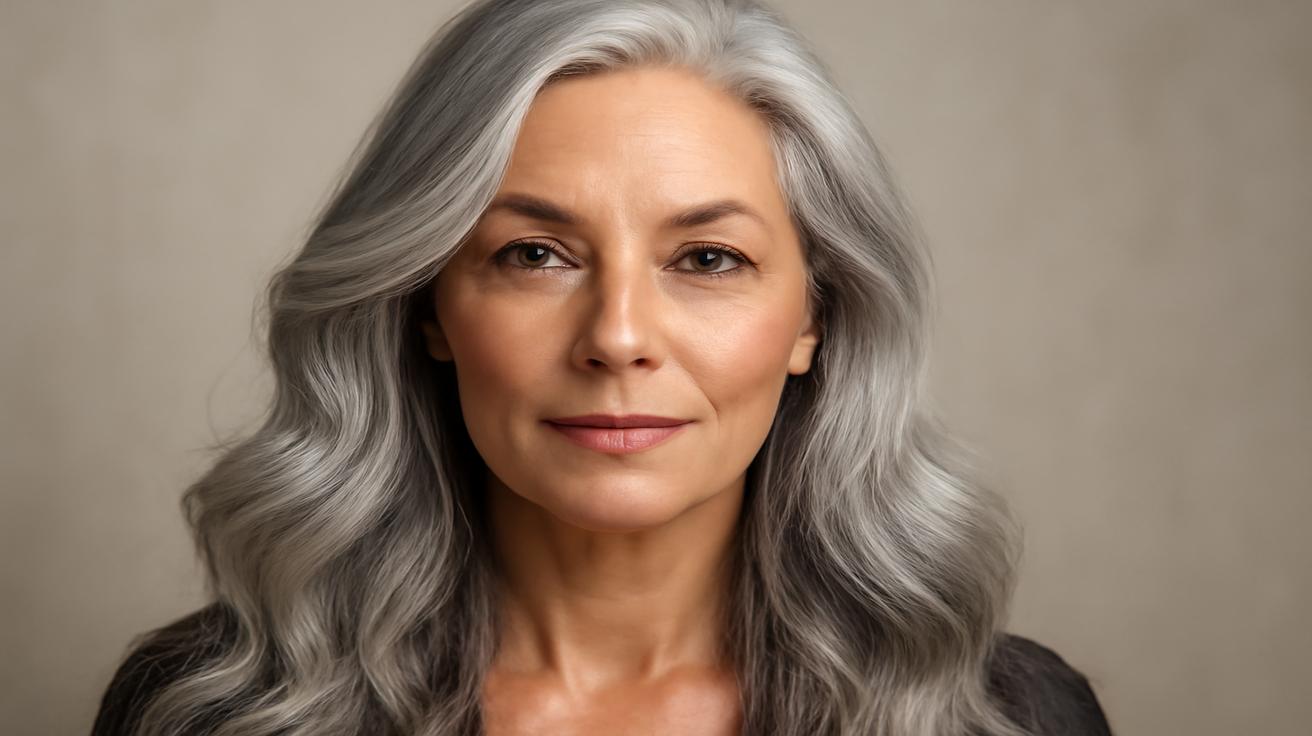
The first silver hair often arrives quietly, like a shy winter bird on a branch you’ve been looking at all your life. One morning, somewhere after 50, you catch a glint in the mirror—not the warm chestnut or deep black you’ve known for decades, but a fine thread of moonlight. Maybe you pluck it. Maybe you sigh. Maybe you lean a little closer and think, “When did this happen?” And then, slowly or all at once, the silvers multiply, until your reflection feels like a map of every laugh, worry, late night, and sunrise you’ve carried on your head. But here’s the surprising part: in the right light, with the right care, that silver doesn’t look like “giving up.” It looks like “finally becoming.” That’s where the quiet magic of “silver gloss” comes in—the color that doesn’t fight your gray, but turns it into your brightest feature.
The Quiet Revolution of Letting Hair Go Gray
Over the last decade, there’s been a slow, shimmering revolution in bathrooms and salons everywhere. Women—and more and more men—are looking at their colored roots, their appointment calendars, their shelves of half-used dye boxes, and deciding: I’m done chasing my old color. Instead of resisting every new silver strand, they’re inviting it in, asking: What if I let this happen? What if I let my hair tell the truth?
Letting your hair go gray after 50 isn’t just a grooming choice; it’s an emotional one. There’s nostalgia for the person you were at 30, grief for the color that defined your youth, and, if you’re lucky, a bracing sense of freedom. The transition can feel messy and awkward—you grow out roots, you wear hats, you experiment with cuts that don’t quite feel like you yet. But then, one day, you catch your reflection in a window instead of a bathroom mirror, and you see it in natural light: the way your gray catches the day like frost catching sunrise. It looks…beautiful. And utterly yours.
“Silver gloss” is the color language for that moment. It’s not platinum blonde or ash brown or white; it’s something softer, more dimensional. It enhances what nature is already doing, polishing the appearance of gray so it looks intentional, luminous, and modern.
What Exactly Is “Silver Gloss” – And Why Does It Love Gray Hair?
In the salon world, a gloss is like a silk robe for your hair. It’s usually a semi- or demi-permanent treatment—often sheer, sometimes lightly tinted—that adds shine, smooths the cuticle, and gently shifts tone without committing you to full-on permanent color. A “silver gloss” is specifically designed to work with gray, white, or salt-and-pepper hair, nudging it toward a polished, chic, silvery sheen instead of the dull, yellowish cast that can creep in over time.
As we age, hair goes through three big changes: it loses pigment, it gets drier, and it often gets coarser. Gray strands tend to be more porous and more stubborn; they can look wiry or matte, especially if sun exposure, hard water, or old dye residue has left behind brassy tones. A silver gloss is like a tiny filter for your hair: it quietly cancels out warmth, enhances cooler reflections, and gives strands a “wet pebble in a stream” shine instead of a “dusty cotton” finish.
What makes it ideal after 50 is that it doesn’t try to drag you backward. Instead of forcing your hair to pretend it’s still naturally chestnut or auburn, it recognizes that silver is already there and asks: how can we make this look expensive, vibrant, and alive? Rather than repainting the whole canvas, a silver gloss refines the existing picture, like adjusting the lighting on a photograph so the subject finally looks the way you remember them.
The Emotional Shift: From “Covering Up” to “Showing Off”
There’s a subtle but powerful emotional alchemy in the word “gloss.” Dyes are about hiding. Gloss is about revealing. When you sit in a salon chair and ask for silver gloss, you’re not saying, “Erase this gray.” You’re saying, “Make this gray worthy of being seen.” That’s a radical act in a culture that still whispers that youth is the only kind of beauty worth having.
Many people who’ve embraced gray describe a similar moment: their first real compliment. A stranger in a café saying, “Your hair is gorgeous.” A niece telling them, “You look like a silver fox.” A friend admitting, “I wish I had the courage to do what you did.” It’s in those moments that gray hair shifts from a perceived deficit into a signature, like a favorite leather jacket or pair of old boots that only get better with time.
How Silver Gloss Transforms Natural Gray
Stand under a soft lamp and look closely at gray hair. It’s rarely just one color. You’ll see white strands, smoky ones, almost transparent ones, some lingering darker hairs that weave through like notes on a staff. Natural gray has its own melody, but it can sound a bit off-key if texture and tone are out of balance. Silver gloss steps in like a quiet conductor, smoothing the roughest notes and bringing out the shimmering chorus.
Most silver gloss formulas are built to do three main things:
- Neutralize yellow and brass. Pollution, UV light, product buildup, and even tap water can turn gray hair slightly yellow over time. A cool-toned gloss gently counteracts that, restoring a cleaner, truer shade of silver.
- Add shine and slip. Gloss closes down the outer layer of the hair, making it smoother. Light can then bounce off it instead of being absorbed in the rough spots, giving that mirror-like gleam.
- Softly refine your overall color. Whether you’re more salt-and-pepper or nearly white, a silver gloss can even things out so that your gray looks unified without erasing its natural variation.
The result is not a flat, chilly silver helmet. Done right, it’s soft, dimensional, and touchable—like the underside of a dove’s wing or the inside of a seashell. In motion, silver-glossed hair catches every stray bit of light: a streetlamp on an evening walk, the sun through kitchen curtains, the glow of your phone screen at midnight.
Real-Life Moments: How It Feels to Wear Your Silver
Imagine stepping into a late afternoon, the sky rinsed in the pale gold before sunset. You’re meeting a friend you haven’t seen in years. As you cross the street, you catch your reflection in a car window. The person looking back at you is older, undeniably—but their hair looks like molten metal, deep silver with little flashes of white at the temples. It doesn’t look tired. It looks confident, even a little mischievous, like someone who knows where they’ve been and doesn’t need to prove themselves anymore.
Later, in a café, your friend leans in and says, “You know, I was nervous about seeing you, because I’ve been freaking out about my own gray. But you…you make it look like an upgrade.” You laugh, and at that moment, the years between you flatten. Your hair, once something to be fixed, has become something quietly liberating—for you, and maybe for the people watching you.
Choosing the Right Shade and Routine for Your “Silver Gloss”
Not all silver is created equal. On one head, icy steel can look elegant and luminous; on another, it might feel a little harsh or draining. The magic of “silver gloss” is that it can be fine-tuned to your skin tone, eye color, and personal style, rather than imposing a one-size-fits-all gray.
Here’s a simple way to think about it when you talk to a stylist—or even when you’re selecting an at-home gloss designed for gray hair:
| If you are… | Silver gloss tone that often flatters | How it looks in real life |
|---|---|---|
| Warm or golden-toned skin | Soft pearl, champagne silver, light smoke | Gentle glow that doesn’t wash you out; a whisper of warmth under cool shine. |
| Cool or pink-toned skin | Icy silver, blue-based steel, frosted gray | Sharp, clean, modern; makes eyes and features stand out like they’ve been subtly highlighted. |
| Neutral or olive skin | Neutral silver, soft graphite, muted pewter | Balanced, understated chic; looks expensive and effortless, like “naturally perfect” gray. |
This isn’t a rulebook so much as a compass. Your personality matters as much as your undertone. If you’ve always loved bold lipstick, sharp tailoring, statement jewelry, a more dramatic icy silver might feel exactly right. If you live in linen, love bare faces and soft colors, a muted pearl or pewter will likely blend more naturally into your life.
Caring for Your Silver: Gentle Rituals, Big Impact
Once your gray is enhanced with a silver gloss, your daily habits quietly decide how long that glow lasts. The texture of aging hair asks for a little more tenderness than it used to:
- Use sulfate-free, color-friendly shampoos. These help preserve your gloss and prevent dryness, so your silver looks silky instead of frizzy.
- Introduce a violet or silver shampoo sparingly. Once a week—or even once every two—is often enough to keep brass at bay without over-toning into purpley dullness.
- Condition like it matters. Because it does. Gray hair tends to be thirsty; a good conditioner or lightweight mask will keep it soft, supple, and reflective.
- Protect from heat and sun. UV exposure can yellow gray hair. A hat, scarf, or UV-protectant spray can keep your shade cool and bright.
Daily care becomes less about disguising your hair and more about respecting it—like tending a favorite plant you finally understand how to keep alive. There’s satisfaction in that, a quiet sense of collaboration with your own body.
The Style Alchemy: Cut, Texture, and the Story Your Silver Tells
Hair color on its own is a voice; the haircut is the grammar. A silver gloss may make your gray luminous, but the way it’s cut and styled tells the rest of the story. After 50, many of us want our hair to say something like: “I’ve lived, I’ve learned, I still like to surprise people.”
A well-chosen cut can sharpen that message. A short, cropped silver pixie can look electric—sharp, confident, a little rebellious. A shoulder-length bob with soft, beveled ends can make gray feel Parisian, like it belongs in a black turtleneck and red lipstick. Long, wavy silver can look romantic and free-spirited, the hair of someone who reads thick novels and still says yes to last-minute road trips.
Texture matters just as much as length. Soft waves catch light along their curves, offering multiple tones of silver in a single lock. Straight, sleek gray can look ultra-modern, a clean sheet of metal. Curls, especially when hydrated, can look like spun glass, each ringlet reflecting a slightly different shade.
Styling Without the Struggle
One unsung benefit of embracing silver with a gloss is that styling often becomes simpler. You no longer fight to hide roots or coordinate color with every brow pencil and foundation. Your silver becomes a neutral base—like a favorite gray sweater—that goes with everything.
A few drops of shine serum or a light cream can define texture without weighing hair down. Air-drying becomes more forgiving when your hair’s natural pattern is supported instead of flattened. The goal stops being “perfect hair” and becomes “alive hair”—hair that moves, reflects light, tells a story.
Why “Silver Gloss” Feels So Right After 50
There’s something profoundly right about silver hair appearing just as life begins to shift into its more reflective chapters. Your 50s and beyond often bring a different rhythm: fewer emergencies, more perspective, a clearer sense of what truly matters. The impatience you might feel toward roots and dye can mirror a growing impatience with pretense in general.
“Silver gloss” fits this season because it doesn’t ask you to erase your age. It allows you to stand in it—clearly, beautifully—while still honoring your desire to look like someone who takes care of themselves. It balances truth and aesthetics, honesty and artistry.
There is a particular kind of power in walking into a room with hair that doesn’t apologize. Fully silver, softly glinting under overhead lights, it announces: I have lived long enough for my body to change, and I am not at war with it. That kind of peace reads from across the room.
It also ripples forward. Younger people notice when someone older embraces themselves without bitterness. Children and grandchildren see that gray isn’t a curtain drawing down but a new backdrop being hung up. The story shifts: silver hair isn’t the end of beauty; it’s just a different, deeper shade of it.
FAQ: Embracing Silver Gloss and Gray Hair After 50
Will a silver gloss make my hair permanently gray?
No. A gloss is typically semi- or demi-permanent. It enhances the gray you already have and tweaks the tone, but it fades gradually over several weeks. Your underlying natural color remains unchanged.
Can I get a silver gloss if I still have a lot of my original color?
Yes. On salt-and-pepper hair, a silver gloss can help blend the darker and lighter strands so they feel more harmonious, without fully covering the darker hair. It creates a softer, more unified overall effect.
How often should I refresh a silver gloss?
For most people, every 6–8 weeks is enough. If your hair is very porous or you wash frequently, you might prefer every 4–6 weeks. You can also alternate between in-salon glosses and at-home toning products to stretch the time.
Will silver gloss damage my hair?
Compared to permanent dye, glosses are generally much gentler. Many formulas are ammonia-free and even contain conditioning ingredients. That said, any chemical service should be balanced with good hydration and regular trims.
What if my gray hair looks yellow or dull—will gloss fix that?
In many cases, yes. A well-chosen silver gloss can neutralize yellow and restore a clean, cool tone. If the yellowing is severe from chlorine or heavy buildup, your stylist might suggest a clarifying treatment first, then a gloss.
Is silver hair aging, or can it actually make me look younger?
It depends on how it’s done. Uncared-for gray can look tired, but well-cut, glossy silver can look strikingly fresh and modern. Many people find that once their gray is intentional and luminous, they look more vibrant—and more authentically themselves—than they did with harsh, flat dye.
Can I grow out my old dye and switch to silver gloss gradually?
Absolutely. Many people transition with blending techniques—like lowlights, highlights, or partial glossing—to soften the line between dyed hair and natural gray. Over time, the artificial color is trimmed away, while silver gloss keeps your emerging gray polished and flattering.
In the end, “silver gloss” is less about a product and more about a perspective. It’s the decision to see your gray not as a problem to be solved, but as raw material for a different kind of beauty—one that reflects not just light, but every year you’ve lived to earn it.







Leave a Comment