
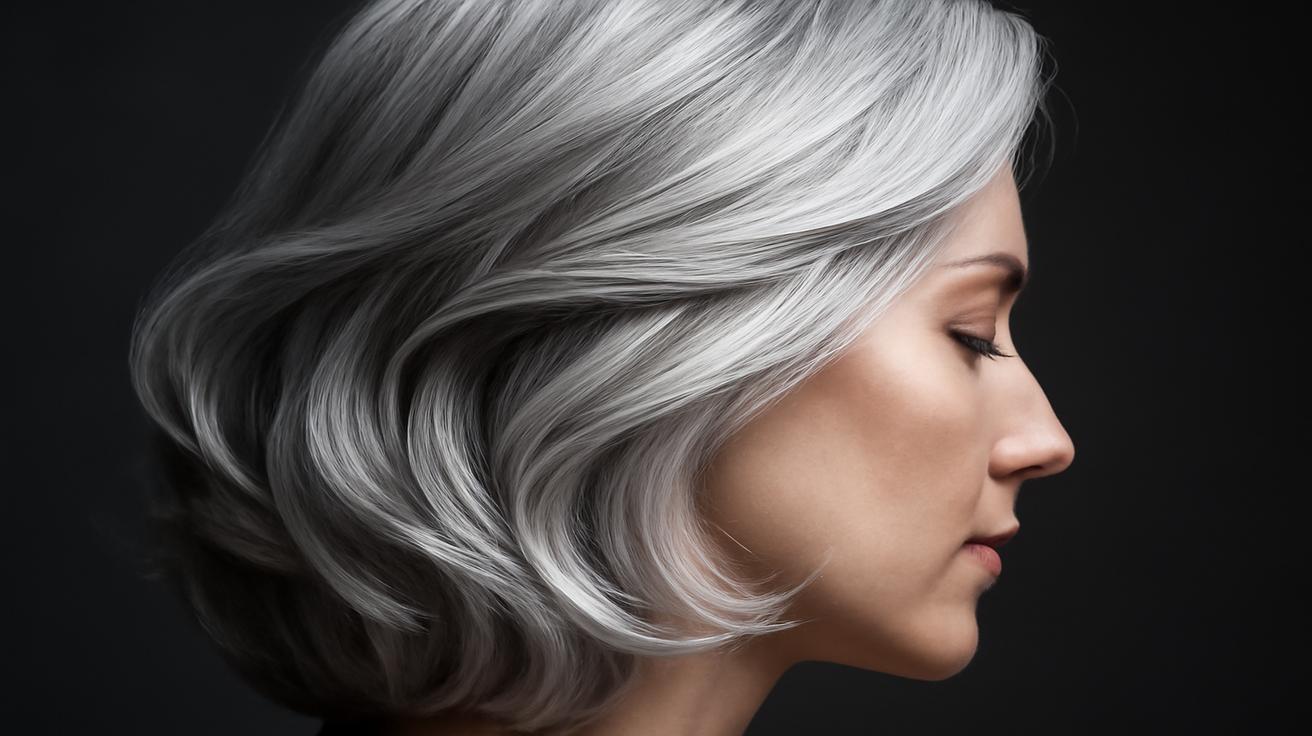
The first glint of silver usually announces itself quietly. Maybe you catch it in the bathroom mirror one rushed morning, or notice a thin, shimmering strand against your usual brown, black, or blonde while waiting at a red light. For many people, that moment happens somewhere around 50. For some, it’s earlier, for others much later, but whenever it arrives, it brings a small, private reckoning: Do I cover this up, or do I let it shine? Increasingly, the answer sounds more like, “Let it shine… but make it stunning.” And that’s where the idea of “silver gloss” comes in—not just a color, but a way of treating gray hair as something to be celebrated, polished, and enhanced, instead of hidden away.
When Gray Hair Becomes a Story, Not a Secret
By the time we reach 50, our hair has been through an entire lifetime of seasons: sunburnt summers, over-enthusiastic perms, botched box dyes, expensive salon miracles, postpartum shedding, stress thinning, and every style trend from blunt bobs to messy buns. Gray hair is simply the next chapter—but for many people, it’s the first one that feels truly honest.
Imagine a head of silver hair walking into a café. It catches the light differently than dyed hair. Every strand feels like a fine thread of frost, soft but bright. It doesn’t try to pretend. It doesn’t apologize. Instead, it tells you quietly: I’ve seen things. I’m still here. I’m still changing.
Gray hair after 50 isn’t just about pigment loss; it’s about a subtle identity shift. You look in the mirror and see someone a little softer around the edges, a little stronger in the eyes. The question is no longer, “How do I keep looking 35?” but “How do I look like the best version of who I am today?”
“Silver gloss” has become a kind of answer to that question. It’s a philosophy dressed as a hair color. Instead of hiding gray under dark dye that demands constant touch-ups and stains your pillowcases, silver gloss leans into the gray, brightening it, refining it, and turning it into a luminous feature. Think of it like polishing a stone until you reveal the pattern that was already there.
What “Silver Gloss” Really Is (And Why It Loves Age)
On paper, “silver gloss” sounds like a cosmetic term, something you’d read on the back of a box in tiny font. In reality, it’s closer to an approach to gray hair than a single formula. It’s the art of taking the varied shades of white, ash, charcoal, and pale blonde that appear when pigment disappears and nudging them toward a flattering, luminous harmony.
Natural gray hair is rarely just one color. It can harbor surprising hints of yellow, dull beige, or flat, murky tones—especially if you’ve spent years dying it darker. Sun, minerals in water, old color, and styling damage can leave gray hair with an uneven, tired look that doesn’t match the liveliness you still feel inside.
“Silver gloss” works like a soft-focus lens for your hair. It often involves translucent, toner-like treatments, gentle silver or violet-based hues, and sometimes subtle highlights or lowlights that blend the line between old color and new gray. The result isn’t harsh white or cartoonish platinum, but a soft, reflective, silvery sheen that catches natural light and gives dimension.
Most importantly, it respects the fact that hair at 50 and beyond has changed texture. The cuticles are a bit more stubborn, the strands often coarser or wirier, more prone to dryness and frizz. Silver gloss color approaches that reality with empathy. Instead of baking the hair with aggressive permanent dyes, it tends toward gentler methods that add shine and tone without beating your hair into submission.
The Science of Why Gray Needs a Little Help
Under a microscope, gray hair looks different from pigmented hair. It often has a rougher surface and fewer protective oils. That’s why it can feel both oddly coarse and strangely fragile. Light hits it differently too: instead of bouncing off a smooth, hydrated strand, it scatters, giving that sometimes dull, matte impression that people mistake for “old-looking.”
This is where silver gloss truly earns its name. Gloss treatments and silver toners smooth out that surface a bit, helping the hair shaft reflect light more evenly. Violet or blue pigments cancel out unwanted yellow, just like a good concealer neutralizes under-eye darkness. You’re not pretending you’re not gray; you’re showing gray at its best, like a well-lit photograph instead of a shadowy snapshot.
Letting Go of Dye: The Awkward Middle and How Silver Gloss Softens It
Anyone who has tried to stop coloring their hair after years of dark dye knows it can feel like a long, very public transition. Roots grow in silvery, while mid-lengths stay stubbornly brown or black. You catch sight of yourself sideways in a store window and feel like two different people glued together. This in-between phase is where many people give up and run back to the dye bottle.
Here’s where the “silver gloss mindset” changes everything. Instead of seeing the transition as a problem, you start thinking of it as a blending project, like art. Silver gloss techniques can be used strategically to bridge the contrast between your natural gray roots and your older dyed lengths, helping you grow out color gracefully.
Stylists often use sheer, cool-toned glazes over the previously colored sections, dialing down harsh warmth and nudging them closer to your natural silver. Very fine highlights or lowlights, painted in with intention, can create a soft gradient rather than a hard line. In the mirror, what you see shifts from “Oh no, my roots!” to “Oh hey, this is actually kind of pretty.”
The Emotional Shift: From “Fixing” to “Curating”
There’s a quiet but powerful emotional pivot that tends to happen somewhere along the journey. At first, the mission feels like: “How do I fix this gray hair?” But slowly, especially as the silver gloss treatments start to reveal how striking your natural tones can be, the question changes to: “How do I curate this?”
You start noticing how certain earrings sparkle more next to your silver strands, how a navy sweater makes the gray look like moonlight on the ocean, how a bold red lip feels less like costume and more like signature. Your hair is no longer a lie you’re trying to maintain; it’s a texture and color you’re styling, like you would a beautiful fabric.
| Approach | How It Treats Gray | Look & Maintenance |
|---|---|---|
| Traditional Full-Dye Color | Covers or hides gray completely | Strong regrowth lines, frequent root touch-ups |
| Going “Cold Turkey” Gray | Lets gray grow out naturally with no blending | High contrast for months, can feel awkward but low effort |
| Silver Gloss Strategy | Enhances, tones, and blends gray; respects natural pattern | Soft transitions, luminous finish, moderate maintenance |
How “Silver Gloss” Looks and Feels in Everyday Life
Picture a woman in her mid-fifties standing in front of a window, morning light spilling across her shoulders. Her hair is mostly gray now, but not the flat, tired gray that haunted her imagination when she first noticed those early strands. Instead, it’s a layered interplay of soft silver and cool, smoky tones that shift like clouds. Some strands shine almost white; others hold onto a shadow of darker pigment, giving depth. Her hair doesn’t fight gravity as hard as it used to; instead, it falls with a kind of lived-in drape, airy but intentional.
When she runs her fingers through it, it feels different from the hair she had at 30—more textured, yes, but also lighter, as if there’s less psychological weight attached. She spends less time worrying about perfectly covering roots before a work meeting. She’s no longer watching the calendar for the next emergency color appointment. Instead, every 6–8 weeks, she goes in for a gloss: a chance to refresh the tone, smooth the strands, and adjust the silver just enough to keep it looking radiant.
In conversation, people compliment her hair differently now. Not “Oh, your color looks great, who does it?” but “Your hair looks so beautiful like that. It really suits you.” The silver doesn’t age her; it matches her. It pairs with the faint laugh lines by her eyes, the confidence in her shoulders, the quiet knowledge in how she listens more than she rushes to speak.
Subtle Choices That Amplify Silver Hair
When you start leaning into silver gloss, you notice how small styling choices amplify or mute its impact:
- Haircuts with deliberate shape – A sharp bob, a long layered cut, or a gently textured pixie can make gray hair look purposeful rather than accidental.
- Soft movement over stiff styling – Loose waves, a slightly tousled blowout, or natural texture emphasize the play of light across silver strands.
- Color temperature in clothes – Cool-toned fabrics (charcoal, navy, berry, icy blue) often echo the silver, while harsh yellowish beiges can wash it out.
- Strategic makeup tweaks – A more defined brow or a bolder lip color can balance the coolness of silver hair and keep your features from retreating.
None of this is about reinventing yourself into someone unrecognizable. It’s about small adjustments that let your new hair tell its story clearly, instead of mumbling under a layer of old habits.
Caring for Silver Hair So It Actually Shines
Silver gloss color looks its best on hair that’s treated with a bit of tenderness. Gray hair after 50 is not fragile in a helpless way, but it is different terrain. It’s like hiking in a new landscape—you adjust your steps, you pay more attention, and in return, you discover new views.
The key is moisture, protection, and tone.
- Hydration as a routine, not a rescue mission
Deep conditioning masks, leave-in creams, and lightweight oils can soften coarser gray strands and bring back movement. Think regular rituals instead of emergency fixes. - Purple or silver-enhancing shampoos
Used once a week or so (not every wash), these gently correct yellowing and help maintain that clean, cool “silver gloss” finish. It’s like polishing the silverware—just enough to keep the shine. - Heat protection always
The structure of gray hair can make it more vulnerable to heat damage. A simple heat protectant spray before blow-drying, straightening, or curling can make a visible difference over time. - Sun and pool awareness
Sun can dry and fade; chlorine and minerals can cause odd color shifts. A hat on very bright days and a clarifying treatment after pool swims help preserve your silver’s clarity.
Instead of battling your hair into submission with harsh products, the silver gloss philosophy asks: “What if I worked with the hair I have now?” In practice, that looks like smaller product arsenals, more intentional choices, and a priority on health and shine over forcing it to behave like it did at 25.
Silver Gloss as a Quiet Rebellion
There’s something quietly radical about walking into your fifties and beyond with visible gray hair that you’ve chosen not only to accept, but to elevate. For decades, entire industries were built on the unspoken rule that gray must be covered at all costs—that silver strands were a problem to be solved, not a feature to enhance.
Embracing a silver gloss look doesn’t mean you’ve “given up.” In many ways, it’s the opposite. It means you’ve opted out of an endless game you were never going to win: the race against time. Instead, you choose to run a different race entirely—one about alignment, presence, and authenticity.
When people talk about “aging gracefully,” it often sounds vague, like a compliment disguised as a concession. Silver gloss hair rewrites that script. It says: “I’m not trying to erase the years behind me. I’m showing up with them, polished, luminous, and undeniably here.”
Ultimately, gray hair after 50 doesn’t ask for permission. It arrives on its own schedule. The power lies in what you do next: hide it, fight it, or notice that, with the right touch of silver gloss, it might just be the most flattering color you’ve ever worn.
FAQ: Gray Hair After 50 and the Magic of Silver Gloss
Is “silver gloss” a specific product or just a general idea?
It’s more of an approach than a single product name. Silver gloss usually refers to gentle, translucent coloring and toning techniques that enhance and brighten natural gray rather than fully covering it. Different salons may use different products, but the goal is the same: soft, luminous, silvery tones.
Can I get a silver gloss effect at home?
You can approximate it with at-home glosses and silver or violet toning shampoos and conditioners. However, if you’re transitioning from years of darker dye, a professional colorist can blend and customize shades in a way that’s hard to replicate in your bathroom. Many people combine salon visits for big changes with simple at-home maintenance.
Will silver gloss damage my gray hair?
When done properly, silver gloss treatments are usually less damaging than traditional permanent dyes. They’re often semi-permanent or demi-permanent, with lower ammonia or none at all. That said, any chemical process can stress the hair a bit, so it’s important to pair glossing with good conditioning and gentle styling habits.
How often do I need to refresh a silver gloss?
Most people find that every 6–8 weeks is enough to keep tone and shine fresh, depending on how often they wash their hair and how much sun or heat styling they get. Some stretch it longer and rely on purple shampoo in between; others enjoy more frequent, very gentle glosses for a constantly luminous look.
What if my gray is very patchy—can silver gloss still work?
Yes. Patchy gray—where some areas are white and others still quite dark—is actually where silver gloss techniques really shine. A colorist can use tonal glazes and very subtle highlights or lowlights to even out contrast and create a beautiful, multidimensional look that feels unified without erasing your unique pattern.
Do I have to cut my hair short to go gray beautifully?
Not at all. Silver gloss works on every length: long, shoulder-skimming, or cropped. While some people like a short cut to dramatically reset and grow out old dye, others keep their length and transition more gradually. The key is shape and health, not length.
Is gray hair after 50 always going to make me look older?
Not necessarily. Many people are surprised to find they actually look fresher and more vivid once they stop fighting their natural gray. A well-toned silver gloss, a flattering haircut, and some small adjustments in wardrobe and makeup often create an overall effect that feels modern, intentional, and very much alive—less about age, more about presence.






Leave a Comment