
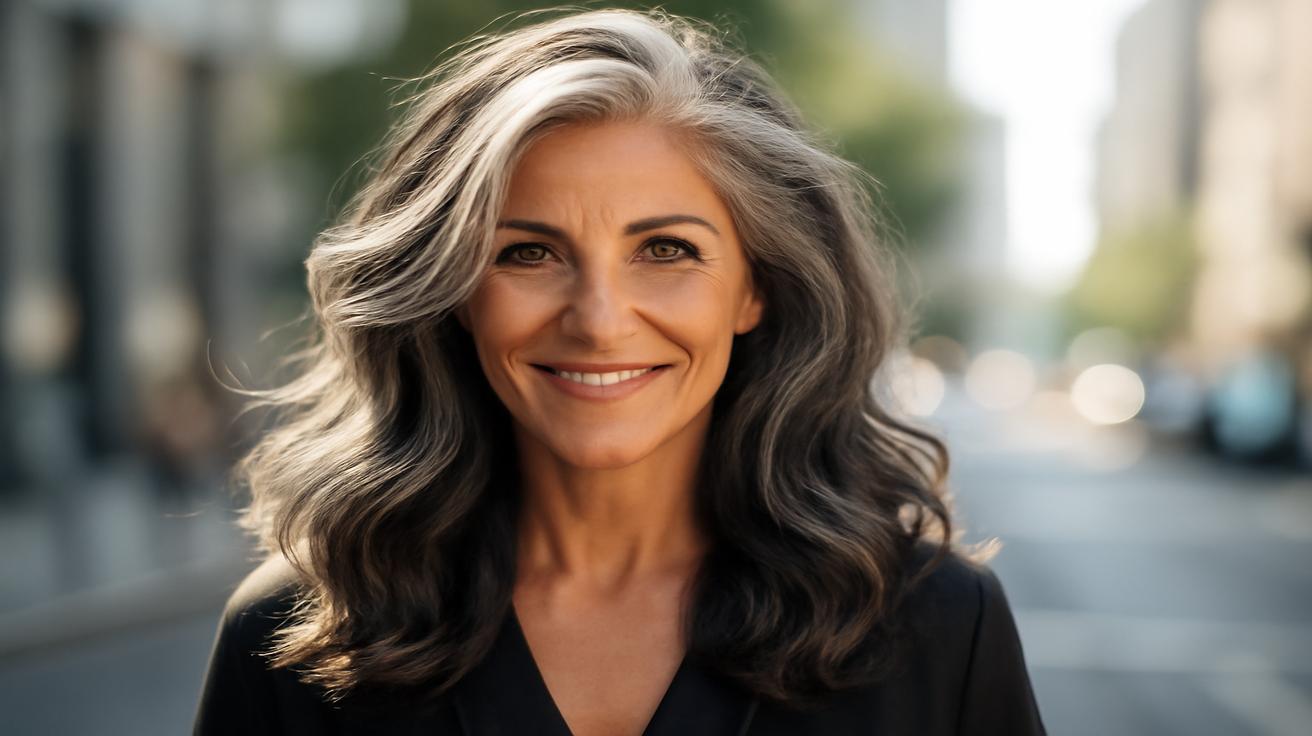
The first time I noticed the silver glinting at my temples, it wasn’t under the harsh light of a bathroom mirror. It was outside, of all places—standing in line at the farmers’ market on a sun-bleached Saturday, the air thick with the scent of peaches and basil. A little girl behind me tugged on her mother’s sleeve and whispered, not quite quietly enough, “Mama, look, her hair sparkles.” For a moment, I forgot to feel self-conscious. Sparkles, not gray. It made me wonder: What if this wasn’t something to hide, but something to highlight?
The Quiet Revolution of Letting Silver Show
If you’re over 50, there’s a good chance you’ve stood in front of the mirror and had a small argument with yourself. Keep coloring? Stop coloring? Go fully gray? Start all over again? Maybe your sink has seen more shades of brown and blonde than a paint store sample wall. Maybe you’ve scrolled through endless photos of stunning silver-haired women and thought, Yes, but my hair doesn’t look like that.
There’s a quiet revolution happening, though, and it doesn’t look like a hard line between dyed and natural. It looks softer, more fluid, more lived-in. It looks like salt and pepper balayage—those whispery, hand-painted ribbons of light and depth that seem to catch the light from every angle. It gives the sense that you didn’t “go gray,” you just… evolved.
Ask a good colorist, and they’ll tell you: the era of fighting every single silver strand is passing. Instead, the focus is shifting toward enhancing what’s already there. The gray you’ve earned—decade after decade of late nights, early mornings, hard work, deep love, worry, laughter—has its own character. Balayage respects that. It doesn’t erase your story; it edits it, gently.
What a Hairdresser Really Sees in Your Gray
“People come in and apologize for their gray,” says an experienced colorist I spoke with, a stylist who has spent more than twenty years painting light into hair. “They sit in my chair and say, ‘I’m a mess. I’ve let myself go.’ And I always tell them: No, you’ve just reached a new canvas.”
From a hairdresser’s point of view, gray hair isn’t a problem; it’s raw material. The pattern of your silver—where it streaks along your part, where it clusters around your temples, where it threads through the ends—gives them a roadmap. Your unique mix of natural color and gray is what makes salt and pepper balayage so personal.
Balayage, which means “to sweep” in French, is exactly that: color swept onto the hair in freehand strokes, instead of being trapped into foils with rigid lines. On gray, this technique becomes a conversation between what’s already there and what you want to see more of. The stylist doesn’t fight the gray; they trace it, echo it, amplify it.
They might deepen some of the natural darker strands so your silver pops brighter. Or they might soften harsh demarcation lines from years of box dye, blending them into a smoky, dimensional mixture that looks intentional instead of accidental. The goal isn’t to cover. It’s to harmonize.
Salt and Pepper Balayage: Where Nature Meets Art
Think of salt and pepper balayage as the meeting point between what your hair is naturally doing and what you wish it would do a little more beautifully. It’s like you and your hairdresser are collaborating with time itself.
For some, that means working with a sprinkling of gray that’s just starting at the roots: soft ribbons of cool-toned highlights and lowlights can help disguise the grow-out, making each new gray strand look like part of a plan. For others, especially when over half the hair is silver, balayage can deepen the remaining dark sections into a rich charcoal or smoky espresso, making the white and silver pieces gleam like moonlight.
The magic is in the transition. Instead of that stark line across your head where old color ends and new growth begins, you get a gradient, like dusk easing into night. When done well, salt and pepper balayage looks like your hair has always been like this—just naturally, impossibly flattering.
And there’s something else: it moves. Under the soft yellow light of your kitchen, under the bright white of the grocery store, under the late afternoon sun, salt and pepper balayage shifts and glows. Pieces catch the light as you turn your head. A streak near your temple suddenly gleams silver; a darker piece at the nape gives an illusion of thickness. It’s not just color; it’s motion.
How Your Stylist Maps Out the Salt and Pepper
When you sit in the chair and say, “I’m thinking about embracing my gray,” a good hairdresser doesn’t reach straight for the dye bowl. They start by studying. They’ll look at:
- Your natural gray pattern: Are you more silver around the face? Is the crown saltier than the rest?
- Your skin tone and undertones: Does your skin glow with cooler tones, or warm golden ones?
- Your haircut and lifestyle: Do you wear your hair up often? Do you like low maintenance or enjoy salon visits?
Then the planning begins. They might paint lighter strokes where you already have gray, amplifying those silvery threads. Darker balayage may be placed strategically to keep your hair from looking washed out, especially if you’ve lost some pigment quickly. Sometimes, a toner is used to cool down any warmth in older dye jobs so the gray and the newly painted shades melt together or, conversely, to add a gentle smokiness that feels lush rather than flat.
The result is not “blonde with gray” or “brown with gray.” It’s something entirely your own—neither fully colored nor fully natural, but a curated version of both. It’s the visual equivalent of turning up the contrast on your own features, so that your eyes, your cheekbones, your expressions stand out more than any single streak of color ever could.
The Feel of Gray Hair—and How Balayage Respects It
There’s a tactile difference to gray hair that often catches people by surprise. Maybe you’ve noticed it: the way the strands feel a bit drier, more wiry, less obedient. The way your once silky ponytail now has a mind of its own. This texture isn’t a flaw; it’s a shift in structure as pigment decreases and the cuticle changes.
Traditional all-over color often tries to bully this new texture into submission, coating every strand with pigment and developer, sometimes repeatedly. Over time, that can roughen the hair even further, making it feel brittle or coarse. The irony is that, in trying to hide the gray, we can make the hair feel more “old.”
Balayage works differently. Because it’s painted in selected sections—not saturating every inch—it’s gentler overall. Less hair is chemically processed, and the stylist can choose specific products that are kinder to delicate, gray-prone strands. They can even leave some areas completely natural, allowing your healthiest, untouched silver to shine through.
There’s a sensory pleasure in that. Running your fingers through your hair and feeling softness again. Seeing a natural sheen return. Watching your silver catch the sunrise as you open the curtains and thinking, That’s me. That looks like me.
With the right care—hydrating masks, a good purple or blue shampoo as needed to keep brass at bay, trims to keep ends from fraying—salt and pepper balayage can actually help you ease into a hair routine that’s simpler, gentler, and more aligned with who you are now. You’re not chasing roots every three weeks. You’re maintaining a look that fades gracefully instead of collapsing all at once.
The Emotional Shift: From “Covering Up” to “Showing Up”
Ask anyone who’s made the move from full-coverage dye to enhanced natural gray, and they’ll often tell you the same thing: it’s about far more than hair. It’s about control, identity, and visibility.
There’s a particular moment that tends to stick in people’s memory. For one woman, it might be seeing her first fully silver streak, artfully painted into a balayage frame around her face, and realizing she looks not older, but sharper, more distinct. For another, it might be running into an old friend at a café and hearing, “You look… like you. Really like you.”
Salt and pepper balayage doesn’t ask you to choose between “young” hair and “old” hair. It gives you space to exist somewhere much more interesting—in the rich middle ground where your age isn’t something being camouflaged, but also not something being exaggerated. It lets you show up without apology.
That doesn’t mean there isn’t fear. Sitting in the chair while your stylist gently strips away years of solid color can feel like shedding armor. You might glance at your reflection mid-process and feel exposed. That’s where the trust between you and your hairdresser matters. “My job isn’t to make you someone new,” the stylist said. “My job is to reveal the version of you that you’ve been slowly, quietly becoming.”
And when you walk out into the daylight afterward—feeling the air move differently through your hair, seeing new shadows and highlights dance in every shop window reflection—there’s often a particular mixture of relief and excitement. You haven’t disappeared. In fact, you might feel more visible than you have in years.
Practical Choices: What Salt and Pepper Balayage Can Look Like
Though the conversation around gray is deeply emotional, the choices you make in the salon are delightfully concrete. Here’s how some common salt and pepper balayage options compare, especially if you’re over 50 and seeking something that feels low-stress but high-impact.
| Option | What It Looks Like | Maintenance Level | Best For |
|---|---|---|---|
| Soft Salt & Pepper Balayage | Fine, blended streaks of silver and charcoal, very natural and diffused. | Low – touch-ups every 3–6 months. | First-timers easing out of all-over color. |
| Bold Face-Framing Silver | Brighter silver pieces around the face, darker through the back. | Moderate – toning every 2–3 months. | Highlighting eyes and cheekbones, adding drama. |
| Smoky Lowlight Balayage | Deeper, cool lowlights woven through heavy gray for contrast. | Low to moderate – refresh every 4–6 months. | Hair that’s mostly white or light gray, feeling too flat. |
| Transition Blend | Balayage used to erase lines from past dye, creating a seamless shift to gray. | Initially moderate, then low once fully blended. | Growing out old color gracefully without a harsh line. |
None of these choices demand that you “pick a side” between gray or not-gray. They’re more like different ways of saying, “This is where I am right now, and I’d like my hair to reflect that beautifully.”
Living with Your New Salt and Pepper Story
After the appointment, your hair becomes part of your daily landscape in a new way. You’ll see it in the low light of early morning, tousled on the pillow. You’ll catch it tied back in a quick bun for a walk, with a silver curl escaping at your neck. You’ll watch it in photos—holidays, birthdays, quiet dinners—and notice how the color seems to hold a softness even in snapshots.
You might also notice who comments. A grown child who says, “Your hair looks so cool.” A colleague who confesses, “I’ve been thinking about letting mine go, too.” A stranger at a café who leans over and says, “I love your gray. Did you do that on purpose?” And you’ll smile, because yes, you did. You chose to meet your reflection halfway.
Some days, you may still miss your old shade. That’s human. Hair holds memory: of youth, of milestones, of the person you were while raising small children or building a career. But the salt and pepper strands you see now are also memory—of everything you’ve navigated since. Enhancing them isn’t giving up; it’s catching up with yourself.
Over time, you and your colorist might tweak things: a little more brightness as more gray grows in, a little more depth at the roots for winter, a toner with a hint of smoke or pearl. Your balayage will shift with you, season to season, year to year, without forcing you back into a battle with your own biology.
In the end, salt and pepper balayage isn’t about chasing youth or declaring war on age. It’s about harmony—between past and present, between natural and artistic, between the woman you used to be and the woman you’re becoming. After 50, gray hair isn’t a problem to solve. It’s an invitation. And hand-painted, light-catching, salt and pepper balayage might just be the most beautiful way to say yes.
FAQs About Gray Hair After 50 and Salt & Pepper Balayage
Is salt and pepper balayage damaging for gray hair?
Any chemical process can stress the hair slightly, but balayage is generally gentler than full, all-over color. A skilled colorist will process only selected sections and adjust formulas to protect your gray-prone strands. With good aftercare—like hydrating masks and minimal heat styling—your hair can remain healthy and soft.
How often will I need to maintain salt and pepper balayage?
Most people can go 3–6 months between balayage touch-ups, sometimes longer. Because the technique is blended and root-soft, your regrowth is less obvious than with traditional foils or full coverage color. You may come in more frequently for a quick toner or gloss to keep silver tones fresh.
Will salt and pepper balayage work if I’m not very gray yet?
Yes. If you’re just starting to see gray, balayage can help blur the contrast between new silver strands and your existing color. Your stylist can paint soft highlights and lowlights that mimic and enhance your natural pattern, making early gray look intentional rather than patchy.
What if I’m almost completely gray or white already?
Balayage can still be useful. Your stylist may add cool lowlights or soft smoky tones to create depth, so your hair doesn’t look flat. They can also brighten selected areas to emphasize your best features. The goal is dimension, not hiding the gray you already have.
Do I need to cut my hair short to transition to gray with balayage?
No. While some people choose a shorter cut for a faster transition, it’s not necessary. Balayage is an excellent way to blend out old color on longer hair, gradually softening the line between dyed lengths and natural gray roots so you can keep your length if you prefer.
Will gray and salt and pepper balayage make me look older?
Not necessarily. A harsh, flat color—too dark, too brassy, or too solid—often adds more age than gray itself. Well-executed salt and pepper balayage complements your skin tone and face shape, often making you look brighter, more defined, and more like yourself, rather than simply “older.”
How should I care for salt and pepper balayage at home?
Use a gentle, sulfate-free shampoo and a nourishing conditioner. Incorporate a hydrating mask weekly, and consider a purple or blue shampoo occasionally to counteract any yellowing in the silver. Minimize heat styling, or use a heat protectant when you do. Regular trims will keep your ends smooth and your color looking intentional, not frayed.








Leave a Comment