
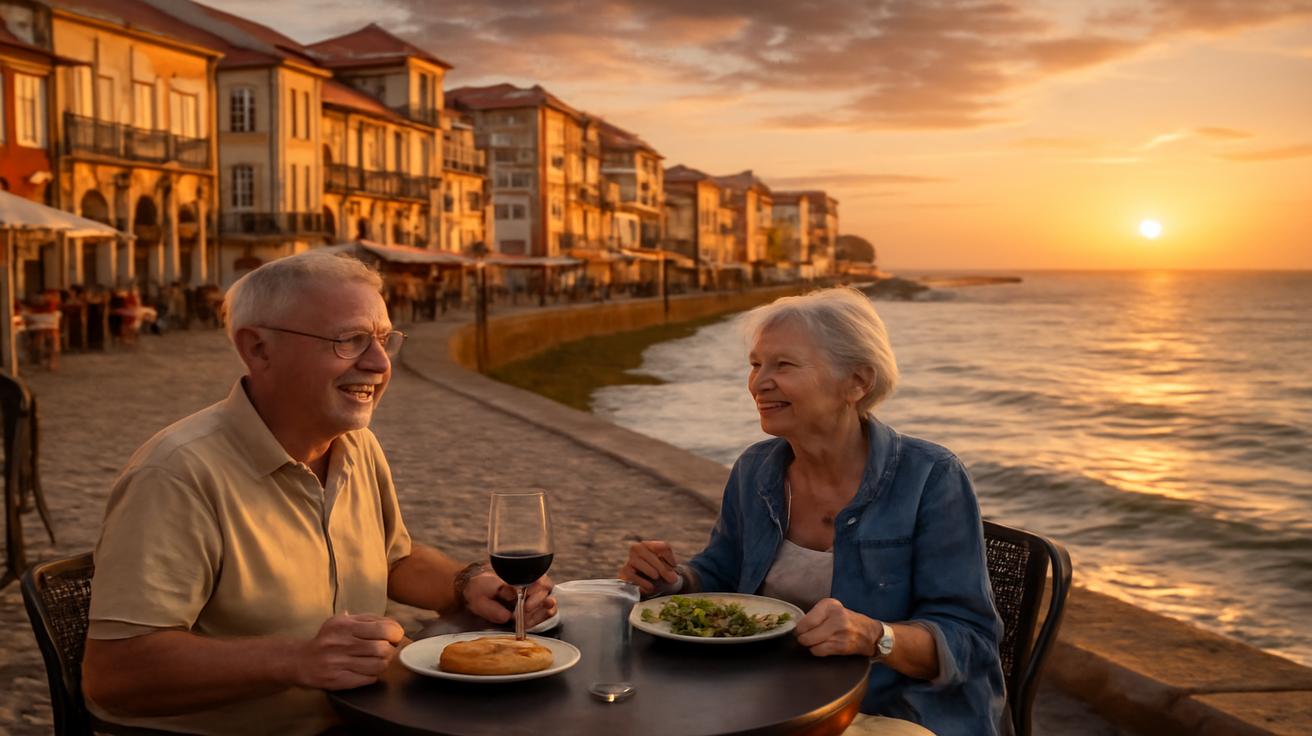
The first thing you notice is the light. It arrives before the sound of the waves, before the smell of salt and grilled fish, before the distant clink of coffee cups. It slips through the shutters and paints the ceiling in a soft Atlantic glow. Outside, the sea is breathing, the city is stretching awake, and somewhere down on the promenade a retired couple from Hamburg is deciding whether to walk north along the beach, or south toward the marina. They moved here last year, trading the crowds and steep prices of Portugal’s Algarve for this quieter corner of the Atlantic coast. And they’re not alone.
From Lisbon Dreams to a New Atlantic Reality
For more than a decade, the European retirement fantasy had a default setting: Portugal. Golden visas. Low cost of living. Sun-soaked terraces in Lisbon and pastel townhouses in Cascais. It was the postcard-perfect dream sold in glossy brochures and carefully lit Instagram posts. But quietly, a shift has started. The retiree caravans are changing direction.
The reasons are as practical as they are emotional. Rents in Lisbon and Porto have climbed at a dizzying pace. Healthcare systems feel more strained. The once-undiscovered coastal villages are now, frankly, discovered. “It was beautiful,” people say, “but it began to feel like the whole world had the same idea.”
And so, eyes turned further up the map, tracing the Atlantic coastline like a fingertip over a globe. France felt too busy, Spain’s big coastal cities too familiar. But then came the whispers: a calmer city by the sea, large enough to feel alive, small enough to breathe in. A place where the Atlantic roars in winter and glitters in summer, and where retired newcomers blend into a rhythm set not by tourism, but by tides and market days.
This is how more and more retirees are saying goodbye to Portugal, and hello to La Rochelle.
The Atlantic City That Still Feels Like a Town
La Rochelle doesn’t shout. It doesn’t seduce you with big, brash promises of eternal summer or tax loopholes. It simply opens its harbor, lets you walk its arcaded streets, and waits for you to notice that your shoulders have dropped a few centimeters since you arrived.
The city sits on France’s Atlantic coast, roughly mid-way between Nantes and Bordeaux. On a map, it looks like a gentle crescent leaning toward the ocean, guarded by two medieval towers that once watched over sailors heading to the New World. Today, those same towers keep quieter watch over joggers, sailors, wine-sipping retirees, and children learning to ride their bikes along the cobblestones.
The air tastes of salt and narrow streets. On mild mornings, the Vieux Port—the old harbor—is a slow-motion ballet of fishing boats, pleasure craft, and tourists debating which café terrace has the best view. Seagulls circle, not yet as jaded as their Mediterranean cousins. There are visitors, of course, but also something rarer on many glamorous coasts: locals who still actually live in the center.
For retirees, that balance is golden. You can find your croissant, your morning market, your favorite bench by the water, all within a distance that feels comfortable to walk or cycle. There’s enough cultural life to stave off boredom—concerts, galleries, festivals—but the city never overwhelms. It moves in a human-scale tempo, somewhere between the slow tides and the turn of the seasons.
A Haven of Peace That’s More Than Just Quiet
“Haven of peace” is a phrase used so often in property listings that it risks meaning nothing. But in La Rochelle, peace has a texture. It’s not the silence of isolation; it’s the soft hum of a place that knows itself.
Peace is the sound of bike tires on the cycle path that hugs the coast, the gentle murmur of conversation in a café under the stone arcades, the steady rhythm of the covered market opening every morning with its chorus of bonjour. It is the absence of frantic traffic horns, the scarcity of oversized cruise ships, the way nights settle quietly rather than explode in neon.
Many of the retirees who have settled here after first trying Portugal talk about a different kind of comfort—less about sun-hours, more about feeling held. The healthcare system is robust and nearby. The city is big enough to have specialists, small enough that your pharmacist remembers your name. You can be fifty meters from the water without feeling like you live in a theme park built for tourists.
And then there is the Atlantic itself: moody, changeable, never boring. On stormy days, retirees wrap scarves around their necks and walk out to watch the waves slap against the seawall. On windless summer evenings, the sea is a sheet of hammered metal, reflecting the pink of the sky as the sun bows slowly behind the lighthouse.
The Subtle Math of a Softer Life
Retirement, beneath the dream images of sunsets and wine glasses, is also a spreadsheet. Budgets. Healthcare premiums. Currency exchange rates. One of the reasons many retirees are now scanning beyond Portugal is that the numbers are changing faster than the brochures.
In La Rochelle, the math isn’t miraculous, but it is, for many, more honest and sustainable. Housing prices have risen—this is still Western Europe, still a city with a coveted coastline—but they have not skyrocketed with the same ferocity as Portugal’s most famous resort areas. Especially if you’re early, willing to explore neighborhoods a ten-minute cycle from the harbor, the value-for-quality feels compelling.
Day-to-day living speaks a language that retirees understand well: the quiet miracle of ordinary costs that don’t sting. A morning coffee and croissant at a local café, a basket of fresh vegetables and Atlantic fish from the market, a monthly bus or bike share pass—these purchases add up to something more than the sum of their receipts. They become a sense that the city is not pricing you out of its everyday life.
Healthcare is another line item where La Rochelle quietly shines. Being anchored within the French healthcare system offers a level of reassurance that becomes more priceless with every passing year. Good hospitals, accessible specialists, clear pathways for foreigners who settle here with the right residency status. The knowledge that, in an emergency, you are minutes—not hours—from quality care is a form of peace rarely pictured on retirement brochures, yet deeply felt once you experience it.
Comparing the New Atlantic Choices
Retirees weighing Portugal against this French Atlantic city often describe a gentle fork in the road: more sun and expat buzz, or more balance and local texture. The differences can be subtle, so sometimes it helps to see them side by side.
| Aspect | Typical Popular Areas in Portugal | La Rochelle (French Atlantic Coast) |
|---|---|---|
| Atmosphere | Tourism-driven, busier in high season, strong expat enclaves | Lively but calm, year-round city life, locals outnumber tourists |
| Cost of Housing | Rapidly rising in coastal hotspots, more competition for rentals | Rising but steadier; options in town and nearby villages |
| Healthcare Access | Generally good in cities; variable in smaller towns | Strong integration into French healthcare system, good local hospital |
| Climate | Hotter, drier summers, more intense heat waves | Milder Atlantic climate, fewer extreme temperatures |
| Lifestyle | Beach-focused, golf, expat social clubs | Harbor walks, sailing, markets, cultural events, cycling |
The table can’t capture the scent of seaweed after rain or the sound of market vendors in French, but it does hint at why a quiet migration is underway. While some chase the brightest sun, others are seeking a gentler, more breathable kind of glow.
Everyday Life: Between Tides and Market Stalls
Ask retirees what their days look like here and you rarely get answers involving luxury, but you often get answers involving ritual.
There’s the couple from Dublin who wake early, walk to the harbor, and sit on the same stone ledge to watch the fishing boats return. They buy their fish directly a few minutes later, then wander into the covered market—one of La Rochelle’s beating hearts—to pick up fennel, tomatoes, and crusty bread. Their French is halting but improving. The fishmonger corrects their grammar with a grin.
There’s the woman from Montreal who bought a small apartment just behind the old port. She cycles along the greenway that connects the city to the beaches further out, sometimes continuing as far as the Île de Ré, that sliver of island you can almost taste from the shore. She joined a local painting group and now spends stormy afternoons by the window, capturing the many moods of the Atlantic in watercolors.
Afternoons unfold slowly here. Some retirees volunteer in local associations, teaching language exchange classes or helping with coastal clean-ups. Others join sailing clubs that welcome all ages, or yoga classes that spill onto the sand when the weather cooperates. There are film festivals, music nights in renovated warehouses, and quiet libraries where rain-striped windows frame the masts of boats outside.
Everyday errands rarely require a car. Many retirees choose to live within or just outside the compact center, where narrow streets and thoughtful urban planning make walking and cycling the most natural ways to get around. When friends visit, they are often surprised to discover a city that feels like a seaside village and a small metropolis at the same time.
A City That Slows You Down—in a Good Way
Peace, for many who move here, is less about silence and more about friction—or rather, the lack of it. Life feels less like a series of tasks to be completed, and more like a sequence of small experiences to be noticed.
You feel it in the way time stretches during the blue hour around the harbor, when the restaurants light their lamps and the towers reflect in the water. You taste it in the long lunches that are not rushed, in the glass of local white wine that arrives perfectly chilled but not aggressively marketed as “lifestyle.”
Even the ocean participates in this reframing of time. Tides come and go with a regular, ancient rhythm, asking nothing from you other than attention. On some winter days, retirees bundle up and walk the sea wall, heads bowed against the wind, coming home flushed and grateful. On golden September afternoons, they linger on benches, feeling the slight chill that signals autumn’s approach.
In a world that often measures value by speed and scale, La Rochelle offers something subversive: the validation of slowness, of enoughness. It’s not only a city where you can retire; it is a city that encourages you to retire into yourself, to rediscover forgotten hobbies, to feel days again instead of just counting them.
Belonging: Learning the Rhythm of a French Coastal City
Retiring abroad is not just a financial or climatic decision. It is a question of belonging. Will I fit in? Will this place hold me when the novelty fades? Will I still feel at home here when I’ve seen all the tourist attractions twice?
La Rochelle does not pretend to be an expat bubble. French is the melody of its streets, and foreigners who settle here quickly realize that learning at least the basics opens doors. But that is also what makes belonging here feel real. When the baker greets you by name, when the neighbor invites you for an apéritif, when you exchange jokes with the pharmacist, you sense that you are not just a visitor in a retirement playground—you are part of a living city.
Local authorities and organizations have begun to recognize the quiet influx of retirees from abroad and from other parts of France. There are civic programs, cultural associations, and sports clubs that make room for new faces of all ages. You might find yourself side by side with teenagers during a beach clean-up, or chatting with thirty-something parents while watching a jazz concert by the harbor.
Belonging also grows in the in-between spaces: the weekly ritual of buying flowers from the same market stall, the shared complaint about the unpredictable Atlantic weather, the way everyone, from retired locals to new arrivals, seems to pause for a heartbeat when the sky turns orange behind the towers.
A New Chapter on the Atlantic
The story of retirees in Europe no longer has a single setting. It is not just about sun-soaked villas in the south or tax-friendly enclaves by tourist beaches. Increasingly, it’s about people who want a different kind of ending—or perhaps, a different kind of beginning for their later years.
Portugal will, of course, remain beloved. Its warmth, its music, its tiled facades will always call to many. But as the pressures of popularity change its landscape, some are stepping quietly away, looking north along the same ocean to a city that offers fewer headlines, fewer hashtags, and more of something simpler: a life that feels livable, day after day.
In La Rochelle, retiree life is less about escape and more about arrival. Arrival in a place where the sea is close, the streets are kind to feet and bicycles, the healthcare is reassuring, and the culture is rich without being overwhelming. A place where peace is not an empty promise, but the everyday texture of life: the smell of coffee under stone arcades, the salt wind on your cheeks, the steady pulse of a harbor that has watched centuries come and go.
As the sun sets and the towers of the old port glow softly, you can almost hear the whispered farewells carried on the breeze: goodbye to overcrowded resorts, to rising rents, to feeling like a tourist in your own retirement. And in their place, a quieter greeting—to a city on the Atlantic coast that more and more retirees are now calling home, their own new haven of peace.
FAQ: Retiring in La Rochelle, the New Atlantic Haven
Is La Rochelle a good choice for foreign retirees?
Yes, especially for those seeking a balance of seaside calm and cultural life. It offers a walkable city center, strong healthcare access, a mild climate, and a more local, less tourist-saturated atmosphere than many traditional retirement hotspots.
How does the cost of living in La Rochelle compare to popular areas in Portugal?
Every situation is different, but many retirees find La Rochelle slightly higher in some categories, yet more stable overall. Housing can be more predictable than in Portugal’s most in-demand coastal regions, and day-to-day expenses like markets, public transport, and healthcare offer solid value for the quality.
What is the climate like in La Rochelle?
La Rochelle has a temperate Atlantic climate: mild winters, warm (but usually not extreme) summers, and a fair amount of wind and changing skies. You won’t get the intense heat of southern Europe, but you will get four real seasons and plenty of fresh sea air.
Do I need to speak French to live comfortably there?
You can get by with basic French and some English in tourist-facing businesses, but learning French, even at a simple level, significantly improves daily life and integration. Locals tend to be helpful when they see genuine effort.
Is healthcare easily accessible for retirees?
Yes. La Rochelle has a well-regarded hospital and a good network of general practitioners and specialists. With the appropriate residency status and health coverage, retirees can access the French healthcare system, which is considered one of the strongest in Europe.
Is La Rochelle safe for older residents?
La Rochelle is generally considered safe, with a calm atmosphere and a strong sense of community. As in any city, normal precautions apply, but many retirees report feeling comfortable walking, cycling, and using public spaces during the day and early evening.
What kinds of activities are available for retirees?
There is a wide range: walking and cycling along the coast, sailing and boating, markets, art and music festivals, language and hobby classes, volunteering, day trips to nearby islands like Île de Ré, and simple pleasures like café culture and harbor watching.
Is La Rochelle easy to reach for visiting family?
Yes. La Rochelle has its own airport with seasonal flights, a train station with connections to major French cities (including high-speed links via nearby hubs), and good road access. For visiting family, it’s a manageable journey from many European countries.







Leave a Comment