
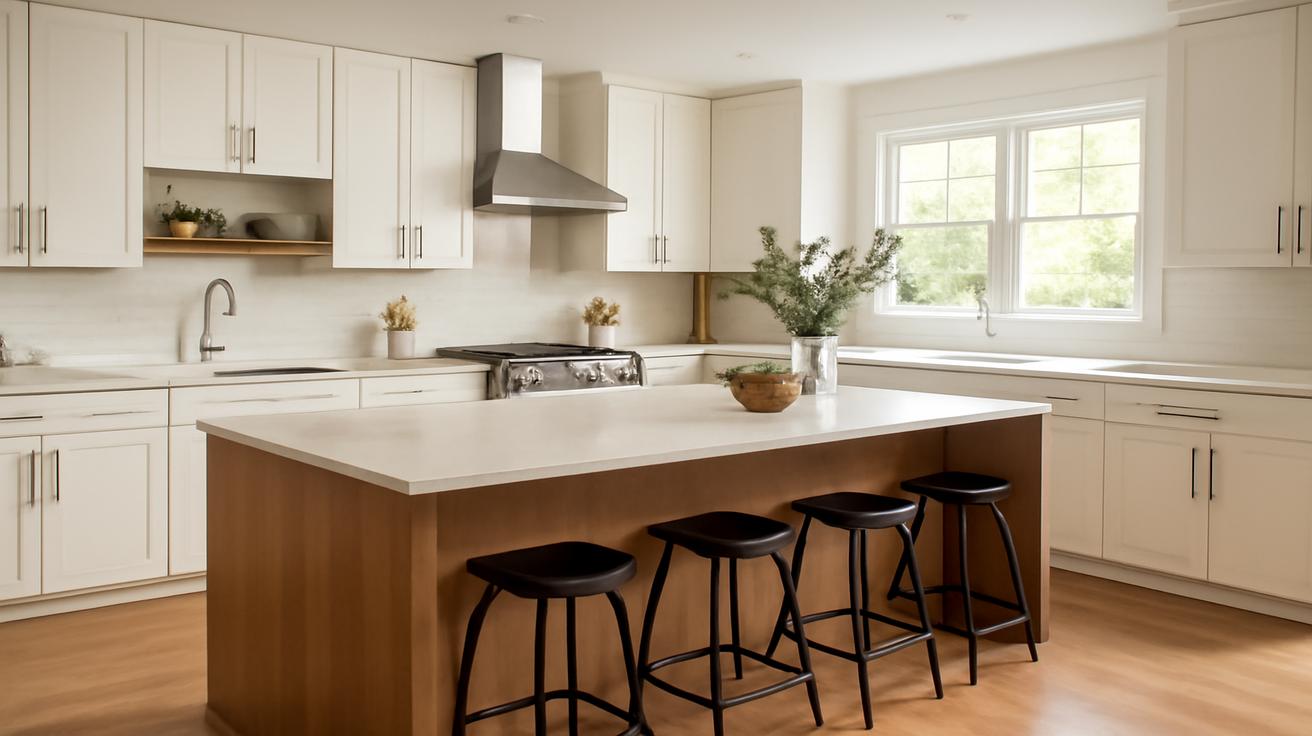
The afternoon light falls softly across the floor, catching the edge of the counter like a slow‑moving tide. There’s dinner half‑prepped—herbs breathing out their green perfume, a loaf of bread cooling beside a shallow bowl of olive oil, a pot muttering on the stove. But what you notice first isn’t the food; it’s the way the room feels. Open, unblocked, almost… conversational. Where a bulky kitchen island once stood, there’s now something slimmer, more graceful, more intentional. The space seems to breathe again.
You can still picture the old island that used to anchor this kitchen: a big, boxy monument in the middle of the room that collected grocery bags, school projects, and the mail no one wanted to sort. It was functional, sure. It was “what everyone did.” But in 2026, more and more homeowners are realizing: maybe the kitchen island is not the hero of the modern home after all. And something better—more practical, more elegant—is quietly taking its place.
The slow fade of the kitchen island
For two decades, the kitchen island was untouchable. It was the badge of a renovated home, the must‑have in real estate listings, the thing buyers looked for first. A big slab of stone, some pendant lights hovering above like planets, a row of barstools waiting for hurried breakfasts and late‑night snacks.
But if you talk to people actually living with them, a different story emerges. Islands often become barriers—both physical and social. They block natural walking paths between the sink, stove, and fridge. They turn hosts into servers, anchoring them behind a counter while everyone else gathers “over there.” Ever tried to squeeze past a row of occupied barstools while holding a hot pan? The layout shows its flaws the moment you cook for real life instead of glossy photos.
By 2024, designers began to quietly question the island’s dominance. By 2025, those questions had names: flow, flexibility, and face‑to‑face connection. And in 2026, a new star stepped into the center of the room—not as a block, but as a bridge.
Meet the kitchen peninsula: the island’s more graceful cousin
This new trend isn’t entirely new at all. It’s the kitchen peninsula—the island’s long‑overlooked sibling—suddenly redesigned, rethought, and elevated. Where an island stands alone, a peninsula is anchored on one side to a wall or base of cabinetry, extending into the room like an open arm.
Imagine a counter that doesn’t sever the kitchen from the rest of the home, but gently frames it. One edge connects to the main run of cabinets, while the other opens into the dining area or living space. Instead of forcing everyone to park themselves on one side looking at the cook, it allows people to wrap around the corner, to mingle, to drift closer without feeling like they’re invading the work zone.
It’s a small shift in geometry with a big impact on how rooms feel. Peninsulas take up less floor space than islands, yet often create more usable surface. They can carve out natural seating niches, reinforce cozy corners, and draw the eye outward instead of filling the room’s center with a heavy block.
Most importantly, they restore something open‑plan homes have been missing for years: subtle, human‑scale boundaries that don’t feel like walls.
The subtle elegance of anchored design
Stand in a kitchen with a peninsula and you can sense the difference even before you notice the details. There’s a sense of groundedness, of something purposeful rather than merely placed. The anchored edge acts like a pivot, letting the room swirl gently around it.
Designers in 2026 are leaning into this anchored form to do more than just hold a countertop. Peninsulas are being crafted as sculptural elements—slender supports, rounded corners, waterfall edges that let stone cascade down to the floor like a quiet spill of light. Instead of a bulky cube, you get an elegant line that feels drawn rather than dropped.
Because one side is fixed, the rest of the peninsula can slim down. Storage can be tucked neatly into the connected cabinetry wall, leaving the overhanging edge light and airy. You can step up to it without feeling boxed in. You can perch a coffee mug, spread out a laptop, or roll out dough without fighting for space with a fruit bowl, four appliances, and the mail.
The elegance is also functional. Lighting becomes more intentional: a single pendant at the end, like a punctuation mark; a soft under‑counter glow along the anchored side; natural light flowing past the open edge instead of being blocked by a monolith in the middle of the room. Even the soundscape changes. Without a giant island in the center, voices ripple more gently from kitchen to living space, blending instead of bouncing.
Practical magic: why peninsulas work better for real life
Trends come and go, but the peninsula’s rise is being fueled by something sturdier than aesthetics: how people actually live and move. Once you watch the way bodies and objects travel through a home, the logic becomes undeniable.
Think about the classic kitchen “work triangle”—the path between stove, sink, and fridge. A huge island often cuts right through that invisible triangle, turning a few steps into a detour. A peninsula, by contrast, tends to frame the triangle, leaving the core movement path clean and open.
In smaller spaces, this matters even more. Many homeowners spent years trying to squeeze an island into rooms that were never meant to hold one, ending up with cramped walkways and constant sidestepping. The peninsula invites a different strategy: tuck prep and cooking zones along the walls, then let the peninsula become a flexible frontier between cooking and living.
That frontier can be almost anything you need it to be: breakfast bar, homework desk, cocktail station, buffet line for holiday dinners, or even a quiet spot to stand and watch the rain while stirring a pot. Because it’s anchored, the storage opportunities expand too—deep drawers on the inner side for pots, a bookshelf at the end for cookbooks, a hidden cabinet for cleaning supplies you don’t want to see but always need.
The ultimate practicality, though, may be emotional. Peninsulas softly choreograph gathering. People can lean on one side while the cook moves on the other, close enough to talk, far enough not to collide. There’s no “backstage” person stuck behind a barrier; there’s a shared line where cooking and living meet.
Peninsula vs. island: how they really compare in daily life
To understand why so many 2026 renovations are saying goodbye to the island, it helps to look at the trade‑offs side by side.
| Feature | Traditional Island | Modern Peninsula |
|---|---|---|
| Space Needs | Requires wide clearances on all sides; often too large for small kitchens. | Anchored on one side; fits comfortably in modest or narrow layouts. |
| Traffic Flow | Can interrupt natural routes and work triangles. | Frames movement instead of blocking it, creating a natural path. |
| Social Connection | Guests line up on one side, cook is isolated on the other. | Encourages wrap‑around gathering and easier conversation. |
| Storage & Utilities | Utilities can be complex; storage often shallow to keep clearances. | Easier to run power/plumbing via wall; deeper, more efficient storage. |
| Visual Impact | Large central block; can feel heavy or cluttered. | Slimmer, lighter presence; defines space without dominating it. |
How peninsulas are quietly transforming modern homes
The real story of the peninsula isn’t just about kitchens. It’s about the way homes are shifting to match the rhythms of contemporary life—more remote work, more casual entertaining, more moments that blur the lines between tasks and rest.
In many 2026 remodels, the peninsula is acting as a hinge between functions. On one side, the kitchen hums with its chopping and stirring and simmering. On the other side, the living room sprawls into a soft landscape of sofas and throws. The peninsula stands between them like a shoreline, where one world becomes the next.
Some homeowners are carving built‑in seating against the anchored side, creating a nook where someone can curl up with a book while another person cooks. Others are extending the countertop slightly and slipping a slender stool beneath, making a place to answer emails with a cup of tea in hand. In tight apartments, the peninsula doubles as the main dining table, with storage neatly hidden in its base.
The design language is shifting too. Instead of matching every cabinet door and surface, people are mixing textures: warm wood on the main cabinetry, a velvety stone on the peninsula; matte metal on the supports, a soft radius corner that begs to be touched. In the morning, sunlight grazes the outer edge. In the evening, a single pendant glows like a small moon, turning the peninsula into a stage for a simple bowl of citrus or a vase of field flowers.
Far from being a purely functional fixture, the peninsula becomes the emotional anchor of the home—the place where days begin with coffee and end with a late‑night slice of cake eaten quietly in the half‑dark, elbows on the cool surface, the rest of the house sleeping.
Designing your own peninsula: form, flow, and feeling
If you’re thinking about saying goodbye to a kitchen island—existing or planned—the first step isn’t about measurements. It’s about imagining how you want the room to feel and function.
Close your eyes for a moment and picture your usual day. Do you want a place where kids can do homework within arm’s reach of the stove? A spot to roll out fresh pasta on a Sunday afternoon, with enough overhang for friends to lean close and watch? Maybe you crave a quieter morning ritual—a stretch of counter where you can stand alone with your coffee and the soft hum of the kettle.
A peninsula can be tailored to those scenes. Keep one section intentionally landing‑zone‑free: a clear patch of counter that isn’t allowed to become a dumping ground for keys and mail. Round the outer corner so hips and thighs don’t bruise on sharp edges in tight spaces. Leave a small overhang for stools, but not so many that the area becomes a never‑ending lunch counter.
Think about what lives under the surface, too. Deep drawers on the kitchen side can hold heavy cookware you’d rather not lift from overhead cabinets. On the living‑room side, consider shallow shelves for favorite cookbooks, storage baskets, or a built‑in bench with hidden compartments for board games. That dual personality—kitchen on one side, life on the other—is where the peninsula shines brightest.
And then there’s the view. With a traditional island, you often stand in the middle of the room facing either a wall or a row of stools. With a peninsula, you can angle yourself toward the window, the garden, the fireplace, or the heart of the home. It’s a small change, but the experience of cooking while looking outward instead of inward can transform mundane tasks into gentle, grounding rituals.
The emotional goodbye to kitchen islands
For many people, the idea of parting with a kitchen island feels almost disloyal, like letting go of a status symbol that once stood for “we made it.” But 2026 is quietly rewriting what “making it” looks like at home. It’s less about big, showy surfaces and more about spaces that work so well you almost forget to notice why.
There’s a certain tenderness in the act of removal. Contractors disassemble the old island, piece by piece. The room exhales. Light spills into corners that haven’t seen it in years. For a brief, echoing moment, the kitchen is just a room again—four walls, a floor, the possibility of something better.
When the peninsula takes its place, it doesn’t arrive with the same swagger. It sidles gently into the architecture, attaching itself to what’s already there, extending like a thought you hadn’t quite finished. The first night you use it, perhaps you eat a simple dinner there: soup and bread, nothing fancy. You notice how easy it is to move, to talk, to clear. How natural it feels to lean there and chat with someone who isn’t stuck on the other side of a barricade.
Days later, you may find a cat curled at the base, a kid building a Lego fortress along the edge, a laptop open beside a cup ring that will never fully wipe away. The peninsula begins to gather stories the way good furniture and well‑loved rooms always do—not as a showpiece, but as a quiet constant in the background of your life.
Maybe that’s the real trend of 2026: not the peninsula itself, but the idea that our homes should reflect how we actually live, not just how we want them photographed. The kitchen island had its moment—bold, glamorous, ubiquitous. Now, we’re turning toward something a little softer, a little smarter, more like a companion than a centerpiece.
Goodbye, kitchen island. Thank you for the years of brunch buffets and birthday candles. The future of the modern home belongs to spaces that move with us, hold us, and make room for the quiet, ordinary beauty of daily life. And the peninsula, anchored yet open, might just be the shape that holds it all together.
Frequently Asked Questions
Are peninsulas only for small kitchens?
No. While peninsulas are excellent for smaller or narrower kitchens, they also work beautifully in large open‑plan spaces. In bigger rooms, they help define zones and create a sense of intimacy without adding walls.
Can I replace my existing island with a peninsula?
In many cases, yes. It depends on your layout, existing plumbing and electrical, and structural walls. A designer or contractor can often reconfigure cabinetry and reroute utilities to anchor a new peninsula to a wall or cabinet run.
Do peninsulas offer as much storage as islands?
Often they offer more. Because one side connects to existing cabinetry, you can extend storage along that wall. Deeper drawers, corner cabinets, and built‑ins on the outer side can all add capacity without crowding the room.
Is seating at a peninsula comfortable?
With proper overhang (usually around 25–30 cm) and enough legroom, peninsula seating can be very comfortable. Many people find it more natural, as the anchored side helps create a cozier, more protected feeling.
Will choosing a peninsula affect my home’s resale value?
Current buyers are increasingly drawn to layouts that feel open yet functional. A well‑designed peninsula that improves flow and adds usable space is likely to be seen as an asset, especially in 2026 and beyond as this trend continues to grow.








Leave a Comment