
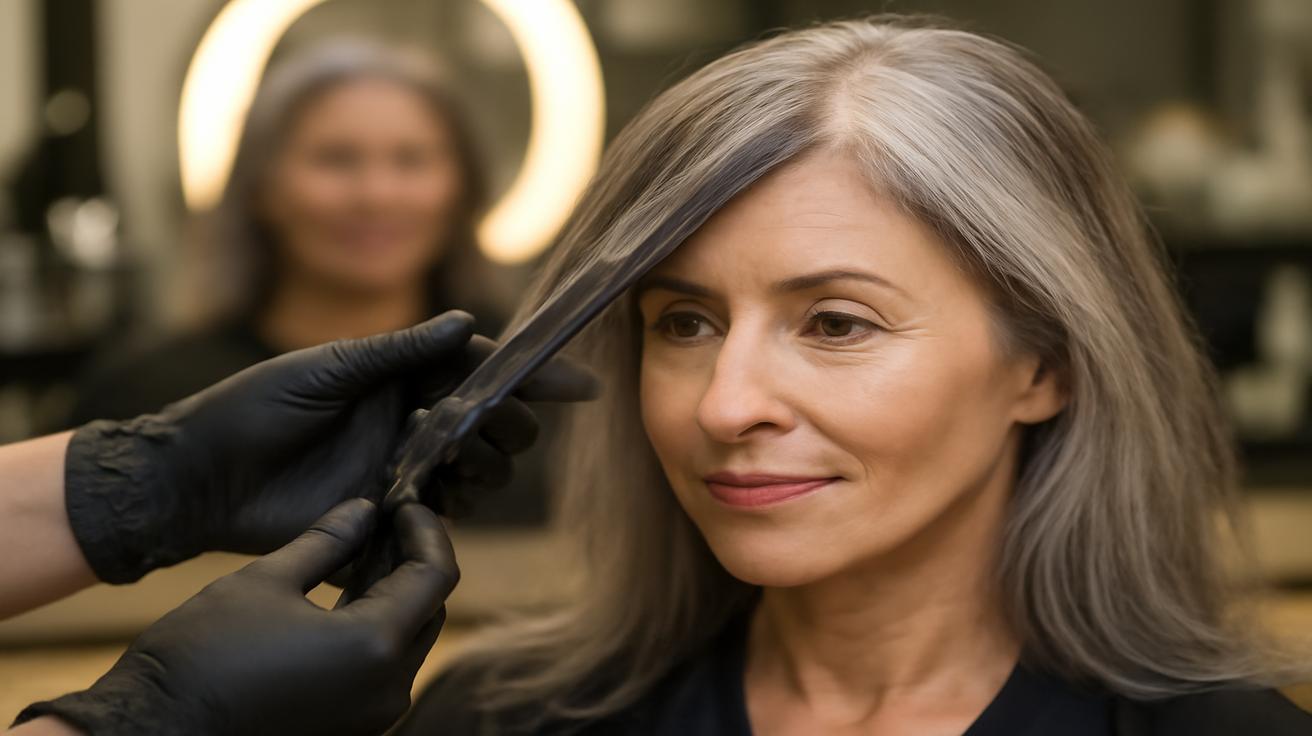
The first time you notice it, you probably pretend you didn’t. A single silver thread glinting at your temple, catching the bathroom light just so. You bend closer to the mirror; maybe it’s the angle, maybe it’s dust, maybe—no, there it is again. A quiet, persistent whisper that time is moving, whether or not your calendar is ready for it. For years, the instinctive response has been the same: reach for the box of dye, schedule an emergency salon appointment, erase the evidence. But lately, something softer, more intriguing is happening. Instead of dumping chemicals over our scalps in a monthly ritual of panic, more people are turning toward a calmer, kinder question: is there a better way to age, to look vibrant, to feel like ourselves, without waging war on every grey strand?
The Day the Hair Dye Smell Got Too Loud
Most people can recall the smell of hair dye almost as clearly as their childhood home. That sharp, chemical scent that clings to your bathroom for hours, sneaks into towels and pillowcases, hovers above your head like a secret. Maybe you remember sitting on a squeaky salon chair, a plastic cape rustling around your shoulders, feeling the sting on your scalp while chatty music played overhead. The colorist called it “covering your wisdom,” laughed, and you laughed too—but something about it began to feel off.
For many, the turning point isn’t dramatic. It’s not a bad allergic reaction or a hair disaster you jokingly call “the Purple Summer.” It’s often smaller and stranger: maybe you notice your hair feeling thinner, drier, as if each coloring session asks more of your strands than they can give back. Maybe you read the fine print on the box for the first time and realize you can’t pronounce half the ingredients. Maybe a friend casually mentions she hasn’t dyed her hair in a year and you’re startled by how radiant she looks—glowy, not older, just… lighter, somehow.
There’s a quiet movement happening in bathrooms and salons everywhere, at kitchen tables and in text threads between friends. It sounds like this: “I’m kind of tired of coloring my hair all the time. Do you think I could pull off my natural greys?” Only now, the question is changing into something even more interesting: “Is there a way to work with what my hair is doing—these greys, this texture, this new phase—while still looking fresh, energized, even younger?”
The New Trend That Doesn’t Smell Like Chemicals
We used to think there were only two routes: you either dyed your hair to hide your greys or you “went natural” and let it all come in, full silver, full stop. But the new wave of hair care is less about black-or-white decisions and more about blending, softening, brightening—about treating hair like a living textile that evolves with you.
Imagine your greys not as invaders, but as threads of light weaving through your natural color. The modern trend doesn’t slam a door on them; instead, it invites them in and rearranges the furniture so everything works together. Instead of full-on dye that blankets every strand in a uniform shade, more people are reaching for gentler, more strategic approaches that:
- Soften the contrast between grey and natural color
- Add dimension and shine instead of a flat, “helmet” look
- Keep hair healthier by avoiding harsh full-head processes
- Let your roots grow in gracefully, without that abrupt “skunk stripe” line
The secret is surprisingly simple: the new era isn’t about hiding. It’s about harmonizing. And when hair looks harmonious—shiny, dimensional, intentional—it reads as younger, even when more of it is technically grey.
Subtle Blending: When Grey Becomes Part of the Design
If old-school hair dye was a paint roller, today’s techniques are more like watercolor. Stylists are using micro-highlights, lowlights, and delicate balayage to mingle your natural base color with your greys, so nothing looks stark or accidental. Rather than force your hair back to what it looked like at 22, they’re working with what it looks like now—and helping it become the best version of that.
Instead of one dense, opaque shade that has to be painstakingly maintained every few weeks, these approaches embrace softness and transition. Your greys become a feature, not a flaw, especially when they’re framed with precision: brighter pieces near the face, gentle shadows in the lengths, and a halo of light where the sun would naturally hit.
How Grey Hair Can Actually Make You Look Younger
It sounds paradoxical, but it happens all the time: someone stops heavy dyeing, leans into blending and shine, and suddenly friends say, “You look so refreshed—what did you do?” They assume you’ve changed your skincare, lost weight, slept more. In reality, you simply stopped fighting your hair and started collaborating with it.
Here’s why this new approach can be so surprisingly youthful:
- Shine beats saturation. Over-processed hair often looks dull and flat. Healthy hair with a mix of tones catches the light, which we instinctively read as vitality.
- Soft contrast flatters skin. Harsh, dark, monochrome shades can cast shadows on the face, making fine lines look deeper. A softer blend can lift your features and brighten your complexion.
- Texture is celebrated, not fried. Many people find that embracing less dye and more care leaves their hair fuller and smoother, which does more for a youthful appearance than any single shade ever could.
When you’re not scrambling to cover every root, you also gain something else: ease. And oddly enough, ease is one of the most attractive things you can wear. No one looks younger because they’re panicked about their hair. They look younger when they’re relaxed in their own skin—and their own strands.
The Quiet Glow of Alignment
There’s a particular kind of beauty that shows up when what you present to the world lines up with who you feel you are inside. For some, that means a proud, full silver mane. For others, it means a soft blend where greys peek through like starlight in the evening sky. The new trend is not a rulebook; it’s an invitation to stop pretending your hair is something it’s not, and instead ask: what would it look like to make this phase feel gorgeous?
A curious thing happens when you stop obsessively chasing your “old” hair: you start noticing how many people look stunning precisely because they didn’t. The woman on the train with salt-and-pepper curls shining like river rocks. The man at the café whose silver temples look distinguished, not tired. The friend whose new, softer color actually makes her eyes look brighter than the inky black she wore for years.
From Panic Appointments to Gentle Rituals
Letting go of monthly dye appointments doesn’t mean doing nothing. In fact, this new trend is rich with rituals—it just swaps the panic for pleasure. The goal is to support your hair so it looks intentional, luminous, and alive, even as the greys join the party.
Picture this: instead of harsh color every 4 weeks, you shift to occasional subtle blending treatments, toning glosses, and a home routine that cherishes your strands instead of assaulting them. Your bathroom shelf becomes less about covering up and more about care—creamy masks, shine serums that catch the light, gentle shampoos that don’t strip whatever pigment you still have.
Gentle Ways People Are Updating Their Hair Without Classic Dye
Across kitchen sinks and cozy salons, a handful of gentler methods are quietly replacing the old all-or-nothing dye jobs. Some are natural, some are semi-permanent, some are purely about optical illusion. They all share one thing: they work with your greys instead of trying to obliterate them.
| Approach | What It Does | Best For |
|---|---|---|
| Toning gloss / glaze | Adds shine and a soft veil of color, reduces brassiness, enhances natural tones without full commitment. | Anyone wanting brighter, younger-looking hair without changing their color dramatically. |
| Strategic highlights & lowlights | Blends grey with your base shade so regrowth looks softer, adds dimension and depth. | People transitioning from solid dye to a more natural, blended look. |
| Plant-based tints (like henna blends) | Gently coats hair, often enhancing warm tones and improving shine. | Those seeking more natural ingredients and subtle coverage. |
| Root touch-up powders/sprays | Temporary camouflage for part lines and hairlines between appointments. | Anyone easing off frequent dye but wanting occasional extra coverage. |
| Cut & style upgrades | Uses shape, layers, and movement to make greys look intentional and modern. | Everyone. A great cut can make any amount of grey look chic. |
None of these methods demand you erase yourself. They ask, instead: how can we make what’s already here look luminous?
The Emotional Shift: From “Fixing” to Curating
The real revolution isn’t just technical; it’s emotional. We’ve been taught that greys are a problem to fix, a signpost of decline. But when you talk to people who’ve stepped away from the dye cycle, a different narrative emerges. They use words like “relief,” “freedom,” and “authentic” more than “resignation.”
You might start this journey tentatively. Maybe you stretch the time between coloring appointments. You let the roots grow a little more than usual. You experiment with a gloss instead of a full dye. You ask your stylist—not, “How do I hide this?” but “How do we make this look cool?” The energy shifts, subtly but unmistakably, from panic to curiosity.
Redefining What “Younger” Really Means
Ironically, clinging desperately to the hair you had at twenty can make you look older—not on the surface, but in spirit. There’s a kind of tightness to it, an anxious grip. What if “younger” could instead mean:
- More playful with your cut and styling
- More experimental with texture—waves, curls, soft movement
- More focused on shine and health than on uniform color
- More at ease walking out the door, knowing your roots are allowed to exist
Greys become less terrifying when they’re not a solitary, stark line screaming from your part, but part of a whole that feels considered and alive. Think of them the way you might think of laugh lines: evidence that you’ve been here, living, smiling, staying up late for good reasons.
Practical Steps to Embrace the Trend (Without Shock)
If your hair dye kit feels like a security blanket, you don’t have to throw it away tomorrow. This isn’t a cold-turkey mission; it’s a gentle experiment. You can move at the pace that feels right, one small, intentional choice at a time.
Start With a Conversation, Not a Color
The next time you visit a stylist—or even when you sit with yourself in front of a mirror at home—change the question. Instead of, “How do we cover this?” ask, “How do we make what’s happening look beautiful?” If you work with a professional, bring photos of hair that inspires you: salt-and-pepper bobs, softly blended brunettes with silver threads, warm, sunlit blondes with a whisper of grey.
Many stylists are now trained in grey blending and low-maintenance color strategies. Some might suggest:
- Adding fine highlights near your part to soften the grow-out line
- Darkening certain sections slightly to create contrast and depth
- Using a sheer, demi-permanent gloss to subtly tone greys instead of covering them fully
Meanwhile, at home, you can begin to treat your hair less like a project and more like a living, changing part of you. Swap sulfates for gentler wash routines. Introduce a weekly mask. Let air-drying become an experiment instead of a last resort.
Upgrade the Supporting Cast: Skin, Brows, and Style
One reason people fear grey is that they imagine it as a lonely change. But when your hair evolves, you can let other elements shift alongside it:
- Skin: A little extra glow—through hydration, gentle exfoliation, or a light-reflecting tint—can make any hair color look fresher.
- Brows: Well-shaped, softly filled brows frame the face and keep the overall effect youthful, even as hair lightens.
- Wardrobe: Colors you once avoided might suddenly flatter you. Many find that greys look stunning with deep blues, soft taupes, crisp whites, or earthy greens.
This is the quieter secret of the trend: it’s not just about hair. It’s about creating a whole look that says, “Yes, I’ve changed—and I’ve curated it on purpose.”
Letting Your Hair Tell the Story of You – Not Just Your Age
One day, you will catch yourself in a passing reflection—shop window, elevator door, the black frame of your turned-off phone—and notice, with a jolt, that you look different. Not younger or older in the way anyone warned or promised, but more like yourself than you have in years.
Your hair might be a soft cloud of silver near your temples, or a warm, dimensional blend with greys glinting like hidden threads. It might be cut shorter than you ever dared at twenty-five, or longer than anyone told you was “appropriate” past forty. It will not be perfect. It will not be frozen in time. It will move when you move; it will frizz when it rains; it will betray the late nights and the early mornings.
But it will also tell the story of someone who refused to stay trapped in the bathroom under a fluorescent bulb, box dye in hand, chasing a version of themselves they had outgrown. Someone who chose, instead, to walk outside, let the daylight touch every strand, and see what happened.
Goodbye, endless hair dyes. Not because color is bad or vanity is wrong, but because the new kind of beauty is quieter and braver. It doesn’t erase the years. It edits them lovingly. It invites the greys in, sits them down at the table with the chestnuts and coppers and golds, and says, “Let’s tell this story together.”
And if that story makes you look younger—not in the frantic, frozen way, but in the lit-from-within way—maybe it’s because letting yourself be seen, as you are, has always been the youngest thing a person can do.
FAQ
Will embracing this new trend mean I can never use hair dye again?
No. This isn’t an all-or-nothing rule. Many people still use color—just more strategically and gently. You might shift from permanent all-over dye to occasional glosses, highlights, or lowlights that blend with your greys instead of covering them completely.
Can blended greys really make me look younger than solid dark dye?
Often, yes. Solid, very dark color can look harsh as skin tone and texture change over time. Softer, multi-tonal hair reflects light better and creates a more flattering frame for the face, which many people perceive as more youthful.
How long does it take to transition away from frequent dyeing?
Expect a gradual process of several months to a couple of years, depending on your starting point and how dramatic your previous color was. A stylist skilled in grey blending can help you create stages that look intentional at every step.
Is this trend only for women?
Not at all. Men are also embracing softer, blended looks, allowing natural greys at the temples and throughout the hair while using subtle cuts, texture, and occasional toning to keep everything polished and modern.
What if I don’t like how my natural grey pattern looks?
You’re not stuck with it exactly as it is. The beauty of this trend is customization: a few well-placed highlights, lowlights, or a gentle glaze can reshape how your greys appear—softening harsh patches, brightening dull areas, and making the overall pattern feel more balanced and flattering.




Leave a Comment