
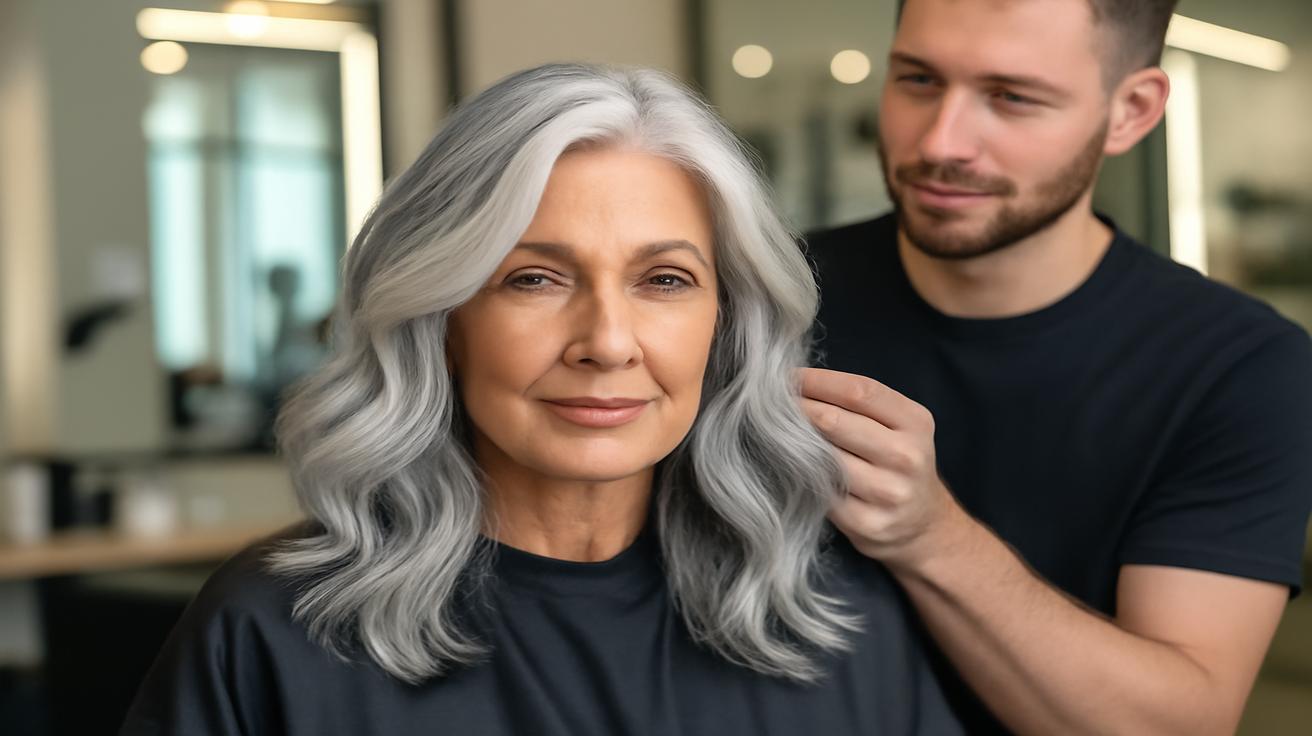
The first time I watched gray hair disappear without actually being covered, it felt a bit like magic. No foils. No harsh lines. No endless root touch-ups. Just a woman, mid-fifties, settling into a salon chair with a sigh that carried ten years of dye appointments—and a colorist who quietly said, “We’re not fighting your gray today. We’re going to melt it.” The word sounded soft, kind, almost decadent. Melt. As if the battle with gray could be replaced with something gentler, something that didn’t require pretending to be twenty-five. By the time she walked back out into the late afternoon light, her hair shimmered in quiet tones of smoke, sand, and pearl—her gray still there, but suddenly…forgettable.
From Balayage to “Melting”: A Shift in How We See Gray
For the last decade, balayage has reigned as the queen of natural-looking highlights. The technique—hand-painted streaks of light that mimic what the sun might do on its best day—transformed color from chunky streaks to seamless ribbons. But balayage, for all its artistry, was never really about making peace with gray. It was about distraction and brightness, about the illusion of endless summer.
Then, slowly, something changed. The women in the salon chairs started asking different questions. Instead of, “How can we hide my grays?” they asked, “Can we make them look intentional?” Instead of hunting for the perfect match to their pre-gray shade, they wondered if there was a way to blend, blur, and soften what was already coming through.
Enter “melting,” a technique that does not pretend your gray hair doesn’t exist. It simply refuses to make a big deal about it.
What Exactly Is Hair “Melting”?
Color melting is what it sounds like: one shade dissolving into another with no visible line where one ends and the next begins. But when it involves gray hair, it becomes something more powerful: the art of making gray part of the story rather than the villain.
Instead of painting big, bright streaks like balayage, a color melt uses a series of tones—sometimes two, sometimes three or more—that sit very close together on the color spectrum. Think smoky taupe fading into pearl blonde, or soft cocoa shifting into ash brown. The roots, mid-lengths, and ends are not separate territories but one slow, graceful transition.
Where balayage often chases contrast—light against dark, sun-kissed ends against deeper roots—melting loves the in-between. With gray hair, the colorist looks at your natural white, silver, and salt-and-pepper patterns and asks, “What shades can we weave around this so the eye stops trying to find the gray and just sees…texture?”
The Moment Gray Stops Being the Main Character
If you’ve ever stared at your roots in a bathroom mirror under unforgiving light, you know how loud gray can feel. It demands attention. It shouts from the part line. Traditional permanent coloring fights back, coating each strand in opaque pigment, turning gray into a secret that needs monthly maintenance.
With melting, something quieter happens. Your gray remains visible, but it’s threaded into neighboring tones so closely that it stops standing apart. Imagine looking at a foggy forest at dawn. You don’t isolate every single misty patch; you just see an atmosphere. That’s what melting does to gray—it turns it into ambiance.
The technique often relies on demi-permanent or gloss colors, which wrap the hair in sheer tone rather than full-cover pigment. Your natural gray peeks through like light behind frosted glass. The result is not “no gray,” but “no obvious gray.” It’s a subtle difference that, for many, feels like relief.
How Melting Makes Gray Hair Forgettable—in the Best Way
Forgettable might sound unflattering, but in a world where gray hair has long been treated as a crisis, making it forgettable is an act of rebellion. Your hair becomes something people notice as beautiful, not something they scrutinize as “aging.”
Here’s what melting does that traditional coloring and classic balayage often don’t:
- Softens the contrast at the roots. Instead of a sudden gray regrowth line, you get a slow, blurred shift. The eye doesn’t catch on a harsh border.
- Uses multiple shades to echo your natural variation. Gray is rarely just gray. It’s platinum, pewter, soft white, and sometimes even pale gold. Melting gently amplifies that complexity.
- Creates movement without high drama. Where balayage throws light and shadow into bold play, melting chooses a more cinematic, low-contrast approach. It’s less “spotlight” and more “soft focus.”
On the street, this translates to hair that doesn’t scream, “I’m growing out my gray!” It just looks like a beautifully nuanced color, somewhere between fully dyed and fully natural. Nobody can quite tell where the salon ends and your own hair begins—and that’s the point.
The Emotional Shift: From Covering to Curating
There’s another layer to melting that has nothing to do with formulas and everything to do with feelings. When you choose this approach, you’re no longer covering your hair as though something is wrong with it. You’re curating it, like a landscape you love enough to enhance but not erase.
Women—and men—who switch to melting often describe a surprising sense of calm. They’re still groomed, polished, intentional, but no longer tethered to a strict four-week root schedule. Miss a touch-up by a few weeks, and the grow-out simply folds into the existing softness.
It’s not about “letting yourself go.” It’s about quietly refusing the idea that the only acceptable version of you is the one who endlessly edits out every hint of silver.
Balayage vs. Melting: What’s Really Different?
Balayage and melting are siblings in the same creative family, but they have distinctly different personalities. If balayage is the bold, golden-hour sibling, melting is the one who loves overcast days and subtle gradients.
| Aspect | Balayage | Melting (for Gray) |
|---|---|---|
| Goal | Sun-kissed, high-contrast brightness | Soft, seamless blending of gray and tone |
| Look | Visible lighter pieces and ribbons | Barely-there transitions; diffused color |
| Gray Strategy | Often tries to distract from or cover gray | Uses gray as part of the blend |
| Maintenance | Moderate; roots may still feel obvious | Low to moderate; grow-out is softer |
| Best For | Those craving lightness and contrast | Those wanting to embrace or transition to gray |
Imagine you used balayage for years: buttery highlights cascading down, caramel mid-lengths, deeper roots. Then gray slowly started joining the party at your temples and part line. Suddenly, that contrast that once felt fresh now makes the gray look starker, harsher. Melting steps in here like a soft-focus lens, gently rebalancing the entire picture.
“Goodbye Balayage” Doesn’t Mean Goodbye to Beauty
Switching from balayage to melting isn’t an admission of defeat. It’s a pivot. A recalibration. You’re not stepping away from beauty; you’re stepping toward a version of it that respects time instead of pretending it isn’t passing.
The colors are still deliberate. The shine is very much there—often more so, thanks to glosses and sheer dyes that reflect light. The technique is just less about spotlighting the ends and more about creating a halo of believable, lived-in color from scalp to tip.
Inside the Salon: How Melting Is Done
In the salon chair, melting feels different than the foil-and-bleach marathons of the past. There’s more conversation, more observation, sometimes more restraint. A skilled colorist will start not with your inspo photos, but with your actual hair in the harsh, honest light of day.
They’ll study:
- Where your gray is most concentrated (front hairline, part, crown, temples)
- How coarse or fine those gray strands are
- Your natural base color and whether it’s warm, cool, or neutral
- Any remnants of old color—bands, stripes, brassiness, over-lightening
Then comes the plan. For many transitioning from all-over color or balayage, the melt begins with a soft, slightly deeper root shade that’s very close to your natural base, tempered with a cool or neutral undertone to harmonize with the gray. Mid-lengths get a sister shade—maybe one level lighter or more sheer. Ends might receive a gloss that pulls everything together, sometimes with a whisper of beige, smoke, or champagne.
The Tools: Less Foil, More Flow
Melting usually involves:
- Demi-permanent color: For translucent coverage that lets gray shimmer through.
- Toners and glosses: To refine unwanted warmth and give a mirror-like finish.
- Brush-and-hand blending: Sometimes with a feathering motion so there’s no harsh demarcation line.
Some stylists use bowls lined up like a painter’s palette: one for the root shade, one for the mid-lengths, another for the ends. They apply, then gently drag and massage where the shades meet so they quite literally melt into one another.
On your head, it can feel oddly relaxing—less like undergoing a procedure and more like being quietly worked on by someone sculpting fog and light.
Living With Melted Gray: Low Drama, High Ease
Once you leave the salon with freshly melted color, the real test begins at home. That’s where this technique often shines brightest: in the quiet days between appointments, in the way it lets you forget about your hair for longer stretches of time.
Because the shades are layered and close in depth, regrowth doesn’t show up as a glaring stripe. Your natural gray slips into the gradient almost shyly. You might notice a bit more silver near the roots over time, but it reads as part of the existing story, not a new problem to solve.
Care, Without the Panic
Maintenance for melted gray tends to revolve around preservation, not correction. A typical routine might include:
- Sulfate-free shampoo and conditioner to keep the color from dulling too quickly.
- Occasional purple or blue shampoo if your gray or light pieces start to pick up warmth, especially in sunny climates.
- Gloss refreshes every 8–12 weeks to recharge shine and tone without a full recolor.
- Heat protection any time you blow-dry or use hot tools, since gray hair can be more fragile.
The result is a lifestyle that supports beauty without orbiting around it. You can miss a salon visit. You can go on vacation. You can live your life without counting the days until your next root cover-up. Your hair no longer dictates your calendar.
Why Now? The Cultural Moment Behind the Melt
It’s no accident that melting emerged just as more people started openly embracing their gray. The last few years have been heavy with conversations about aging, authenticity, and what we owe the mirror. We’ve watched public figures and neighbors alike stop coloring overnight, ride out the awkward grow-out stages, and emerge with shockingly cool silver clouds framing their faces.
But not everyone wants to go fully, dramatically gray. Some crave a middle path—one that honors what their hair is doing naturally, without making a bold announcement about it. Melting settles into that in-between space gracefully. It lets you be both polished and honest.
And there’s something distinctly modern about the aesthetic itself. Fashion and beauty are in their soft-focus era: blurred lips, diffused blush, “skinified” foundations. Hair melting fits right in. It’s not about perfection. It’s about presence.
Saying Goodbye to Balayage, Saying Hello to Yourself
For those who’ve relied on balayage for years, letting it go can feel oddly emotional. You say goodbye not just to a technique, but to the version of yourself who first chose it—the one chasing lightness, youth, the glow of summer even in the dead of winter.
Melting doesn’t ask you to abandon that love of beauty. It just invites you to reinterpret it. Your hair can still shine. It can still move. It can still turn heads. But it no longer has to pretend your age doesn’t exist.
Instead, you get a different kind of radiance: the look of someone who knows exactly where they are in their life and has decided that the strands of gray that show up there don’t need to be erased. Just softened. Just woven in. Just melted.
FAQ: “Melting” and Gray Hair
Is melting the same as balayage?
No. While both use freehand techniques and aim for natural-looking results, balayage focuses on lighter pieces and contrast, often for a sun-kissed effect. Melting focuses on seamless transitions between shades, especially around gray, so there are no visible lines or strong color breaks.
Will melting completely cover my gray hair?
Usually, no—and that’s intentional. Melting typically uses demi-permanent colors and glosses that provide soft coverage or translucency. Your gray will still be there, but blended and softened so it’s much less noticeable.
Is melting a good option if I want to grow out my gray naturally?
Yes. It’s often used as a transition strategy. By blurring the line between your dyed hair and your natural gray, melting can make the grow-out phase far more graceful and less obvious.
How often will I need to get my color refreshed?
Most people can go 8–12 weeks between appointments, sometimes longer. You may come in for gloss or tone refreshes rather than full color. The exact timing depends on how fast your hair grows and how polished you want it to look.
Can melting work on very dark hair with gray?
Yes, but it requires a skilled colorist. On dark hair, melting might involve slightly softening the base color and adding sheer, cool or neutral tones so the gray blends more gently. The goal is not to go drastically lighter, but to reduce the starkness of gray regrowth.
Is melting damaging to the hair?
Because melting often relies on demi-permanent color and glosses, it can be less damaging than repeated permanent dye or heavy bleaching. That said, any chemical process affects the hair, so good aftercare—hydrating products, low heat, and regular trims—is still important.
How do I explain “melting” to my stylist if they haven’t used that term?
You can describe it as “soft, seamless blending of my gray into my natural color with no harsh root line.” Show photos with gentle gradients and ask for demi-permanent or gloss-based tones that let your gray show through slightly rather than full coverage. A good colorist will understand the concept even if they use a different name.




Leave a Comment