
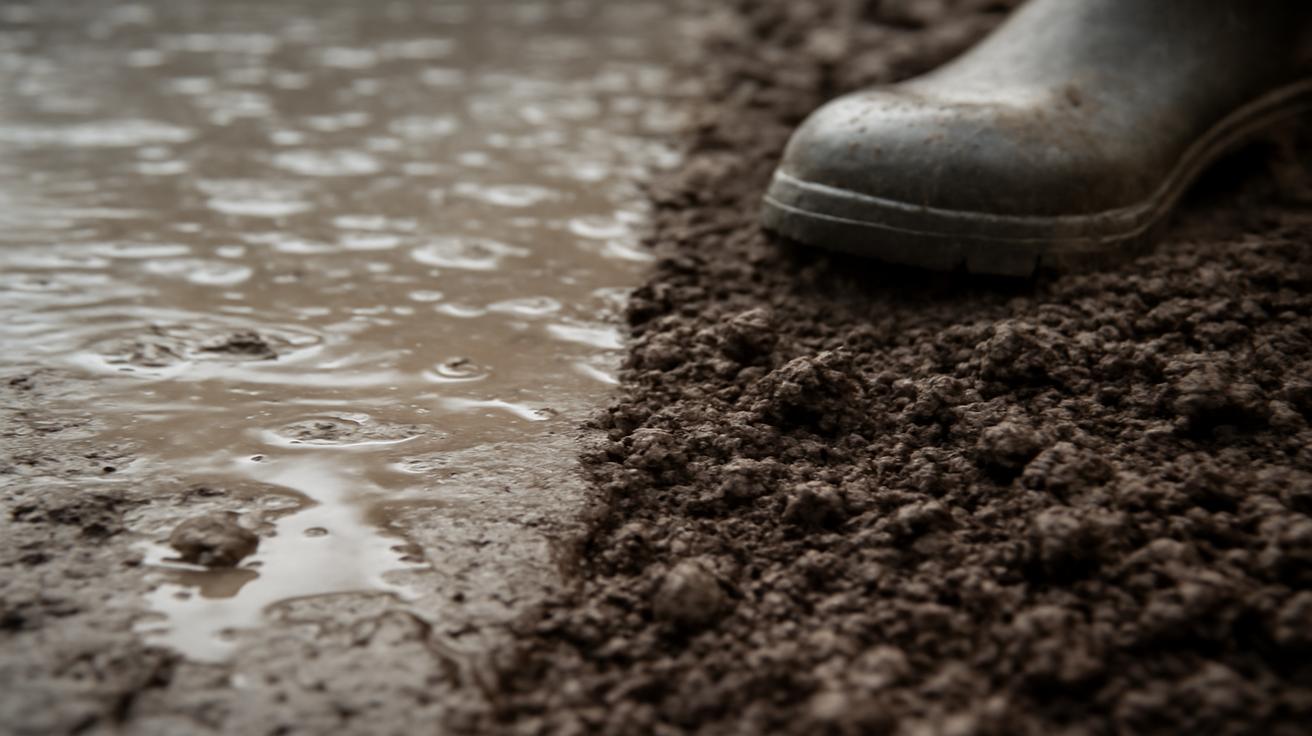
The first time I stopped raking my vegetable beds perfectly flat, it felt a little like breaking a rule handed down from gardening elders. The bed looked rumpled, a little wild, almost careless. I kept wanting to reach for the rake, to smooth the bumps, to press the soil down “neatly” the way I always had. But a week later, during a heavy spring rain, I watched something I’d never seen in my garden before: the water didn’t sit. It slipped in. The puddles that usually formed like mirrors on my tidy, flattened beds never appeared. Instead, the rain threaded its way between little ridges and hollows, soaking in quietly. The soil drank; it didn’t drown.
The Day the Soil Started Breathing Again
If you’ve spent years flattening and tamping your garden beds, you probably know the ritual. You pull out the rake or the hoe, work the surface until it’s perfectly level, then press it down “just to firm it.” It looks satisfying. Predictable. As if perfection on the surface guarantees success in what grows above it.
But soil is not a floor. It’s not a platform for plants. It’s a living, layered community, and when we flatten it, we often silence the very processes we want to encourage.
Imagine this: a soft early evening, the air thick with the scent of damp leaves. You turn the hose onto a bed you’ve been cultivating for years. On the left side, a bed you’ve always flattened: raked smooth, stepped along the edge to firm it down, edges neat as a freshly made bed. On the right, a newer experiment: no tamping, no obsessive leveling. Just a surface left slightly lumpy, sprinkled with bits of mulch, leaves, and the gentle footprints of worms.
Within seconds, the difference appears. On the flattened bed, water pools in shallow sheets, spreading faster than it sinks. Tiny rivulets form and slide across the pan-like surface, looking for the lowest point. You can almost hear the soil gasping beneath the thin glaze of water, deprived of air once again.
On the unflattened bed, the water disappears more quickly. It pauses in a small depression, then vanishes, drawn down through invisible channels. You see it finding pathways into the earth—down worm tunnels, through root voids, among crumbly clusters of soil that behave more like a sponge than a slab.
This is the quiet magic that begins when gardeners stop trying to iron the earth.
Why Flat, Tamped Soil Struggles with Water
Flattening soil seems harmless. After all, you’re not using heavy machinery, just your boots or a rake. But to soil life, even that light compaction matters. Those tiny crumbs and pores—the spaces that hold air and let water through—are easily squashed. Over time, the surface becomes tight and crusted, especially after rains.
When rain or irrigation hits that compacted surface, it battles a sealed layer. Instead of slipping between crumbs, the water hits a barrier that resists infiltration. It spreads sideways, creating runoff. It pools, evaporates, or, in heavier bursts, erodes your topsoil altogether. The garden might still grow, but the soil beneath is slowly becoming less alive, less porous, less welcoming to roots and microbes.
Unflattened soil behaves differently. It preserves microtopography—those small rises and hollows you see after you loosen soil gently with a fork or allow organic matter to accumulate instead of scraping it away. Water lands unevenly, gathers in dips, and then, crucially, has more time and ways to move down rather than out. In the spaces between crumbs and aggregates, it settles in and becomes available to roots rather than lost to evaporation or runoff.
It sounds almost too simple: stop flattening, and water will infiltrate better. Yet again and again, gardeners discover that their soil starts to manage water on its own when they stop trying to flatten its personality away.
The Invisible Engineers Under Your Feet
What really makes this shift possible are the creatures you rarely see. Earthworms, fungi, springtails, beetles, bacteria – they are the architects of the underground. But they work best in a world full of nooks, crannies, and varied conditions.
When you don’t flatten, you keep more of those nooks intact. Worm tunnels stay open. Fungal threads stretch between crumbs. The surface roughness slows raindrops so they land more gently, instead of hammering the soil into a crust. Bits of leaf litter and mulch tuck into low spots, where they decompose slowly, feeding microbes that glue soil particles together into stable aggregates.
Those aggregates—crumbs of soil held together by organic glues—are your real water managers. They create pores of different sizes: small ones that hold water like a sponge, and larger ones that move water downward like tiny pipes. Flattening breaks and smears them; leaving the soil surface more natural lets them accumulate and stabilize.
So when gardeners stop flattening, they’re not simply being lazy. They’re inviting the underground engineers to reopen the plumbing.
Letting Go of the “Perfect” Bed Surface
There’s a quiet perfectionism in gardening that often goes unnamed. We straighten edges, line up rows, scrape away stray leaves. A smooth, flat bed feels orderly and under control—a sign of diligence. So it can feel oddly rebellious to leave the surface a little messy.
You might catch yourself thinking, “But won’t my seeds wash away?” or “Won’t it look neglected?” Yet many gardeners who experiment with not flattening discover the opposite: their seeds stay put better in a textured surface, and their beds look rich, alive, and soft rather than stiff and sterile.
Instead of treating your soil surface like a tabletop, imagine it as forest floor in miniature. Forest soils, rarely if ever flattened, absorb water remarkably well—even during heavy rains. They are uneven, padded with leaves and stems, pockets of air, tiny sticks and roots. That complexity is exactly what helps them capture water before it can run away.
Small Shifts That Change Everything
You don’t have to stop all soil shaping at once. Instead, think in terms of gentle shifts:
- When you prepare a bed, loosen soil with a fork or broadfork, but don’t rake it smooth. Just brush aside large clods that would interfere with planting.
- Avoid stepping on beds. Walk in paths only, so the soil structure you’ve invited stays intact.
- When you plant seeds, make only the small furrows you need, rather than flattening the entire surface. Let the surrounding micro-ridges and hollows remain.
- Leave a light scattering of mulch or chopped plant residues on top between rows or transplants, instead of stripping the surface bare.
Each of these is a way of saying to the soil: “I trust you to shape yourself.”
| Habit | Flattened Soil | Unflattened / Gently Shaped Soil |
|---|---|---|
| Water after rain or irrigation | Pools, runs off, forms crust | Pauses in hollows, soaks in through pores |
| Soil life | Reduced worm channels, fewer aggregates | More tunnels, better aggregation, richer biology |
| Root growth | Shallow, constrained by dense layers | Deeper, following natural channels |
| Effort required | More raking, tamping, “fixing” after rain | Less fuss, more observing, minor adjustments |
Watching Water Change Its Mind
One of the most satisfying parts of this shift is simply watching what water starts to do differently. You may notice it during the first storm after you decide to retire your rake from flattening duty.
The raindrops arrive, ticking softly against the leaves of beans and kale. On a flattened bed, you’d see water skimming across the top, seeking escape. On your now-unflattened bed, the landscape is miniature but varied: a small ridge here where last year’s roots once ran, a slight dip there where a mole tunneled below, patches of compost and old mulch creating a mosaic of textures.
As the rain continues, each depression gathers a small pool, momentary and fragile. These puddles never have time to become trouble, because between the soft soil crumbs, water keeps slipping downward. You might press your fingers lightly into the earth and feel how far the moisture has traveled—deeper than before, cooler and more evenly spread.
Over weeks and months, the pattern often becomes consistent: you water less and get more out of it. Storms that used to wash your topsoil into the path now leave it in place. Young seedlings no longer sit with their roots in cold, stagnant puddles. The whole system feels calmer, more buffered against both dry spells and downpours.
Less Effort, More Partnership
That’s the quiet gift hidden in this approach: there is no extra gadget, no elaborate technique, no backbreaking labor. The improvement in infiltration arrives not because you worked harder, but because you stopped working against the soil’s own design.
We are used to thinking that better gardens always demand more: more amendments, more irrigation, more clever tools. But sometimes, better comes from stepping back. From noticing that the soil, given half a chance, builds its own structure far better than we can sculpt it.
The rougher, gently settled surface becomes a kind of treaty between you and the land. You agree not to press it into hard submission; it agrees to handle water with more grace. It’s a partnership that invites patience and curiosity. When a heavy rain falls, instead of worrying, you find yourself leaning at the window, eager to see how your unflattened beds will respond this time.
From Control to Curiosity in the Garden
There’s a deeper shift tucked into this simple choice. When you stop flattening the soil, you also loosen your grip on the idea that every square inch must be managed and straightened. You begin to relate to the garden less like a project and more like a conversation.
Instead of asking, “How do I make this soil behave?” you start asking, “What does this soil do when I give it space?” You pay attention to where water naturally wants to gather, which spots stay moist longest, where the worms are most active, how the surface changes through the seasons.
This kind of noticing is its own reward. It grounds you in the rhythms beneath the plants—the breath of the earth itself. You become attuned to the subtle sigh of a bed that has finally begun to absorb water again, instead of tensing up under every rainfall.
And you realize that every time you resisted the urge to flatten, you were quietly making room for life: for the roots to wander, for microbes to multiply, for fungi to spin filaments through dark corridors of air and moisture. You begin to see that healthy soil isn’t just “good dirt”; it’s a living sponge, a slow-moving reservoir, a community that’s been practicing water management for millennia.
So, if you find yourself standing at the edge of your garden this season, rake in hand, ask yourself a gentle question: What would happen if I did a little less here? If I let the surface stay a bit rumpled, a bit uneven, a bit more itself?
You might find that the answer arrives with the next rain: a quiet, steady soaking, water slipping into the soil with an ease you never had to force.
FAQ
Will my seeds still germinate well if I don’t flatten the soil?
Yes. You only need small, locally firmed areas for seeds. Make shallow furrows or individual planting holes and gently press just around the seed. The rest of the bed surface can stay slightly uneven. In fact, the micro-depressions help catch water and keep the seed zone moist without creating surface crusting.
Could uneven soil cause water to pool and drown plants?
If the soil is very compacted below the surface, any bed can hold standing water. But a naturally textured, unflattened surface usually reduces pooling because water has more entry points. Over time, as soil life improves, infiltration gets better and standing water becomes less common. If you notice a persistent puddle, gently loosen the soil there rather than flattening the whole bed.
Does this approach work in clay soils?
It can be especially helpful in clay. Flattening clay tends to create a hard, slick surface that sheds water. Leaving the surface more textured, combined with adding organic matter and avoiding compaction, helps build structure in heavy clay. It won’t transform overnight, but season by season you’ll usually see better infiltration.
How do I keep the garden looking “tidy” without flattening everything?
Use clear paths, defined bed edges, and intentional planting patterns. These give a sense of order even if the soil surface is softly uneven. A light, even layer of mulch can also make beds look finished while still preserving microtopography underneath.
Will I need to water less if I stop flattening my soil?
Many gardeners notice they can water less often because more of the water they apply actually enters and stays in the root zone. Results vary by climate and soil type, but improved infiltration and structure usually mean better water retention and less waste through runoff and rapid evaporation.






Leave a Comment