
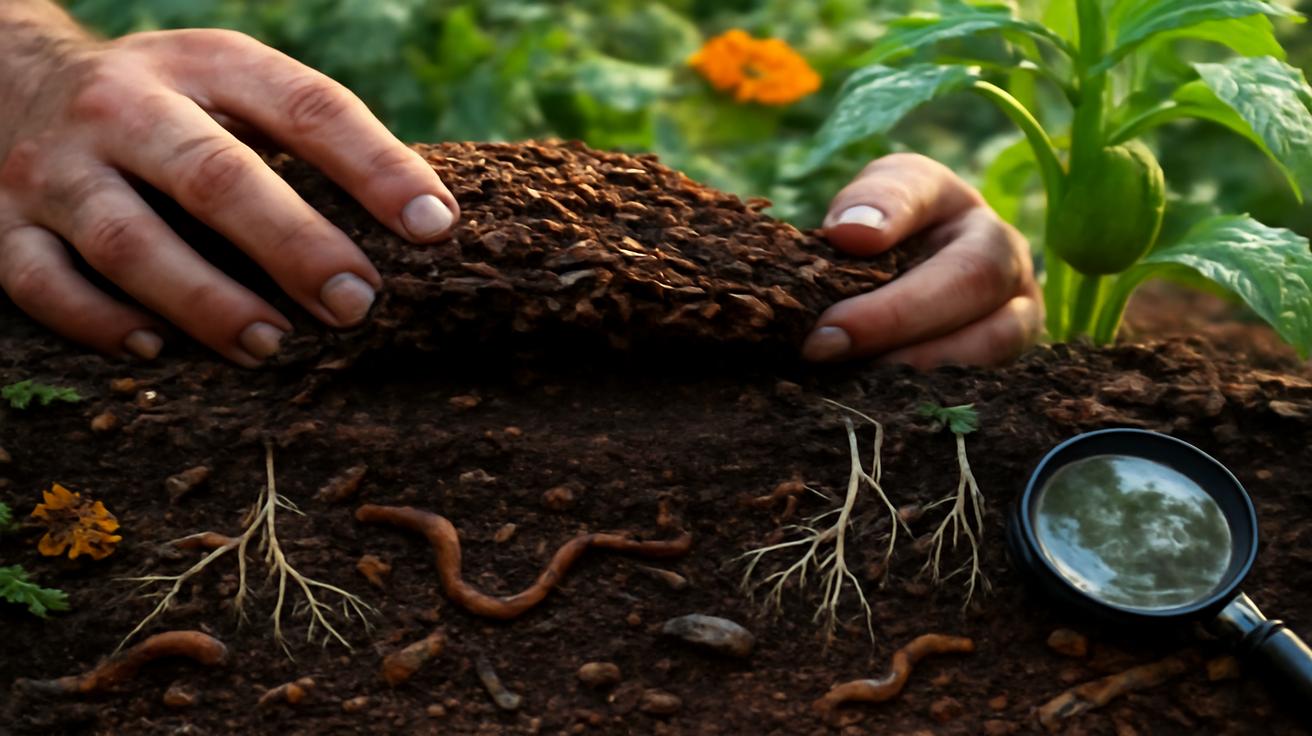
The first thing you notice isn’t the flowers. It’s the sound. A slow, velvet buzz of bumblebees drifting between blossoms, the crisp rustle of beetles slipping beneath leaves, the delicate crumble of soil between your fingers that feels more like cake than dirt. The garden in front of you doesn’t shout with manicured perfection. It hums. It breathes. It feels alive in a way that’s hard to name but impossible to ignore.
At first glance, it looks a little wild: leaves left to decay where they fall, stems standing long after flowering, mulch laid thick like a comforting blanket. But stay a moment, kneel down, and the true story begins underground. This is a garden shaped not just by what grows above the surface, but by what’s protected below it. Here, the gardener doesn’t just tend plants. They tend the soil’s hidden life—and in return, the garden offers something that goes far beyond strong stems and lush harvests.
The Day You Realize the Soil Is Alive
Most gardeners can point to a moment when their view of soil shifts. For some, it’s the first time they pull up a weed and see more worms than roots. For others, it’s the way a bed once hard as brick transforms into something soft and friable after a season of compost and mulch.
For Lena, it happened on a gray November afternoon. The community garden where she rented a small plot had finished its last harvest, and other gardeners were busy “cleaning up”—yanking brown stems, raking bare earth into exposed, obedient order. Lena, new to gardening, followed their lead for a few minutes. The more she cleared, the more the bed looked like a wound.
On a whim, she walked over to the older man at the far corner plot. His garden looked different: nothing was cleared, only gently cut back. Leaves still hugged the beds like a quilt. She watched as he pushed his hand into the soil. No shovel. Just fingers. The soil parted like chocolate cake.
“You don’t turn your soil?” she asked.
He smiled. “I try not to disturb the city that lives in there. They do better work than I ever could.”
The city. It lodged in her mind. Not a substance. Not dirt. A city. Microbes like invisible citizens, fungal highways, earthworm architects, beetle janitors, springtail commuters. That winter, instead of stripping her garden, she laid down leaves and compost and walked away. By spring, her soil smelled rich and woodsy, the way a forest floor smells when you move the duff aside. The seeds she planted seemed to leap up from it.
But what surprised her most wasn’t the plant growth. It was the way the garden began to change everything else—her routines, her moods, conversations with neighbors, the frequency with which birds visited, even the way rain moved across the surface of her little patch of Earth.
The Underground Allies We Never See
Beneath the mulch of any soil-respecting garden, an entire web of life weaves quietly. This underground community doesn’t just support plants; it shapes the character of the place itself.
There are the fungi, sending out gossamer threads of mycelium that wrap gently around roots, exchanging nutrients like currency in a silent marketplace. Bacteria crowd around root tips, forming tiny, shimmering biofilms that help plants access nutrients and even communicate stress. Earthworms churn tunnels that allow rain to soak in instead of rushing away in a flood. Predatory nematodes keep their plant-eating cousins in check. Microarthropods—those near-microscopic little jaws and legs—shred decaying leaves into bite-sized pieces for others to break down.
Most conventional gardening habits treat this entire web as either irrelevant or expendable. Tilling breaks the fungal networks. Synthetic fertilizers short-circuit the careful give-and-take between microbes and roots. Bare soil bakes in the sun, its moisture and microscopic residents evaporating together.
Gardeners who choose instead to protect this living soil begin to notice subtle shifts:
- Water soaks in faster and stays longer.
- Plants look resilient, not just big.
- Fewer pests appear, and when they do, they don’t stay long.
- The soil grows darker, more crumbly, more fragrant with each season.
It’s easy to say, “Healthy soil equals healthy plants.” That part is true—and well known. But in gardens that protect soil life, the changes spill outward, touching pollinators, birds, the gardener’s own sense of time and responsibility. The benefits blur the line between ecological and emotional, practical and spiritual.
Beyond Bigger Harvests: Unexpected Rewards of Protecting Soil Life
Ask soil-conscious gardeners what they’ve noticed beyond yield, and their answers stretch well past “more tomatoes.” Patterns emerge: calmer minds, richer wildlife, easier maintenance, surprising resilience in droughts and storms.
Here’s how those underground allies ripple outward into everyday life:
1. A Calmer, Slower Way of Gardening
When you decide not to overturn the soil, something else flips instead: your relationship with time. You stop seeking immediate, chemical quick fixes and start investing in slow processes.
Mulching instead of bare-tilling. Feeding the soil instead of feeding the plant. Leaving roots in the ground after harvest so soil organisms have something to chew on. Each choice is small, but it trains you to accept that not all progress looks like constant activity.
Soon, the pace of the garden becomes a kind of antidote to the rest of life. You kneel, pull back mulch, see a pill bug scuttle away, and realize you’re watching decomposition in motion—the quiet miracle that turns waste into fertility. Protecting soil life demands patience, and in practicing that patience, gardeners often discover a kind of low, steady joy.
2. A Backyard Wildlife Refuge
Living soil isn’t just good for plants; it feeds a whole chain of life that extends above ground. That thick mulch layer? It shelters beetles that prey on pests. The leaf litter on the edges of the beds? It becomes overwintering habitat for solitary bees. The undisturbed soil? It houses ground-nesting insects and spiders, many of which take care of aphids, slugs, and other troublemakers.
Birds notice. Hedgehogs, toads, and lizards notice, where they are native. What began as a choice about earthworms and microbes becomes a full-blown wildlife corridor, even in a small urban lot. Gardeners who prioritize soil life often speak about an uptick in birdsong, in soft rustlings at dusk, in the sense that the garden is not a display, but a neighborhood.
3. Resilience in the Face of Weather Extremes
Healthy soil behaves like a sponge and a shock absorber. When heavy rain falls on bare, compacted ground, it sheets off, taking bits of soil—and nutrients—with it. When rain falls on a bed protected with mulch and rich in organic matter, it seeps in, finds worm tunnels, moves slowly downward. In drought, those same organic-rich soils release water back to the roots like a savings account.
Gardeners who care for soil life often notice that their plants bounce back faster from heat waves, rebound from a missed watering, or stand unruffled after storms that flatten neighboring beds. That resilience carries a quiet peace of mind: you don’t have to hover and rescue as much. The garden, supported from below, can carry more of itself.
4. Less Work, More Observation
At first blush, protecting soil might sound like more work—composting, mulching, resisting the urge to tidy. Over time, it often becomes less work, just work of a different kind. You weed less because the soil is covered. You water less because the soil holds moisture. You fertilize less because every fallen leaf is now a resource, not trash.
What fills the space is observation. You start to notice where the soil stays moist longest, where the worms congregate, which patches of mulch disappear the fastest. You find yourself learning your garden’s microclimates by feel, not just by reading labels or calendar reminders.
5. A Shift in How You See Waste
In a living-soil garden, “waste” becomes an endangered word. Weeds pulled before flowering get laid on the surface as green mulch. Autumn leaves are not bagged and dragged to the curb; they’re welcomed home as winter blankets. Coffee grounds, vegetable scraps, eggshells—all become ingredients, not garbage.
This changes how you see your household. The apple core in your hand is no longer something to get rid of; it’s a future crumb of soil, a small gift to your underground city. Protecting soil life often nudges gardeners toward broader changes—less plastic, more reusing, more asking where things go when they leave our hands.
Simple Practices That Safeguard Soil Life
Protecting soil life doesn’t require a degree in microbiology, just a shift in habits. The garden doesn’t ask for perfection—only for a gentler touch.
- Keep soil covered: Use leaves, straw, grass clippings, or compost as a protective layer. Bare soil is like exposed skin in a blizzard or under a desert sun.
- Disturb less: Replace heavy tilling with minimal digging. Use a fork to loosen, not flip, or create permanent beds you rarely step on.
- Feed from above: Add compost, not by mixing deeply, but by top-dressing and letting worms and microbes do the hauling.
- Grow roots year-round: Where possible, plant cover crops or perennials so microbes always have root exudates—the sugars and compounds plants leak into the soil.
- Reduce harsh chemicals: Limit or eliminate synthetic fertilizers and pesticides that can disrupt soil communities.
To see how these choices stack up in daily practice, consider a quick comparison:
| Gardening Approach | Typical Habit | Effect on Soil Life | Long-Term Result |
|---|---|---|---|
| Conventional, soil-ignoring | Annual tilling, bare beds, quick synthetic feeds | Fungal networks broken, microbial balance disrupted | Compacted soil, higher inputs, more fragility |
| Soil-life protecting | Mulch, minimal disturbance, organic inputs | Diverse soil web thrives and self-organizes | Improving structure, fewer problems, more resilience |
Notice that the “soil-life protecting” column doesn’t promise instant miracles. It promises direction—each year better than the last, each season building on the work of the one before.
Stories from Gardens That Chose the Underground
In a small backyard, a young family plants a mix of vegetables, herbs, and flowers in raised beds. The first year, they follow an online guide that recommends frequent tilling and granular fertilizer. The tomatoes grow large, the lettuces crisp—but the soil beneath feels tired by autumn, pale and lifeless.
The second year, they experiment. They stop tilling and instead lay down shredded leaves in fall. They sprinkle compost on top in spring and plant directly into that soft, quiet bed. By midsummer, they notice something: the soil stays damp between waterings, and when they slide a hand shovel in, earthworms coil and uncoil like slow question marks. They start seeing robins hunting in the beds each morning, flicking mulch aside to snag breakfast.
On the other side of town, an older gardener who has tended the same plot for twenty years no longer measures success only in pounds harvested. He measures it in the number of fungi he can spot when he lifts a chunk of mulch—fine, white threads lace the underside. In the spring, he notes how quickly the snow melts on his garden, how the dark soil draws warmth and wakes earlier.
“I used to think soil was something you bought in a bag,” he says now. “Now I know it’s something you raise.”
In a schoolyard garden, a teacher invites her students to scoop soil from two patches: one from a bare, compacted edge of the playground, and one from a mulched vegetable bed. They hold the samples up to their noses. The playground soil smells faint, dusty. The garden soil smells rich and complex, like walking through a forest after rain.
“This one smells like it’s breathing,” one of the children says.
They look at both samples under a simple microscope. The living soil wiggles with tiny forms; the bare patch shows far fewer. In that instant, for a classroom of children, soil stops being a background and becomes a universe.
What Protecting Soil Life Gives Back to the Gardener
At the heart of it, soil protection is an act of reciprocity. You cover, feed, and spare the underground world from chaos, and it offers you a cascade of gifts that can’t be bought in a bottle.
- Trust: Knowing that there is a system beneath your feet ready to step in—buffering pH, cycling nutrients, holding water.
- Curiosity: A reason to lean closer, scoop up a handful, and ask, “Who’s here today?”
- Companionship: A garden that feels less like a project and more like a collaboration.
- Humility: The realization that the most important work in your garden happens where you can’t see it.
- Belonging: A feeling that your small patch is participating in something larger: the restoration of living soil on a planet that has lost too much of it.
In the era of climate worries and ecological grief, there’s something deeply grounding about kneeling in a bed you’ve tended for years and feeling its steady improvement. Year by year, the mulch turns to humus, the worms multiply, the fungi map out new routes. While headlines scream of loss and degradation, your soil quietly moves in the opposite direction—toward richness, toward abundance, toward life.
Plant growth is the most visible reward, and it is real: sturdier stems, deeper greens, fruit that carries the faint sweetness of a well-fed root system. But beyond the harvest baskets and bouquets, something subtler blooms in gardeners who protect soil life: a different way of being on the land, even if that land is only a few raised beds behind an apartment.
You begin to feel, in your bones, that caring for what you cannot see is one of the most powerful acts you can offer.
Bringing It Home: Your Own Patch of Living Earth
You don’t need a perfect plan to start. You don’t need specialized tools or rare amendments. You only need to begin with a shift in question: from “What can I get this soil to do for my plants this season?” to “What can I do for the life in this soil this year?”
Try letting one bed go untiled this season. Lay down leaves instead of clearing them away. Add a thin layer of compost on top of the soil instead of digging it in. Watch how water behaves, how the texture changes. Keep notes. Notice which plants seem more at ease, which corners attract more birds or insects.
Over time, those small experiments stack up into a deep, quietly radical practice: gardening not as dominion, but as stewardship of a world that teems just below your fingertips.
In that world, the soil is not a backdrop or a tool. It is a living, breathing partner. Gardeners who choose to protect it find themselves rewarded not only with thriving plants, but with something harder to quantify: a feeling that they, too, are being tended—by the slow, generous work of life unfolding under their feet.
FAQ
Why is disturbing soil harmful to soil life?
Frequent tilling or deep digging breaks up fungal networks, exposes microbes to light and air they’re not adapted to, and destroys the structure that earthworms and other organisms create. Occasional, gentle digging is fine, but repeated disturbance forces soil life to constantly rebuild instead of steadily improve your soil.
Can I protect soil life in containers or on a balcony?
Yes. Use high-quality compost, keep the surface mulched with leaves or straw, avoid over-fertilizing, and disturb the soil as little as possible when replanting. Even in pots, worms, microbes, and fungi can thrive under the right conditions.
Do I have to stop using all fertilizers and pesticides?
Not necessarily, but reducing reliance on harsh synthetic products helps. Use compost and slow-release organic fertilizers where possible, and reserve targeted pest controls for serious issues. Many soil-life gardeners find they need far fewer interventions as the underground web strengthens.
How long does it take to see benefits from protecting soil life?
Some changes, like improved moisture retention and easier digging, can appear within a single season. Deeper transformations—richer structure, more wildlife, and long-term resilience—unfold over several years of consistent practices.
Is mulching really necessary for healthy soil?
While not absolutely required, mulching is one of the simplest, most powerful ways to protect soil life. It moderates temperature, preserves moisture, provides food for decomposers, and shields microbes from harsh sun and rain. In nature, bare soil is rare; your garden benefits from the same constant cover.







Leave a Comment