
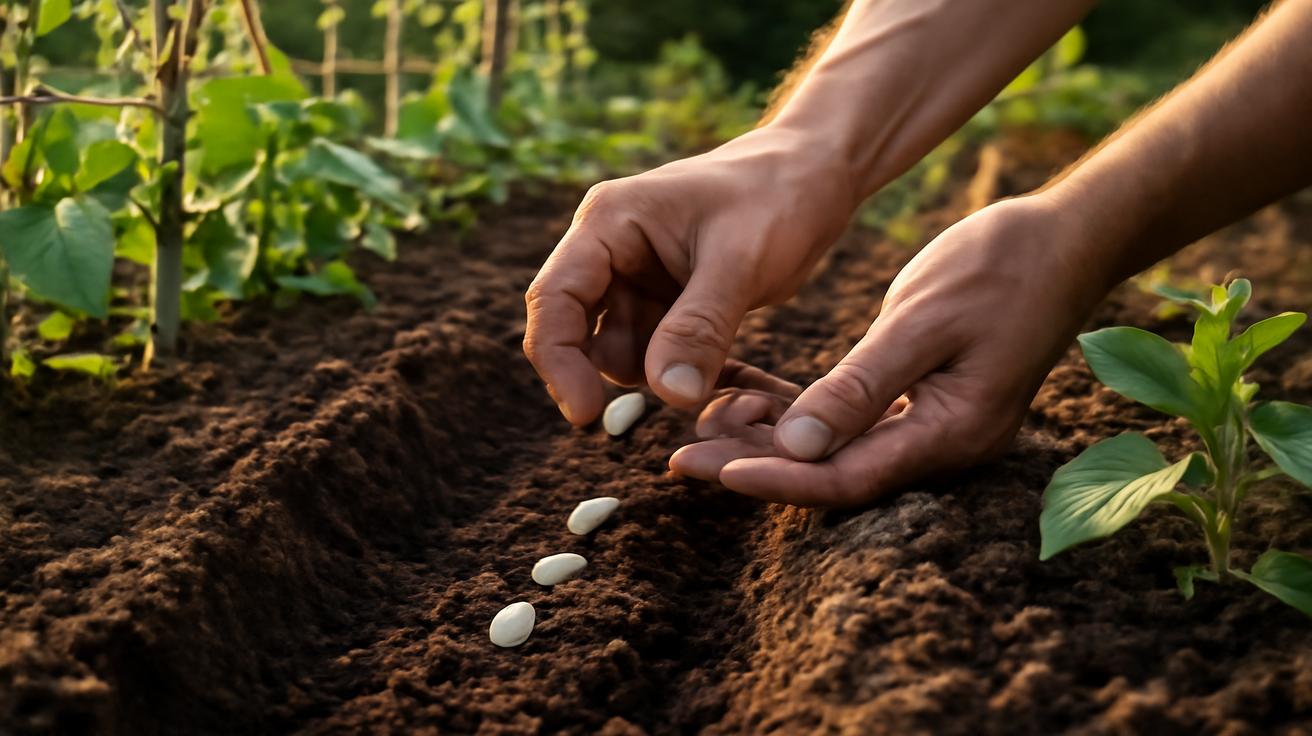
The first thing you notice is the sound. Not the distant whine of traffic or the thrum of a lawnmower, but the particular hush that settles when people are listening to plants. In a small community garden behind an apartment block, three neighbors are bent over a patch of soil, palms pressed into the earth, eyes narrowed in concentration. They are not just planting beans. They are experimenting, comparing, questioning. One cradles a seed between finger and thumb as if weighing possibility. Another runs a hand along a trellis of twine, testing its give. It looks simple from the outside: dig, drop, cover, water. Yet what’s happening here reflects a quiet revolution. Gardeners are changing the way they plant beans, and in the process, they are discovering how much more these unassuming seeds can give when we meet them halfway.
The Shift From “Just Stick Them In” to Paying Attention
For a long time, beans carried a reputation as the easy children of the vegetable world. Plant them after the last frost, point the eye downward, remember to water them, and they’ll likely grow. They were the backup plan crop, the reliable understudy if tomatoes sulked and cucumbers sulked harder. But talk to gardeners now—backyard tinkerers, balcony growers, small-scale farmers—and you’ll hear a different tone. They still trust beans, but they no longer take them for granted.
“Five years ago I just poked them into the ground,” says Maya, a first-generation gardener who turned a scrappy city yard into a small jungle of edibles. “They’d come up, sure. But they were kind of… fine. Now that I treat beans like a real partner instead of a placeholder, they’re outrageous. Taller, thicker stems, fuller leaves, and I don’t have to baby them through the summer.”
What changed is not the bean itself, but the attention paid to the choreography around it: when it goes into the ground, how deeply it’s planted, what sort of support it climbs, what lives in the soil waiting for those roots. Like many quiet revolutions, this one started with observation. People noticed that two rows of the same variety—planted just days apart, or with slightly different spacing—told wildly different stories. One row sulked in yellowish hesitation; the other sprinted skyward, leaf by leaf.
Those tiny differences paired with collective curiosity have led to a new wave of planting habits, passed along in seed swaps, online forums, garden club meetings, and stoop-side conversations. Instead of simply asking, “Will this grow?” gardeners are asking, “How strong can this grow, and what can I do to help?”
Rethinking Variety: Not All Beans Want the Same Life
From “Green Beans Are Green Beans” to a Cast of Characters
Open a seed catalog and the bean section feels less like a grocery list and more like a roll call of personalities: rattlesnake pole beans with their curving, streaked pods; slender French filet beans; sturdy bush types that sit compact and dependable; scarlet runners that throw out crimson blooms like festival flags. It used to be that gardeners picked based mostly on color and days to maturity. Now, many are beginning with a different question: What kind of life does this bean want?
Pole beans are adventurers. They want height, space, and a structure to explore. Bush beans are homebodies, content to fill out low and dense, asking little more than sufficient room and sunlight. Dry beans prefer the patience of a long season and good airflow so their pods can mature and cure. Understanding who’s who changes how and where they’re planted.
Maya learned this the hard way. “I tried to cram pole beans into short cages meant for tomatoes. They twisted on themselves, slumped, got tangled. They did grow—but they never looked happy. Once I built a tall A-frame trellis and spaced them a little wider, they just exploded. Same seeds, completely different energy.”
Gardeners are experimenting not only with support structures but with variety mixes. Some plant bush beans in the front of a bed and pole beans at the back, allowing two habits to coexist without competition. Others intermix shelling beans with snap beans, so the bed provides both fresh eating and dry storage from the same footprint. The shift is subtle but powerful: beans are no longer generic. They are distinct characters in an ensemble cast, and how they’re planted reflects that growing respect.
Soil, Inoculants, and the Quiet Work Underground
Feeding the Beans by Letting the Beans Feed Themselves
If you dig up a thriving bean root system, you’ll see it: tiny pearly nodules clinging to the roots like beads. Inside those nodules live rhizobia bacteria, the quiet chemists that turn atmospheric nitrogen into plant-ready food. This symbiosis is the secret engine of beans. Yet for decades, many hobby gardeners barely thought about it. Soil was either “good” or “bad,” and fertilizer was something you added from a box or bottle.
The new wave of bean planting starts below the surface. Instead of asking, “How much fertilizer do I need?” gardeners are asking, “Who’s already here, and who’s missing?” That “who” is microbial. Rhizobia don’t just appear in every patch of ground at the same levels, especially in new raised beds filled with sterile or heavily composted mixes.
This is where inoculants have stepped quietly into the routine. A small packet of fine, dark powder—rhizobia matched specifically to legumes—is dusted onto seeds just before planting. The act is humble and takes seconds, but what follows underground is a microscopic handshake. The bacteria colonize the roots, build nodules, and begin feeding the plant in exchange for plant sugars. Gardeners notice the result above ground: sturdier stems, deeper green leaves, faster recovery after a hot spell.
“It felt silly the first time,” admits Andre, who gardens in containers on a second-floor balcony. “I dabbed this charcoal-looking dust on the seeds and thought, ‘This can’t actually matter.’ But the bean plants I inoculated were twice as vigorous as the ones I didn’t. I had to stake the inoculated ones more carefully because they were so heavy with pods.”
Along with inoculants, there’s a shift in how soil itself is prepared. Many gardeners now lay down compost in fall rather than spring, allowing moisture, time, and soil life to integrate it. They avoid over-fertilizing with nitrogen-heavy products, recognizing that too much free nitrogen can actually discourage roots from forming nodules. The goal is no longer just “rich soil” but alive soil.
Timing, Soaking, and Spacing: Small Tweaks, Big Results
Learning to Read the Season and the Seed
If you grew up with gardening elders, you might remember rules like “Plant beans after the lilacs bloom” or “Wait until the soil is warm enough to sit on comfortably.” These folk metrics, rooted in observation, are making a comeback in a more intentional form. Gardeners are paying attention not only to the calendar but to soil temperature, nighttime lows, and the soil’s feel under bare hands.
Beans sulk in cold, wet soil. Seeds may rot, or early seedlings may turn purple and stunted. Planting just a week or two too early can mean a month-long delay in real growth. With springs becoming more unpredictable in many regions—late cold snaps, early heat waves—people are trading impatience for precision. Simple soil thermometers have become as common as trowels. Gardeners wait for a consistent soil temperature around what’s recommended for their variety—often in the mid-60s °F (around 18 °C) or higher—before committing beans to the ground.
Then there’s the question of soaking. For some, soaking bean seeds in water for a few hours before planting speeds germination. Others have found that in cool or heavy soil, soaked seeds are more likely to rot. The new approach is nuanced: gardeners adjust soaking times based on their conditions. In hot, dry climates, a short pre-soak helps beans break dormancy quickly and outpace the drying surface soil. In damp climates, many now plant dry and rely on a gentle, consistent watering schedule instead.
Spacing, too, is getting reimagined. The old advice often suggested dense rows. Now, many growers are pulling plants slightly farther apart to encourage better airflow, stronger individual root systems, and easier harvesting. This is particularly true in humid regions where fungal diseases can rip through a crowded bean patch. It turns out that giving each plant just a bit more elbow room can mean healthier vines and a longer, more generous harvest.
| Planting Choice | Traditional Approach | Emerging Practice for Stronger Growth |
|---|---|---|
| Soil Prep | General compost added at planting time | Compost added in fall, focus on living soil and gentle nutrients |
| Seed Treatment | Plant without inoculant | Use rhizobia inoculant to boost nitrogen-fixing nodules |
| Timing | Based mainly on calendar date | Based on soil temperature and recent weather patterns |
| Spacing | Crowded rows for higher plant count | Slightly wider spacing for stronger plants and airflow |
| Support | Basic stakes or low cages | Tall, sturdy trellises matched to variety and wind exposure |
Vertical Dreams and Living Architecture
From Simple Stakes to Climbable Skylines
Look closely at modern bean patches and you’ll see something striking: they’ve grown taller. Where many gardens once used short bamboo sticks or repurposed tomato cages, now you find eight-foot teepees, string lattices stretching like spiderwebs, and arches made of cattle panels bending into green tunnels. Vertical gardening has moved from a niche trick to a central strategy, and beans might be its greatest beneficiaries.
Pole beans, in particular, seem to answer with delight. Given something to climb that matches their vigor, they respond by thickening, branching, and setting pods from ankle height to above your head. With this new architecture, a single square meter of soil can produce meals for weeks. The strength of the plants often mirrors the strength of their supports.
“I underestimated wind,” confesses Russell, who gardens on a hilltop where summer breezes regularly become gusts. “My first year with tall trellises, I used flimsy stakes. A storm came through and the whole structure leaned at a 45-degree angle. The beans twisted, some snapped. The next season, I set solid posts, anchored them deep, and ran horizontal crossbars. The beans were like different plants—more confident, if a plant can be confident.”
Beyond yield, these new vertical systems change the way gardeners move through their space. Walking under a bean tunnel, you can hear the soft rustle of leaves, feel the filtered light on your skin, smell a faint greenness like fresh-cut stems and rain-cooled stone. Harvest becomes an immersive experience; reaching up for a dangling pod connects your body to the structure in a small, satisfying stretch. This intimacy can have practical consequences, too: when people enjoy being among their plants, they notice trouble earlier—chewed leaves, signs of mildew, a wilting vine that hints at a root issue.
Companions, Cover Crops, and the Wider Community of the Bed
Planting Beans as Part of a Neighborhood, Not a Monoculture
Beans have never grown alone in the wild. They evolved in a world of companions: grasses, broadleaf plants, vining neighbors, and a tapestry of creatures underfoot. Gardeners are echoing that complexity by rethinking what shares a bed with beans and what precedes or follows them through the season.
The classic “Three Sisters” tradition—beans grown with corn and squash—is being revisited in both community and home gardens, not as an aesthetic nod but as a science-backed collaboration. Corn gives beans a sturdy living pole; beans offer nitrogen; squash sprawls to shade the soil and suppress weeds. In modern adaptations, tall sunflowers sometimes stand in for corn, or compact bush squash varieties are used in limited spaces. The underlying principle is the same: each plant earns its place by giving as well as taking.
Even outside of such iconic combinations, gardeners are threading beans through a larger fabric of plantings. Low-growing herbs like thyme or oregano at the edge of bean beds can draw beneficial insects and protect bare soil. Flowering companions like calendula or nasturtium bring in pollinators and predatory insects that help control pests. Some growers sow quick cover crops—like clover or buckwheat—in the off-season, then cut them down before planting beans, leaving their roots to feed soil life and their top growth as mulch.
All of this shifts the question from “Where should I put my bean row?” to “What kind of community do I want around my beans?” The answer, more and more, is one that supports stronger growth not through a single magic trick, but through a woven set of relationships.
A New Kind of Abundance
Late in the season, when the sun tilts lower and shadows lengthen across the garden, the changes in how we plant beans reveal themselves not in theory but in weight. Hands that once cupped a few slim pods at a time now cradle whole armfuls of them. Plants that used to yellow and tire by mid-summer are still pushing out fresh flowers, still setting new pods against a backdrop of mature ones firming toward dryness.
Walking through that community garden behind the apartment block in early autumn, you’d see trellises stitched with green, pods curving like commas, drying shells rattling softly when brushed. The air smells faintly of sun-warmed chlorophyll and damp mulch. Kneeling between rows, Maya runs her fingers along a vine, stopping at the knuckles of root where it disappears into the soil. “It’s not really about getting more beans,” she says after a moment. “It’s that now I feel like I understand them. I can read them.”
This, perhaps, is the quiet heart of the shift. Gardeners are changing how they plant beans not just to increase harvests, but to deepen the conversation. They are trading habit for attention, convenience for curiosity, assumption for experiment. In return, the beans answer in the only language they know: thicker vines, deeper greens, more generous yields, and a resilience that carries through summer heat and surprise storms.
The next time you press a bean seed into the earth, you might pause for a second longer. Feel the cool crumble of soil between your fingers. Notice the angle of the light, the smell of the air, the memory of last year’s plants and what they taught you. Then plant it not as a routine action, but as the opening line of a conversation that will last all season. In that small change of posture—from “Will it grow?” to “How strongly can it grow with my help?”—lies the real revolution unfolding quietly in gardens everywhere.
FAQ: Changing How We Plant Beans for Stronger Growth
Do I really need to use a bean inoculant?
Not always, but it can make a noticeable difference, especially in new beds, containers, or areas that haven’t grown legumes before. In established, healthy garden soil that regularly hosts peas and beans, natural rhizobia populations may already be strong. Many gardeners test it: they inoculate half their beans and compare vigor and yield.
How warm should the soil be before planting beans?
Most beans prefer soil consistently in the mid-60s °F (around 18 °C) or higher. Below that, seeds are slower to sprout and more vulnerable to rot or early stress. Using a simple soil thermometer and waiting for a stable warm trend can lead to faster emergence and stronger early growth.
Is soaking bean seeds before planting a good idea?
It depends on your conditions. In hot, dry climates or very free-draining soil, a brief soak (a few hours) can speed germination. In cool, damp, or heavy soil, soaking may increase the risk of rot. Many gardeners now adjust based on weather and soil rather than following one fixed rule.
How far apart should I space my beans?
For bush beans, slightly wider spacing than older recommendations—often around 10–15 cm between plants, with room between rows—can improve airflow and root strength. Pole beans usually benefit from 15–20 cm between plants along a sturdy trellis. Local climate, soil fertility, and variety can nudge those numbers up or down, so experimenting in your own garden is valuable.
What’s the advantage of growing beans vertically?
Vertical supports let beans express their natural climbing habit, which can result in thicker, healthier vines and higher yields from a smaller footprint. Tall, sturdy trellises also improve airflow, reduce some disease pressures, and make harvesting easier and more enjoyable—especially when beans hang at eye or shoulder level instead of hiding in dense foliage near the ground.
Can I grow beans with other crops in the same bed?
Yes, and many gardeners are doing this intentionally. Beans pair well with corn or sunflowers as living supports, and with low, spreading plants like squash that shade the soil. Herbs and flowers around the edges can attract beneficial insects and protect soil structure. The key is to avoid overcrowding and to choose companions that complement, rather than compete heavily with, your beans.
Do beans actually improve the soil for future crops?
They can, particularly when healthy nodules form on their roots. While most of the nitrogen they fix goes into their own growth, some remains in the roots and leftover plant material after harvest. Leaving roots in place and incorporating or mulching with bean residues can add modest fertility for the next crop, especially when combined with good compost and overall soil care.








Leave a Comment