
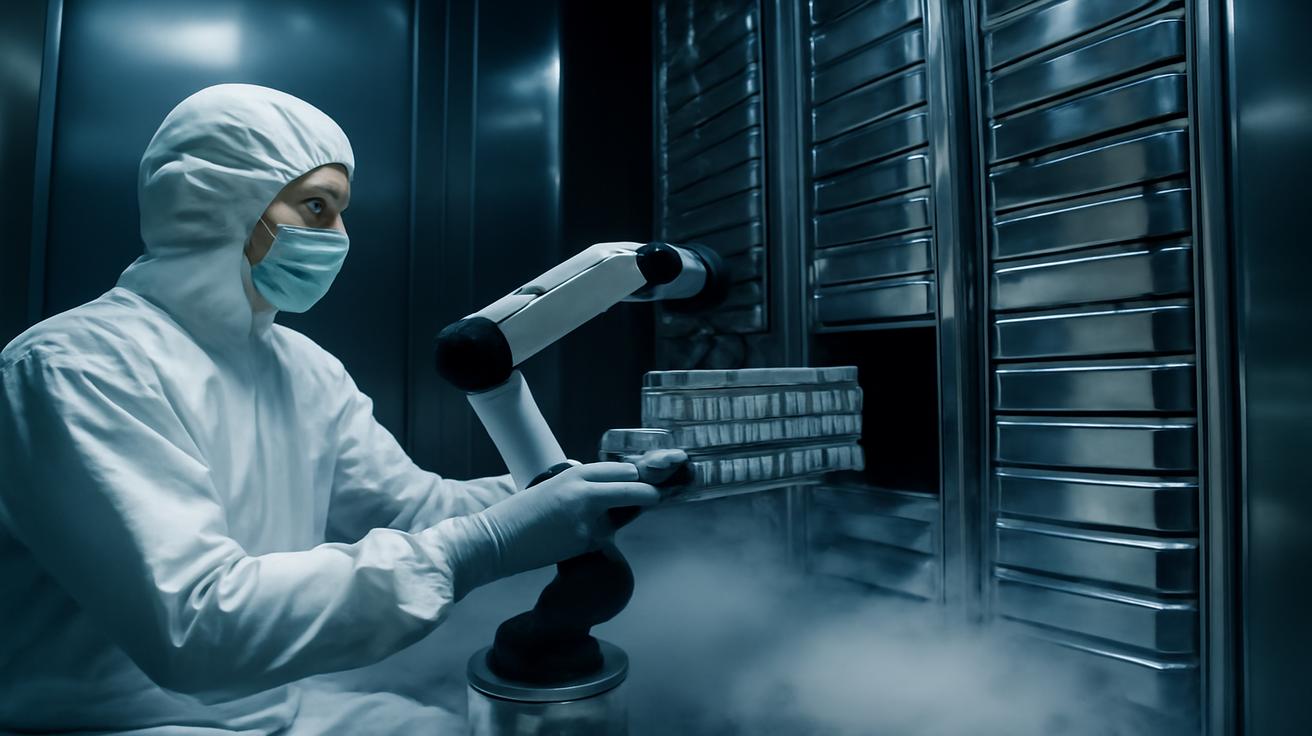
You don’t really feel the cold at first. Not through the double doors, or under the fluorescent lights, or over the low hum of the compressors. You just notice your breath hanging in the air like a tiny, private storm. Then the technician swings open one of the towering steel lids and there it is: a ghostly cloud rising from the tank, liquid nitrogen boiling and roiling, carrying within it what might one day be the last fragments of an entire planet’s wild heart.
Inside, under frost and stainless steel, are the frozen seeds of alpine flowers no longer found on their namesake slopes. Tiny vials of coral larvae that once clung to a living reef now bleached to bone. Blood samples from wolves, bats, frogs, and an unassuming prairie grass that feeds more animals than we’ll ever count. It looks, at first glance, like a high-tech pantry. But this is not a pantry. This is a bet. A quiet, almost unbelievable wager placed by an American company that believes the future of life on Earth may depend on how well we learn to freeze what we are busy destroying.
The Warehouse Where Time Stands Still
The building sits on the edge of an industrial park, the kind of nowhere you drive past without thinking. Delivery trucks lumber by, a chain-link fence rattles in the wind, and somewhere a forklift beeps in reverse. Nothing about the exterior suggests that it might be one of the most ambitious biodiversity projects on the planet.
You step inside and the air changes. The warehouse is strangely quiet, as if sound is muffled by all that cold. Long rows of dew-frosted tanks, each one roughly the size of a person, stand in disciplined lines. Every tank is a vault of absence and possibility, of what we have and what we have already lost.
This American company—let’s call it, broadly, a “frozen ark” operation—doesn’t grow food, or design apps, or sell you anything you can touch. Instead, it gathers living materials: seeds, spores, sperm, eggs, embryonic cells, slivers of tissue so small they cling to the edge of a pipette. Most of them belong to species you have never heard of and may never see. All of them are being placed on ice in a last-minute bid to outrun extinction.
Employees move through the rows briskly, shoulders hunched against the chill, scanning barcodes on cryovials, checking tank levels, topping off the liquid nitrogen that evaporates each day. Each sample gets a digital twin in their database: a name, coordinates, the story of where and when and how it was collected. “We’re trying to catch time by the tail,” one of the lab managers says, rubbing a gloved hand over a metal lid glistening with frost. “Before it slips away from us completely.”
The Insane Logic of Freezing Everything
On paper, the idea sounds like science fiction: build a library of life by freezing as much of it as possible. But the logic—if you accept a few chilling premises—is brutal in its simplicity.
First, we are losing species at a speed that makes the fossil record look lazy. Forests are cleared before anyone understands what lives there. Reefs bleach faster than legislation moves. Animals vanish without field guides ever having carried their names. Second, once a species is gone, its entire evolutionary story, written over millions of years, is erased in a single human lifetime.
The company’s founders stared at that curve of loss and asked a question that feels at once heroic and terrifying: what if we could pause it?
Cryopreservation—freezing biological material at ultra-low temperatures—has been around for decades. It’s used for human fertility treatments, livestock breeding, seed banks, even for preserving some individual cells for research. But scaling it up to become a planetary back-up drive? That’s the mad leap.
The scientists here are not just storing popular, photogenic animals. They are hunting for the hidden threads that hold ecosystems together: a nearly invisible moss that stabilizes a wetland; a beetle that pollinates a single shrub; a fungus that whispers nutrients from root to root under a forest floor. They talk about “functional diversity” in everyday conversation, about “saving options for futures we can’t yet imagine.”
It is not about building a zoo in deep freeze. It’s about preserving the raw ingredients of adaptation itself.
The Art of Freezing Life Without Killing It
To freeze life without destroying it is like trying to stop a river mid-fall without shattering the water. Cells are mostly water; freeze them wrong and ice crystals grow like knives, slicing delicate membranes, rupturing the micro-architecture that makes life possible.
In the lab, a young cryobiologist holds up a vial the size of your pinky finger. “Inside this,” she says, “could be the last viable sperm from a population of frogs that no longer exists in the wild.” She doesn’t say this dramatically. It’s almost a murmur, the way people talk around hospital beds.
To survive freezing, cells get bathed in cryoprotectants—compounds that slip between water molecules, slowing crystal formation, coaxing ice into a glassy, non-destructive state. Temperatures plummet faster than seems reasonable: down past the point where breath becomes frost, past the death of bacteria, until you arrive just above absolute zero, where molecules barely move at all. In that near-stillness, on that edge of nothing, life waits.
Waiting is the whole point. If the warming world is a ticking clock, these tanks are an attempt to tap the snooze button.
| Material | Typical Storage Temperature | Primary Goal |
|---|---|---|
| Seeds of wild plants | -20°C to -196°C | Restore habitats, safeguard genetic diversity |
| Animal sperm & eggs | -196°C (liquid nitrogen) | Future breeding & genetic rescue |
| Tissue & cell lines | -150°C to -196°C | Research, cloning, disease resistance studies |
| Coral fragments & larvae | -196°C | Rebuilding reefs in a warmer ocean |
The company works with zoos, aquariums, field biologists, tribal land stewards, even small nonprofits with little more than a boat and a passion project. Samples arrive in coolers and shipping containers, packed with dry ice and taped with labels from every corner of the map. Each is a small emergency, a message that reads: this might not be here much longer.
Banking a Future We May Never See
It’s one thing to freeze a seed; it’s another to imagine what it might mean to thaw it in a future no one recognizes.
In a corner of the facility, there’s a row of freezers dedicated to what they call “keystone and culturally significant species.” This is where you find the tissue of salmon that once ran silver and thick up Northwestern rivers, or the genetic material of medicinal plants that Indigenous healers have relied on for generations. These samples are not simply “biodiversity units.” They are stories, sustenance, ceremonies, taste memories, entire cosmologies shrunk down to carefully labeled vials.
The company’s long-term pitch is bold: one day, as climates stabilize or technologies mature, these frozen archives could help re-seed decimated forests, revive reefs, or bolster weakened animal populations with fresh genetic diversity. They imagine releasing nursery-raised corals bred from thawed, heat-tolerant parents onto restored underwater scaffolds. They imagine prairies replanted from seeds collected when the skies still held flocks of birds.
To some, that kind of thinking feels like hope. To others, it smells a little like hubris, or at least a dangerous comfort. After all, who gets to decide when it’s time to thaw? Or which places deserve to be brought back and which become footnotes in a frozen catalog?
If you ask the company’s founder, a biologist who left academia because the clock felt louder on the outside, he’ll tell you this: “We’re not trying to play god. We’re trying to play archivist. The real question is whether humanity will give itself a future in which these archives are ever needed.”
The Ethical Frost Line
At the edges of all this cold science lies a surprisingly hot argument. Is freezing life a bold, necessary insurance policy—or a moral escape hatch that lets us continue business as usual?
Some conservationists worry that the promise of future resurrection could soften the urgency of protecting habitats now. If a rainforest can live on in test tubes and tanks, does it matter as much if the real forest is cleared for cattle or rare metals? If a rare frog’s DNA is “saved,” are we less haunted by the sound of its last song in a darkening wetland?
Inside the company, they wrestle with these questions directly. They refuse, they say, to be called a “Plan B.” Their policy is to partner only with projects that are also fighting tooth and nail for in-the-dirt, in-the-water conservation. No frozen sample is accepted without what they call a “living strategy”: a plan for how that species, or its ecosystem, can be protected in place, today, not just in theory, tomorrow.
And yet, the paradox lingers. To walk through the aisles, breathing air turned metallic by the cold, is to feel both awe and a creeping unease. We are the first species to build freezers for the rest of the tree of life. We are also the first species to push so many branches of that tree toward the saw.
The People Who Tend the Frozen Forest
The work, despite its futuristic gloss, is deeply human. Technicians who once handled restaurant freezers now manage cryogenic inventories worth more, to some scientists, than any safe of gold. Data managers sit beneath buzzing lights, turning field notes into digital coordinates. A logistics coordinator has to figure out how to move a sliver of coral halfway across the world without warming it beyond salvation.
They are not all scientists. Some are here because a river they loved as kids no longer freezes in winter. Others because they watched wildfires jump a freeway that once felt like an unburnable line. Their grief and their grit infuse the place with something you don’t expect to find in a biotech warehouse: tenderness.
One afternoon, a shipment arrives: seed pods from an endangered desert shrub, collected just before a new road sliced through its last known population. The botanist who gathered them sent a note tucked under the labels. It reads, in careful handwriting, “For whoever lives on the other side of all this. I hope you get to meet this plant in person.”
The technician who opens the box pauses, gloved hands hovering. Then she smiles, faintly, and says, “We’ll do our best.” She scans the barcodes, logs the coordinates, and carries the seeds to a waiting freezer, where the desert heat in their cells is about to meet a cold they have never known.
Can We Bring Them Back?
The question forms on its own when you stand in that corridor of tanks: will this stuff actually work? Can frozen life really be unfrozen and returned to a living Earth?
Technically, in some cases, yes. Scientists have already thawed decades-old seeds and coaxed them back into germinating. Sperm and eggs stored in liquid nitrogen have produced healthy offspring in species ranging from cattle to rare carnivores. Coral larvae have survived the deep freeze and later attached to reef structures, laying down the first bright, hopeful calcium of their new homes.
But there are hard limits. You cannot pour a thawed ecosystem out of a tank like soup. A rainforest is not just a list of species; it is a choreography of relationships, soil microbes to canopy leaves, bat wings to night flowers, flood pulses to seed timing. You can preserve ingredients. You cannot easily reconstruct the original recipe, especially once the climate, water, and land have changed beyond recognition.
The company knows this. In their internal meetings, someone will eventually say, “We should be honest: this is a partial answer at best.” A hedge against the worst outcomes. A collection of keys we might, one day, fit into a few rusted locks.
Still, they keep collecting. Because a partial answer is better than none. Because a handful of viable seeds might one day mean shade on a scorched hillside. Because a tube of cells could end up reviving a genetic line that helps a species survive a disease we don’t even know is coming.
Freezers Are Not Futures
Outside, beyond the warehouse walls, the world goes on warming. Highways spread, seas creep higher, forests thin, and the insects that once rattled summer nights fall silent in too many places. The tanks inside do nothing to slow that outward story; they are, at best, a parallel narrative.
And yet, there is a strange comfort in knowing they exist—not as an excuse to look away, but as a reminder of what is at stake. Freezing life is not a plan to save the world. It is a way of saying: we were here, we noticed what was slipping, and in the time we had, we tried to hold onto something precious.
The true work of saving wild places and wild beings still happens far from the hiss of nitrogen—a ranger sleeping in a hammock to guard a forest, a coastal community restoring oysters by hand, a farmer leaving a strip of field messy and alive for pollinators. The frozen archives are a quiet chorus behind them, storing up the genetic echoes of what they fight for.
One day, decades from now, someone may open one of these tanks and withdraw a vial collected in our time. Maybe they’ll be standing in a laboratory on a planet that managed to pull back from the brink; maybe the world outside will be stranger, harsher, harder. They will thaw the sample, coax its cells awake, and in that small act, a voice from our century will speak.
It might say: we saw the darkness coming and we did not only despair. We also, in our wild, flawed way, prepared.
Frequently Asked Questions
Why are companies freezing plants and animals in the first place?
They are racing to preserve the genetic material of threatened species before those species, or their remaining populations, disappear. By freezing seeds, sperm, eggs, embryos, and tissues, they create a long-term biological archive that could support future conservation, research, and, in some cases, potential reintroduction or genetic rescue efforts.
Can frozen material really bring a species back from extinction?
In limited situations, frozen samples can help revive or strengthen small, struggling populations by adding genetic diversity, or potentially support de-extinction-style projects. However, fully rebuilding a vanished species and its ecosystem is extremely complex. Frozen material is best seen as a powerful tool to help endangered species now and in the near future, not a magic reset button for extinction.
Isn’t this just an excuse to keep destroying habitats?
That is a major ethical concern. Responsible cryobanking efforts insist that frozen archives must support, not replace, in-the-field conservation. They partner with groups actively protecting habitats and wild populations. A frozen sample has real value only if there is a living world and functional ecosystems to return it to.
What kinds of species are being stored?
Collections typically include wild plants, crops and their wild relatives, corals, fish, amphibians, reptiles, birds, mammals, fungi, and even microorganisms. Priority often goes to species that are endangered, ecologically important (keystone or foundation species), culturally significant, or possess traits that may help life adapt to climate change, such as heat or drought tolerance.
How long can frozen samples actually last?
At cryogenic temperatures near -196°C, biological activity virtually stops. In theory, samples can remain viable for many decades, possibly centuries, as long as they are maintained correctly. The real challenge is not the biology, but the human commitment needed to keep the infrastructure running, secure, and funded over very long periods of time.
What technology is needed to use these frozen archives in the future?
To turn frozen material back into living organisms, scientists rely on techniques like in vitro fertilization, artificial insemination, tissue culture, cloning, and advanced breeding programs. Ongoing research is improving these tools, particularly for species that are difficult to breed or preserve using current methods.
How can ordinary people support efforts to protect biodiversity now?
Supporting local conservation groups, backing policies that protect habitats and reduce emissions, choosing food and products from more sustainable sources, and participating in community science or restoration projects all help. Frozen biodiversity banks are important, but the most powerful action remains keeping species and ecosystems alive, thriving, and un-frozen in the places they belong.






Leave a Comment