
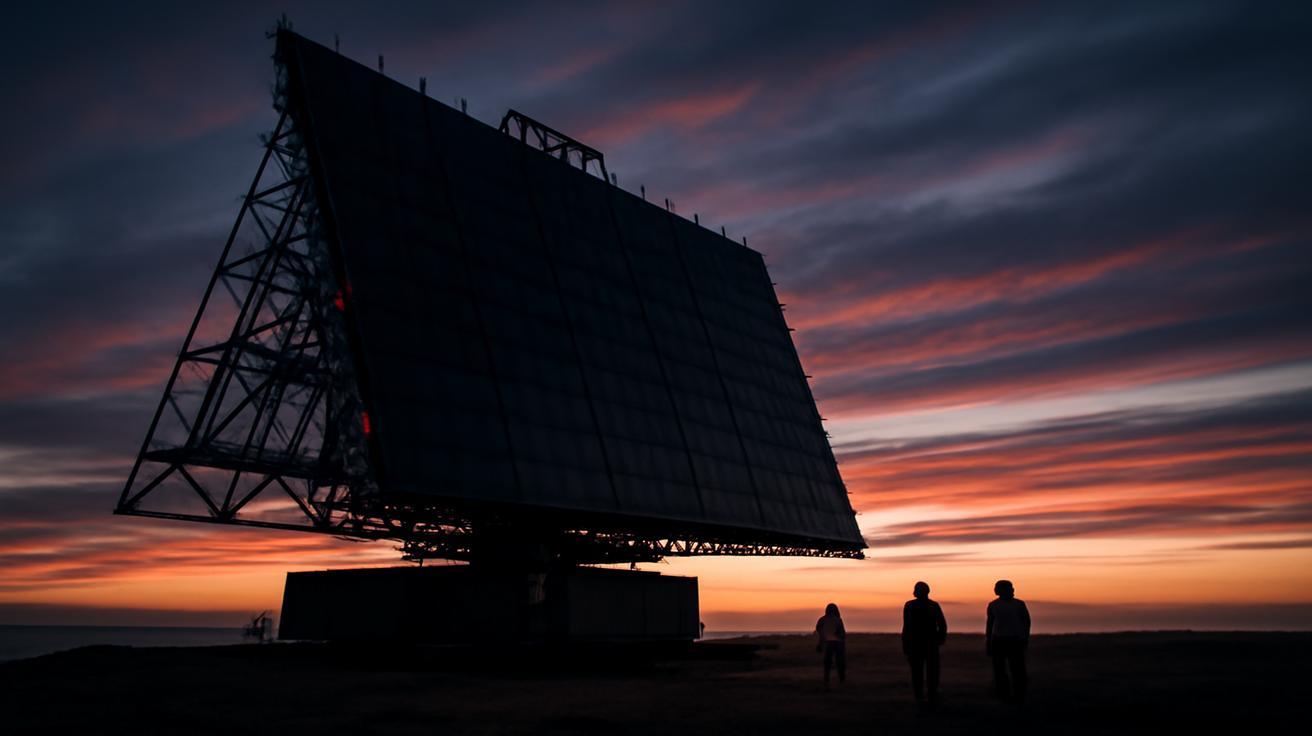
The radar stood alone in the drizzle, a pale mast rising from the Breton headland, its dish slowly panning across the slate-gray sky. Somewhere beyond the horizon, past the gulls and fishing trawlers and the far line where the Atlantic flexes into deep water, something moved that no human eye could see. But the machine could. Quietly, relentlessly, it was listening to the sky—up to 550 kilometers out, further than any French radar of its kind had ever reached. And across the ocean, in offices lined with flags and polished wood, people who used to assume they would always be part of this story were realizing that, this time, they were not.
Europe’s New “Monster” and the Day France Drew a Line
It didn’t happen with fireworks or a dramatic midnight speech. It arrived in the unglamorous language of contracts and acronyms: a €1.1 billion deal, signed and sealed, to build what French defense planners have come to call a “monstre de détection” — a detection monster — with a reach of 550 kilometers into the sky.
On paper, it’s a set of next-generation long-range air-defense and surveillance radars, developed with European partners and European money, aimed at European skies. In reality, it feels like something more visceral: a country quietly turning its shoulders away from the familiar grip of the United States, and leaning instead into a sturdier, if still growing, European embrace.
For decades, high-end detection technology in Europe usually meant American. Patriot batteries, U.S.-designed radar systems, joint projects that came with shared capabilities—but also shared control, shared secrets, and shared dependencies. If Europe needed to see further, it often paid in dollars and waited for Washington’s nod.
This time, though, France chose differently. The contract is European. The technology is European. The industrial ecosystem is European. The message, though not shouted from the rooftops, is loud and clear: when it comes to watching the sky, France intends to stand on its own feet—and it wants its neighbors standing there too.
A Sky That Feels Closer Every Year
Radar used to be the quiet background noise of defense—necessary, important, but not particularly dramatic. In recent years, that background hum has grown into something more urgent, almost anxious. The sky, and what crosses it, has changed.
You can feel the shift in the news cycle’s rhythm. Russian bombers testing the seams of European airspace. Hypersonic missiles in glossy animations on state television. Drones over battlefields that look uncomfortably like European farmlands. Satellites watching satellites. Suddenly, the sky is no longer a calm blue canvas; it’s layered, contested, crowded with things that move too fast and too far.
For a country like France, with coastlines on both the Atlantic and the Mediterranean, overseas territories dotted like stepping stones across the globe, and nuclear deterrence at the core of its strategic posture, seeing early and seeing clearly isn’t a luxury. It’s survival doctrine.
That’s what the 550-kilometer figure really means. It’s not just about range on a spec sheet. It’s about time—precious minutes of warning. A long-range detection “monster” doesn’t just spot an object earlier; it hands decision-makers a longer fuse before they need to act. In a crisis, those extra minutes can be the difference between nervous diplomacy and an irreversible launch command.
The New Radar Landscape in a Nutshell
| Feature | New European “Monster” Radar | Typical Legacy System |
|---|---|---|
| Detection Range | Up to ~550 km | 200–300 km |
| Origin | European-developed | Often U.S.-designed |
| Primary Role | Long-range air & missile detection, integrated in European networks | General air surveillance, limited missile tracking |
| Upgrade Freedom | Full European control over updates and export | U.S. approval often required |
| Political Symbolism | Strategic autonomy, European industrial sovereignty | Transatlantic dependence |
The Quiet Divorce: Why Turning Away from the U.S. Matters
No one in Paris slammed a door in Washington’s face. Officially, France remains a NATO ally, a nuclear power inside the Western camp, deeply tied to U.S. intelligence sharing and military coordination. But history is made as much by subtle shifts in posture as by dramatic breaks, and this radar decision sits in that quieter category: unmistakable, but not explosive.
From Washington’s perspective, this is part of a broader pattern. Europe, pushed by years of Trump-era doubts, the war in Ukraine, and the chilling possibility of future U.S. political swings, has started asking itself a blunt question: what if the American umbrella frays?
Paris, perhaps more than any other European capital, has been repeating the same refrain for years: autonomie stratégique—strategic autonomy. President after president, left or right, has circled back to that phrase. The idea isn’t to abandon the U.S., but to make sure that when the weather turns bad, Europe isn’t standing in the storm with no coat of its own.
A €1.1 billion investment isn’t just a procurement choice; it’s a declaration that France is willing to pay the premium for sovereignty. American systems might have been cheaper on paper, benefitting from scale and mature production lines. But they come with strings: export controls, software black boxes, dependency on U.S. upgrades, and, above all, a political signal that the high-end eyes over Europe still ultimately trace back to American hands.
By turning to a European-built radar, France is saying something different: if we are to be watched over, let it be by our own instruments. If we are to share data, let it be as equals, not as clients. The divorce is not total, but it is unmistakably emotional.
Inside the Beast: What a 550 km Radar Really Does
On the surface, radar sounds almost disappointingly simple. Send out radio waves, wait for them to bounce back, calculate where they hit something. But the “monster” that France is buying into isn’t the spinning dish of old Cold War movies. It’s more like a giant, invisible web that constantly reweaves itself around the sky.
Modern long-range radars use phased arrays—flat panels bristling with tiny transmitters and receivers that can steer beams electronically, without physically moving. Instead of sweeping the horizon like a lighthouse, they can jump from one patch of sky to another in milliseconds, track dozens or even hundreds of targets, filter out noise from the sea and the clutter of civilian traffic, and pick out something that doesn’t belong—a missile, a high-altitude drone, a stealthy aircraft trying not to be seen.
At 550 kilometers, the radar’s gaze reaches far beyond the visible horizon. In strategic terms, it can see threats before they arc toward French airspace, before they cross invisible lines that would trigger alarms and phone calls between capitals. It doesn’t protect only the territory on which it stands; it projects an invisible early-warning bubble deep into shared European skies.
Link that radar to others—German, Italian, Polish—and a different picture emerges: a Europe that doesn’t just react to what NATO’s U.S.-led systems tell it, but builds its own map of the air above its head. The radar becomes not only a defensive organ, but a political organ: it gathers data, but it also gathers confidence.
And then there’s the industrial side. Building something this complex means designing chips, algorithms, cooling systems, secure data links, hardened shelters that can shrug off weather and maybe one day even hostile fire. It means engineers and test ranges and software teams that stay in Europe, rotating from project to project. This kind of radar is a capability, but it’s also a school—one that trains the next generation of technicians and thinkers who will build whatever comes after this monster.
The Scent of Salt Air and the Hum of Autonomy
Imagine standing near the coast where one of these systems might one day operate. The air smells of salt and diesel. A patrol aircraft groans overhead as it circles, banking slow and watchful. You can’t hear the radar—it’s no louder than the distant throb of generators—but you know it’s working, because somewhere in a cramped, climate-controlled room, a young operator is tracing green points on a screen, each one representing a fragment of reality that would otherwise be invisible.
On the glass, Europe exists not as lines on a political map, but as shapes of responsibility: zones of coverage, corridors of civilian flights, approach paths from the Atlantic and the Mediterranean. There’s a track coming in low from afar—probably a commercial flight, but it glows just a little brighter in the operator’s attention, tagged by the software as something to double-check. Further out, a high, fast-moving trace, nothing dangerous today, but watched all the same.
The operator doesn’t know the exact history of the contract that paid for the humming cabinets around them. Maybe they only know two things: that the system is new, and that the story people tell about it is different. “C’est à nous,” someone said during training. This is ours.
Europe’s Patchwork Sky, Slowly Stitching Together
The radar deal is as much about Europe as it is about France. Because a single long-range sensor doesn’t make a shield; it’s just a tile in a mosaic. The deeper ambition—the one that often surfaces in quiet phrases at Brussels conferences and late-night negotiations—is to build a European layer of air and missile defense on top of, and sometimes parallel to, what NATO already has.
Some states still look across the Atlantic first, and buy American systems with a sense of comfort that comes from tradition. Others, like France, are pushing hard for a European spine of capabilities: radars, interceptors, command networks, satellites. The detection monster slots into that vision like a keystone. It says: we can see for ourselves.
This creates tension, inevitably. Washington wants Europe to do more, to spend more—but preferably in ways that keep U.S. industry central. Paris wants Europe to do more too—but in ways that grow European industry and decision-making. Somewhere between those desires lies a fragile balancing act.
Still, there’s a deeper cultural shift at play. For decades, Europe could afford a certain softness about hard power. The end of the Cold War, the lure of global trade, the comfortable idea that history had finally calmed down—all of it made big radar systems and missile defenses feel like relics, or at least less urgent concerns.
Now, with a hot war burning on its border, energy routes weaponized, and the rules-based order looking shakier than it has in a generation, Europe is waking up to the sky again. To own the means of detection is to own the first chapter of any future crisis. France’s radar monster is one of the early, loud pages in that new chapter.
Why €1.1 Billion on Radar Feels Like an Environmental Story Too
On the surface, a military radar might look like the furthest thing from the nature stories that usually glide through glossy magazines—no wild horses, no misty forests, no rewilded rivers. But look closely, and there’s a subtle, unexpected overlap.
Both climate and security reshape the way we see space. Rising seas redraw coastlines; shifting migration routes and droughts create new lines of friction; climate-fueled instability can push fragile states toward conflict. The atmosphere itself becomes contested, not only as weather and climate, but as a domain of surveillance and defense.
The radar’s 550-kilometer reach is a reminder that what happens far away can matter very quickly at home. A missile launched hundreds of kilometers off, a drone crossing invisible borders, a military aircraft edging closer than anyone expected—these are fast-motion versions of the same lesson climate science has taught for years: systems are connected, and distance is a fragile comfort.
In a strange way, Europe’s decision to build its own tools—to observe, anticipate, and protect—echoes the logic of environmental resilience. Don’t rely entirely on distant providers. Don’t assume that benign conditions will last forever. Build local capacity. Understand your own vulnerability. And when the wind shifts, be ready.
Living Under the Gaze of the “Monster”
One day, not long from now, this radar will be fully awake, its beams slicing invisibly through rain and turbulence over the continent. The software will have gone through updates and patches, the crews through drills and boredom and the occasional jolt of adrenaline when something unexpected appears. Its existence will fade into the hum of ordinary life, like cell towers and internet cables—unseen until something goes wrong.
And yet its presence will subtly shape politics. When European leaders gather in emergency rooms lit by flat screens and harsh fluorescent light, they’ll be making decisions partly based on the picture this system paints. If a crisis flares near Europe’s borders—Baltic sky, Black Sea airspace, Eastern Mediterranean corridors—French and European radars will feed their data into that shared nervous system.
In those tense hours, no one will be thinking about NATO procurement debates or industrial supply chains. They will think instead in hard, simple questions: What’s coming toward us? How fast? From where? Do we trust what we see?
The choice France has made ensures that at least part of the answer to that last question—do we trust what we see?—rests in European hands, on European soil, built by European minds. It is an expensive kind of trust, paid in billions, but also bought with a stubborn belief that, in a world of shifting alliances and rising uncertainties, the ability to watch the sky for yourself is worth the price.
The monster will keep turning, day after day, rain after rain, quietly rewriting the way a continent understands its own vulnerability. America will still be there, across the water, still bound to Europe by deep ties of history and interest. But the signal has been sent—across the Atlantic, across the airwaves, across that gray, restless strip of sea.
France is no longer content to borrow someone else’s eyes. It has built its own—and they can see very, very far.
FAQ
Why is the 550 km range such a big deal?
A 550 km detection range gives France and its European partners significantly more warning time in case of incoming threats like missiles, long-range drones, or hostile aircraft. Those extra minutes can be critical for assessing intent, launching interceptors, scrambling fighters, or activating civil protection measures.
Does this mean France is leaving NATO or breaking with the U.S.?
No. France remains a core NATO member and still cooperates closely with the U.S. militarily and politically. This radar decision is less about abandoning the alliance and more about reducing technological dependence and strengthening European strategic autonomy within that alliance.
Who is building this “detection monster” for France?
The system is being developed and produced by European defense industry players, led by French and other EU-based companies specializing in advanced radar and air-defense technologies. The key point is that design, software, and upgrades stay under European control.
Will other European countries use the same radar?
It’s likely that elements of this radar family, or derived systems, will be offered to other European states. Even if not identical, the goal is an interoperable network of European sensors that can share data and create a coherent picture of the continent’s airspace.
How does this affect ordinary people in France and Europe?
Most citizens will never see or notice these radars directly, but they contribute to national and regional security by improving early warning and deterrence. Indirectly, they also support jobs, research, and high-tech industrial capacity inside Europe, which has economic and political benefits beyond the strictly military sphere.





Leave a Comment