
The sea was unusually quiet that morning—a flat pewter skin stretched tight over the English Channel, broken only by the low thrum of engines and the hiss of wind against metal. On the horizon, two silhouettes moved in slow, deliberate choreography: a British minehunting vessel and a sleek French support ship, sharing data, sharing purpose. Above them, the sky was as open as the future they were trying to shape—one in which invisible killers, hidden beneath waves and mud, might finally lose their advantage.
The Old Ghosts Beneath the Waves
If you could drain the Channel dry, you’d see it clearly: a graveyard of steel and spite. Old moored mines, some from wars whose veterans are long gone. Modern influence mines, dormant but listening. Forgotten shells and rusted drums. A century of conflict has left its fingerprints on the seafloor, and the ocean has done what it always does—it has kept the secrets close.
But the ghosts are not harmless relics. Storms roll in, eroding sediments and shifting sands. Fishing trawlers drag nets, ferries crisscross the lanes, oil and gas pipelines snake along the bottom. Every so often, something that was meant to remain buried shifts a little closer to the world of the living. Sometimes, disastrously so.
For navies like those of the United Kingdom and France, the threat of underwater mines is not theoretical. It’s an everyday calculation. There are straits to keep open, supply routes to secure, humanitarian missions to protect. In a world that depends on the silent, ceaseless movement of ships, invisible mines might be one of the most cost‑effective weapons ever invented—and one of the most stubborn to defeat.
For decades, the answer was bravery and patience. Sailors in small specialist ships, edging through suspected minefields. Divers slipping into cold, opaque water with nothing but training and trust to shield them from catastrophe. Remote‑controlled robots, painstakingly steered by human operators watching grainy video feeds from far above.
Now, in the age of artificial intelligence, those ghosts are about to meet a new hunter—one designed not in isolation, but in a cross‑Channel partnership.
When London Called, Paris Answered
There’s a particular electricity in a room where languages blend but intentions align. Engineers from Portsmouth and Brest hunched over the same digital maps. French AI researchers pointing at heatmaps and probability curves. Royal Navy officers tapping the table where the Channel would sit if the chart had been real water.
The UK has been modernising its mine warfare fleet, stepping away from older, crewed wooden‑hulled minehunters toward a future of uncrewed systems: sleek surface drones, nimble underwater vehicles, swarms of sensors talking to one another in real time. But hardware can only go so far. To move from cautious clearance to confident prediction, from slow reaction to rapid anticipation, the UK needed smarter brains beneath the waves.
That’s where France stepped in—not just as a neighbour, but as a partner with its own long tradition of mine warfare and a rapidly advancing ecosystem in AI and robotics. Together, they’ve begun weaving a new nervous system for anti‑mine operations, one built from neural networks, pattern recognition, and a kind of machine intuition shaped by tens of thousands of images of the sea floor.
It’s easy to imagine this partnership as abstraction: code repositories, secure servers, software sprints. But at its core, it’s tactile and human. A British officer describes how a mine looks on sonar “when it’s pretending to be a rock.” A French scientist translates that intuition into data features—is it the shadow length, the echo strength, the way sediment accumulates around the base? A diver recalls a current that always seemed to nudge them off‑course in a particular estuary, and an AI engineer quietly takes notes about environmental noise patterns to feed into the next training dataset.
A Nervous System for the Silent War
Picture an uncrewed surface vessel—little more than a sleek hull, antennae, and sensors—sliding out of a grey harbour before dawn. No bridge, no bunks, no galley. Just circuits and purpose. Above the waterline, it looks sparse, almost fragile. Below, it tows a sophisticated sonar array, a curtain of sound gently sweeping the seabed like fingertips over Braille.
Every ping, every echo returns as raw data. Once, that data would have been poured into human eyes, an operator staring at a screen, fighting fatigue and distraction, watching for the tell‑tale bright spot that might be a mine… or just a rock. Now, much of that work is offloaded to an AI trained not just to detect, but to doubt, to weigh, to learn.
The Anglo‑French system doesn’t simply flag suspicious shapes. It starts to understand context. It notices that this “rock” is too smooth for its surroundings, that its shadow is sharper than it should be at that depth, that currents in this area would normally push sediment in this direction, but somehow this object is clean on the upstream side. It cross‑references with historical data—nothing was here last year, or five years ago, or ten. Immediately, its confidence spikes.
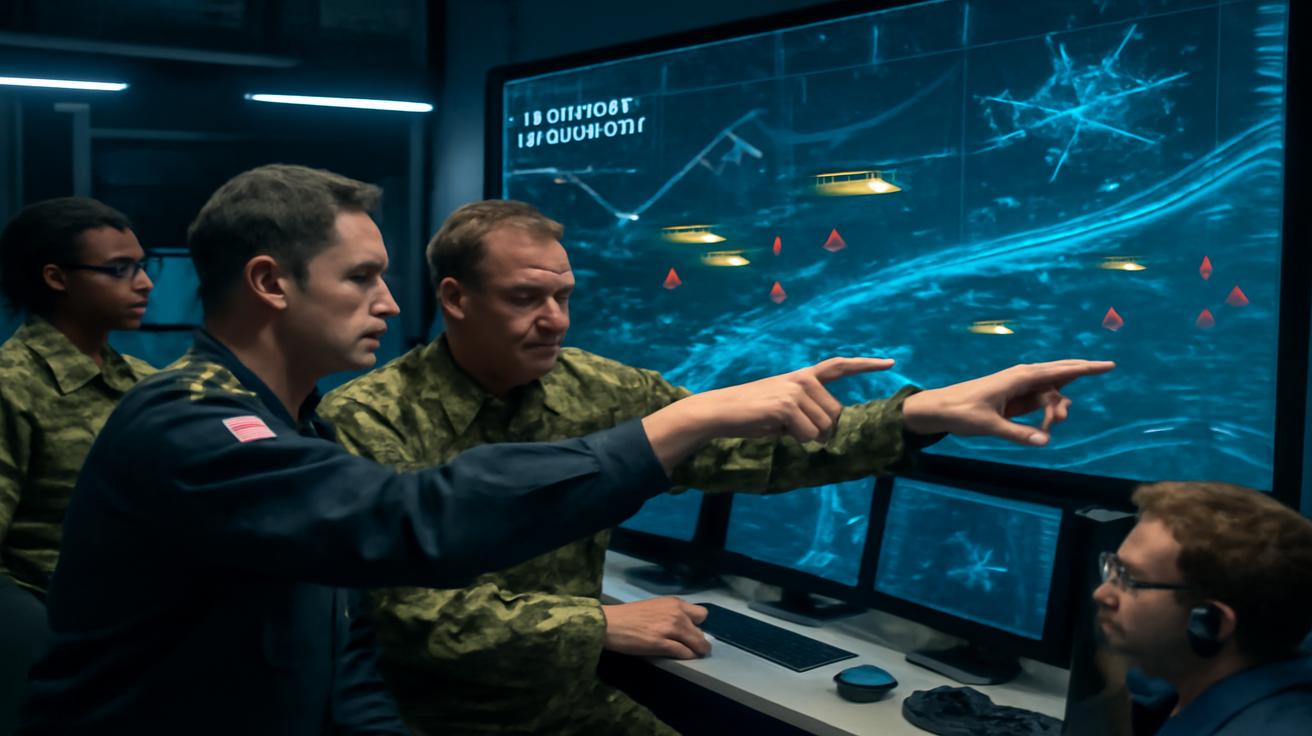
Back on the support ship, human operators don’t see a wall of sonar noise. They see a curated picture: a probability heatmap, a ranked list of potential threats, confidence scores coloured from calming blues to urgent reds. The AI has already thrown away the clutter, allowing human judgment to focus where it’s most needed.
This isn’t some flashy “robot navy” fantasy. It’s more subtle: a redistribution of mental labour from navies to machines. What changes is tempo. Mines that might once have taken hours to locate—and could still be missed—are identified within minutes. Larger areas of seabed can be searched with the same or fewer people. Divers and remotely operated vehicles are sent into the water only where they’re truly needed.
The Dance of Trust Between Human and Machine
Still, trust isn’t automatic. No captain wants to navigate a ship through a corridor cleared by something they can’t question, can’t read, can’t look in the eyes. So the Ango‑French design philosophy is quiet but radical: transparency.
The AI doesn’t just say, “Mine: 91% confidence.” It shows why. Overlayed sonar imagery. Annotations: “Object geometry matches Western influence mine profile within 3% tolerance.” “No historical record of seabed feature at this location.” “Acoustic shadow inconsistent with natural rock patterns.” Operators can trace the logic, challenge it, override it.
During trials, this back‑and‑forth became almost like a conversation, except one half was a system humming in a rack of equipment. A French engineer described it as “teaching the AI to be less arrogant”—to lower its confidence when environmental conditions were poor, when sonar data was noisy, when the water column was filled with bubbles from a passing storm.
On board, the mood is not that of a crew being replaced, but one of a team getting a new, indefatigable colleague. Someone who can stare at sonar screens for twelve hours straight and never blink, never miss the faint outline in the static.
Training a Mind That Lives Underwater
If you want an AI that understands the sea floor, you have to feed it the sea floor—an almost impossible amount of it. That’s where the cooperation between the UK and France becomes quietly powerful. Between them, they possess decades of minehunting records: sonar images, diver reports, ROV footage, classified maps of old minefields, declassified sections of forgotten conflicts.
In a secured building far from the sound of waves, vast drives whir as these records are anonymised, tagged, and structured. Not just “mine” and “no mine,” but nuanced labels: buried object, possible wreckage, natural rock, marine debris, pipeline anomaly, fishing gear. Each example becomes a line of experience for the AI—a kind of seafloor memory.
The training process is iterative and strangely similar to how you’d teach a junior operator. At first, the AI over‑flags everything. A rock with a shadow becomes suspicious. A cable joint looks “too round.” The system is corrected. It adjusts. New data comes in from fresh trials in the Channel, the North Sea, the Bay of Biscay. The AI learns not just shapes, but behaviours: how sandbank edges shift with the seasons, how sonar reflections change with water temperature and salinity.
There’s something almost intimate about this. Nations that once guarded their undersea secrets now share them—not the strategic ones, but the textural ones. The “feel” of their coastal waters, the quirks of their seabeds. It’s a cartography of risk, drawn in cooperation.
| Aspect | Traditional Mine Warfare | AI‑Enhanced UK–France Approach |
|---|---|---|
| Detection | Human operators scan sonar feeds manually. | AI filters noise and highlights likely threats in real time. |
| Risk to Personnel | Crewed ships and divers operate in potential minefields. | Uncrewed surface and underwater vehicles take the front line. |
| Coverage Speed | Limited by operator fatigue and vessel endurance. | Larger areas scanned faster, with continuous AI monitoring. |
| Decision‑Making | Heavily manual, case‑by‑case assessment. | AI proposes priorities; humans confirm and direct action. |
| Data Use | Past missions archived but rarely reused at scale. | Historical datasets actively train and improve AI models. |
Beyond the Channel: Shared Seas, Shared Stakes
The Franco‑British project is not just about their own shorelines. Mines are littered across the world’s seas: from narrow straits that bottleneck global trade to coastal waters where fishing communities live with invisible danger. The more effective navies become at clearing mines quickly and safely, the more options open for humanitarian intervention, disaster relief, and stabilising fragile regions.
Imagine a crisis: a coastal city struck by conflict, its harbour mined to choke off aid. In the past, clearing a safe channel might take weeks or months of painstaking operation. With AI‑guided systems, navies could map and evaluate threats far faster, threading lifelines of safe water to bring in food, medicine, and evacuation ships. The same tools that watch over the busy shipping lanes between Southampton and Le Havre could, one day, be deployed to protect fishing boats in a distant, contested bay.
There’s also a quieter, longer‑term gain. The data gathered by these systems—on currents, sediment flows, seafloor habitats, wreck locations—doesn’t vanish after the mission ends. With care and classification, much of it can support marine science and conservation. Patterns of underwater noise, for example, matter both to sonar engineers and to biologists studying whales. Detailed maps of the seafloor help navies avoid mines and help ecologists understand benthic ecosystems.
That dual‑use nature of knowledge is part of what makes this new era so complex. AI doesn’t belong to a single domain. It seeps across boundaries, military and civilian, commercial and scientific. An algorithm that learns to distinguish a mine from a rock is, fundamentally, just learning to see under water—something countless disciplines have always wanted.
Ethics in the Shifting Tide
Yet the story isn’t simple technological triumph. AI in warfare carries its own heavy questions, and neither London nor Paris can ignore them. When you teach a machine to recognise and respond to threats at sea, how far do you let it act on its own? Who is responsible when a model misclassifies an object and a ship is damaged—or when a clearance operation disturbs an underwater habitat?
The current generation of Anglo‑French systems is firmly “in the loop”: tools that inform human decisions, not replace them. But the pressure for speed is always there. In a future conflict, the temptation to let AI operate more autonomously—faster than a human can think—will be strong. That’s why these early projects place such emphasis on explainability, governance, and shared standards.
Interestingly, the partnership itself becomes a kind of ethical friction. Decisions must cross national lines, legal frameworks, naval cultures. French lawyers question how far an AI can shape operational decisions; British commanders insist on clear audit trails for every automated detection and classification. Each side forces the other to articulate assumptions that might have gone unnoticed at home.
In that sense, cooperation is not just a way to pool money and expertise. It’s a way to slow down precisely where it matters—to insert deliberation into a domain that might otherwise race too quickly toward opacity.
The Quiet, Human Core of a Technological Shift
Walk the decks of one of these new‑generation mine warfare support ships and you won’t see rows of glossy screens with futurist graphics. You’ll see mugs of tea cooled beside keyboards, handwritten notes taped to consoles, a French phrase scribbled in the corner of an English check‑list. You’ll hear a Breton accent trading jokes with someone from Plymouth about the weather, about football, about whose coastal waters are more treacherous.
In one corner, a young AI specialist still unused to the sway of the sea tries to steady their stomach while explaining a model update to a veteran sonar chief who has spent half his life listening to the ocean through headphones. The chief, in turn, explains that on some nights the seabed feels “nervous” for reasons no model has quite captured yet.
This is where the future of anti‑mine warfare is actually being forged—in this messy, human space between code and current, between experience and experiment. Neither country could do it alone with the same richness. The UK brings its long history of minehunting in some of the world’s busiest shipping lanes and a defence ecosystem increasingly obsessed with autonomy. France brings a strong tradition in maritime robotics, advanced AI research, and its own complex, far‑flung maritime zones.
Between them flows not just the Channel, but data, stories, habits, humour. And in that flow, the sea’s old ghosts—those silent, stubborn mines lying in wait—are slowly losing their grip on the future.
Looking Ahead: A Safer Sea, Not a Simpler One
The day’s trial ends as it began: the sea flat, the sky lowering, a faint smell of salt and diesel in the air. The small uncrewed vessel returns on pre‑programmed coordinates, its sensors full of the day’s finds. Some flagged objects will turn out to be nothing more than oddly shaped rocks or forgotten cables. Others will be real, malignant devices, logged and, in time, neutralised.
On a screen in the operations room, a map of the seabed blooms with colour—areas surveyed, threats classified, corridors of relative safety traced like fingerprints across the blue. It is not a promise that the sea is safe. It is a promise that it is being watched with a new kind of attention.
France stepping in to help the UK design new AI for anti‑mine warfare is, on paper, a defence cooperation project. In reality, it feels closer to an act of shared guardianship over a living, unpredictable space. The Channel does not care about borders painted on charts. Mines do not respect flags. AI models do not know passports. But people do. And people, reaching across the water, are deciding to make one of the oldest, deadliest tricks of naval warfare just a little less powerful.
The sea will never be tame. But perhaps, with machines that listen more carefully and nations that work more closely, it can be made less haunted.
Frequently Asked Questions
What exactly is AI doing in anti‑mine warfare?
AI systems analyse sonar and other sensor data to detect, classify, and prioritise potential underwater mines. They filter out noise, recognise suspicious shapes and patterns, estimate threat levels, and present human operators with clearer, faster assessments than manual analysis alone.
Does this mean humans are being replaced in minehunting?
No. Humans remain central to planning missions, validating AI decisions, and authorising any action. AI is used as a decision‑support tool—it handles repetitive, data‑heavy tasks so operators can focus on judgment, tactics, and safety.
Why are the UK and France working together on this?
Both countries have strong naval traditions, extensive experience with mine warfare, and advanced AI and robotics sectors. By sharing data, expertise, and costs, they can develop more capable systems faster, while ensuring interoperability for joint missions.
Is this technology only for military use?
Its primary purpose is defence, but the underlying capabilities—like detailed seabed mapping and environmental monitoring—can benefit civilian applications such as marine research, offshore infrastructure planning, and search‑and‑rescue operations.
How does this make the seas safer for civilians?
Faster, more accurate mine detection and clearance reduces the risk to commercial shipping, fishing fleets, ferries, and coastal communities. It can also speed up the reopening of ports and sea lanes after conflicts or incidents, supporting both safety and economic stability.





Leave a Comment