
The news did not arrive with the thunder of artillery or the drama of a breaking headline. It slipped quietly into the public space, like a distant rumble on a clear afternoon: France, long anchored in a cautious nuclear doctrine and a European defense posture built on diplomacy and deterrence, is preparing a new land-based missile system able to strike targets 2,000 kilometers away. For most people, it passed like any other military announcement—numbers, acronyms, timelines. But if you pause, if you really sit with what it means, the shape of the continent’s future seems to tilt, just a few degrees, toward something unfamiliar and uneasy.
A Missile Meant for a Different Europe
Imagine standing on a quiet hill in Brittany or Normandy, the wind sliding over fields, the sky a pale wash of blue. Somewhere, not so terribly far away, engineers are sketching designs for a machine that can arc across that same sky, vanish into the high cold air, and drop back to Earth 2,000 kilometers from where it was launched. That distance, in European terms, is intimate. From central France, it brushes the Baltic, shadows the Mediterranean, touches deep inside Eastern Europe and the fringes of North Africa.
This is not just another technical program in a defense budget. It is a signal that France—nuclear-armed, politically influential, forever wrestling with its self-image as both warrior and humanist—is rewriting its role in a rapidly changing security landscape. In the language of officials, this is about “credible deterrence,” “strategic autonomy,” and “closing capability gaps.” Beneath that, there is a more visceral story: fear, uncertainty, and a quiet determination not to be strategically naked in a world that suddenly feels more dangerous than at any point since the end of the Cold War.
For decades, France’s power projection revolved around three pillars: its airborne nuclear deterrent, its submarine-launched ballistic missiles, and its highly mobile conventional forces capable of operating in Africa, the Middle East, and beyond. Land-based intermediate-range missiles—especially those able to reach across borders—have been something Europe carefully stepped away from, bound by treaties, history, and memory. The very idea carried the ghost of 1980s missile crises, marches in the streets, and banners calling for a nuclear-free Europe.
Now, in the 2020s and early 2030s, that ghost is walking back into the room.
The Quiet End of Old Rules
The story behind this new French missile starts, in some ways, with the slow unraveling of old restraints. The Intermediate-Range Nuclear Forces (INF) Treaty between the United States and the Soviet Union once banned land-based missiles with ranges between 500 and 5,500 kilometers in Europe. It was signed in 1987, at the tail end of an age when missile deployments sparked protests from Paris to Berlin. For many Europeans, it was proof that arms control could cool the fever of confrontation.
Then, across three decades, the world moved on. New powers rose, older rivals began testing the limits, and accusations of treaty violations piled up. In 2019, the INF Treaty collapsed completely. For Europe, that meant a quiet lifting of a taboo: the legal wall separating the continent from an entire class of land-based missiles simply disappeared.
France had not been a direct party to the INF Treaty, but it lived under its shadow. It benefited from a continent where certain weapons simply did not exist. When Russia began fielding new intermediate-range systems and other regional players experimented with long-range strike capabilities, the ground shifted. Not overnight, not with panic, but with a steady, grinding inevitability. A strategic vacuum is like an empty chair at a table; sooner or later, someone will sit in it.
Paris began to rethink. If the map had changed and the rules that once shaped Europe’s military posture were gone, could France really continue as if nothing had happened? The answer, it seems, is no.
A 2,000km Reach: What That Really Means
Two thousand kilometers is a technical figure, but it carries a human weight. It means that from French soil, a missile could reach deep into regions where crises are already smoldering or could erupt with little warning. It allows planners in Paris to imagine striking key targets—airfields, command centers, logistical hubs—far beyond the immediate neighborhood, without needing aircraft over hostile airspace or warships in contested waters.
In a way, this presents a paradox: a weapon built to be used precisely so it never has to be used. Deterrence works, at least in theory, because potential adversaries know a country can reach them, with speed, precision, and devastating effect. If they believe that, the thinking goes, they will hesitate before crossing certain lines.
But deterrence is also a language written in hardware and posture. Every time a country fields a new capability, it says something. It speaks not only to opponents but to allies, neighbors, and citizens. And what France is saying with this missile project is stark: The environment is dangerous enough that we are willing to step into a domain Europe tried for decades to avoid.
Steel, Circuits, and Strategy: Inside the New System
We still do not have a complete window into the technical soul of this weapon, but patterns from existing French systems offer hints. France already operates the MdCN (Missile de Croisière Naval), a ship and submarine-launched cruise missile with a range of around 1,000 kilometers. It maintains sophisticated air-launched cruise missiles and a mature industrial base in guidance, propulsion, and stealth technologies.
Translating that experience into a land-based system means combining rugged mobility with high-end electronics: launchers that can move along roads and blend into landscapes, communications systems that connect these launchers to distant command centers, and guidance packages that navigate across long distances, hugging terrain or riding high above it, avoiding defenses as best they can.
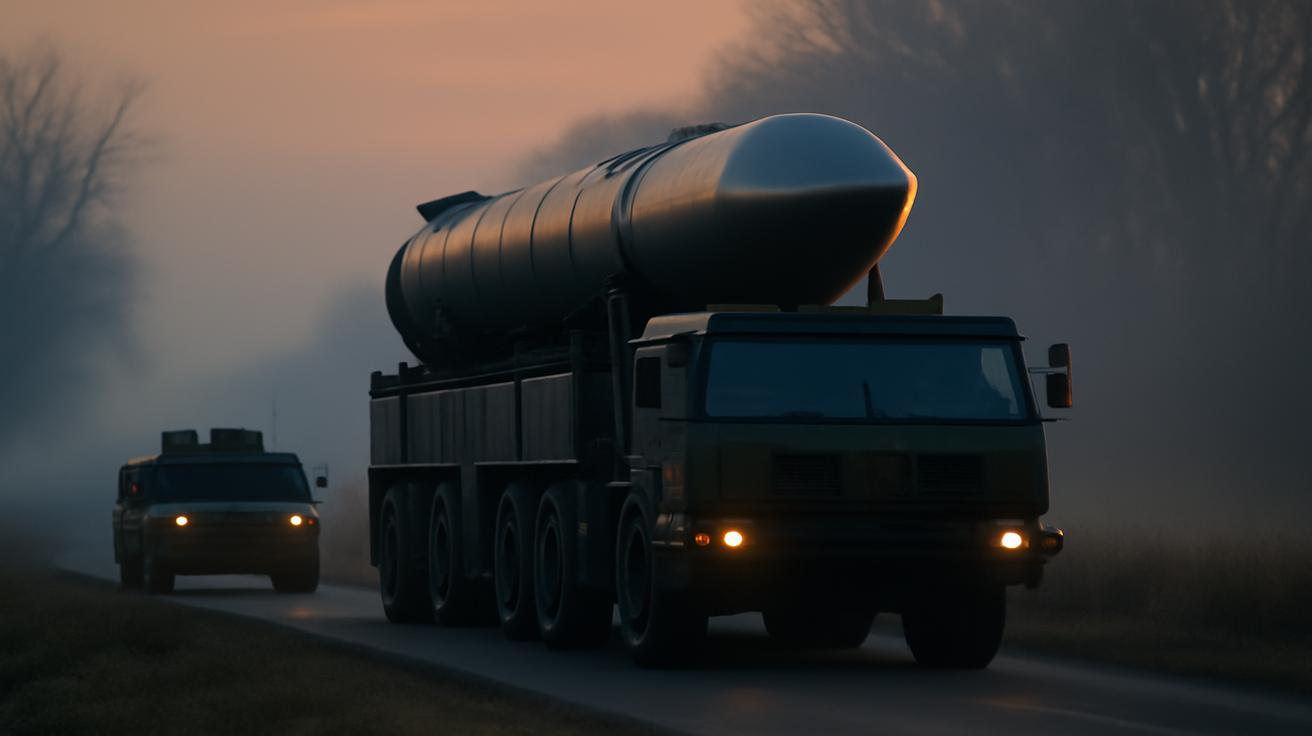
Think of it as a tightly choreographed relationship between soil and sky. On the ground sits the launcher, likely a heavy truck, outwardly not so different from commercial vehicles carrying grain or machinery—until the shelter on its back rolls open and the missile, all angles and composites and complexity, cranes upward. In the air, the missile must be clever and stubborn, holding to its path through jamming and deception, adapting if needed, and arriving where it was intended to arrive. Whether it carries a conventional or, potentially, a nuclear warhead fundamentally shapes the stakes of each launch.
To put the emerging system in context, consider a simple comparison with other known French and international missiles:
| Missile System | Platform | Approx. Range | Primary Role |
|---|---|---|---|
| MdCN (France) | Ship/Submarine-launched | ~1,000 km | Long-range precision strike |
| ASMP-A (France) | Air-launched | ~500 km | Nuclear deterrent |
| Planned 2,000km Land Missile (France) | Land-based mobile launcher | ~2,000 km | Theater-level deterrence & strike |
| Kalibr (Russia) | Ship/Submarine-launched | ~1,500–2,500 km | Land-attack cruise missile |
| Tomahawk (US) | Ship/Submarine-launched | ~1,600 km | Long-range precision strike |
Into this landscape, France’s land-based 2,000km system is not a technological anomaly; it is the missing leg of a tripod, filling a gap between air and sea-based strike tools and giving French planners something they have long watched others wield.
From Villages to Front Lines: The European Ripple
It is easy to discuss missiles in abstraction, as entries in tables or slides in classified briefings. But Europe is small enough that every new range ring drawn on a map brushes familiar places. A farmer in eastern Poland or a cafe owner in northern Italy may never see a French missile convoy passing through their village, yet the logic behind that missile touches their lives in a quiet, invisible way.
The French project is closely tied to a broader question: Who, exactly, defends Europe, and with what tools? NATO still looms large, with the United States as its most powerful member. But in the wake of shifting American priorities and domestic polarization, European leaders increasingly talk about “strategic autonomy,” about being able to protect the continent even if Washington’s attention wanders or its politics fracture further.
For France, which already sees itself as a nuclear umbrella for the European Union, a 2,000km land-based strike capability is a way to make that promise more concrete. It is a message to allies: if the world gets darker, we are not coming empty-handed. It is also, implicitly, a nudge to others in Europe to think more ambitiously about their own defense industries and doctrines.
Yet, every step forward comes with a shadow. Neighboring states—both within and outside the EU—will study this program and ask their own hard questions. Does this force them to reconsider their weapons? Will they respond with their own missile programs, new basing decisions, or closer alignment with rival powers? In a region as densely layered and historically scarred as Europe, no major military shift happens in isolation.
A Historic Turning Point, Written in Careful Language
Officials in Paris chose their words carefully when news of the missile program surfaced. No talk of arms races, no dramatic rhetoric. Instead: modernization, adaptation, responsible deterrence. The vocabulary of calm technocracy used to describe a move that, in quieter terms, amounts to this: after decades of stepping away from land-based mid-range missiles, a leading European power is stepping back in.
It is historic because it marks a psychological break with the post–Cold War illusion that geography and treaties alone could guarantee Europe’s safety. It signals an acceptance that the strategic landscape resembles something older—less restrained, more competitive, more reliant on hard power—than many European citizens ever wanted to imagine.
But “turning point” does not necessarily mean “catastrophe.” It can also mean finally acknowledging a reality that has been building at the edges of attention. Russia’s use of long-range missiles in Ukraine, Tehran’s growing missile capabilities, North Korea’s theater systems, China’s ballistic arsenals—all of these have unfolded while Europe sat between old norms and new threats. France’s decision is, in part, a belated reply.
To see this clearly is to hold two truths at once: this may well strengthen deterrence and, in the same breath, make the long-term arms control picture more complicated and fragile. The story is not written in black and white. It lives in grays and half-tones, in the uneasy knowledge that safety sometimes leans on the very instruments that make our world feel most precarious.
Ethics in the Shadow of the Launch Pad
There is, beneath every technical specification and geopolitical argument, a quieter ethical question. What does it mean for a democracy shaped by the memory of two World Wars and countless peace movements to invest in a weapon that can strike 2,000 kilometers away? How does a society that celebrates cafes, literature, and human rights reconcile that with the ability to send precise destruction over horizons?
In France, such questions rarely dominate the front pages for long; daily life presses in, and defense policy retreats to the margins of public attention. Yet the contradiction hums in the background. It is the same tension found in many Western democracies: a deep commitment to values that reject violence, paired with a pragmatic acknowledgment that power vacuums invite even worse violence.
This missile, then, sits at a moral crossroads. Supporters argue it will never be fired in anger precisely because it exists. Critics fear it nudges the world one step closer to normalizing long-range warfare as a conventional tool, used at arm’s length, screens flashing, impact sites reduced to grainy satellite images. Both sides, in their own way, are trying to prevent catastrophe. They simply disagree on which path does that best.
Looking Ahead: Between Sky and Soil
Somewhere in a French laboratory, a small team will soon watch a prototype’s guidance system hum to life. Software will simulate a flight path, numbers streaming past, virtual terrain rising and falling beneath an imagined missile. On a test range, perhaps years from now, a first real launch will carve a white arc into the sky, the roar fading into the distance as observers watch through narrow slits in protective bunkers.
By then, the world may have changed again. Conflicts could have cooled or flared. Alliances could have tightened or fractured. What will not change is the fact that this decision—this choice to build a land-based missile capable of 2,000km reach—marks a break from what came before. A historic military turning point rarely looks dramatic in the moment; it looks like a line item in a budget, a quiet announcement, a technical briefing invisible to the average citizen.
But history often moves this way: subtly at first, then all at once. The French countryside will still smell of wet leaves after rain. Children will still kick footballs across schoolyards, oblivious to range circles on military maps. And somewhere, in the spaces between those two worlds, stands a new launcher on a patch of reinforced concrete, its presence a reminder that security and vulnerability now travel together in ways that are both unsettling and, for the time being, inescapable.
France has chosen to step into that tension with eyes open, steel and circuitry in hand, hoping that the knowledge of what it can do will be enough to ensure that it never has to do it. The rest of Europe, and indeed the wider world, will be watching—quietly, carefully—waiting to see if this new chapter in the continent’s military story will be one of deterrence upheld or escalation invited.
FAQ
Why is France developing a 2,000km land-based missile now?
France is responding to a more volatile security environment marked by the end of the INF Treaty, the expansion of long-range missile arsenals by other powers, and growing doubts about long-term US security guarantees. The new missile is intended to strengthen deterrence and give France—and by extension Europe—greater strategic autonomy.
Is this missile intended to carry nuclear warheads?
Public discussion has focused mainly on the missile’s range and conventional strike role. However, because France is a nuclear-armed state, any long-range system inevitably raises questions about dual-capable use. Whether it will be configured for nuclear missions is a political and strategic choice Paris will treat with extreme caution.
Does this violate any international treaties?
No. With the collapse of the INF Treaty, there is currently no binding international agreement banning land-based missiles in this range category. France nonetheless remains bound by other arms control and non-proliferation commitments, but those do not prohibit such conventional systems.
How does this affect other European countries?
For EU and NATO partners, the missile can be seen as a reinforcement of Europe’s collective deterrent posture. At the same time, it may prompt debates about arms control, basing, and whether other European states should pursue similar capabilities or rely on shared frameworks like NATO for protection.
Could this trigger a new arms race in Europe?
It could contribute to competitive dynamics if rival states perceive it as a threat and respond with their own deployments or new systems. Whether it becomes part of an arms race or a stabilizing deterrent tool depends on future diplomatic efforts, transparency measures, and the broader political climate among European and neighboring powers.
When will the missile be operational?
Complex systems like this typically require several years of design, testing, and integration. Exact timelines are usually classified or only loosely stated, but it is reasonable to expect an operational window measured in the latter half of the 2020s or into the 2030s, rather than in a matter of months.
What makes this a “historic turning point” for France?
It marks a deliberate move back into the domain of land-based intermediate-range missiles, a category Europe largely avoided for decades. Symbolically and practically, it signals that France is reshaping its defense posture for a harsher strategic era, and that the assumptions underpinning the post–Cold War European security order are being quietly, but decisively, rewritten.








Leave a Comment