
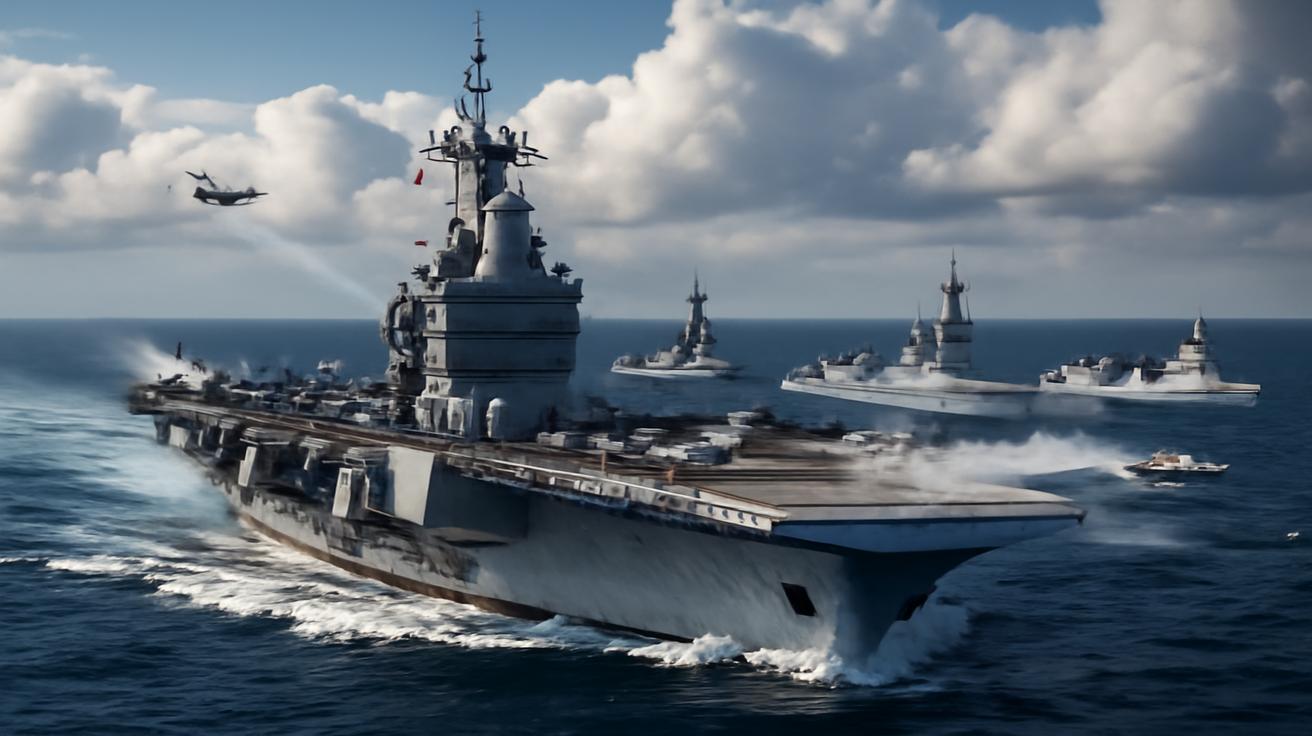
The sea looks almost gentle from a distance—a soft slate-blue skin folding itself into slow, deliberate waves. But if you stand on the wind-whipped deck of a warship and listen carefully, you hear a different story: the hiss of jet engines, the bark of orders in clipped French and accented English, the grinding rumble of metal under strain. Somewhere in that restless expanse, France has just made a decision that says far more than any speech or parade flyover: it has pushed its single aircraft carrier, the Charles de Gaulle, into the beating heart of a weeks-long, multinational exercise whose main goal is not glory, but endurance.
Beyond the One-Day Show
Most people’s idea of military power is built on snapshots: a dramatic photo of fighter jets streaking over a city, or a brief clip of a ship slicing through the water, flags snapping in the wind. These are the moments crafted for the cameras, often compressed into a single day—an airshow, a parade, a tightly choreographed demonstration meant to impress and reassure.
What France is attempting now is the exact opposite. Instead of a perfectly timed, high-gloss exhibition, it has chosen to test its naval flagship in a setting where there is nowhere to hide: a massive joint exercise with allies where the key metric is not spectacle, but stamina. Can the Charles de Gaulle and its battle group operate at high tempo for weeks, maybe longer, while coordinating with foreign navies, dealing with breakdowns, fatigue, and friction? Can it be not just powerful, but persistent?
This is a far more uncomfortable question to ask in public, especially for a country that possesses only one aircraft carrier. For France, the Charles de Gaulle is not just another ship—it is a floating symbol of strategic independence, the core of its blue-water ambitions, and a central pillar of its ability to project force. Putting that symbol under a microscope, in real time, among allies and observers, is a bold move. And a risky one.
The Beating Heart of a Floating City
Walk the length of the Charles de Gaulle during an exercise like this and the air feels dense, almost electric. The deck vibrates faintly with each engine test, each catapult launch rehearsal, each helicopter landing. The smell is a layered thing—salt and fuel, coffee that’s been sitting too long on a hot plate, machine oil, wet metal, and the faint tang of jet exhaust that clings to uniforms and hair.
Below decks, the ship feels like a small city under pressure. In one compartment, a young radar operator traces ghostly blips of allied aircraft flying complex patterns, making sure that what appears on the screen matches the thick stack of pre-planned flight schedules. In another, mechanics with streaked hands and red-rimmed eyes coax a stubborn turbine back into compliance, knowing that every minor failure in a system can ripple through the entire carrier group’s carefully orchestrated rhythm.
For weeks, there will be no “offstage.” The Charles de Gaulle will be living out in the open, its crew forced to balance training realism with real limits: spare parts that run low, sailors who are exhausted, software that glitches at the worst moment, weather that refuses to cooperate. In a one-day demonstration, you can smooth these things over. In a prolonged joint exercise, they are the story.
To place your only carrier in the center of that story is to accept something quietly radical: that demonstrating resilience—warts, delays, breakdowns and all—is more important than preserving an immaculate image.
The High Stakes of Having Only One
Unlike countries that operate multiple carriers, France does not have the luxury of redundancy. When the Charles de Gaulle sails out, it is not part of a rotating cast of substitutes waiting in the wings. It is the entire show, the single platform that carries France’s nuclear-capable air wing at sea, the single ship that allows Paris to act far from home with more than just diplomatic statements.
This raises the stakes of any decision involving the carrier. A major technical problem during a prolonged exercise doesn’t just mean embarrassment; it could signal deeper vulnerabilities. If the ship has to leave early, or if its air wing struggles to keep up the sortie rate that the exercise demands, those limitations will be noted quietly in briefing rooms from Washington to Tokyo to Moscow. Allies will nod and take note; rivals will do the same, for different reasons.
Yet that’s exactly why this risk matters. By placing its lone carrier front and center, France is broadcasting an important message: that it is willing to subject itself to hard tests alongside its allies, to treat the Charles de Gaulle not as a delicate symbol but as a working tool that must be proven in harsh, realistic conditions. That posture earns a different kind of respect—the respect that comes from not hiding your weaknesses, but confronting them.
Allies in the Same Storm
Out at sea, the idea of “joint exercise” turns into a very physical reality. Ships from several nations spread across the horizon, each a moving island of language, culture, doctrine, and pride. Overhead, aircraft from different air forces share the same sky, weaving together in complex patterns that only a handful of people in each command center truly understand moment by moment.
From the bridge of the Charles de Gaulle, allied ships are both partners and quiet judges. A British destroyer tests its radar as French Rafales roar overhead. An Italian frigate adjusts course to align with the French-led task group’s maneuvers. A U.S. logistics ship moves in close to practice refueling at sea; hoses snake across the water between hulls as the crews line the rails, watching closely for mistakes.
These long, shared weeks do something that no glossy summit can. They expose every navy’s quirks and limits: who struggles with communications latency, who adapts quickly to a changed plan, whose crews maintain discipline on the tenth difficult day as well as they did on the first. Amid all this, the Charles de Gaulle is more than a French asset—it is a test of whether France’s most prized military instrument can plug seamlessly into a larger allied orchestra.
Endurance as the New Prestige
For decades, naval prestige was built around visibility and tonnage. Bigger ships, larger air wings, more missiles on deck—these were the things that signaled power. But in an era of complex, long-term crises and near-constant deployments, the more meaningful measure has shifted. Now, the question is: how long can you stay in the game, far from home, without cracking?
This exercise frames that question in very practical ways. Can the carrier sustain a high sortie rate for its aircraft over weeks, integrating with allied air tasking orders day after day? Can its logistics chain keep food, fuel, and spare parts flowing without gaps? Can onboard systems, some already aging, endure the wear and tear of continuous operations? And can the human beings who make up its crew hold their focus and cohesion as days blur into one another?
France, by choosing to measure itself openly against these questions in front of allies, is signaling that endurance is now a central part of its national military identity. It is not just about flying the tricolor over distant seas; it is about proving that this can be done consistently, reliably, within the tight mesh of coalition operations.
Inside the Pressure Cooker
Life aboard during a prolonged exercise feels like living inside a finely tuned pressure cooker. Every system is being pushed just shy of its limits. The cafeteria line moves fast, because there are never enough minutes to rest. Sleep comes in mismatched slices, two hours here, three hours there, interrupted by alarms, drills, or the roar of a night launch.
On the flight deck, yellow-shirted handlers direct aircraft through the dark with glowing wands, their movements sharp and deliberate. Pilots climb down from cockpits with faces creased from the pressure of masks and helmets, only to be briefed and sent back into planning rooms. The air wing’s maintenance crews, some of the ship’s most vital and least glamorous personnel, work in a perpetual half-light, replacing parts, patching, checking, double-checking.
The atmosphere in the command center, deep inside the ship, is a concentrated calm. Large screens glow with maps and symbols, tracking allied ships, designated exercise “threats,” and layers of air traffic. Voices crackle over secure radios in English, French, and occasional fragments of other tongues. There’s no time for any of it to be just for show. The simulation must be realistic enough to generate stress, and the responses must be steady enough not to tip that stress into chaos.
This invisible grind is one of the real reasons France’s decision is a risk. Cameras thrive on dramatic moments: the thump of an arrested landing, the spray as the bow cuts into a heavy swell. What they can’t fully capture is the creeping weariness that can lead to mistakes, or the quiet ingenuity that prevents those mistakes from becoming disasters. That is what this exercise uses as its raw material.
When Failure Is Part of the Plan
In a sense, the French Navy is gambling on a paradox: that visible failure, managed well, will strengthen confidence more than a perfectly polished facade. Every complex exercise of this scope is a magnet for things going wrong. A radar will glitch at the wrong moment. A replenishment at sea will be aborted and rescheduled. A key system will need to be taken offline and patched. The weather will roll in ugly and early.
In isolation, each problem can look like a crack in the armor. But the story France is trying to tell with this deployment is not a fairy tale of invulnerability. It is a narrative about resilience—how quickly issues are identified, how effectively crews communicate across language and national boundaries, how well contingencies are executed.
This is the logic of modern alliances: your partners do not expect perfection; they expect reliability under strain. Show them that your flagship can stumble and recover, that your crews can adapt mid-exercise, and you earn a deeper kind of trust than any immaculate press release can buy.
Reading the Signal at Sea
Beyond the internal drama of shipboard life, there is the outward message that this long exercise sends. Other nations are watching—not just allies participating in the drills, but adversaries observing from afar. For them, the presence of the Charles de Gaulle at the heart of prolonged coalition operations is both a military and political signal.
On the military side, it says: France is willing to test the real limits of its carrier strike group’s readiness. It is not content with theoretical planning or short, controlled demonstrations. It wants data, friction, and proof. On the political side, it says something equally important: France sees its security not as a solo performance, but as something intertwined with other democracies, and it is prepared to put its most valuable naval asset into that shared framework.
In an age when great power competition is intensifying and the oceans feel more crowded and contested, this willingness carries weight. It means that in a real crisis, when the cameras are pointed somewhere else and the sea is less forgiving, the Charles de Gaulle will not be entering unfamiliar waters. Its crew and its commanders will have already lived through scenarios where plans shifted daily, allied demands were complex, and endurance—not elegance—was the deciding factor.
Risk, Reputation, and the Future
There is no denying the reputational risk. If the carrier suffers a widely publicized technical issue, or if its air wing is perceived as lagging behind allies in tempo or effectiveness, the criticism will come swiftly. Questions will be asked about whether France should invest in a second carrier, or modernize more aggressively, or rethink its global naval ambitions.
But the alternative—limiting the Charles de Gaulle to safer, shorter, more scripted appearances—would carry its own kind of risk: the slow erosion of relevance. In a world where endurance, interoperability, and coalition operations are becoming the true currency of naval power, a carrier that cannot prove itself over time, with others, begins to look less like a weapon and more like a symbol.
France, by choosing the harder path, is betting that the future belongs to those who are willing to be tested in public, alongside friends who will both support and quietly judge them. It is a bet that credibility is forged not in a day of choreographed excellence, but in the long, messy, salt-streaked weeks when no one gets to step off the stage.
Numbers Behind the Narrative
Behind the sensory drama and strategic storytelling, there are concrete elements that shape this gamble. From crew size to aircraft complement and the rhythm of operations, the Charles de Gaulle’s performance in a long joint exercise can be thought of in very tangible terms.
| Aspect | Details (Approximate) | Why It Matters in a Long Exercise |
|---|---|---|
| Crew Size | Around 1,200 ship crew + 600–800 air wing & support | More people mean more skills—but also more strain on logistics, food, water, and medical support over weeks. |
| Aircraft Onboard | Rafale M fighters, E‑2C Hawkeye AEW aircraft, helicopters | Diverse air wing enables multiple missions, but maintenance tempo and spare parts become critical over time. |
| Propulsion | Nuclear-powered | Creates strategic endurance for fuel, but demands strict technical discipline and highly trained specialists. |
| Typical Exercise Duration | From several days up to multiple weeks at high tempo | The longer the exercise, the more visible the human and mechanical limits become. |
| Allied Participants | Multiple NATO and partner navies & air forces | Interoperability, shared procedures, and trust are tested in real time—not just on paper. |
Seen through this lens, the French decision is as much about data as about drama. Each sortie, each refueling, each simulated engagement adds to a growing body of experience that will guide future design choices, training priorities, and political decisions about what kind of navy France wants to send into the world.
Choosing to Be Measured
In the end, the boldness of putting the Charles de Gaulle at the center of a long, demanding allied exercise comes down to a simple, almost uncomfortable idea: France is choosing to be measured. Not by what it can stage for a day, but by what it can sustain for weeks. Not only by how loudly its engines roar, but by how steadily its systems, its sailors, and its commanders hold up when the days are long, the sea is rough, and no one is clapping.
There is risk in that choice—risk to reputation, to political comfort, to the myth of effortless power. But out on the open water, amid the swell of steel hulls and the hum of radars, those myths don’t matter much. What matters is whether, when the exercise clock ticks past day ten, day fifteen, day twenty, the Charles de Gaulle is still there at the center of things: launching, recovering, coordinating, adjusting, enduring.
That is the story France has volunteered to tell with its only carrier. Not a flawless pageant, but a long, demanding voyage whose real audience is made up not of spectators, but of partners and potential adversaries, all silently asking the same question: when the sea gets serious, who can stay in the fight the longest—and still fight well?
FAQ
Why is it risky for France to put its only aircraft carrier in a long joint exercise?
Because France has only one carrier, any technical failure, accident, or visible underperformance directly affects its global image and operational credibility. A prolonged exercise increases the chances that weaknesses or problems will surface in front of allies and observers.
What makes a long exercise different from a one-day demonstration?
A one-day demonstration is tightly scripted and designed to minimize surprises. A long exercise introduces fatigue, mechanical wear, logistical challenges, changing scenarios, and real-time coordination with allies—factors that reveal deeper strengths and weaknesses.
How does this benefit France despite the risk?
It provides realistic training, exposes issues that need fixing, strengthens interoperability with allies, and builds trust by showing that France is willing to test its key asset under demanding conditions rather than protect it from scrutiny.
Why is endurance so important for modern aircraft carriers?
Modern crises and conflicts often require sustained presence and operations over weeks or months, far from home ports. A carrier that can only perform impressively for a short burst is less valuable than one that can maintain effective air and sea operations over extended periods.
What do allies gain from France taking this approach?
Allies gain a clearer understanding of how the French carrier strike group performs under stress, how it plugs into joint command structures, and how reliably it can operate alongside them in real-world contingencies. That makes collective planning and deterrence more credible.







Leave a Comment