
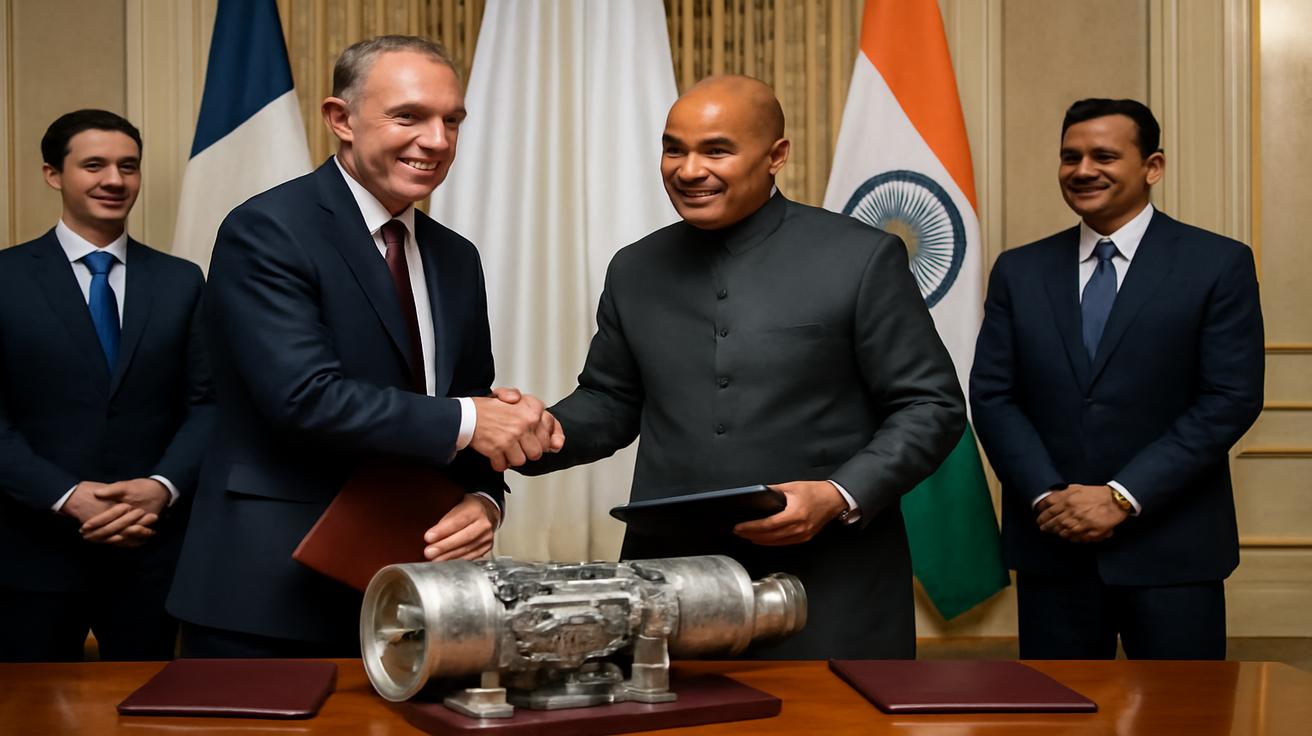
The rain had not yet decided what it wanted to be—mist, drizzle, or a full monsoon downpour—when the French delegation stepped onto the tarmac in New Delhi. The air smelled of jet fuel and wet asphalt, the kind of scent that makes you look up instinctively, searching for the source of that low, distant roar. Somewhere beyond the haze, a Sukhoi fighter cut a pale crescent across the sky, its engines grumbling like thunder caught in a metal cage. Down below, in conference rooms sealed from the weather but not from history, India was quietly choosing the beating heart of its future warplanes. By the time the clouds finally opened, the choice was made: France had edged out the United Kingdom to clinch a €6.7 billion deal to co-develop the engine for India’s next, almost-mythical prize—its 6th-generation fighter.
Whispers in the Jet Wash
The story did not begin with a signature on creamy paper or a triumphant press release. It began, as many such stories do, with a whisper—an offhand remark from an engineer, a rumor leaking out of a meeting room, a line in a defense budget that seemed more question than answer.
For years, India has watched its skies with a mix of wonder and restlessness. Its pilots fly an eclectic flock: French-designed Rafales, Russian-crafted Sukhois, homegrown Tejas light fighters, and aging MiG-21s that creak like veterans with too many stories. The dream has always been the same: strategic autonomy. The ability to build, power, and sustain its own air power—without looking over its shoulder at Moscow, Washington, or Paris.
Engines have been the one stubborn riddle. Airframes can be designed, radars can be fine-tuned, avionics can be updated. But the engine—that hot, feral heart of the aircraft—has been elusive. Previous attempts at a wholly indigenous fighter engine stumbled on the hard edges of metallurgy, thermodynamics, and cold geopolitical realities. India needed a partner, but not merely a vendor. It needed someone willing to share the crown jewels of engine technology.
For a time, it looked like the United Kingdom might step into that role. Rolls-Royce, with its rich history chiseled into the wings of everything from Spitfires to modern Eurofighters, looked like a natural fit. Yet in the background, quietly methodical, was France—Safran, Dassault’s compatriot in the long game of propulsion and power. The whispers grew louder, until one morning they weren’t whispers at all.
A Tug-of-War in a Changing Sky
On paper, the contest between the UK and France seemed finely balanced. Both countries brought formidable engine pedigrees. Both promised collaboration, co-development, and technology sharing. But the sky in which this competition played out was not the blue, unchanging canvas of old. It was streaked with new contrails: a rising China, an unpredictable Russia, an Indo-Pacific simmering with friction.
This engine was not just a cluster of turbines, blades, and combustors; it was a declaration of alignment. India, increasingly wary of overreliance on any one supplier, had already noted the delicate dance of export controls, sanctions, and strategic conditions. The question was not just who could build the best engine, but who would treat India as a partner, not a client.
France had history on its side. The Rafale deal, for all its political turbulence, had landed solidly in Indian service. French engineers had walked the hangars of Indian airbases, worked alongside Indian technicians, and—crucially—shown a willingness to discuss deeper technology transfers. The UK, while eager, wrestled with the gravitational pull of its broader defense ecosystem and regulatory entanglements that come with being tightly woven into US-anchored alliances.
Inside meeting rooms lit by cool white LEDs, Indian decision-makers weighed the unspoken as carefully as the written. How much source code would be shared? How much design freedom would India truly enjoy? What happens if global politics shift? Every answer added weight to one side of the scale. In the end, when the balance finally tipped, it tipped towards Paris.
The Numbers Behind the Roar
Deals of this magnitude often blur into abstraction—just another eye-watering sum tossed around in headlines. But this one has tangible contours. At €6.7 billion, it is not merely a purchase; it is a co-development pledge, anchored in years of engineering, testing, and iteration. The engine is set to power India’s future Advanced Medium Combat Aircraft (AMCA) program and, more ambitiously, feed into what New Delhi envisions as a 6th-generation fighter family.
If a contemporary fighter engine is a masterpiece of metal and heat, a 6th-generation engine is something closer to alchemy. We are talking about thrust levels that defy the old ratios, thermal management that can sustain stealthy, sensor-rich, high-speed operations, and fuel efficiency that turns vast regions—from the Himalayas to the Indian Ocean—into seamless patrol zones.
For India, the deal touches on more than performance numbers. It threads into a fabric of jobs, labs, foundries, and test cells that will stretch across the country. This is not just about buying power; it is about growing it.
| Aspect | France–India Engine Deal | UK–India Proposal (Indicative) |
|---|---|---|
| Estimated Value | €6.7 billion | Lower, with phased scope |
| Core Focus | 6th-gen capable engine for AMCA & future fighters | Advanced engine upgrade and co-development |
| Technology Transfer | Deep co-design, material tech, hot-section know-how | More incremental, subject to wider export regimes |
| Strategic Signal | Tightening India–France strategic axis | Continuation of traditional UK–India defense ties |
| Industrial Footprint in India | New joint labs, test facilities, supply-chain buildout | Component manufacturing, possible R&D hubs |
Inside the Forge: What 6th-Generation Really Means
Say “6th-generation fighter” aloud and it sounds more like marketing than metal, a phrase designed for glossy brochures and breathless segments on defense channels. But behind the label lie a handful of very real, very difficult engineering frontiers—and the engine sits at the crossroads of all of them.
Picture a pilot—or perhaps, in some missions, no pilot at all—sitting at the center of a web of sensors. The aircraft is less a machine and more a flying node in a data ecosystem, talking to satellites, drones, ships, ground stations, even swarms of autonomous wingmen. To do this while remaining stealthy, fast, and agile requires power—more than older engines were ever designed to generate.
A 6th-gen-capable engine must be:
- Ferociously hot—running at temperatures that test the limits of alloys and ceramic composites—yet consistently reliable.
- Quiet, at least to radar and infrared eyes, masking the aircraft from prying sensors.
- Adaptable, able to throttle up for supersonic dashes and throttle down for long, fuel-efficient patrols.
- Intelligent, packed with diagnostic systems that predict failures before they happen.
France’s experience with the M88 engine that powers the Rafale—and its ongoing work on next-generation European projects—offers a foundation. But what India is asking for goes beyond an off-the-shelf upgrade. It wants to weave its own requirements, climate, terrain, and strategic temperament into the design.
High-altitude airfields in the Himalayas, with thin air and unforgiving temperatures, demand engines that can wake up and roar under conditions that would make others sulk. Long over‑water flights over the Indian Ocean require unflinching endurance. And then there is the very human desire, understandable in a country that has so often waited on others for critical tech: the desire to hold the blueprints in its own hands.
France, India, and the Long Memory of Metal
Some partnerships are born of convenience. Others grow from long, if occasionally complicated, acquaintance. The France–India defense relationship belongs firmly in the latter category. From Mirages that defended Indian skies in earlier decades to Rafales now bristling on frontline bases, French aircraft have been steady companions in India’s aerial story.
In this engine deal, that rapport matters. It means Indian teams walking into French labs not as transient customers but as co-authors, their notebooks open, their questions sharper. It means French engineers spending long monsoon weeks in Indian test ranges, learning how dust, humidity, heat, and altitude conspire against machines, and figuring out how to outwit them together.
For France, this is not merely a win over a traditional rival in aerospace. It is a statement about how a mid-sized power can carve out a distinct identity in a world dominated by US and Chinese industrial giants: by being agile, flexible, and willing to share more deeply than larger players often can afford to.
For India, each weld and rivet in this joint engine becomes a small act of reclamation—the slow, patient move from license-built copies to genuinely indigenous capabilities. Not isolationist, not alone, but a partner on equal footing.
The UK on the Sidelines: A Quiet Disappointment
Across the English Channel, the news would not have landed gently. For the United Kingdom, seeking a renewed footprint in Indo-Pacific defense after Brexit, India is not just another market; it is a stage on which London hopes to prove its continued relevance. Missing out on a flagship engine program of this scale is more than a commercial loss.
In aero-engine circles, Rolls-Royce is spoken of in almost reverential tones. The company’s civil engines crisscross the planet; its military heritage is stitched into the narrative of modern air combat. British engineers had hoped that a new partnership with India could tie into future Global Combat Air Programme (GCAP) ambitions, creating a kind of grand arc of Anglo-Indian aerospace collaboration.
But the currents of politics and policy are rarely gentle. UK export frameworks, overlapping with broader Western technology control regimes, can make deep technology transfer a more complex promise to keep. India, with its painful memory of past embargoes and sudden policy pivots, has learned to read the fine print in such offers.
So, while official statements will be polite, measured, and forward-looking, there will be a quiet sense of a door half-closed—for now. The UK will still court India in other domains: maritime security, cyber, perhaps even future UAV projects. Yet, the engine—the heart of a fighter—is a symbol, and symbols have weight.
Factories, Foundries, and Futures
Back in India, the implications of the deal will not be measured solely in thrust-to-weight ratios or thermal efficiency curves. They will be counted in training programs, welding schools, material labs, and test beds that hum late into the night. For the young engineer in Bengaluru or Coimbatore, this is the kind of program that turns textbooks into turbines.
Joint manufacturing lines are expected to rise like new constellations across the industrial landscape. Blades that once arrived in wooden crates from far-off countries will now emerge from Indian furnaces, their edges honed in collaboration with French metallurgists. Sensor systems will be calibrated not just to fly, but to learn—from every minute of operation, feeding back into design tweaks and software updates.
It is easy to overlook the softer effects. University departments will shape new courses around advanced propulsion. Startups will sniff at the edges of this supply chain, offering niche solutions in AI-based diagnostics, material science, or additive manufacturing. Over time, the engine program becomes an ecosystem, and ecosystems have a way of outgrowing the boundaries of their original purpose.
Beyond Borders, Above Politics
On a still night, the sound of a fighter taking off can travel for miles, a loud, insistent reminder that power, in our world, still has a physical form. But the meaning of that sound is changing. Where once it might have signaled simple dominance, now it speaks of networks, alliances, shared technologies, and competing visions of security.
The France–India engine deal sits at a crowded intersection: between East and West, between old colonial memories and new strategic calculations, between dependence and autonomy. It tells us something about the future of military aerospace—that it will be less about solitary national masterpieces and more about intricate, co-authored projects that mix cultures, engineering philosophies, and political bets.
It also raises questions. What will this do to delicate balances in the Indo-Pacific, where every new capability is watched from Beijing to Canberra? How will Russia interpret India’s deepening ties with Western suppliers in such a critical area? Will this nudge other partners—Japan, the US, European consortia—towards more generous, more flexible offers of collaboration to avoid being left behind?
The answers will not arrive in a single press note. They will unfold over years, perhaps decades, as prototypes roll out of hangars, engines scream to life on static test stands, and pilots climb into cockpits powered by something that was, in every sense, built together.
For now, somewhere over the Indian Ocean, a Rafale traces a high, silver line against the morning sun, its French engine singing that familiar, practiced song. In a few years, another aircraft will join it in that sky—sleeker, stealthier, born of two nations’ shared ambition. When it does, the sound it makes will carry a new kind of echo: the echo of a choice that edged out one old partner in favor of another, and in the process, redrew a small but meaningful piece of the map of power above our heads.
FAQ
What exactly is the €6.7 billion deal between France and India?
It is a large co-development agreement under which France and India will jointly design and build an advanced fighter jet engine, intended primarily for India’s future AMCA program and a broader 6th-generation fighter ecosystem. The deal covers R&D, testing, industrial setup, and significant technology transfer.
Why did France win over the UK for this engine program?
France is believed to have offered deeper technology transfer, more flexibility in co-design, and a track record of relatively independent export policies. Combined with the existing Rafale partnership and fewer external political constraints, this gave Paris an edge over the UK’s proposal.
What makes a 6th-generation fighter engine different from current engines?
A 6th-gen-capable engine must provide higher thrust, better fuel efficiency, improved stealth characteristics, advanced thermal management for power-hungry sensors, and built-in health monitoring. It is essentially a smarter, hotter, quieter, and more adaptable evolution of current fighter engines.
How will this deal help India’s indigenous defense capability?
The program brings advanced know-how in materials, high-temperature turbine design, manufacturing techniques, and engine control systems into India. It will support new test facilities, local production of key components, and hands-on experience for Indian engineers, strengthening long-term self-reliance.
Does this mean India will stop working with the UK in defense?
No. While the UK lost this particular competition, India and the UK continue to cooperate in other defense areas, including maritime security, training, and potential future aerospace or unmanned systems projects. This deal mainly reflects India’s priorities for deep technology access in fighter propulsion.
When will engines from this program actually power Indian aircraft?
Timelines for such complex programs typically stretch over a decade or more. After design and prototype testing, engines must complete rigorous evaluation before being integrated into flying prototypes and, later, operational squadrons. Initial operational use is likely to be in the 2030s.
Will this engine be used only by India and France?
Initially, the focus is on India’s requirements. However, depending on export policies, performance, and geopolitics, the engine—or derivatives of it—could potentially find its way into other platforms and markets where both countries are comfortable with co-exporting.







Leave a Comment