
The first time you notice it, really notice it, isn’t in a mirror. It’s in a moment. Maybe you’re tying your shoes and feel your stomach press a little too tightly against your thighs. Maybe you’re walking up the stairs and you catch that subtle, unsteady wobble in your middle. Or you’re lying in bed, hand resting absently on your belly, feeling its soft rise and fall and thinking, “When did this become…me?”
The Quiet Story Your Belly Is Telling
We call it “bloated,” “protruding,” “puffy,” like it’s just an aesthetic flaw sitting there under your shirt. But your belly tells a deeper story—about your posture, your breath, your stress, your sleep, your hormones, your habits, and the way you’ve been carrying yourself through the world.
Under that soft curve is a set of muscles that do far more than look good in a bathing suit. Your core isn’t just your “abs”—it’s a wide, woven hammock of muscle that wraps from your ribs down to your hips and all the way around your back. It supports your spine when you pick up your kids, haul groceries, or sit hunched over a laptop for hours. It guides every twist, reach, and step. When this system is weak or “asleep,” your belly often drifts outward, like a hammock with too much weight in the middle and not enough tension at the edges.
That’s why crunches and sit-ups alone often fail to “flatten” anything. They strengthen a narrow strip of muscle at the front while ignoring the deep corset-like muscles underneath—the ones that gently pull your belly inward and upward, supporting your organs and spine. When those deep muscles kick in, your middle doesn’t just get smaller; it feels more contained, more stable, more you.
So instead of obsessing over the mirror, imagine this: what if your core felt so strong and alive that you could sense it with every step? What if your belly no longer felt like a separate, stubborn thing you needed to “fix,” but a powerful center you could trust? That’s what the right kind of core work can do.
The 3 Core Exercises That Change How You Stand in Your Own Body
You don’t need a gym, a mat made from rare Himalayan fibers, or a 90-minute workout. You need three carefully chosen movements that wake up the deep core, recruit the supporting cast of muscles around your spine and hips, and slowly, steadily pull that “bloated, protruding” look back toward a more balanced, supported shape.
These exercises are deceptively simple. But the magic lies in how you do them—how you breathe, how you align your body, and how present you are for those subtle trembling seconds when your muscles begin to remember their job.
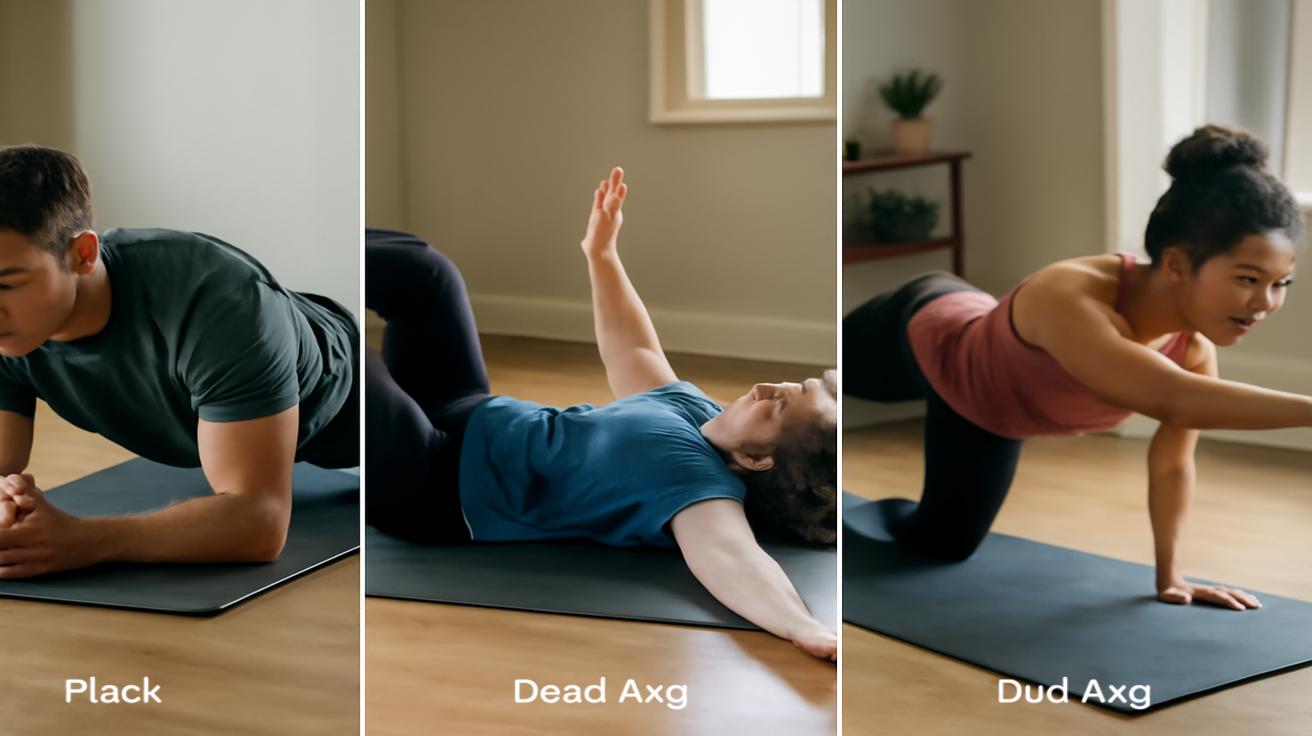
1. The Dead Bug: Reawakening the Deep Core
Lie down on your back. The floor feels cool and reassuring beneath you. Bend your knees and lift your legs so your shins are parallel to the ceiling—like you’re sitting in a chair that’s been tipped over on its back. Now raise your arms straight up toward the sky, fingers reaching gently upward.
This is your starting shape. If anyone walked by, you’d look a little like a stranded beetle—hence the name “dead bug.” But inside, there’s nothing dead about what’s happening.
Take a slow breath in through your nose, letting your ribs widen gently to the sides. As you exhale through your mouth, imagine you’re fogging up a window. Feel your ribs knit closer together, and—here’s the key—imagine zipping a long, invisible zipper from your pubic bone up toward your sternum. Your belly will slim down and lightly draw inward, but you’re not sucking in harshly; you’re gathering in, like pulling on a snug but comfortable jacket.
Now, keeping that gentle “zip” sensation, slowly lower your right arm and left leg toward the floor. Move as if you’re in slow motion, stopping your leg just above the ground and your arm just above the floor behind you. If your low back wants to arch and pop off the ground, that’s your cue to not go quite as low. Pause. Breathe. Feel that deep, inner shaking—that’s the core re-learning its role.
Inhale as you hold, then exhale and bring the arm and leg back to the starting position. Switch sides: left arm, right leg. Alternate, 6–10 reps each side, resting if you feel your low back taking over.
The dead bug doesn’t care how “in shape” you look. It cares how connected you are. Over time, as you practice, your low belly starts to respond faster. That outward, soft curve begins to feel slightly more lifted, as if someone is cupping it gently from underneath.
2. The Plank: Finding Strength Between Your Shoulders and Toes
The plank is brutally honest. It doesn’t let you hide behind clever angles or stretchy waistbands. It asks one question: can you hold yourself up, in one clean line, using the whole front and back of your body working together?
Start on all fours: hands under shoulders, knees under hips. Spread your fingers a little, pressing your palms firmly into the floor. Tuck your toes, then step one foot back, then the other, until your body forms a straight line from your head to your heels. Your hips aren’t sagging toward the floor, and they’re not poking up toward the ceiling. You are a long, steady plank of wood—strong, simple, and unwavering.
Now breathe. Inhale through your nose. As you exhale through your mouth, lightly knit your ribs toward each other and imagine those deep low-belly muscles hugging in again, almost like you’re cinching a drawstring just inside your hip bones. Your goal isn’t to hold your breath—it’s to keep breathing while maintaining that quiet, inner support.
Your shoulders may start to whisper complaints. Your thighs will burn. Your belly will quiver. This is your body’s way of recalibrating: “Oh, right, this is what it feels like to be held together.” Start with 10–20 seconds, maybe less, then lower your knees. Rest. Try again.
If a full plank is too much, you can begin with your knees on the floor, keeping a straight line from shoulders to knees instead of shoulders to heels. The sensation in your core should feel like work but not like panic. No clenching your jaw, no pinching in your low back. Just a steady, tremoring engagement, as if your entire midsection is waking up from a long nap.
3. The Bird Dog: Teaching Your Core to Move With You
Daily life is not a static plank. You reach for things, twist, bend, rotate. A strong core isn’t about being a statue; it’s about controlling movement. That’s where the bird dog comes in—a gentle yet potent way to teach your core how to stabilize as your limbs move in opposite directions.
Back to all fours again: hands under shoulders, knees under hips, the weight of your torso resting evenly across your palms and shins. Your spine is long, like a tabletop. Imagine a glass of water balanced on your lower back—you want to move without spilling it.
Take a steady inhale. As you exhale, lightly engage that same deep core “corset”—belly gently lifting toward your spine, ribs softening inward. Now reach your right arm straight forward while sliding your left leg straight back, toes hovering off the floor. Don’t let your hips twist or tilt. Everything in the middle stays quiet and centered while your hand and foot explore opposite directions.
Hold for a breath or two. You might feel the muscles around your spine and waist flicker awake, using tiny adjustments to keep you balanced. Then slowly bring your hand and knee back down. Switch sides: left arm, right leg.
Move with the calm precision of a fox padding across a log over a stream—deliberate, alert, but never rushed. Try 8–10 repetitions on each side. Done consistently, the bird dog knits your back, belly, and glutes into a coordinated team, making that protruding, unsupported middle much less likely to slump forward in daily life.
How Often Should You Do These? A Simple Weekly Rhythm
The body loves rhythm. It doesn’t need punishment; it needs repetition. Consistency is what gently coaxes your core muscles from “I’ve been off-duty for years” to “This is just what we do now.”
Here’s a simple way to think about practice:
| Day | Focus | Details |
|---|---|---|
| 2–3 days per week | Core Session | Dead Bug, Plank, Bird Dog done together in one 10–20 minute session. |
| Most other days | Mini-Core Moments | 1–2 sets of one exercise, or 30–60 seconds of deep core breathing and posture checks. |
| Weekly Goal | Consistency | Aim for at least 3 full sessions and a few short check-ins across the week. |
You can flow through all three exercises like this:
- Dead Bug: 2–3 sets of 6–10 controlled reps per side
- Plank: 2–3 sets of 10–30 seconds (knees down if needed)
- Bird Dog: 2–3 sets of 8–10 reps per side
Rest 30–60 seconds between sets. The entire routine can fit into the length of a podcast intro, a kettle boiling, or the quiet stretch before bed when the house finally goes still.
More Than Just a Flatter Belly: The Subtle Wins
You’ll probably notice changes before you see them. Walking up a hill, your body might feel more “held together,” less jiggly around the middle. Standing at the sink, you might catch yourself softly lifting tall through your spine, ribs stacking naturally over your hips instead of collapsing forward.
That bloated, forward-hanging belly often comes with low-back tightness, hip discomfort, and that foggy fatigue that settles in after long hours of sitting. As your core strengthens, these begin to shift:
- Posture improves: Your spine has more muscular support, so slouching becomes less automatic.
- Breathing deepens: With better alignment and a more engaged diaphragm, your breath can expand further into your ribs, easing that tight, shallow chest breathing.
- Movement feels lighter: Climbing stairs, lifting bags, or simply standing up from a chair feels less like a heave and more like a smooth rise.
- Clothes sit differently: Over time, as your deep core gathers in and upward, waistbands may feel a little looser, and shirts may skim a little smoother.
This isn’t magic. It’s biology mixed with attention. When you reclaim your core from the chaos of slouching, shallow breathing, and endless sitting, your whole midsection stops fighting you and starts holding you.
Small Daily Shifts That Quietly Support Your Core
A stronger, less protruding belly doesn’t just come from those 15 minutes of exercise. It’s also shaped by what you do with the other 23 hours and 45 minutes. You don’t need a total life overhaul—just a handful of small, almost invisible adjustments.
Stand Like You Mean It
The way you stand either helps your belly hang forward or gently encourages it inward. Instead of locking your knees and letting your hips drift forward, try this:
- Plant your feet under your hips, toes soft and relaxed.
- Imagine a string gently lengthening your spine upward from the crown of your head.
- Let your ribs stack over your pelvis, not flaring forward.
- Let your belly soften, then lightly gather in, like a quiet exhale.
Hold that posture for a few breaths whenever you wait—at the stovetop, in line, or brushing your teeth.
Sit With Support, Not Surrender
Hours in a chair can undo your best intentions. Instead of sinking into a C-shape, hips rolled under, belly spilling forward, adjust:
- Bring your sit bones (those bony points under your butt) to the back edge of the chair.
- Lean slightly forward from your hips, not your waist.
- Let your spine grow tall, as if you’re balancing the lightest book on your head.
- Every 20–30 minutes, stand and stretch for 30–60 seconds.
Breathe Like You’re Meant To
Chronic stress often traps your breath high in your chest, keeping your diaphragm tight and your core sleepy. A few times a day, pause and try this:
- Inhale through your nose for 4–5 seconds, feeling your ribs widen to the sides and back.
- Exhale gently through your mouth for 6–8 seconds, as if blowing through a straw.
- On the exhale, feel your low belly gently glide inward and upward.
In less than a minute, you’ll feel calmer, taller, and more connected to that deep inner center.
Reframing the Goal: From Flat to Strong, From Shame to Connection
There’s a quiet cruelty in the phrase “bloated, protruding belly.” It reduces an entire living, breathing body to one stubborn curve. But your core is not a problem to be punished into submission; it’s a relationship to rebuild.
The three exercises—dead bug, plank, bird dog—are not a bootcamp sentence. They’re invitations. Each rep is a tiny conversation with your center: “Can I support you better? Can we work together again?” Over weeks and months, that conversation becomes familiar. Your belly’s shape may change—gently drawing in, feeling firmer to the touch, clothes draping differently. But the deeper shift is this: you start to inhabit your own middle with respect, not resentment.
You are not trying to erase your belly. You’re teaching it to remember its original role: to hold, protect, and power you. When that happens, the way you move through the world changes—less bracing, more grounded; less hiding, more present.
So tonight, when the house goes quiet, or tomorrow morning in that soft, gray light before the day begins, lay down on the floor. Feel the firm, unjudging support beneath you. Raise your arms. Lift your legs. Breathe. Begin.
Frequently Asked Questions
How long will it take to see changes in my belly?
Many people feel a difference—better posture, more stability, less “loose” feeling around the midsection—within 2–3 weeks of consistent practice (about 3 sessions per week). Visible changes in shape typically take 6–8 weeks or more, depending on your overall activity, nutrition, stress, and sleep.
Will these exercises burn belly fat?
No single exercise burns fat from one specific area. These core moves strengthen and tone the muscles beneath your belly. Combined with regular movement (like walking or other exercise) and supportive eating habits, they can contribute to a slimmer, more supported midsection over time.
Can I do these exercises every day?
You can do gentle versions daily, especially bird dog and short planks, as long as you’re not experiencing pain or extreme fatigue. For most people, 3–4 focused sessions per week with rest days in between is a good rhythm for progress and recovery.
What if I have low-back pain?
If you have existing back pain, move slowly and stay well within a comfortable range. Focus on keeping your spine neutral (not arched or overly rounded) and stop any exercise that increases your pain. You may benefit from professional guidance from a physical therapist or qualified trainer who can adjust these exercises for your specific needs.
Do I still need crunches and sit-ups?
Crunches and sit-ups aren’t necessary for a strong core and can sometimes aggravate the neck or low back. The dead bug, plank, and bird dog target deeper and more functional layers of your core. If you enjoy crunches and feel no discomfort, they can be included, but they don’t need to be the foundation of your core training.








Leave a Comment