
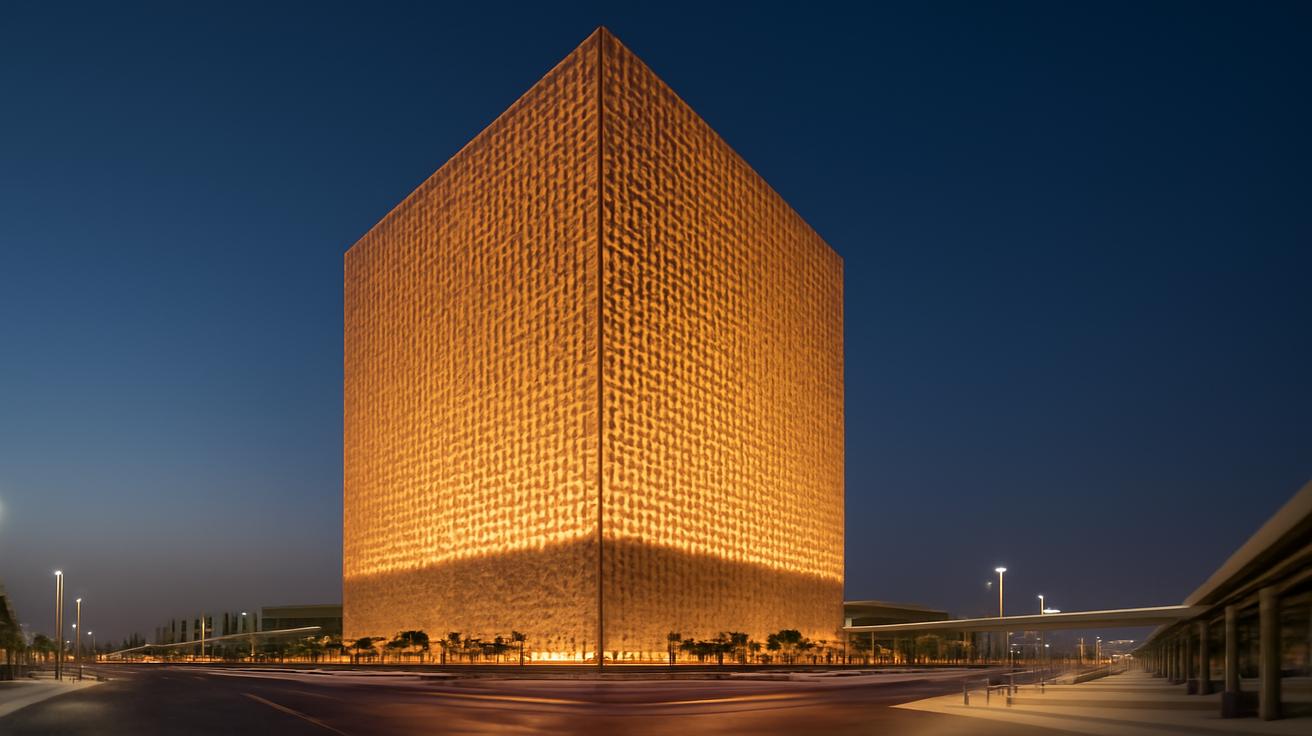
The desert wind hits you first—dry, sun-baked, carrying a faint tang of salt from the distant Red Sea and a trace of something else: hot metal, poured concrete, ambition. If you stand on the outskirts of Jeddah at dawn, when the sky is still lavender and the cranes are sleeping, you can almost hear it. A low, humming promise pressed into the horizon: We’re going higher.
Skyscrapers, Superlatives, and the Human Itch to Go Up
For years, the vertical conversation has been dominated by two names: Burj Khalifa in Dubai and Shanghai Tower in China. Their photos circle the globe—sleek glass spears piercing the sky, markers of power and progress, the reigning champions in a global contest to redefine “tall.” Yet somewhere in the Saudi desert, the scoreboard is being quietly rewritten.
Saudi Arabia isn’t just entering the skyscraper race; it’s trying to redraw the finish line. The plan? A skyscraper soaring to around 1,000 meters—one full kilometer into the sky. A building so tall it begins to play with the edge of what’s physically and psychologically comfortable for us as humans. If Burj Khalifa is a statement, this is a question: How far can we go before the sky pushes back?
This is not fantasy art from a sci-fi cover. Foundations have already been poured. Reinforcements twist out of the sand. The skeleton exists, rising from the ground, waiting for its story to continue in steel and light.
A Tower Born of Sand, Oil, and Reinvention
The seed for this mega-tower didn’t come out of nowhere. Saudi Arabia stands at a hinge moment in its history. Oil built the kingdom, but oil alone won’t sustain it. Under Vision 2030, the country has thrown itself into a risky, radical experiment: transform from a hydrocarbon giant into a diversified, globally magnetic hub of tourism, technology, and culture.
In that context, a kilometer-tall skyscraper is more than a building. It’s a symbol of reinvention, a vertical announcement that the story of Saudi Arabia is changing. Just as Dubai used Burj Khalifa to stamp its identity as a global city, Saudi Arabia is betting that a taller, more audacious tower will cast a longer shadow across the world’s imagination.
Picture the outline on the horizon. Imagine flying into Jeddah at night and seeing a spire of light so tall you have to crane your neck inside the airplane just to follow it upward. At this scale, architecture stops being background and becomes atmosphere—like a new kind of weather system thrown into the sky.
The Engineering of a 1-Kilometer Dream
You can’t build a kilometer-tall skyscraper with ordinary rules. Gravity has opinions. Wind has a temper. The higher you go, the more the sky begins to tug and twist at your design. Engineers working on Saudi Arabia’s “vertical city” have had to think like both architects and mountain climbers, battling invisible forces at every meter of height.
At ground level, the building’s core must be thick, extremely dense, and anchored to foundations that are almost mythic in scale—piles driven deep into the earth like artificial roots of a man-made mountain. As the structure rises, it tapers, slimming down so the wind can slide around it instead of pushing it like a sail. You can’t eliminate sway at such altitudes, but you can tame and redirect it using tuned mass dampers—huge counterweights, hidden far above the city, moving in opposition to the tower’s motion so that the people inside feel calm even while the structure is subtly breathing with the sky.
Temperature is another quiet adversary. Near ground level, the Saudi air is scorching. Higher up, the temperature drops. The materials expand and contract. Facades must shield interiors from brutal desert sun while letting in enough light to make the tower feel inhabitable, human. Glass isn’t just glass anymore; it’s a smart skin, filtering radiation, adjusting to the rhythm of the day, sometimes even generating power.
And then there are the elevators—a vertical transit system on the scale of a metro line. To cross nearly a kilometer of height, elevators need to be faster, smarter, and safer than anything most cities have ever seen. You don’t simply press a button and shoot straight to the top; you change “lines,” moving through sky-lobbies, using multi-stage lifts that hopscotch through the structure. It’s a building, but it’s also a transportation network folded into a single, slender silhouette.
Between Sand and Sky: Life Inside a Vertical City
Walk with your imagination into the completed tower for a moment. The lobby isn’t just a lobby; it feels like a cooled oasis. The hush of air conditioning. The smell of polished stone and faint perfume. Light pools across marble floors from a towering glass wall that frames the desert like a painting. Palm trees may stand here, indoors, their fronds catching filtered light that has traveled through meters of engineered glass.
You step into an elevator. The doors slide shut with a quiet hiss. There’s a soft chime, a small sensation in your knees, and suddenly the city drops away. Floors blur on the display. Thirty. Fifty. One hundred. Two hundred. The air pressure changes just a little. Your ears feel it before your brain does: you are leaving the ordinary human zone and climbing into a realm usually reserved for aircraft and birds.
At a mid-level sky-lobby, life hums. Offices stretch across entire floors, lit by digital dashboards and sunrise light. Conference rooms overlook a city that looks more like a circuit board than a settlement. Cafés line elevated promenades where people sip coffee and watch dust storms roll in far below like distant weather on another planet.
Higher still, the tower shifts in character. Maybe you walk into a restaurant where the horizon curves slightly, an illusion of Earth’s roundness accentuated by pure altitude. Perhaps there’s an observation deck with a glass floor. You step onto it, heart knocking in your chest, staring down through a clear pane at thousands of tiny cars tracing faint lines of light. Up here, the noise of traffic is gone. The city is pure geometry and glow.
A Quick Look at the Skyscraper Arms Race
The Saudi super-tower doesn’t exist in a vacuum. It stands at the edge of a quiet competition among nations and cities, each trying to rewrite what’s possible in vertical construction. To understand where this new giant fits, it helps to see the landscape of ultra-tall buildings it’s poised to surpass.
| Building | Location | Approx. Height | Status |
|---|---|---|---|
| Burj Khalifa | Dubai, UAE | 828 m | Completed |
| Shanghai Tower | Shanghai, China | 632 m | Completed |
| Abraj Al-Bait Clock Tower | Mecca, Saudi Arabia | 601 m | Completed |
| Ping An Finance Center | Shenzhen, China | 599 m | Completed |
| Saudi 1-km Skyscraper | Near Jeddah, Saudi Arabia | ~1,000 m (planned) | Under development |
Look at that last line. One thousand meters. The number doesn’t just edge ahead; it leaps. We’re used to thinking of tall buildings in terms of floors and functions, but at this scale the height itself becomes part of the experience—psychological, symbolic, almost mythic.
Desert, Sustainability, and the Question of “Should”
Whenever the world announces a new superlative—biggest, tallest, fastest—another question walks in right behind it: Why? In an era where the climate crisis is no longer a warning but a lived reality, the idea of pouring millions of tons of concrete and steel into a single structure in the desert feels complicated, even uncomfortable.
Saudi Arabia’s ambitions collide with this tension head-on. On one hand, the tower promises to be stitched into a new urban fabric that is denser, more walkable, and potentially more efficient per person than car-centered sprawl. Vertical living can mean shorter commutes, fewer roads, and a smaller footprint per capita.
On the other hand, everything about building that high strains the planet’s resources. Concrete production is carbon-intensive. Steel comes with a heavy environmental price tag. Running a vertical city in a desert climate demands brutal amounts of cooling, ventilation, water management, and energy—all in a place where the sun burns hot enough to warp your sense of time just by standing outside at noon.
To justify itself, a kilometer-tall skyscraper in Saudi Arabia has to be more than a vanity project. It has to become a proving ground for new, cleaner technologies. Think high-performance facades that reject heat while harvesting energy from the sun. Think advanced gray-water recycling systems that treat and re-use every possible drop. Think district cooling powered increasingly by renewables, rather than a chain of gas-fired plants.
There is a certain irony here. The nation whose wealth sprang from oil is now building high-tech monuments that, at their best, could model a post-oil future: smart grids, energy storage, low-carbon materials. Whether that promise will fully materialize is an open question—but the scale of the tower makes it an unignorable test case.
A New Kind of Desert Story
For centuries, the Arabian Peninsula has existed in the global imagination as a place of caravans and dunes, minarets and mirages. Then came oil, pipelines, freeways, and air-conditioned malls. This new skyscraper is another pivot point in that evolving story, but it also helps us see the desert in a different, more complicated light.
From the tower’s glass-wrapped heights, the desert won’t look empty. It will look patterned and alive—ridges and folds, light and shadow, a living topography of stone and sand. Far below, traffic will flow, cranes will move, people will cross bright plazas. Yet beyond the last highway interchange, the land reclaims its long silence.
The contrast will be stark. Inside: chilled air, soft seating, digital displays, fragrant coffee, the blurred world of global finance and tourism. Outside: heat that can sear the breath from your throat in a few minutes, hot wind rasping over sand, a sky whose colors at sunset seem almost exaggerated—mauve, fire orange, a bruised purple melting into night.
This tower, if completed as envisioned, will become a storytelling device in itself. Every photograph taken from its top will show a human-made vertical miracle framed by an ancient horizontal world. Every time a visitor steps out onto an observation deck, they will feel, consciously or not, that strange equation: what we can build versus where we have built it.
Beyond Height: What Comes After a Kilometer?
There is an odd thing about records: the moment you set one, you begin to wait for it to fall. Somewhere, someone looks at your achievement and thinks, We could go higher. We could go further. But with a kilometer-tall skyscraper, the question isn’t just about engineering capacity—it’s about human appetite.
At what point does height stop adding meaning? A few meters more on top of 1,000 doesn’t change the view much. Past a certain level, space becomes abstract rather than intimate; a city turns into a cloud of lights, not a place of streets and faces. The emotional return on height diminishes even as the cost—in money, materials, and energy—skyrockets.
So perhaps the Saudi mega-tower represents not just the next record, but a pivot away from the obsession with height for its own sake. Once we reach the psychological wall of one kilometer, we might begin to ask different questions. Not “How tall?” but “How livable?” Not “Who can build the biggest?” but “Who can build the most humane, the most sustainable, the most enduring?”
It’s possible that when people look back on this skyscraper decades from now, they won’t just remember the number. They’ll remember whether life inside it felt like a vision of a better urban future—or a fragile, glittering symbol of a world that tried to outbuild its own limits.
A Tower, a Kingdom, and a Moment in Time
For now, the story is still being written. Cranes continue to swing under the desert sun. Workers in reflective vests move like bright dots along the rising structure. Boardrooms hum with renderings and models, arguments and calculations. Outside, the wind keeps scraping over the sand, same as it has for millennia, unconcerned with human blueprints.
One day, if all goes according to plan, someone will stand on the highest publicly accessible point of this Saudi skyscraper—perhaps a viewing deck behind thick glass, or a sheltered terrace open to the sky. They will press a hand against the barrier, feel the faint vibration of the wind trying to claim what humans have built. They will look out over a kingdom in transformation: old cities expanding, new megaprojects blooming from coastal plains and desert plateaus, the Red Sea glinting in the distance.
They might think about Burj Khalifa and Shanghai Tower, about the towers that came before, about the cathedrals and pyramids and pagodas that, in their own times, also tried to reach closer to the heavens. They might feel a flicker of wonder, mixed with unease, at just how far up we’ve managed to climb.
And maybe, just for a moment, they’ll step away from the glass, close their eyes, and listen—not to the quiet hum of the elevator systems or the murmur of other visitors, but to the ancient, low roar of the wind outside. The reminder that everything we build, no matter how high, still stands on the same restless, turning Earth.
Frequently Asked Questions
Why is Saudi Arabia building a 1-kilometer skyscraper?
The project is part of a broader national push to diversify the economy beyond oil, attract tourism and investment, and signal Saudi Arabia’s emergence as a major global destination. The tower is meant to function as a mixed-use “vertical city” and as a powerful symbol of transformation under Vision 2030.
How tall will the tower be compared to Burj Khalifa?
Burj Khalifa in Dubai stands at about 828 meters. The planned Saudi tower is designed to reach roughly 1,000 meters, or one kilometer, making it significantly taller and positioning it as a new benchmark in skyscraper design.
Will the building be environmentally sustainable?
The intention is to incorporate high-performance facades, advanced cooling systems, water recycling, and increasing reliance on cleaner energy sources. However, any structure of this scale still carries a heavy environmental footprint, so its true sustainability will depend on how effectively these technologies are implemented and operated over time.
What will be inside the skyscraper?
The tower is expected to host a mix of uses: offices, luxury residences, hotels, restaurants, observation decks, and various public and semi-public spaces. The idea is to create a self-contained vertical district where people can live, work, and spend leisure time without constantly returning to ground-level streets.
Is this the future of cities—building higher and higher?
Ultra-tall skyscrapers will likely remain rare and symbolic rather than the norm, but denser, more vertical living is already a clear trend in many growing cities. The real future of urban design may focus less on absolute height and more on creating compact, walkable, energy-efficient environments—whether those are 50 stories high or 200.






Leave a Comment