
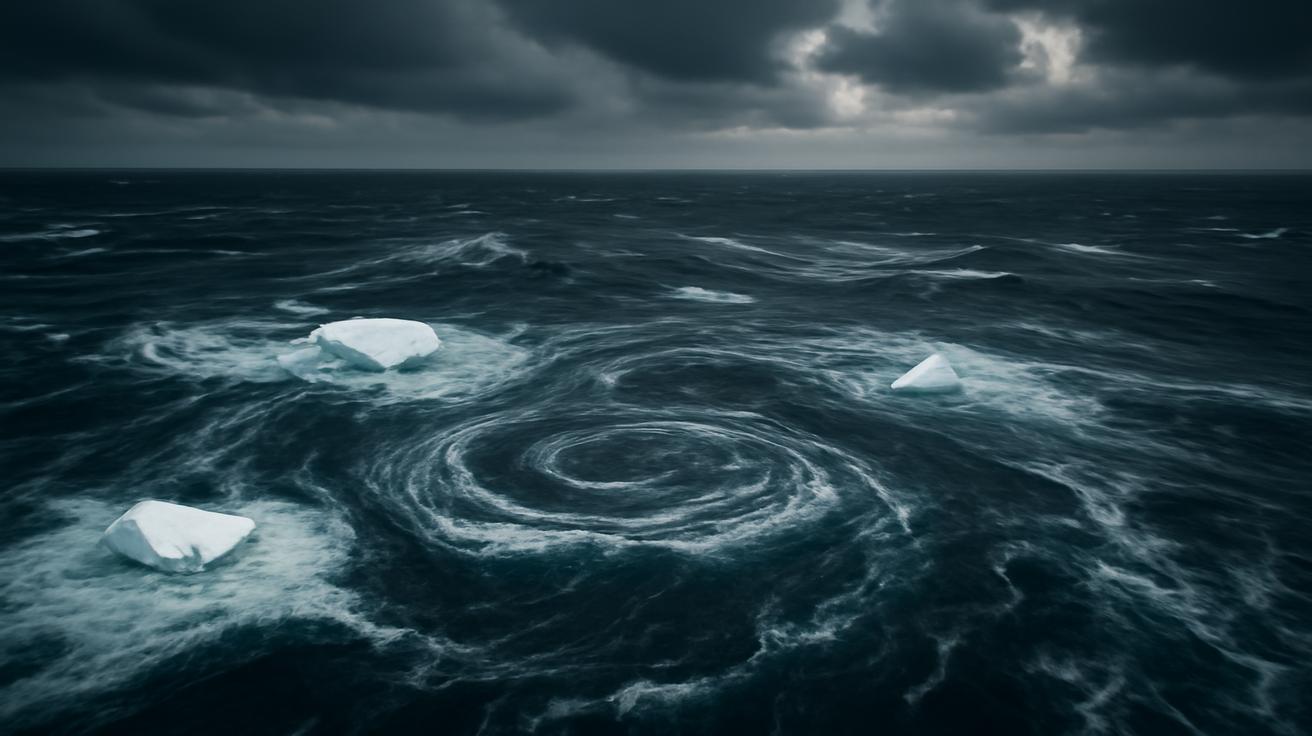
The first time the current changed direction, the scientists didn’t believe their instruments. It was the kind of glitch you blame on a loose cable, a frozen sensor, a software bug. Down in the roaring latitudes of the Southern Ocean, where wind and water never seem to rest, something had flipped. A flow that had been moving one way for as long as we’ve watched it – as long as we’ve understood how the planet breathes – had turned around.
In the control room, thousands of miles away, a row of monitors showed a thread of color bending back on itself, the blue streak of east-bound flow suddenly shot through with red, like an artery pumping the wrong way. Nobody spoke for a moment. Then someone swore, quietly. Someone else laughed, the nervous kind of laugh you give to the impossible. Outside, beyond the walls and the coffee and the hum of computers, the Southern Ocean heaved against the cold skirts of Antarctica and went on doing whatever it was now doing, with or without our permission.
When the Ocean’s Heart Skips a Beat
To understand why that reversal matters, you have to picture the Southern Ocean not as empty blue on a map, but as the beating heart of Earth’s climate. Around Antarctica, a ring of water circles the planet – the Antarctic Circumpolar Current, or ACC. It is the strongest current on Earth, a liquid highway driven by screaming westerly winds and the temperature contrast between icy Antarctic waters and warmer mid-latitude seas.
For millions of years, the ACC has spun like a colossal flywheel, always eastward, knitting together the Atlantic, Pacific, and Indian Oceans. It helps regulate how heat, salt, and carbon move around the planet. It pulls deep, cold water up from the abyss, lets it taste the air, then sends it on journeys that last centuries. It is, in a quiet, invisible way, one of the reasons you can drink coffee in a temperate kitchen instead of watching crops fail under a collapsing climate.
So when instruments anchored deep in the Drake Passage and other strategic chokepoints began to show a sustained reversal in one of the ACC’s major branches, it wasn’t just a weird curiosity. For oceanographers, it felt like hearing an irregular heartbeat in a patient who had always seemed indestructible.
Picture standing on the deck of a research vessel in the Southern Ocean. The air smells like iron and cold salt. Wind claws at your jacket. Waves don’t crash so much as roll in endless, hulking shoulders under the gray sky. There’s no land in sight, only an encircling wilderness of water that seems too vast to change in any meaningful way. Yet far beneath that restless surface, a ribbon of flow has quietly turned around, carrying heat and fresh water in the wrong direction – or at least in a direction we have never seen before in the age of instruments.
What It Means When a Giant Turns
Currents don’t simply decide to reverse. They respond – to wind, to temperature, to the weight and saltiness of the water itself. In the Southern Ocean, climate change has been rewriting those rules.
Antarctica’s ice shelves are melting from beneath as warm, relatively salty water gnaws at their undersides. Glaciers spill more fresh water into the sea. Fresher water is lighter; it floats more easily above the denser, saltier layers. This layering can choke off the normal sinking of cold, heavy water that helps drive the global “conveyor belt” of circulation known as the overturning circulation.
Now imagine that carefully balanced layering being nudged, year after year, by record-breaking heat in the atmosphere, by winds that have crept southward and intensified, by the relentless addition of fresh meltwater. At some point, a tipping moment comes for the currents themselves.
The reversal that startled researchers didn’t flip the entire Antarctic Circumpolar Current on its head. Instead, a major branch – a powerful jet that threads its way through underwater mountains and narrow gateways – slowed, weakened, and then, over weeks and months, began to move the other way. A local event, yes. But in a system this interconnected, “local” is a temporary illusion.
| Key Feature | Normal Behavior | Observed Change | Climate Risk |
|---|---|---|---|
| Current Direction | Stable, persistent eastward flow | Sustained regional reversal | Sign of disrupted circulation patterns |
| Water Properties | Cold, salty deep water upwells and sinks efficiently | Fresher, warmer surface layers; reduced sinking | Weakening global overturning circulation |
| Heat Transport | Southern Ocean absorbs and redistributes heat globally | Altered pathways, potential heat buildup in key regions | Regional climate extremes, marine heatwaves |
| Carbon Storage | Deep ocean stores large amounts of CO₂ | Reduced ventilation between deep and surface layers | Less carbon absorbed, more left in the atmosphere |
In climate science, what worries people most is not a single weird year or one freak event. It’s when the weirdness begins to line up with what the models have been warning about for decades. A major Southern Ocean current reversing direction is exactly that kind of chilling echo – a real-world signpost matching the red flags in our simulations.
The Ocean Knows Before We Do
The Hidden Warnings in the Water
Most of us feel climate change through obvious messengers: searing summer heat, smoke-thick skies, floods in places that never used to flood. The ocean speaks more quietly. It whispers its warnings through changes in temperature a thousand meters down, through salinity shifts measured in the third decimal place, through a current that used to run east and now, improbably, pulls west.
Oceanographers have been tracking the Southern Ocean with a flotilla of robotic floats, satellites, moored instruments, and old-fashioned shipboard casts. Taken together, they’ve drawn a simple, unsettling picture: this ocean, which has been swallowing much of the excess heat and a big share of the CO₂ we dump into the sky, is changing the way it does its job.
The reversal of a major current is like a bold stroke of red ink on that picture. It hints that the thresholds we used to talk about as far-off possibilities may now be brushing up against lived reality. If the circulation that ventilates the deep ocean falters, more of the heat we add to the system stays closer to the surface, where it can fuel marine heatwaves and disrupt weather. If the ocean absorbs less carbon, the atmosphere keeps more, and the greenhouse blanket thickens further.
Stand on a beach almost anywhere – crisp morning air, wet sand cold under your feet – and the waves feel timeless. But the water touching your toes may carry a new history now, shaped by altered currents thousands of miles away. The ocean has been buffering us from our own excess, taking in more than its share of the damage. There are limits to how long it can keep doing that.
From Southern Swells to Global Weather
The Southern Ocean sits far from most human eyes, but it is welded into the rest of the planet by invisible chains of cause and effect. When currents shift there, consequences ripple outward.
Ocean currents transport heat much like winds do in the atmosphere. A change in one branch of the Southern Ocean’s circulation can change where that heat ends up. More warmth steered toward West Antarctica? Ice sheets melt faster, seas rise sooner. Heat shunted toward mid-latitudes? Storm tracks might shift, rainy belts migrate, drought settles where crops once thrived.
In the language of meteorology, the Southern Ocean “talks” to the atmosphere through sea surface temperatures and sea ice. Warmer water eats at sea ice from below, while winds shred it from above. Less sea ice means darker water that absorbs more sunlight, amplifying warming and feeding back on atmospheric circulation. Patterns like the jet stream feel that tug, wobbling in response, sending weird weather far north of the screaming latitudes.
We often treat climate risks as linear: add a bit more CO₂, get a bit more heat, a bit more sea level rise. But the ocean is nonlinear by nature. Once circulation patterns twist beyond a certain point, the system can lurch into a new state – not a gentle slide, but a step change. A major current reversing direction is the kind of move that hints we are not just sliding; we may be nearing one of those steps.
The Science Ship in a Swirling Sea
Inside the Moment of Discovery
Onboard a research icebreaker slicing its way through Southern Ocean swells, the discovery did not feel historic at first. It felt like tedium – instrument checks, data downloads, the slow, careful work of confirming whether what you’re seeing is real.
The ship’s lab smelled faintly of seawater and plastic and overworked coffee machines. On a monitor, the current profile scrolled: arrows, depths, velocities. Each new line of data stacked on the last, tracing out not a one-day glitch but a sustained, persistent reversal. The signal held up against every test the team threw at it. Redundancy in the sensors. Cross-checks with satellite altimetry. New casts over the side to measure temperature and salinity directly.
Outside, albatrosses rode the roaring winds on long, effortless wings, skimming waves that had been rolling across the planet without hitting land since they left the tip of South America. Below them, a current that had flowed in one direction for as long as any human instruments remembered was now insisting on something different.
In the email drafts and urgent calls to colleagues back home, a cautious sentence kept recurring: “We may be observing the first documented reversal of a major Southern Ocean current.” Behind the restraint of that phrasing was a simple human reaction: this isn’t supposed to happen.
From Data Point to Planetary Alarm
One anomalous measurement does not rewrite our understanding of the climate system. But when that measurement fits into a broader pattern – accelerated ice melt, faster warming of Southern Ocean waters, shifting winds – it becomes part of a bigger story.
Climate models have long predicted that as greenhouse gas emissions continue, the great overturning circulations of the world ocean would weaken. Most of the attention has focused on the Atlantic, with headlines about the possible slowdown of the Atlantic Meridional Overturning Circulation (AMOC). The Southern Ocean’s role, while just as crucial, is less familiar. It is the deep intake and exhaust system of the planet, where ancient waters rise and breathe and sink again.
The observed reversal suggests that parts of this system may already be tilting in the directions those models warned us about: altered pathways of flow, sluggish sinking of dense water, a rearrangement of how the ocean moves heat and carbon around. The surprise isn’t that change is happening. The surprise is how quickly the ocean is beginning to show its hand.
What a Reversing Current Asks of Us
A Global Story, Told in Local Weather
It might be tempting to file all this under “distant science problems” – something for polar researchers and policy briefings, not daily life. But the story of a reversed Southern Ocean current is not really about faraway water. It’s about the increasingly fragile balance that lets crops grow on schedule, keeps coastal cities dry most days of the year, and allows familiar seasons to return with something like predictability.
As the ocean’s circulation shifts, regional climate patterns can warp in ways that catch us off guard. Fishermen may find once-reliable stocks gone, their spawning grounds too warm or stripped of nutrients. Farmers may watch planting calendars drift out of sync with rainfall. Coastal planners might revise their maps as seas edge higher, not decade by decade but storm by storm.
The Southern Ocean is a reminder that there is no true “away” on this planet. Carbon burned in a city finds its way into remote waves. Heat trapped under a thinning ozone layer in polar skies helps push winds that, in turn, reshape currents. And those currents quietly cradle the conditions that make familiar weather possible.
If a current can reverse, so can a story. The risks signaled by that reversal do not seal our fate, but they narrow our margin. They sharpen the urgency of choices we already knew we had to make: cutting emissions faster, protecting and restoring ecosystems that help absorb carbon, listening more carefully to the planet’s quieter signals.
Learning to Hear the Ocean in Time
There is a particular silence in the Southern Ocean – not an absence of sound, but a presence of enormity. Wind howls, waves thunder, ice groans and shatters, yet underneath it all is a sense of being very small in the face of something vast and indifferent.
The current that reversed direction does not care whether we understand it. The ocean will find a new balance under whatever pressures we place on it. The question is whether that new balance will be one we can live with.
We are, in a way, latecomers to the conversation. The ocean has been speaking in data for decades, telling us it is warming, freshening, acidifying, that its great conveyor belts are straining under the load we’ve given them. The reversal of a major Southern Ocean current is not the first sentence in that story. It is more like a raised voice.
In the end, the drama is not in the instruments or the scientific papers, but in the choices that follow. Do we treat this as another strange headline and move on? Or do we understand it as a glimpse of the deeper machinery of the climate system creaking under stress – a rare, unambiguous warning that the limits of our experiment with the atmosphere and ocean are coming into view?
On some future ship, in some future decade, another team will stand in a humming lab, watching lines scroll across a monitor. They will see either a system that has restabilized under reduced pressure – currents altered but coherent, a planet still bruised but recovering – or one that has tipped into a new, harsher rhythm. The choice of which story they inherit is being written now, far from the empty horizon, in the crowded, warm-lit places where we decide what to burn, what to protect, and how seriously to take the ocean when it speaks.
Frequently Asked Questions
Is the entire Southern Ocean current system reversing?
No. The observation refers to a major branch within the broader Antarctic Circumpolar Current system, not the entire ring of flow around Antarctica. The overall current still moves predominantly eastward, but a sustained reversal in one of its important components is a serious warning sign of changing circulation patterns.
Does this mean a sudden climate catastrophe is imminent?
It does not signal an overnight catastrophe, but it does indicate that key parts of the climate system are shifting in ways consistent with high-risk climate projections. Think of it as crossing from “early warnings” into “active reconfiguration” of the ocean’s circulation – a process that raises long-term risks for weather, sea level, and ecosystems.
How could this affect everyday weather where I live?
Changes in Southern Ocean currents can alter where heat is stored in the ocean and how sea ice forms. Those shifts can influence atmospheric circulation, storm tracks, and rainfall patterns far from Antarctica. The effects won’t be as simple as “colder” or “hotter,” but rather more erratic seasons, altered storm behavior, and a higher chance of extremes.
What does this mean for sea level rise?
If altered currents send more warm water toward Antarctic ice shelves, they can accelerate ice loss, adding meltwater to the oceans and raising sea levels. Additionally, changes in circulation can cause regional differences in sea level, making some coastlines more vulnerable than global averages suggest.
Can anything be done to stop these ocean changes?
The single most important action is rapidly reducing greenhouse gas emissions, which drive the warming and freshening of the Southern Ocean. Protecting and restoring natural carbon sinks – forests, wetlands, and marine ecosystems – can also help. While we cannot “reset” currents directly, we can ease the pressures pushing them toward dangerous thresholds.







Leave a Comment