
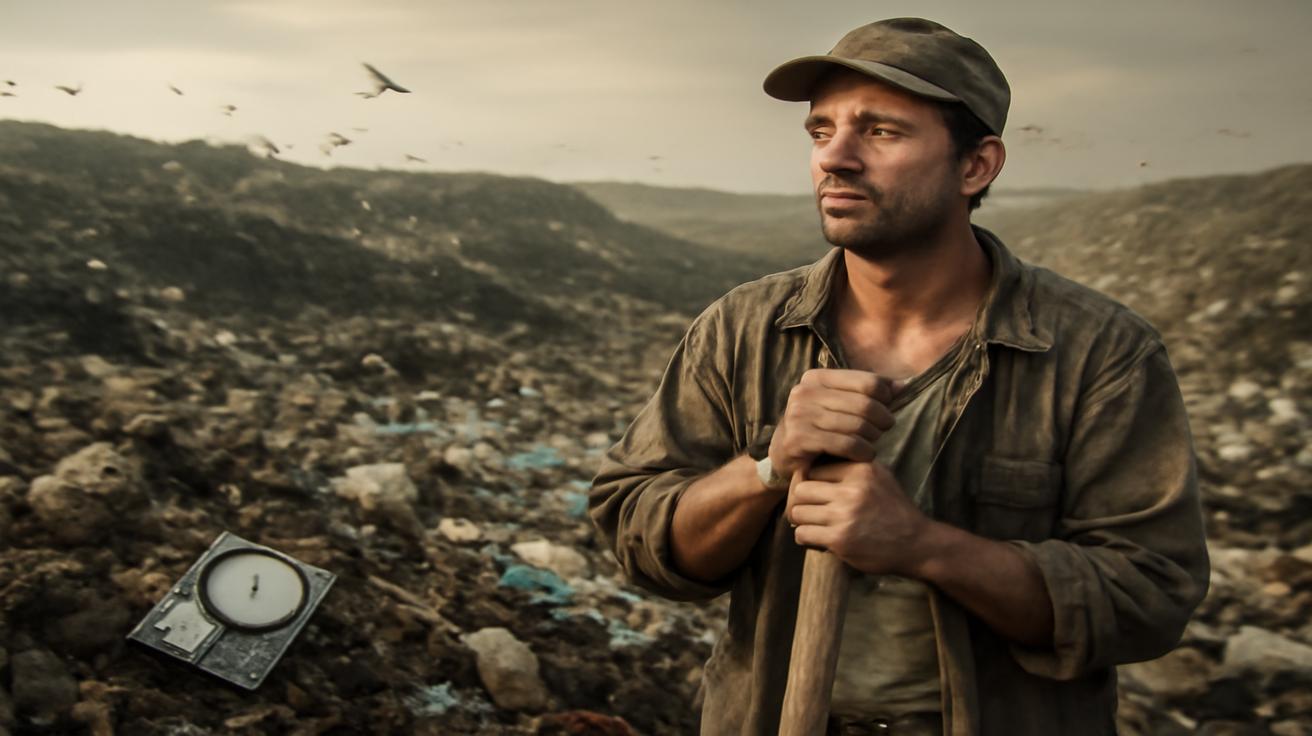
The wind at the edge of the landfill tastes like rust and rain. It curls around mountains of broken televisions and split-open suitcases, rattles through plastic bottles, and tugs at the sleeves of a man who has been walking this same ground for more than a decade. His boots crunch on glass, sink into clay, slide on black plastic slick with old rainwater. Above him, gulls wheel and scream, turning on invisible spirals of warm air that rise from the buried past of a town—and from one lost fortune worth €737 million.
The Man Who Threw Away a Fortune
His name is James, and the story always begins with the same tiny, ordinary gesture: a hand reaching for a bin bag. Not a vault door slamming shut. Not a bank error in anyone’s favor. Just a simple cleanup in a house somewhere in Wales. Papers here, old drives there, a few dead batteries, outdated electronics—all swept into a black bag and dragged to the curb.
On that old hard drive, he says, is the key to a digital wallet—a code that unlocks a fortune in cryptocurrency, mined in the days when it was still an experiment more than an economy. Back then, the world laughed at people who traded computing power for imaginary coins. Now, those digital whispers are worth hundreds of millions of euros. Or they would be, if James could find them.
But the bag left the curb. The truck came. The landfill took it. The ground swallowed it. Life, unlike a hard drive, offers no neat “undo” button.
Most people, told that their wealth had been shoveled into a landfill, would cry, pace, swear, and then, finally, move on. But James did something else. He kept moving back—into the stink, into the mud, into the improbable possibility that persistence might outmuscle probability.
How Do You Keep Walking Into the Same Storm?
It started as a sharp, immediate pain: the realization that he had tossed away what would become generational wealth. The numbers climbed, year by year, as the world woke up to crypto’s strange marriage of math and money. What was once pocket change bought on a whim ballooned into a headline-hijacking fortune.
He did the math: the date of disposal, the routes of trucks, the grid of the landfill. He spoke with council officials who looked at him with equal parts sympathy and disbelief. He didn’t ask to be given the money back. He asked for something more difficult: the chance to go looking for it.
And so the landfill became his labyrinth.
Some mornings, he would stand at the chain-link fence before sunrise, watching the fog pool in the dips and folds of the waste mounds, waiting for the first bulldozer to cough to life. The workers came to know him: the man with the lost millions, the man who wouldn’t give up, the man whose story had escaped the smallness of the town and spilled into global news feeds.
To outsiders, it seemed almost funny at first—a cautionary parable for the age of digital wealth. But humor withers in the face of time. Twelve years is a long time to keep a joke going. Twelve years changes the color of things. It turns news into myth, and a man into a symbol.
Inside the Landfill: A Landscape of Almosts
To understand his search, you have to understand the place he is searching—a landfill is not chaos; it’s a slow-motion geology of waste. Everything that arrives is weighed, recorded, pushed, compacted, buried. Over time, layers rise like pages in a terrible archive of human consumption.
James became, in an odd way, a student of this landscape. He learned how the trucks line up, how the loads are spread, how rainwater channels through the valleys of refuse and gathers in shadowed pools. He learned to read the ground the way some people read weather.
He spent countless hours hunched over maps and satellite images, tracing hypothetical paths from curb to compactor. He imagined that fateful bin bag jostling along in a metal belly, dumped into a valley of unsorted trash, pressed under the treads of heavy machinery. He pictured it torn open, the hard drive spilling out and sliding sideways into the strata of a growing hill.
The irony wasn’t lost on him: that something as intangible as digital currency depended, in his case, on something as stubbornly physical as a palm-sized piece of metal and plastic lost somewhere beneath thousands of tons of waste. The future of money, pinned to the past’s garbage.
People asked him why he kept going. Why not declare it lost, chalk it up to the wild early days of crypto, and walk away? But the question misses something essential about human beings: we are not built to surrender quietly to the idea that something unimaginably valuable is within reach, but just out of sight. The landfill became, for James, both a prison and a promise.
The World Starts Watching
Stories like this don’t stay local for long. There is something irresistibly human about them: the absurdity, the determination, the sheer scale of the “what if.” As years went by, cameras arrived. Journalists, documentary crews, podcasters—the landfill, with its apocalyptic silhouettes and endless gulls, became a backdrop for talking about risk, regret, and the strange digital gold rush of the 21st century.
They filmed him walking. They filmed him talking. They filmed bulldozers moving mountains of trash in the middle distance while James spoke about algorithms, keys, and the stubbornness of the human heart.
But filming is not the same as solving. For all the interviews, the news articles, the social media debates, the hard drive remained exiled under meters of compressed debris and soil. Technology raced ahead—cryptocurrencies soared and crashed and soared again—but the laws of physics and landfill management didn’t budge.
He tried to convince local authorities to allow a full excavation, backed by private investors who believed that the potential payout justified the cost and environmental risk. Plans were drawn up involving teams of engineers, data specialists, industrial-scale sorting systems, even environmental safeguards that would treat and manage any disturbed waste.
And yet, bureaucracy has its own gravity. Concerns about environmental damage, liability, and precedent piled up like another layer of compacted waste. Permissions stalled. Proposals gathered dust. The landfill, indifferent, continued to grow.
A Series, A Second Chance
Now, after twelve long years of starts and stalls, another chapter is about to begin—not in a boardroom or a council office, but on screens around the world. A series, set to be released soon, has followed James deep into this long, unlikely quest. Not just the numbers and the headlines, but the smell, the weather, the days when the wind cut through every layer of clothing and the nights when he lay awake wondering if he had built his life on a ghost.
This series doesn’t just retell the story; it reframes it. It lingers on the human moments: the coffee gone cold in his hand as he scrolls through old emails, trying to reconstruct the exact date he dragged that bin bag outside; the awkward laughter of friends who don’t quite know what to say anymore; the quiet pride when someone writes to say that his refusal to give up helped them face their own losses.
In following him, cameras also follow the question at the heart of all this: what does it mean to keep believing when the rational world tells you to stop?
The series is, in some ways, his second chance—not necessarily at getting the money back, but at being understood. At showing that this isn’t just a man chasing numbers on a screen, but someone grappling with the physics of regret and the psychology of perseverance. It’s a chance to shift the story from “man loses hard drive” to “man keeps faith with his past self, however flawed.”
There is also, unavoidably, a practical angle. Attention can move mountains that money and logic cannot. Public interest has a way of bending the will of institutions. If enough people are watching, if enough minds are engaged, what once seemed impossible might begin to seem merely difficult. Difficult things, history shows, have a way of getting done.
Hope, Measured in Kilograms and Kilobytes
To grasp the scale of what he is chasing, and what stands in his way, it helps to break it down—not into complex financial models or cryptographic diagrams, but into something small enough to fit on a phone screen.
| Piece of the Story | Approximate Scale |
|---|---|
| Estimated fortune on lost drive | €737,000,000 |
| Years spent searching (so far) | 12 years |
| Likely landfill search area | Tens of thousands of tonnes of waste |
| Size of the missing object | A hard drive, roughly the size of a hand |
| Number of times he’s considered giving up | Too many to count |
Somewhere within those thousands of tonnes of refuse, James believes, lies a small, silent drive, its metal skeleton perhaps corroded, its casing battered—but maybe, just maybe, its memory intact. Data is more resilient than we imagine. Under the right conditions, those magnetic impressions, those tiny ordered charges, can outlive plastics, fibers, even wood.
The series leans into this tension: the almost unbearable proximity of ruin and rescue. You watch as he walks through mud that smells of diesel and sour milk, pointing out where he thinks the load might have landed; you hear technicians explain how industrial-scale scanning and sorting could, in theory, isolate electronic waste from a particular slice of the landfill.
They talk about drones and ground-penetrating radar, about conveyor belts and robotic pickers, about filters and leachate treatment and methane management. It’s a strange fusion of environmental engineering and treasure hunt, a project that would have sounded like science fiction when that hard drive first slid into a bin bag.
The Weight of “What If”
Under all the machinery and mathematics, though, lies a quieter question: how do you keep living your ordinary life while a lost extraordinary life haunts the horizon?
James has had to watch version after version of his alternate future parade through his mind. Houses he might have bought, debts he might have cleared, strangers whose medical bills he might have paid. He has imagined funding scholarships, building community projects, setting up trusts that would outlive him. He has also, honestly, imagined the simple freedom of never again glancing at a price tag.
But every future begins in the same place: a recovered drive, a working disk, an intact key. Without that, all those lives remain unwritten.
Over twelve years, that absence seeps into everything. Decisions at the supermarket. Choices about jobs. The quiet ache of friends moving on, buying homes, starting businesses, building the kinds of stable, unremarkable lives he once assumed would be his baseline. He is trapped in an in-between space, tethered to the possibility that tomorrow might be the day everything changes.
The new series doesn’t flinch from this. It follows him not just into the landfill, but into kitchens and cars, late-night conversations and early-morning silences. It watches the way he navigates that invisible weight of “what if,” the way he has to decide, over and over again, what kind of person he will be even if the hard drive is never found.
When a Personal Story Becomes a Mirror
It’s easy, from a distance, to frame his search as an oddity: one man, one hard drive, one ruined stroke of luck. But as viewers follow his story, something else comes into focus: the universal nature of loss and stubborn hope.
Most people will never misplace hundreds of millions of euros in digital currency. But many will misplace something else of enormous personal value—a relationship, an opportunity, a path not taken. Many will have that one moment they would rewrite if they could, that one bin bag they wish they’d checked twice.
James’s landfill becomes a metaphorical landscape as much as a physical one: a place where all our discarded past selves might lie buried, waiting for a braver or more patient version of us to come digging. His refusal to stop searching is, depending on how you look at it, either a refusal to forgive himself or a radical act of self-belief.
The series invites viewers into that ambiguity. It doesn’t tell them what to think of him. It doesn’t decree him a hero or a fool. Instead, it lingers on his contradictions: the clarity of his purpose and the fragility of his hope; the obsession that edges close to self-destruction and the undeniable courage of refusing to abandon a dream just because the odds are brutal.
Second Chances Rarely Look Like We Expect
There is a temptation, in stories like this, to reach instinctively for a clean ending. Either he finds the drive and the credits roll over celebrations, or he doesn’t and we file the whole saga under “hard lessons of the digital age.” But life rarely obliges our hunger for neat conclusions.
What this second chance—embodied in a series, in renewed public attention, in potential new negotiations—really offers is not a guarantee, but a widening of possibilities.
Perhaps the spotlight will finally gather enough momentum to persuade officials and investors to attempt a carefully managed excavation. Perhaps fresh eyes will bring fresh ideas: new scanning technologies, smarter environmental safeguards, more precise modeling of where the drive might have ended up.
Or perhaps the physical drive will remain stubbornly hidden, and the second chance will be something less tangible: a chance for him to step out from under the crushing shadow of private regret and be seen as a whole person, not just a man defined by a single mistake.
In watching this story unfold, people might find the courage to reconsider their own long-buried hopes. To look again at what they’ve written off as impossible, and ask: is it really? Or have I just grown tired of imagining it could be different?
The landfill, after all, is not just a place where things are thrown away. It is also a place where, paradoxically, things endure. A hard drive, a decision, a dream—they can lie dormant for years, waiting on the patience and persistence of the one who remembers where, and why, they were lost.
At the edge of that landscape, under a sky shared with wheeling gulls and drifting clouds, a man takes another step into the smell of rust and rain. Twelve years behind him. Who knows how many ahead. Around him, the world is finally watching again.
Somewhere under his boots, or nowhere at all, lies a small object that could change everything. The series can’t promise the ending. But it can promise this: that the search, and the man behind it, will finally be seen in full.
Frequently Asked Questions
Did he really lose €737 million in a landfill?
Yes. The estimated value is based on the amount of cryptocurrency believed to be stored on the missing hard drive and its current approximate market value. The exact figure fluctuates with the market, but it has reached around €737 million in some calculations.
How did the hard drive end up in the landfill?
During a house clear-out, an old hard drive containing the access key to a cryptocurrency wallet was accidentally placed in a rubbish bag and taken to the curb. That bag was collected by local waste services and transported to the landfill with countless others.
Why hasn’t the landfill been excavated already?
Excavating a landfill at the required scale is complex, expensive, and environmentally risky. Local authorities must consider contamination, gas emissions, stability of the landfill, and the precedent it sets. Despite private investment offers, concerns over safety, liability, and regulation have delayed or blocked full excavation efforts.
Is it even possible that the hard drive still works after all these years?
It’s uncertain. Hard drives can sometimes survive if physical and environmental damage is limited, and data recovery specialists can occasionally retrieve information from damaged devices. However, years of compression, moisture, temperature changes, and chemical exposure in a landfill greatly reduce the odds.
What role does the new series play in his search?
The upcoming series documents his 12-year quest, bringing global attention back to the story. This renewed interest may help attract technical experts, investors, and public support, potentially influencing authorities to reconsider excavation or to explore new, more precise search methods.
Is he searching for money or for redemption?
Both, in different measures. The financial incentive is enormous, but the story also revolves around his relationship with regret, responsibility, and perseverance. The search has become part of his identity, and recovering the drive would also mean reclaiming a part of his past self.
What can we learn from his story?
His story reflects how one small decision can carry enormous consequences, but it also shows the depth of human persistence. It invites us to think about how we handle regret, how long we’re willing to pursue a seemingly impossible goal, and what “second chances” might look like in our own lives—even when the outcome is uncertain.








Leave a Comment