
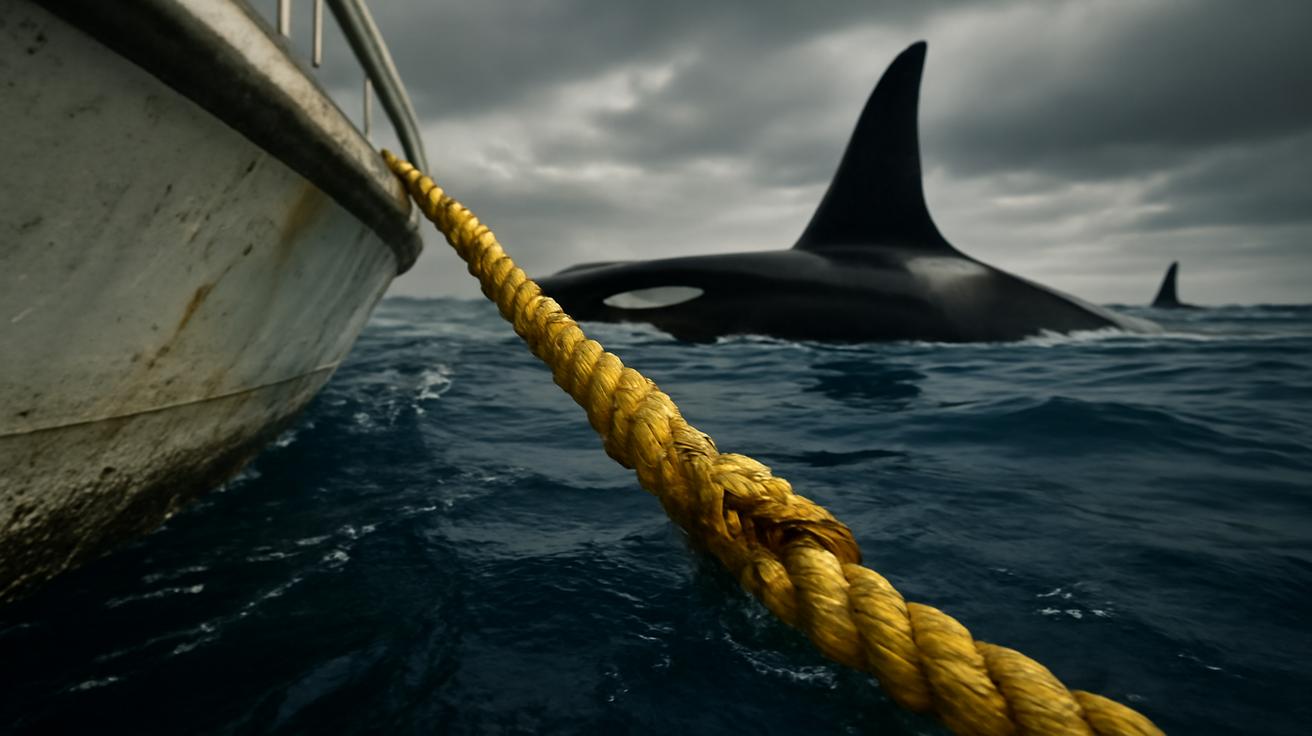
The first thing they noticed was the silence—the strange, charged kind of quiet that folds over the ocean when something is about to happen. The engine hummed, gulls wheeled overhead, and the late afternoon light broke open in molten streaks across the sea. Then came the shadows. Long, slick, purposeful shapes sliding just beneath the surface, circling the boat like slow, confident ghosts. Orcas.
A Circle of Black and White
The fishermen would later say it felt like being watched by something that understood them a little too well. They were far offshore, the coast a faint smudge on the horizon, working a line of gear in water that ran deep and dark. The routine of hauling, coiling, and checking catch had worn into that comfortable rhythm that makes you forget how small a boat really is.
Then, off the starboard side, a tall dorsal fin cut cleanly through the swell.
Another followed. And another.
“Orcas,” someone breathed, as if saying it too loudly might invite them closer. But they were already close—shoulder-close, chest-close, the way a stranger might stand too near to you on a crowded train. Only there was no crowd, and no train, just a floating island of aluminum and fiberglass in an endless spread of water—and a pod of orcas that seemed in no hurry to pass by.
They moved with the assurance of animals who know they are the apex of their world. Black backs gleamed like wet stone, white patches catching the sinking sun in sudden, startling flashes. One surfaced so near the hull that the men could hear the sharp, wet rush of its exhale, like a punch of steam against the air.
The ocean, moments before only another workplace, became a room where the walls had disappeared.
When Curiosity Feels Like Calculation
Orcas are not strangers to fishing boats. Around the world, they have learned to associate nets and lines with easy meals, snatching hooked fish before they ever see a deck. They tail trawlers, ghost beneath longlines, and have built a reputation as clever opportunists—part thief, part strategist. But this encounter felt different. It wasn’t just about the fish; it was about the boat itself.
The pod formed a slow-moving ring. One orca glided under the bow, rolling slightly, its white belly flashing through the water like a pale slice of sky. Another surfaced off the stern, lingering just long enough that one of the crew found himself looking straight into a black eye set in a white patch of skin—an eye that somehow did not feel empty.
“They were… checking us out,” a fisherman later recalled. “Not just the lines. Us.”
The engine idle seemed too loud, too mechanical in the living hush that wrapped around them. The fishermen spoke in low voices without quite knowing why, as if they had stepped into someone else’s house.
The First Bite
It began with a shudder.
The kind that runs up through the bones of the boat, a tremor that is less a sound and more a feeling behind your knees. The men looked at one another. That wasn’t a wave. This was calm water, a soft roll of ocean that had been steady for hours. Something had hit them.
They checked the gear. Lines, secure. Catch, quiet in the holds. No logs, no debris banging in the swell.
Then came the second jolt—sharper, more deliberate. The boat twitched against the invisible weight tethering it to the seabed. Someone leaned over, peering down into the mottled blue-green. At first he saw nothing but their own reflection, cut by thin cords of rope vanishing into dark water.
And then, from below, a pale shape exploded upward in a surge of muscle and teeth.
A shark. Big enough that the word “shark” landed flat and insufficient for what it really was: a blunt head, thick shoulders, jaws working in fast, decisive arcs around the anchor line. The rope vibrated with every bite, the echoed crunch of teeth on twisted fiber faint but unmistakable.
“He’s on the anchor,” someone whispered, stunned. “He’s actually biting the anchor line.”
Predators in the Same Story
Orcas and sharks share a complicated history, one written in scars and sudden disappearances. In some parts of the world, great white sharks vanish when orcas arrive, abandoning rich feeding grounds for weeks at a time. Orcas have been known to kill sharks with surgical precision, targeting their livers—their richest store of energy—and leaving the rest to sink. Between them, there is a hard, quiet rivalry.
But here, on this afternoon, the rivalry took on an unexpected shape. While orcas circled the surface, a shark had moved in close—too close—and started chewing on the very line that kept the boat anchored in place.
Was it disoriented? Riled up by the presence of larger predators? Drawn by fish caught around the anchor? The fishermen had no time for theories. All they knew was that their lifeline to the bottom was being carved into by something with more teeth than patience.
The shark came in again, jaw unhinging in a wide, grey blur. This time, a strip of frayed rope broke free and drifted upward like dead seaweed.
A Boat Between Two Worlds
The fishermen stood in the uneasy space between awe and alarm. Above, orcas traced slow arcs like living crescents of black and white. Below, a shark worked the anchor line, methodical in its destruction. The boat bobbed within this tension, a fragile border between air and water, breath and gill, mammal and fish.
On land, a cut anchor line is an inconvenience, a fixable annoyance. Out here, in deep water, it can quickly become something else—a drift into unknown currents, a slow slide into trouble if the wind picks up or the engine fails. And always, there is the knowledge that help is not minutes, but hours away.
The men moved into motion. One checked the tension on the line. Another ducked into the cabin to radio their position and keep an ear on the forecast. Someone else reached instinctively for the gaff, as if the wooden handle might offer some symbolic reassurance, though there was no sane world in which you’d lean over and poke at a shark big enough to take the whole tool.
The shark bit again, twisting its body as if trying to shake the rope free, eyes hooded with that ancient, indifferent focus that big sharks carry. Its rough skin flashed grey-brown in the muted light, speckled like sand. Every movement sent tiny vibrations up the line, telegraphing its effort into the soles of the fishermen’s boots.
Just meters away, an orca surfaced with a slow, loud exhale, the sound startlingly close. For one strange moment, shark and whale, bite and breath, existed in the same breath of time.
Patterns in the Chaos
This wasn’t the first tense marine encounter reported by offshore crews in recent years. Around popular fishing grounds, stories have been stacking up: orcas shadowing boats for hours, sharks appearing soon after, tangled dramas unfolding in the blue beneath the keel. Scientists have begun to listen more closely, sifting through logbooks and eyewitness accounts, trying to understand whether these are coincidences—or fragile hints of a new pattern.
Some researchers suggest that the presence of orcas may displace other predators, pushing sharks into tighter spaces or new behaviors. Others think both species may be attracted to the same hotspots of life—shoals of fish, migrating schools, or the buffet of discards and bycatch that follow hardworking boats. When humans gather fish into dense, convenient clusters, predators notice.
For the fishermen on this boat, theory was a distant luxury. What they had was raw sensation: the slick curve of an orca’s back, the raw shake of a shark’s bite, the shifting weight of a vessel no longer entirely under their control.
The Line Between Safety and Drift
The decision came quickly: they couldn’t stay on that anchor. The risk of losing it entirely—and worse, getting the hull fouled if the remaining line snapped back or tangled—was too high. The shark seemed determined to finish what it had started, and the orcas showed no hurry to leave.
Working as one, the crew brought the line in, hand over hand with the winch chattering, trying to steal back what remained before another bite could sever it. The rope rose through the water, wounded. The shark made a last twisting lunge, teeth snagging the fraying fibers, but the sudden motion of the boat startled it. With an abrupt turn of its body, it vanished into the deeper blue below.
Above, the orcas shifted position, their slow circle widening with the movement of the boat. One rode the pressure wave off the bow for a moment, a sleek silhouette surfing the invisible hill of water. Another surfaced alongside, so close the fishermen could see the pattern of scars etched along its flank—scrapes from siblings, marks of hunts, a biography in pale lines.
As the anchor broke the surface, it came up half-stripped, rope shredded in rough, fibrous tufts. The metal flukes swung free, water streaming off in silvery curtains. The damage was unmistakable: they had been bitten, tested, and very nearly cut loose from the seafloor by a jaw that was never meant to understand ropes.
A Table of Tension: What the Crew Saw
Later, as the story traveled from dockside to galley tables, someone sketched it out in the simplest possible way—a rough summary of an afternoon that tightened the air around their small world.
| Time | Event | What the Crew Noticed |
|---|---|---|
| Late afternoon | Orcas appear | Pod circles boat; close surfacing, eye contact, heavy breathing sounds. |
| Minutes later | Boat shudders | Unexplained jolts traveling up the hull and through the anchor line. |
| Shortly after | Shark sighted | Large shark seen biting and twisting on anchor rope just below surface. |
| Ongoing | Dual presence | Orcas remain at surface while shark continues attacking line beneath. |
| Decision point | Anchor retrieval | Crew hauls damaged anchor; shark withdraws as tension on line changes. |
On a small screen, the story compresses into neat rows and reassuring borders. Out on the water, there were no borders—only the feeling that the sea, just for a moment, had tightened its grip around them.
Reading the Sea
Every seasoned fisherman learns to read the water. The shape of a swell, the color of a current line, the oily sheen of a baitball just below the surface—little details become a language. Wind against tide says one thing. A sudden silence of birds says another. Writing that language into words, however, is harder.
How do you write the silence that fell when the first orca surfaced? The way every man on deck felt something deep in his gut, that precise, weightless instant where admiration met unease? How do you record the scraping sound of rope between a shark’s teeth, or the way your hands move faster than your brain when the boat shudders, hauling the line because every story you’ve ever heard about things going wrong at sea wakes up at once?
In ports along rugged coastlines, stories like this are passed along in coffee-steamed wheelhouses and diesel-scented bait sheds. “We had orcas on us.” “Shark took the line.” A few words, a shrug, maybe a laugh that doesn’t quite ring all the way to the eyes. Out there, in the immensity of open water, it’s easier to understate.
Yet behind the understatement is a kind of reverence—a recognition that these are not just animals, but forces. The fishermen know their own smallness better than anyone.
Living With Big Predators
On paper, the encounter becomes a series of actionable lessons. Give orcas space. Don’t tow gear near them if you can help it. Be ready to move if sharks start chewing on lines or anchors. Secure backup systems, keep communications clear, understand that the wild doesn’t owe you predictability.
On the water, those guidelines bleed into something more felt than stated: respect. Not the polished kind turned into slogans, but the raw version you earn when you watch an animal bigger than a pickup truck turn on its side just to look at you. Or when a shark’s indifference to your tools, your anchors, your tidy plans reminds you that all of it—every chart, every GPS, every carefully coiled rope—is a human attempt to manage something immeasurably larger and older.
For the crew whose anchor line was bitten, the ocean changed subtly that day. Every hum in the hull now carries the memory of another vibration. Every shadow under the surface is double-checked. But so too does every surfacing blow from a whale, every glimpse of a fin, seem sharper, more charged. They’ve seen, up close, how two apex predators can fold into the same patch of water and drag a small boat into their story without a word.
After the Circle Breaks
Eventually, the orcas slipped away. One by one, their dorsal fins disappeared into distance, the sea closing over their passage with deceptive calm. The last one to go—a large animal, possibly a mature female—surfaced once more off the bow, let out a final heavy breath, and sank beneath the waves without fanfare.
The shark did not return. Perhaps it followed the fading trail of sound and vibration left by the whales. Perhaps it moved on to more familiar food. The ocean gave no explanation.
By the time the boat turned for shore, the sky had darkened into a soft, bruised blue. The first lights of the coastline winked faintly on the horizon, fragile points of yellow against the gathering night. Behind them, the sea reset to its infinite blankness, as if the afternoon’s drama had been nothing more than a brief tightening in the fabric of water and life.
But on board, it lingered—in the way the men told the story, in the careful way they checked their lines, in the new understanding that out here, being between predators is not a metaphor. It’s a location.
That day, the fishermen reported something specific and tangible: sharks biting their anchor lines just moments after orcas surrounded their boat. But what they also brought back was something harder to quantify: a reminder that the sea is a layered world of overlapping hungers, shifting alliances, and encounters that challenge the idea that humans are always at the center of the story.
Sometimes, the ocean rearranges the cast. On that calm afternoon, in a ring of black, white, and grey, the fishermen were not the hunters. They were simply the ones holding on to the line, listening to it vibrate between their hands, while two great pages of the marine predator story turned around them.
FAQ
Why would a shark bite an anchor line?
Sharks investigate unfamiliar objects with their mouths. An anchor line can carry vibrations, smells from bait or catch, and visual contrast in the water. All of these cues may trigger exploratory bites, especially if other predators or feeding activity are nearby.
Do orcas and sharks often appear together?
They can, especially in rich feeding areas. Both orcas and large sharks target similar prey like fish, squid, and marine mammals. In some places, orcas displace sharks; in others, they seem to overlap in complex ways we are only beginning to understand.
Are orcas dangerous to fishing boats?
Direct attacks on boats are rare, but in some regions, orcas have learned to take fish from lines, causing gear loss and tension with fishermen. While they are powerful animals capable of damaging vessels, most interactions remain at the level of curiosity and opportunistic feeding.
What should crews do if sharks or orcas approach their boat?
They should maintain distance where possible, reduce noise and sudden movements, avoid feeding or interacting, and be prepared to move if gear or anchors are compromised. Following local guidelines and reporting unusual behavior helps scientists and authorities track emerging patterns.
Is this kind of encounter becoming more common?
Reports of tense interactions—including orcas taking fish from gear and sharks damaging lines—have increased in some fishing regions, partly due to more people on the water and better communication. Whether the behaviors themselves are new or simply newly noticed is an active area of research.







Leave a Comment