
The room went silent when the first mouse moved its back legs.
It was an almost imperceptible twitch at first—a faint, awkward shiver of muscle under smooth fur. But to the scientists at the lab bench, that tiny flicker was nothing short of electric. They had broken these animals’ spinal cords days earlier in the name of research. By all conventional wisdom, those back legs should have stayed forever still. Yet there it was: movement. Awkward, halting, imperfect—but real.
The researchers leaned in. One of them held their breath, another gripped a clipboard a little too tightly. After months of preparation, years of incremental failures, and decades of cautious hope in the field, something was changing right there on the stainless-steel table. The mouse pulled itself forward, hind legs dragging, then—like a hesitant swimmer relearning the water—began to push. Not smoothly, not gracefully, but undeniably.
In that quiet lab, surrounded by the hum of incubators and the soft glow of monitors, the story of spinal cord repair took a bold and unexpected turn. And at the heart of it all was something disarmingly familiar: fat.
The Unexpected Hero in the Mirror
The word “fat” rarely arrives with a halo. It usually drags along a tangle of judgments and anxieties, of diet plans and mirror-checking and late-night promises to change. But inside that soft, often-maligned tissue lies one of the body’s most versatile, quietly powerful tools: mesenchymal stem cells.
They’re tucked into the nooks and crannies of our adipose tissue, riding along with our stored energy, doing their steady, unglamorous work. Until, that is, scientists invite them into the spotlight.
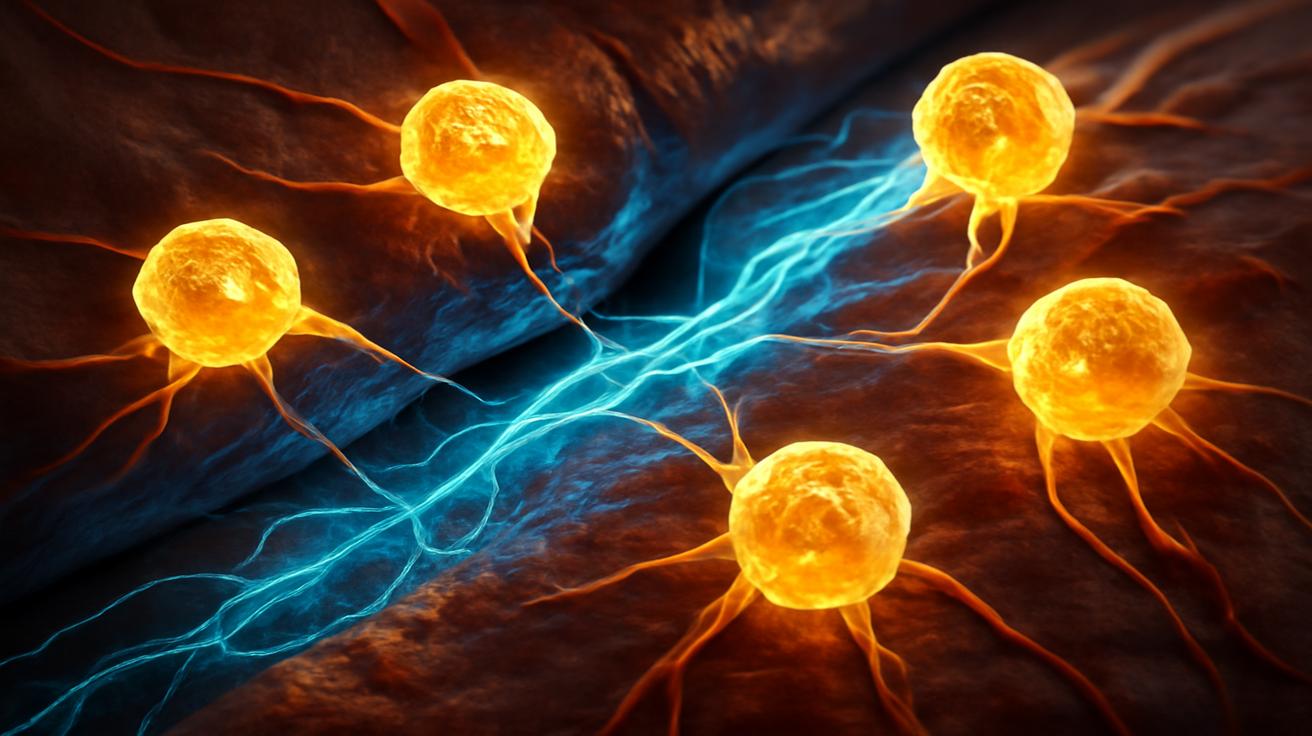
Fat-derived stem cells, or adipose-derived stem cells (ADSCs), are like the generalists of the cellular world. They don’t commit early to being bone or muscle or cartilage. Instead, they hold onto a kind of flexible identity, waiting for the right signals, the right environment, the right crisis. Compared with stem cells taken from bone marrow, fat stem cells are easier to harvest, kinder on the donor, and astonishingly abundant—just a small liposuction sample can yield millions of them.
For years, they’ve been quietly tested in the backgrounds of clinical trials: for healing damaged joints, softening scarred heart tissue after heart attacks, soothing inflammation in autoimmune diseases. But the spinal cord? That narrow, delicate column of neural highways, where an injury can mean the instant redraw of a life?
That felt like the holy grail.
The Landscape of a Broken Spine
To understand why this new study is being called a breakthrough, it helps to picture what actually happens when a spine breaks—not the bone, but the spinal cord itself. Imagine a mossy forest floor crisscrossed with millions of slender trails, each one a path of communication. An injury is not just a fallen tree; it’s a landslide. Pathways shatter. Nerve fibers snap. The body’s own defenses pour in: immune cells, inflammation, a chaotic rush to protect. But that protection comes at a cost. Scar tissue builds. Chemical roadblocks form. The once-living pathways fall silent.
Below the level of the injury, the brain’s voice goes mute. Legs don’t move. Skin doesn’t feel. Bladders and bowels forget their rhythm. Doctors stabilize, prevent infection, manage pain, and optimize what’s left. But the injury itself sits there like a dead zone in the middle of a highway network. For decades, the message to patients has been: there’s no way to truly fix this—only to adapt around it.
So when a research team takes fat stem cells, injects them near the site of severe spinal injury, and then watches as animals begin to move again—spontaneously, purposefully—it doesn’t feel like just another experiment. It feels like the first crack in a wall that was once thought impenetrable.
The Study That Made Scientists Hold Their Breath
The breakthrough study, published recently in a leading neuroscience journal, followed a deceptively simple recipe: take fat stem cells, prepare them in the lab, and deliver them to animals with serious spinal cord injuries. But underneath that simplicity lay a tapestry of meticulous design: timing the injections, fine-tuning the dose, and checking not just movement, but the underlying biology of recovery.
In the study, researchers induced spinal cord injuries in laboratory animals, then divided them into groups. Some received no special treatment beyond standard care. Others were given injections of concentrated fat-derived stem cells directly around the injured spinal tissue. After that, the scientists did what might be the hardest part of all: they waited—and watched.
Weeks passed. The untreated animals showed what spinal injury researchers sadly know too well: minimal, inconsistent recovery, some reflexive responses, but little in the way of meaningful return of function. The stem-cell treated animals, however, began to offer a different story.
Their hind limbs started to respond. Initially, it was small: a twitch, a tremor. But then, step-like movements emerged. Some animals could bear partial weight, pushing themselves upright in a tentative, trembling posture. Motor function scores—those clinical, dry numbers that hide entire worlds of meaning—began to climb significantly higher in the treated group compared to controls.
Under the microscope, the transformation looked even more dramatic. Where the spinal cord had once been a fractured landscape of broken nerve fibers and scarring, there were signs of new growth. Nerve fibers sprouted across once-empty gaps. Blood vessels wove fresher pathways. Inflammation quieted. The environment of the injury—the very soil in which healing might or might not happen—had changed.
How Fat Stem Cells Turn Chaos into Opportunity
On their own, injected fat stem cells don’t simply become new spinal cords. That’s one of the misconceptions that often follows stem cell headlines. Instead, they act more like conductors in a chaotic orchestra, coaxing other players into harmony.
These cells release a storm of signaling molecules—growth factors, anti-inflammatory agents, and protective proteins. Think of it as opening a biochemical toolbox right at the injury site. The result?
- Inflammation eases: Instead of letting swelling and immune attacks run uncontrolled, the environment begins to calm. The scar tissue that normally shuts down regeneration becomes less aggressive.
- Neurons feel safer: Damaged nerve cells are more likely to survive instead of withering under pressure.
- Axons regrow: The long, delicate projections that carry signals up and down the spine begin to sprout again, nudging across boundaries that used to be dead ends.
- Blood flow improves: New vessels form, bringing oxygen and nutrients into the heart of the injury.
Some of the transplanted stem cells may slowly adopt roles as support cells in the spinal cord, integrating into its architecture. Others simply do their work and fade. But together, they shift the injury from a site of permanent shutdown to a landscape with options—where healing isn’t guaranteed, but is finally, genuinely possible.
More Than a Mouse Story: Why This Matters for People
If you live with a spinal cord injury—or love someone who does—these lab scenes can sound like a heartbreaking “almost.” Yes, it works in animals. Yes, the videos look miraculous. But what about the person in the wheelchair, the one who has learned to navigate life in careful, looping paths around what their body can’t do anymore?
This study matters not because it claims an instant cure for human paralysis, but because it proves, with real data and real movement, that the spinal cord’s resignation is not as final as once believed. It shows that the right kind of biological nudge, delivered in the right way, can reopen channels long thought closed.
Fat stem cells hold particular promise in bridging the gap between the lab and the clinic because they come from the patient’s own body. That means fewer immune complications, reduced risk of rejection, and a smoother ethical path than some other stem cell sources. You’re not borrowing youth from embryos or donors—you’re repurposing your own quiet reserves.
Already, early-phase clinical trials in humans are exploring similar approaches: isolating fat stem cells from a person’s abdomen or thighs, concentrating them, and then delivering them near damaged spinal tissue. The outcomes so far are modest but encouraging: small gains in sensation, improved trunk stability, better bladder control, whispers of voluntary movement below the injury line. Not every patient improves. No one jumps out of a wheelchair and runs a marathon. But the direction of movement—in both senses of the word—is unmistakably forward.
What We Know So Far, in Simple Terms
Amid the emotional charge of this research, it helps to pause and look at the landscape with clear eyes. Here’s what current evidence is beginning to show about fat stem cells and spinal cord injury:
| Question | Current Understanding |
|---|---|
| Can fat stem cells repair spinal cords in animals? | Yes. Multiple studies, including the new breakthrough, show improved movement, nerve growth, and reduced scarring. |
| Are they safe in humans so far? | Early clinical trials suggest they are generally safe when prepared and delivered under strict medical protocols. |
| Do they “cure” paralysis? | No. They may improve some functions, but no large, consistent cure-level results exist yet. |
| Why use fat instead of bone marrow? | Fat yields more stem cells with less invasive collection, often with strong anti-inflammatory and regenerative potential. |
| How close are we to routine treatment? | We’re still in the trial and refinement phase. Larger, long-term human studies are needed before widespread clinical use. |
The Human Heartbeat Inside the Data
Behind every graph in the study—every line trending upward, every bar reaching a bit higher—there’s a story that doesn’t fit neatly into a chart. It might be a patient who had given up on ever feeling the brush of bedsheets on their legs and suddenly, one morning, notices a faint, ghostlike sense of pressure. It might be a person who needs a little less help transferring from chair to bed. Or the quiet, private moment when someone feels a partial return of bladder control and with it a sense of dignity they feared had been permanently left behind.
These changes sound small, and in the roar of headlines about miracles and cures, they can be eclipsed. But in the lived reality of spinal cord injury, they are seismic. A few degrees of trunk control can mean the difference between needing two people to help with daily care and managing with one. A faint sensation in the foot can be the first fragment of a map that the brain begins to redraw.
Nature loves to work in increments. Forests don’t reclaim clearcuts in a single season. Rivers don’t carve canyons in an afternoon. In much the same way, the nervous system seems to respond to fat stem cells in layers—quiet adjustments, small regrowths, better support, new connections—until one day there is just enough there for something as simple and miraculous as a toe to move on command.
The Caution in the Hope
With every promising study comes a necessary shadow: caution. The same eagerness that draws people toward new therapies can also make them vulnerable, especially when it comes to expensive, unproven treatments offered in glossy brochures and distant clinics. The words “stem cells” can carry a kind of magical shine—and some clinics are more than willing to polish that shine into a sales pitch.
Real scientific progress is slower, messier, and more demanding. It asks hard questions like: Which patients benefit most—those with fresh injuries or those injured years ago? What is the ideal dose? Should cells be delivered once or multiple times? Are there rare side effects that only appear after many years? Should therapies be combined with electrical stimulation, rehabilitation training, or new biomaterials that help guide regrowing nerves?
The breakthrough study doesn’t answer all of those questions. It doesn’t claim to. What it does is open a door in a wall that’s stood for generations. It says, with evidence rather than optimism alone: spinal cords are not as irreparably fragile as we once believed. Under the right conditions, they can be coaxed back toward function—and fat stem cells are one of the tools that can help.
Listening to What Our Bodies Have Been Saying All Along
There’s something poetic about the idea that the body’s own softness—its stored energy, its much-criticized extra—might hold the key to healing one of its most devastating injuries. Fat, so often framed as a problem to be solved, is reemerging as a quiet ally. It’s as if the body has been carrying a secret resilience all along, waiting for us to learn how to ask it for help.
In the coming years, more trials will launch. Some will disappoint. Others will surprise. Combinations of fat stem cells with gene therapies, biomaterial scaffolds, or precise rehab regimens will be tried, refined, abandoned, and reborn in new forms. Patients will volunteer their time, their bodies, their hope, turning sterile protocols into lived experiments.
But somewhere in all that effort—a lab bench crowded with Petri dishes, a surgical theater lit in strong white light, a rehabilitation center where a person grips parallel bars with trembling hands—there will be echoes of that first mouse in the breakthrough study. The small, shaky movement. The shared, disbelieving silence. The dawning realization that we have only just begun to understand what the injured spinal cord might still be capable of, given the right kind of help from the most unlikely of places.
Maybe one day, years from now, a person newly injured will be told something different from what so many have heard before. Not “there is nothing we can do,” but “we have options, and one of them comes from you.” From your cells. From your own hidden reservoirs of repair.
And perhaps they will say yes, and add their story to this growing, unfolding chapter in the long, intertwined narrative of injury, recovery, and the strange, generous biology of being alive.
Frequently Asked Questions
What exactly are fat stem cells?
Fat stem cells, or adipose-derived stem cells, are special cells found in body fat that can develop into different types of tissues, such as bone, cartilage, and muscle. They also release powerful healing and anti-inflammatory molecules that help repair damaged areas.
How do fat stem cells help a broken spine?
They don’t simply replace the spinal cord. Instead, they calm inflammation, reduce scar formation, support surviving nerve cells, encourage new blood vessels to grow, and promote the regrowth of nerve fibers. Together, these effects create better conditions for the spinal cord to recover some function.
Is this treatment available for people right now?
Only in the context of regulated clinical trials in certain hospitals and research centers. Some private clinics offer stem cell injections, but many of these are not well tested or approved, so it’s important to be cautious and ask for solid scientific evidence before considering them.
Can fat stem cells completely cure paralysis?
There is no reliable evidence yet that they can fully cure paralysis in humans. Some patients in early studies have seen partial improvements in sensation, movement, or bladder and bowel function, but results vary and are not guaranteed.
Are there risks to using fat stem cells?
Any medical procedure carries risks. When done properly in research or hospital settings, fat stem cell collection and injection appear relatively safe so far. However, long-term effects are still being studied, and unregulated treatments can be dangerous.
Who might benefit most from this kind of therapy?
Scientists are still figuring that out. Some evidence suggests that people with more recent spinal injuries may respond better, but there is growing interest in testing chronic injuries too. Clinical trials are designed to answer exactly these questions.
How soon could this become a standard treatment?
That depends on the results of ongoing and future trials. If larger studies confirm strong benefits and safety, it could move toward wider use within several years, but timelines in medicine are always uncertain and depend on the data.








Leave a Comment