
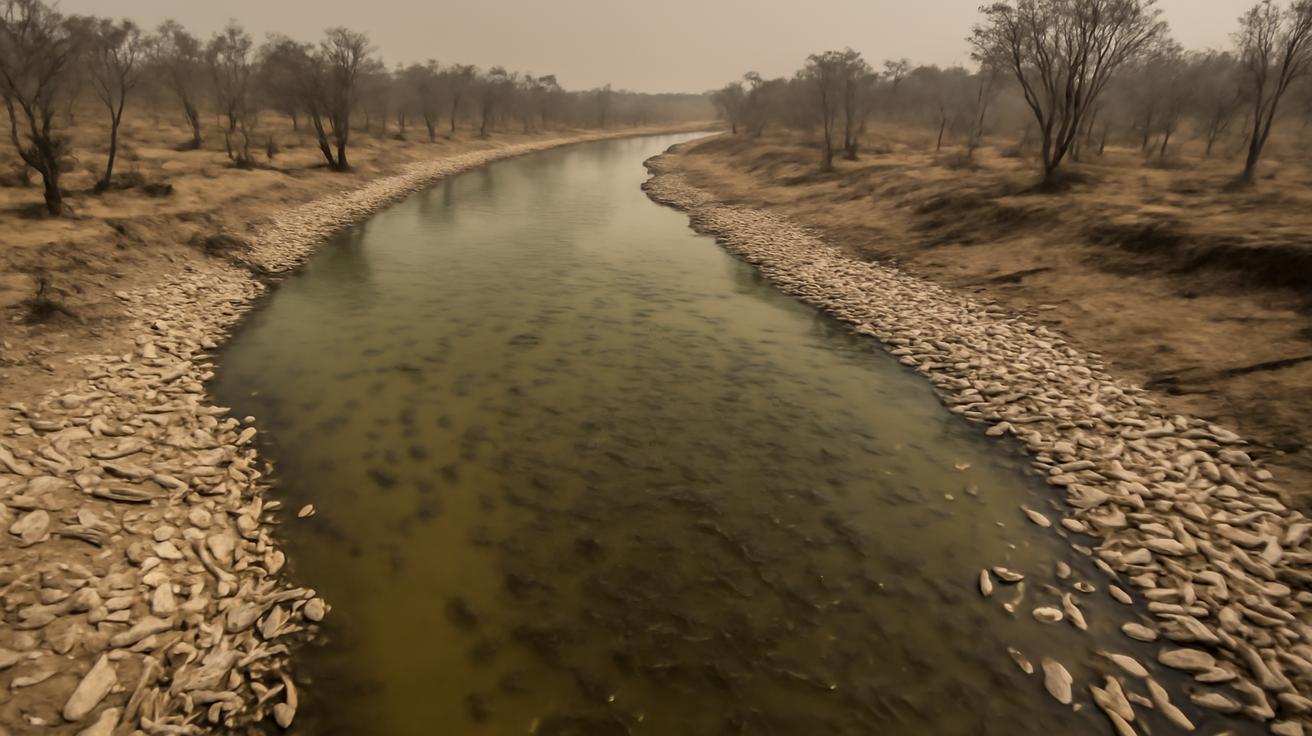
The first thing you notice is the silence. Not the peaceful kind that settles over a river at dusk, when swallows skim the surface and frogs begin their nightly chorus, but a heavier, stranger quiet. The water looks calm enough, flecked with late light, sliding past cracked red banks and leaning river red gums. Yet something is missing. The flick of native fish near the edge. The soft clatter of mussel shells shifted by current. The chorus has thinned. Australia’s longest, mightiest river is still flowing, but those who know it best say it is unraveling from the inside out.
An ancient river, newly fragile
The Murray–Darling Basin is not just a river system; it is a continent’s backbone. Stretching across four states and the ACT, it drains more than a million square kilometres – nearly one-seventh of Australia. For tens of thousands of years, First Nations communities along its banks have read its moods like a living text: the way the river fattens with flood and slims with drought, how certain plants bloom when the fish are running, how birds arrive just before the big rains. This is a river that holds time.
But in the last century and a bit, that timescale has been brutally compressed. Dams, weirs, levees, irrigation networks – all the machinery of modern water use – have reshaped the Murray–Darling’s pulse. Now another force, quieter but no less devastating, is at work: invasive species. They arrive as tiny eggs, clever seeds, hitchhiking spores. They turn up in farm dams, aquarium dumps, bait buckets, or tucked away in thick clumps of imported water plants. Once they settle into this altered river, they don’t just join the story; they start rewriting it.
Experts across the Basin – ecologists, river rangers, First Nations water advocates, fisheries officers – are sounding an uncomfortable warning: Australia’s largest river system is edging toward ecological collapse, and invasive species are one of the main accelerants.
Carp: the ghost tide beneath the surface
Drop a weighted line or sinker into many stretches of the Murray, and you’ll feel it thump softly on the bottom, stirring a puff of silt. Wait a moment, and the river itself seems to breathe out a cloud – the water goes murky, the edges blur. Often, that’s carp.
European carp, introduced in the 1800s and disastrously expanded in the 1960s, now occupy up to 90 percent of fish biomass in many parts of the Basin. They are not glamorous monsters. They don’t have the jaws of a crocodile or the menace of a shark. Instead, they are a slow-motion catastrophe with rubbery lips, vacuuming the river bed, rooting through mud for food, uprooting plants, and constantly churning sediment into the water.
Imagine walking into a library where someone has kicked over every bookshelf, mixed all the pages with dust, and left fans running to blow it all into the air. That is what carp do to the river’s underwater world. The clear, complex habitat of plants, insect larvae, snags and stones becomes a dim brown soup. Native fish that rely on sight to hunt struggle. Aquatic plants can’t get enough light. Eggs and larvae are smothered. The river’s food web – once as delicate as lace – gets coarse and clotted.
It’s easy, from the riverbank, to underestimate this. The surface looks the same. A paddle steamer ghosts by. Picnickers toss bread to ducks that aren’t really ducks at all, but opportunistic birds thriving in a changed ecosystem. Underneath, a single species is quietly crowding out a whole community, turning the river into one broad, shallow monoculture.
Silent invaders: weeds, snails and fungal threads
Carp are the headline villain, but they aren’t acting alone. Across this vast basin, a chorus line of other invasive species is slipping into the story, each one tweaking the river’s chemistry, structure or rhythm.
Along shaded backwaters and irrigation channels, dense mats of invasive aquatic plants – cabomba, salvinia, water hyacinth – can double in size in a matter of days under the right conditions. What looks like a lush green raft is, in reality, a slow suffocation. Light is blocked from penetrating the water column. Oxygen levels drop, especially at night. Native plants die back. Fish and invertebrates flee, if they can, or perish quietly beneath the mat. A once-open channel becomes a sealed lid.
Then there are the smaller intruders, almost invisible unless you’re searching for them. Exotic snails and clams cluster on hard surfaces, sometimes outcompeting native mussels that have filtered these waters for millennia. Tiny zooplankton communities – the drifting, microscopic animals that form the base of many aquatic food webs – are subtly reshaped by foreign species better adapted to the new, nutrient-rich, turbid conditions humans have created.
Fungal pathogens and diseases, potentially hitching rides with introduced fish or gear, lurk as an underexplored threat. For native species already stressed by warm, low-oxygen water and altered flows, a new disease can be the tipping point. The river, once buffered by redundancy and diversity, has far fewer safety nets now. One more cut can be the one that finally bleeds.
Riverbank strangers: the invasion above the waterline
Invasions don’t stop at the water’s edge. Walk along many stretches of the Murray and its tributaries and you’ll see thickets of willows, poplars, blackberry, boxthorn, and other pastoral hitchhikers stitched along the banks. They may look idyllic, especially in autumn when willows flame gold against the sky. But to the river, they are foreign scaffolding.
Native river red gums, coolabahs and black box trees evolved in a dance with this river’s wild, boom-and-bust flooding. Their roots clasp the banks, their trunks offer hollow nesting sites, their fallen branches create the underwater snags that so many native fish rely on for shelter. Many invasive trees don’t perform those roles. Their roots can alter bank stability. Their leaves fall and rot at different times and in different ways, changing the seasonal pulses of nutrients that once fed the river.
On the floodplains, invasive grasses like phalaris and couch, as well as woody weeds such as olives and privet, can choke out native ground layers. This matters more than it might appear. In a healthy floodplain, rising water fans out through native reeds, sedges and grasses, slowing and filtering the flow, depositing fine sediments, and releasing a slow drift of organic matter back into the river as waters recede. It’s a conversation between land and water. Thick mats of invasive plants garble that conversation – they burn differently, flood differently, and retreat differently.
Even the animals watching from the banks have changed. Foxes and feral cats patrol the edges, taking eggs, chicks and small mammals. Feral deer, pigs and goats trample wetland edges, stirring mud and destroying delicate vegetation. Every footprint, every bite, is another small push away from the river that once was.
Stress on every side: climate, flow, and a crowded stage
If invasive species were the only problem facing the Murray–Darling, the story might be simpler. But they are moving through a landscape already pulled tight with other pressures: over-extraction, river regulation, climate-driven heatwaves and extended droughts. It’s in this context that scientists’ warnings about “collapse” begin to sound less dramatic and more like straightforward description.
Warmer water holds less oxygen. During intense heatwaves, entire reaches of the river can become hostile to life, especially when combined with algal blooms fed by nutrients washing in from farms and towns. In these stressful moments – such as the mass fish deaths at Menindee in 2018–19 and again in 2023 – invasive species can have a cruel advantage. Carp, for instance, tolerate poor water quality better than many native fish. They survive the crisis. Their competitors don’t.
Layered on top of this are the altered flow regimes created by dams and weirs. Native fish species like Murray cod, golden perch and silver perch evolved to respond to natural spring floods that signalled spawning time and opened up vast feeding and nursery grounds across the floodplain. When those floods are flattened into a controlled trickle or shifted to suit irrigation timetables, breeding opportunities shrink. Invasive species that don’t rely on those ancient cues often slip through the cracks, spawning opportunistically and capitalising on the new, regulated patterns.
Experts talk about “cumulative impacts” – a dry phrase for something you can feel in your chest when you stand by a quiet river and notice how few dragonflies hover, how few fish break the surface at dusk. Each pressure – a carp school, a willow stand, a hot summer, a low flow – is a finger on the scale. Together, they are pushing the system toward a state where recovery becomes harder and harder, even if some of the pressures are eased.
The warning signs scientists are watching
When researchers say the river system is “on the brink,” they’re not speaking in metaphors. They are tracking specific signals: declines in native fish populations; the loss of invertebrate diversity; changes in water clarity and nutrient loads; the frequency and size of hypoxic “blackwater” events after big floods; the spread of particular invaders deeper into once-refuge habitats.
In some stretches, native fish numbers are a fraction of what they were just half a century ago. Aquatic plant communities that once flourished in clear shallows have vanished, replaced by sparse growth or fine algal films. Wetlands that served as breeding and feeding hubs now cycle between cracked dryness and brief, muddy inundation dominated by carp and weeds.
Ecologists describe this as the slow crossing of a threshold – a tipping point beyond which the river doesn’t simply “bounce back” if a good season comes along. The structure of the ecosystem itself has been rearranged. It begins to prefer the invaders, in a sense, the way a disturbed garden begins to favour the toughest weeds.
Fighting back: nets, viruses, and listening to old stories
Despite the grimness of the warnings, the Murray–Darling’s story is not only one of decline. Along the river, people are fighting – fiercely, creatively – to keep this system alive.
Hands-on battles with carp and weeds
Carp removal programs have become a familiar sight on some stretches of the river. Specialist teams use nets, traps and sometimes temporary barriers to herd and capture vast schools of the fish. The numbers can be staggering: tonnes of carp pulled from a single lagoon or channel, their bodies repurposed as fertiliser or pet food. It is exhausting, Sisyphean work, but localised successes are real – clearer water, the return of native aquatic plants, young native fish seen where they had all but disappeared.
A more dramatic proposal has hovered over these efforts for years: the potential release of a carp-specific herpesvirus as a biological control. It’s a high-stakes idea that has enthralled and alarmed scientists in equal measure. The promise is huge – a significant, perhaps sudden reduction in carp numbers. The risks, questions and unknowns are equally large: What happens to all the dead fish? How will water quality and other species respond? Could the virus behave differently here than in controlled lab conditions?
Meanwhile, on the riverbanks and wetlands, teams of rangers, volunteers and Traditional Owners are methodically cutting, poisoning and replacing invasive plants with natives. Willows are ringbarked and removed. River red gums are planted and protected in cages. Wetland margins are reseeded with native reeds. Each site is small relative to the Basin’s enormous sprawl, but stitched together they form a patchwork of resistance.
Bringing back the river’s original logic
Managing invasive species in a river as big and complicated as the Murray–Darling can’t just be about killing or removing things. It is also about restoring the conditions that once kept invasions in check. That’s where water management – and older knowledge – comes in.
Environmental water managers are increasingly using carefully timed water releases – from dams and weirs – to mimic something of the river’s old rhythms. A managed spring “fresh” down a reach can cue native fish to spawn, flush out sediment, and give native plants a fighting chance. Well-planned floodplain inundations can drown out some weeds, restock wetlands, and deliver a pulse of food to young fish and birds.
Layered into these strategies is a deepening partnership with Traditional Owners, whose understanding of this river reaches far beyond the invention of the word “invasive”. Many First Nations communities along the Murray–Darling remember, in stories only a few generations old, when the river still ran differently. They’re working to bring back cultural flows – water regimes that support not just environmental health, but cultural practices like fishing, ceremony and harvesting. In many cases, the health of native species and habitats is inseparable from those practices.
| Invasive Threat | Key Impacts on the River | Current Responses |
|---|---|---|
| European carp | Stir up sediment, increase turbidity, damage plants, outcompete native fish | Targeted netting, research on biocontrol viruses, habitat restoration |
| Aquatic weeds (e.g. cabomba, salvinia) | Block light, reduce oxygen, clog channels and wetlands | Mechanical removal, herbicides in select areas, biological control agents |
| Riparian weeds (e.g. willows, blackberry) | Alter bank stability, change leaf-fall patterns, reduce native habitat | Cut-and-paint control, replanting native trees, long-term monitoring |
| Feral animals (foxes, pigs, deer, goats) | Predation on wildlife, trampling wetlands, increased erosion | Trapping, aerial and ground control, exclusion fencing in key sites |
The river’s future: choosing what kind of silence we hear
Stand on the banks of the Murray at dawn after a good rain, and the river still feels powerful. Mist rises off slow bends. Cormorants perch on snags that have snagged here for generations. If you didn’t know the numbers – the decline curves, the biomass graphs, the map of weed infestations – you might think everything was fine.
This is one of the most chilling aspects of ecological collapse: it can be strangely quiet. There is no dramatic, single moment when the river “dies”. Instead, it thins. Certain birds stop arriving. Net hauls grow lighter. Turtles become rarer. Children grow up thinking a carp-churned channel under willow shade is what a river is supposed to look like. Shifting baseline syndrome, scientists call it – each generation accepts a more degraded state as normal.
The experts raising the alarm about the Murray–Darling aren’t predicting a dry, empty channel, but something perhaps more haunting: a river that still flows, still looks like a river, but has lost much of its original character and resilience. A river where invasive species dominate, native species hang on in small refuges, and each drought or heatwave lands like a body blow instead of a test the system can withstand.
And yet, every time water is released to fill a wetland, every time carp are pulled from a lagoon and native fish fingerlings are released in their place, every time a stand of willows gives way to young river red gums, the story bends a little. The river is not a passive victim; it is a system with memory. Given space, light, and the right flows, native plants re-sprout from old seed banks. Crusty, long-lived mussels filter away quietly in the mud. Small, overlooked invertebrates return, and with them the birds and fish that feed on them.
The question hovering over the Basin now is not whether the river can change; it always has. The question is what kind of change we are willing to live with – and whether we act fast enough, and boldly enough, to keep the Murray–Darling from settling into a new, invasive-dominated normal that our grandchildren will inherit as their baseline.
Some future morning, those grandchildren may stand on a riverbank of their own. They might hear either a thin, simplified quiet – the hum of pumps and the plop of carp in murky water – or a richer silence, layered with the wingbeats of waterbirds rising from a healthy wetland, the splash of native fish, the creak of old red gums leaning over clear shallows.
Experts are on alert because the choice between those futures is being made, right now, in decisions about water, land, and the patient, unglamorous work of pulling up weeds and hauling out carp. The river is still speaking. The real question is whether we listen – and how we answer.
Frequently Asked Questions
Why are invasive species such a big problem in the Murray–Darling Basin?
Invasive species thrive in the Basin because the river system has already been heavily altered by dams, weirs, and water extraction. These changes weaken native species and simplify habitats, making it easier for hardy, adaptable invaders like carp, aquatic weeds and feral animals to dominate. Once established, they further damage the system by muddying the water, displacing native plants and animals, and disrupting natural processes.
Is European carp the main reason the river is “on the brink”?
Carp are a major driver of ecological decline, especially in terms of water quality and habitat damage, but they are not acting alone. Experts see carp as part of a bigger web of pressures: invasive plants, feral animals, altered flows, pollution, and climate change all interact. Carp often make other problems worse, and they benefit from the stress those problems place on native species.
Can the Murray–Darling ever go back to how it was before invasives arrived?
It is unlikely the river can return exactly to its pre-invasion, pre-regulation state. Too much has changed in terms of climate, land use and infrastructure. However, it can recover many of its lost functions and much of its biodiversity. The goal scientists and Traditional Owners increasingly talk about is a resilient river – one where native species are abundant, invasive species are controlled, and the system can better cope with droughts and floods.
What are the most promising solutions being used right now?
Key approaches include targeted carp removal, intensive control of aquatic and riparian weeds, environmental water releases that mimic natural flow patterns, restoration of wetlands and floodplains, and stronger partnerships with Traditional Owners to guide cultural and ecological flows. Research into biological controls, such as viruses for carp and biocontrol agents for weeds, also holds promise but must be handled with great caution.
How can local communities and individuals help protect the river?
People can help by never releasing aquarium fish or plants into waterways, reporting new or suspicious infestations of weeds or pest fish, supporting local Landcare or river restoration groups, using water wisely, and backing policies that protect environmental flows. Even small actions – such as keeping riverbanks free of rubbish, planting native species, and learning local river history – help build the social will needed to keep the Murray–Darling alive and thriving.






Leave a Comment