
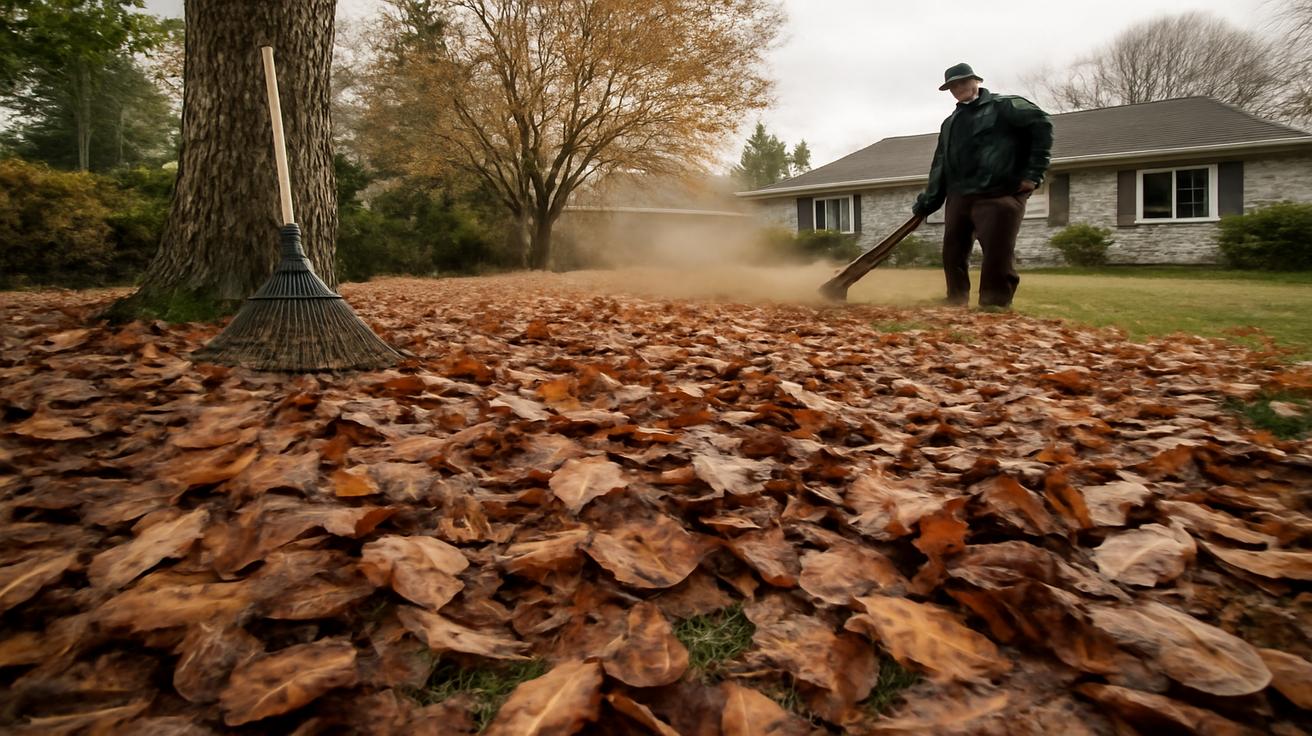
On the first cold morning, when you can see your breath and the world smells faintly of woodsmoke, you notice it: the yard has changed overnight. The maple that was showboating in scarlet last week is suddenly half-bare, a skirt of leaves pooling beneath its branches. They’re stacked along the fence line, gathered in the corners of beds, ruffling down the path like a rust-colored tide. And, almost by muscle memory, you reach for the rake.
The Rustle That Starts the Mistake
You tell yourself you’re just “getting ahead of it.” A quick tidy-up. A little autumn workout. There’s a certain satisfaction in the rasp of metal tines on grass, in neat piles that grow like little topographical maps of your effort. The air is crisp, your cheeks burn, and the familiar childhood choreography returns: rake, scrape, drag, bag.
Leaf bags begin to march along the curb—brown paper soldiers waiting for collection. There’s the smell of broken leaf flesh, that earthy, tannic scent that clings to your gloves. Maybe you run the mower over the lawn “just to pick up the rest” and watch the grass appear clean, uniform, respectable.
It looks good. It looks “done.” It looks like what a well-kept yard is supposed to look like in autumn.
And that’s where the mistake begins.
Every autumn, gardeners—new and seasoned alike—make the same quiet error. Not out of laziness or neglect, but out of habit and an old story about what a garden should be: leaves belong in bags, not on the ground. Yet those crinkling, curling, tumbling leaves are not trash. They are a delivery system. A pantry. A blanket. A neighborhood in disguise.
The Hidden City Under the Leaves
Pause for a moment before you drag the rake through that drift of oak leaves. Kneel down and lift a handful. Listen. Smell. The layer closest to the air is dry, light, rattling like parchment. But just below, it is different: slightly damp, cooler, and already beginning to soften into something dark and crumbly around the edges.
This is the frontier between leaf and soil, between one season and the next. It’s also a city.
Under that loose patchwork quilt, there are spiders overwintering in tiny silk hammocks, beetles wedged into crevices, centipedes coiled in spirals, and the near-invisible threads of fungi quietly stitching leaf to earth. Millipedes scroll their way under the cover, sowbugs and springtails harvest decaying fragments, and worm castings accumulate like small, quiet opinions about the value of organic matter.
Many of the insects that pollinate your flowers in May and June are here right now, disguised as nothing special at all—eggs, pupae, or sleepy adults waiting for spring. Fireflies, for instance, spend most of their lives not as glowing summer romances in the sky, but as larvae in soil and leaf litter, hunting snails and slugs. Mourning cloak butterflies overwinter as adults tucked into bark crevices and leaf piles. Native bees take refuge in stems and the shelter of that soft, shifting cover.
When we sweep up every leaf and ship them off in tidy bags, we aren’t just “cleaning up.” We’re throwing away homes, food, and the raw materials of next year’s fertility. It’s a bit like packing up your pantry, attic, and guest room and leaving them at the curb, then wondering why spring seems a little quieter.
Why We’re So Addicted to Leaf Perfection
There’s a particular sound you can hear on a sunny November weekend: the synchronized hum of blowers, the scratch of rakes, the revving of mulching mowers. A kind of ritual performance of order. Many of us inherited this idea of the “proper” yard from our parents, our neighbors, or glossy images in magazines: a lawn free of leaves is a sign of care. Leaves left on the ground, we’re told, suffocate grass, invite pests, “look messy.”
Some of that isn’t completely wrong. A heavy, matted wet layer of leaves left on a delicate lawn can cause problems, especially if it freezes and thaws all winter, holding moisture and blocking light. But the answer isn’t the all-or-nothing purge we’ve been rehearsing each year.
The problem is not the leaves themselves. It’s how we’ve been trained to manage them.
What Really Happens When Leaves Disappear
Imagine your yard in layers instead of surfaces. Up top, there are trees and shrubs catching the sun like sails. Beneath them, the lawn or groundcovers. Beneath that, soil, roots, and the intricate, humming network of fungi and microbes. And on that soil, at least half of the year in a natural woodland, is a layer of fallen leaves, renewing itself in a cycle of fall, winter, and spring.
In this layered world, leaves are not “extra.” They’re the essential middle step between tree and soil. They are how trees return nutrients to the ground, how moisture is held through winter, how soil stays insulated from heaving frost. They’re also how carbon is stored and slowly released, rather than burned or hauled away.
When we insist on a bare, leafless lawn and send our leaves off in trucks, several things happen:
- We remove a huge source of free organic matter and nutrients that could have fed our soil.
- We expose soil to temperature extremes, erosion, and drying winds.
- We inadvertently destroy or displace the larvae, eggs, and sheltering adults of countless beneficial insects and other invertebrates.
- We often replace the lost fertility with synthetic fertilizers, which come with their own environmental costs.
The irony is hard to miss: we spend money and time raking away nutrition, then more money and time putting nutrients back in bags and bottles labeled “fertilizer,” “mulch,” and “soil amendment.” All while complaining that gardening is expensive and time-consuming.
A Different Autumn Ritual
This doesn’t mean you should simply abandon your yard to an ankle-deep blanket of leaves and disappear indoors until April. What it does mean is that the most powerful change you can make is not to work harder, but to work differently.
Think of autumn as an opportunity to rearrange leaves, not remove them. Like moving furniture in a room so it works better, rather than dragging it all out to the curb.
You can still hear the bright rasp of the rake, still feel that meditative rhythm of gathering and carrying. But instead of loading bags, you’re building next year’s fertility. Instead of stripping your garden of cover, you’re tucking it in.
Smart Leaf Use: Where They Belong (And Where They Don’t)
Not all leaves behave the same way, and not all garden areas have the same needs. Some leaves are light and quick to break down; others are waxy, tough, and persistent. Some spaces welcome a thick leaf blanket; others benefit from a lighter hand. The key is to be strategic, not ruthless.
| Leaf Use | Where It Works Best | Tips for Success |
|---|---|---|
| Leave in Place | Under trees, shrubs, in naturalized areas, around perennials | Keep depth to about 5–7 cm; avoid smothering small, low plants. |
| Light Mulch on Lawn | Established turfgrass, not already stressed | Shred leaves with a mower and leave a thin, visible but not thick layer. |
| Mulch for Beds | Vegetable beds, flower borders, new plantings | Use partially shredded leaves; keep a small gap around stems. |
| Leaf Mold Creation | Shady corner, behind shed, unused strip | Pile leaves 60–90 cm deep; moisten occasionally; use after 1–2 years. |
| Avoid Thick Layers | On tiny seedlings, over low groundcovers, on waterlogged soils | Rake aside or thin out; use elsewhere as mulch or compost feedstock. |
If you have a traditional lawn, you can mow once or twice over a thin layer of leaves and simply let the fragments fall. Studies have shown that this kind of light leaf mulch can actually improve lawn health, adding organic matter and a slow, steady trickle of nutrients.
In beds, gather leaves into a loose layer around perennials and shrubs. They’ll act like store-bought mulch, but with better ecological benefits and no plastic bags. Over the winter, frost and microbes will begin to turn the sharp edges soft, and by spring you’ll find the beginnings of rich, dark leaf mold—one of the finest soil conditioners you can get.
The Magic of Leaf Mold (And How Little Work It Takes)
Leaf mold is simply decayed leaves. Not composted with kitchen scraps, not carefully turned, just a slow, fungal-driven transformation. It feels like chocolate cake crumbs and smells like the floor of an old forest after rain.
To make it, you don’t need a special bin. Choose a quiet corner—behind a shed, along a fence—and pile your leaves there. Water them once if they’re bone dry, then mostly ignore them, aside from occasionally giving the pile a shake or turn if you walk by with a rake in hand. That’s it.
In a year or two, depending on your climate and the kinds of leaves, you’ll have a mound of dark, crumbly material that holds water beautifully, improves soil structure, and gently feeds plants without the risk of burning them. It’s especially treasured by gardeners of woodland plants—hellebore, trillium, ferns, hostas, and their kin—but any bed will benefit.
The Wildlife You Don’t See (But Will Miss)
One of the quiet tragedies of the annual leaf purge is how invisible its effects can be. You may not notice that there are fewer fireflies blinking over your lawn in June, or that your flowering shrubs host fewer butterflies. You might miss the slower disappearance of ground-feeding birds that rely on leaf litter for insects and seeds—robins, thrushes, sparrows.
Removing leaves doesn’t just strip away their food; it also changes the microclimate they depend on. Exposed soil dries faster and swings more wildly between cold and warmth. For insects and other small creatures overwintering in or near the ground, that can be the difference between survival and death.
And yet, it doesn’t take much to start reversing this. Leaving some leaves—especially under trees, along hedges, and in corners—creates mini-sanctuaries. Instead of one big rectangle of “perfect” lawn, your yard becomes a patchwork of habitats: open spaces, sheltered zones, rough edges. Life loves an edge.
Balancing Beauty, Neighbors, and Nature
Of course, you don’t garden in a vacuum. There are neighbors with their own ideas about neatness, city ordinances about leaf collection, perhaps a homeowners association that keeps an eye on “debris.” You might worry that leaving leaves will make your yard look neglected, or that you’ll be that house on the street.
The answer lies in intention and design. A yard that is clearly cared for but not obsessively stripped bare sends a different message than one that looks abandoned. You can:
- Keep paths, sidewalks, and driveways clean and swept.
- Rake leaves away from the street gutter to avoid clogging storm drains.
- Create clear edges around beds where leaves are left, so it looks purposeful.
- Mow a neat border around wilder areas; a sharp lawn edge can make even a leaf-filled bed look intentional.
Think of it as the difference between a well-curated natural look and simple neglect. The same way a carefully rumpled linen shirt looks stylish, and a crumpled one on the floor does not.
Changing the Story We Tell Ourselves
The hardest part of breaking the autumn leaf mistake isn’t the physical task; it’s the internal narrative. For years, many of us have equated “good gardening” with removing anything that looks dead, brown, or spent. Fallen leaves fall squarely in that category. They register as “mess.”
But a garden is a living system, not a set of decorative objects. And in living systems, what looks dead is often just a stage—a pause, a disguise, a transition. The dry sunflower head is a bird feeder. The hollow stem is a bee nursery. The fallen leaf is tomorrow’s soil.
Once you start to see leaves as infrastructure instead of clutter, your whole relationship with autumn shifts. Raking becomes gentler, more question-driven: Does this area need a thick blanket, or just a sheet? Can this corner become a leaf mold stash? Is there a spot where birds forage that might benefit from a little extra cover?
You begin to notice who’s living in the leaf litter. You find ladybugs tucked along the stem bases, spider egg sacs attached like tiny paper balloons, the glint of beetle shells, the pale threads of mycelium running through the dampest layers. The ground itself becomes more interesting, more alive.
And when spring comes, there’s another reward: the soil beneath those leaves will be easier to work, darker, and looser. Early bulbs will push through with less effort. You’ll need less mulch, fewer fertilizers. The garden will, in small but undeniable ways, feel more self-sustaining.
So What Should You Actually Do This Autumn?
Standing in your yard with a rake in hand, you can make a few simple shifts that add up to a big change:
- Skip the “perfect” lawn. Mulch a thin layer of leaves in place with your mower instead of removing every last one.
- Designate leaf zones. Under trees, shrubs, and in out-of-the-way corners, intentionally leave leaves as winter mulch and habitat.
- Start a leaf mold pile. Pile extra leaves somewhere discreet; add to it each year and harvest the rich material from the bottom.
- Protect delicate plants. Rake thick, wet mats off tiny perennials or young lawn, but move those leaves to sturdier beds rather than bagging them.
- Keep edges tidy. Maintain clean paths and borders so your more natural approach reads as intentional rather than neglectful.
These are not radical acts. They don’t require expensive equipment, special training, or hours of extra work. In many cases, they will save you time and money. But they ask something subtler and more powerful: a willingness to let your yard participate in the wider patterns of the living world, instead of holding it apart in cosmetic perfection.
This autumn, when the first big windstorm sends leaves flocking to the ground, notice the old reflex when your hand goes automatically for the rake and the leaf bags. Then, just for a moment, pause. Look at the way the leaves catch the low light, how they move when a bird hops through them, how the air under a small drift feels warmer, softer, quieter.
You don’t have to leave every leaf where it falls. But you also don’t have to keep making the same mistake of treating them like trash. Somewhere between bare and buried is a new kind of autumn ritual—one that lets your garden breathe, feed itself, and shelter the wild lives that make it truly alive.
In that small shift, as the season leans toward winter, you may find that you are not just tending a garden, but finally letting it be what it has always wanted to be: a place where nothing is wasted, and even the simplest fallen leaf is a promise, not a problem.
FAQ
Will leaving leaves on my lawn kill the grass?
A very thick, matted layer of wet leaves can smother turf, especially in small or poorly drained areas. But a thin layer, shredded with a mower, is actually beneficial. Aim for a light covering where you can still see grass poking through.
Are some types of leaves bad for the garden?
Very tough, waxy leaves—like those from some oaks, magnolias, or evergreens—break down more slowly. They’re still useful but may be better in a leaf mold pile or used as a thinner mulch layer rather than a heavy blanket.
Won’t leaves attract pests or diseases?
Healthy leaves are unlikely to cause problems and, in fact, support beneficial insects and soil life. If a plant had a serious disease (like fungal blight on tomatoes), it’s wise to remove and dispose of those specific leaves rather than using them as mulch.
What if my city requires bagging leaves?
Many municipalities allow some flexibility. You can still keep a portion of your leaves on-site in beds and leaf mold piles, and only bag what’s necessary. Keeping sidewalks and gutters clear is important, but what happens inside your garden beds is often your choice.
How long does it take for leaves to break down?
In a moist climate, a loose mulch of leaves starts breaking down noticeably by spring and may be mostly decomposed by late summer. In a dedicated leaf mold pile, expect one to two years for a fully crumbly, dark material, depending on leaf type, moisture, and temperature.







Leave a Comment