
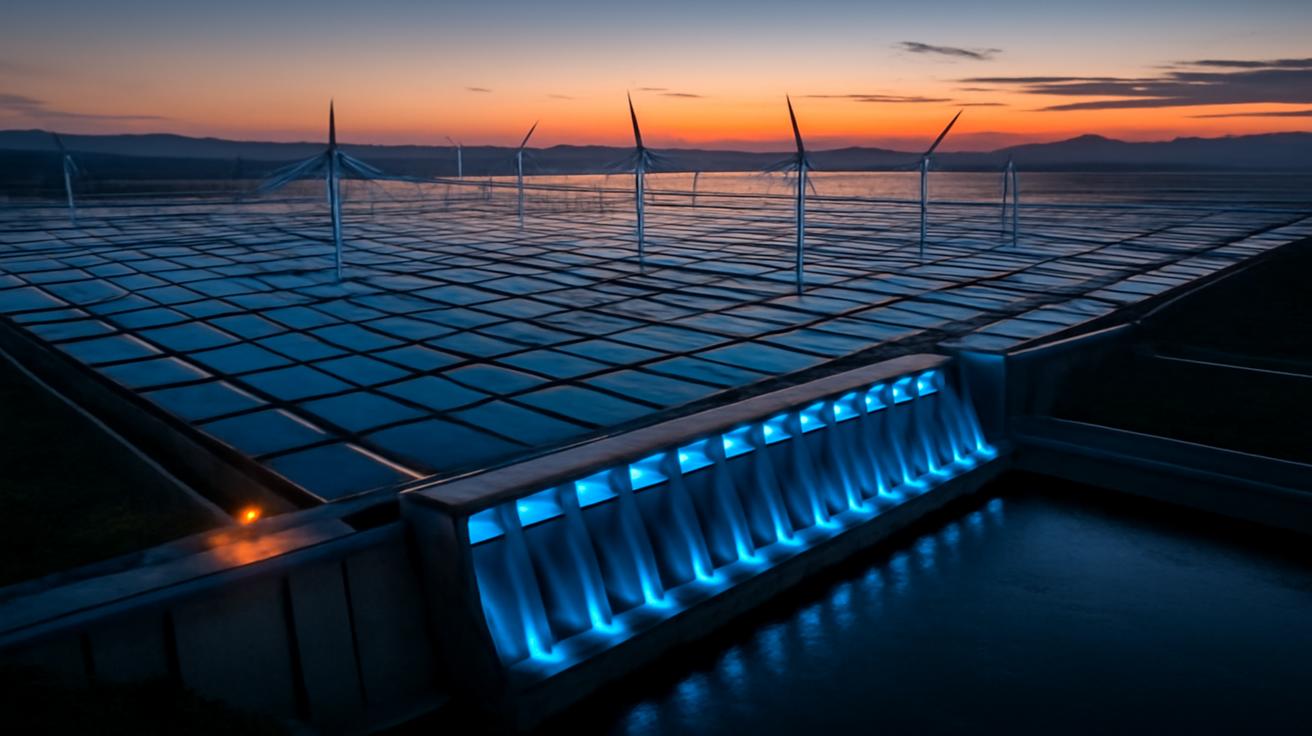
The first time someone told me that a single human-made structure could measurably slow the rotation of our planet, I laughed. It sounded like a pub joke, the kind of wild factoid you throw onto the table between sips of beer and arguments about space travel. But then came the number: China’s Three Gorges Dam, a concrete colossus holding back so much water that, according to NASA scientists, the redistribution of its mass has lengthened Earth’s day by a few microseconds. We built a dam, and time itself—barely, subtly—ticked slower.
When a River Becomes a Planetary Lever
Stand on the edge of the Yangtze near the Three Gorges, and it doesn’t feel like something that could nudge a planet. The water looks like any other river water—brown, muscular, restless. There’s the smell of damp stone and algae, boat fuel and mud. Mist hangs along the green ridgelines. But behind that gray wall of concrete, an ocean’s-worth of freshwater waits, its weight pressing down into the faults and fractures of the Earth’s crust.
The dam turned what was once an endlessly moving river into a staggered heartbeat of turbines and spillways. When its reservoir filled, billions of tons of water shifted inland and upward, away from the center of Earth’s rotation. The effect on the planet’s spin is almost comically small—fractions of milliseconds—but it’s real. Our days lengthened. Our clocks, in theory, would need the tiniest of corrections.
There’s something dizzying about that. For most of our history, rivers were simply backdrops—sources of food, routes for travel, lines on maps. We sketched them, named them, sang about them. But we never imagined we’d engineer them so completely that they would start to show up in the quiet math of planetary physics.
Yet China, restless and ambitious, didn’t stop with a dam that could lean on the spin of the Earth. That, it turns out, was just the prologue. The next project is less visible than a concrete wall, but in its own way, even more audacious: an attempt not only to bottle the power of a river, but to tame the thin blue ceiling of our entire world.
A New Project, Written in the Sky
High above the Three Gorges—and above every river, mountain, village, and city in China—lies a layer of air that has become the stage for a new kind of engineering story. This time the raw material isn’t rock or water, but sunlight, scentless and weightless. And the new monumental project is a network of solar and wind installations, an energy super-grid of almost mythic scale, that aims to harness this invisible power and send it throbbing across thousands of kilometers of land.
Picture it from far above: deserts the color of old bone, high plateaus streaked with snow, coastal plains shimmering with heat. Now imagine those landscapes turning slowly into constellations—not of stars, but of panels, towers, and cables. Each panel glints for a moment in the sun. Each wind turbine describes a lazy, relentless circle. Each substation hums just at the edge of hearing, the sound of electrons queuing and surging through lines that vanish toward the horizon.
This is the China that rarely appears in simple headlines. Headlines love the shock of the singular: the “world’s largest dam,” the “giant telescope,” the “longest bridge.” But this new project is not a single monument; it is a connected organism. It crosses deserts in the northwest, skirts jungled mountains in the south, threads itself through cities whose names most of the world still stumbles over.
In the dry air of Xinjiang and Gansu, fields of solar panels soak in light that has traveled eight minutes from the sun, only to land silently on silicon. In the open skies of Inner Mongolia, turbines stand like white sentinels, pulling energy out of invisible currents of air. Along the coasts, offshore turbines mark the edge where land memory meets ocean wind. And tying them all together are ultra-high-voltage transmission lines—sleek metallic scars that stitch provinces into a single circulatory system.
From Concrete Colossus to Invisible Empire of Light
The contrast is startling. The Three Gorges Dam is brute presence: a wall, a wound, a monument you can feel in your chest as the turbines roar. The new energy web is the opposite. It’s diffuse, scattered, almost shy. No single panel screams for attention. No turbine alone defines an era. It’s the scale that matters, the quiet accumulation of parts, the way it seeps into the background until it feels like it was always there.
If the dam was a symbol of mastery over a river, this sprawling renewable tapestry is something else entirely: an assertion that the nation can, and will, rewire its relationship with energy itself. Coal, for decades, was the dark heartbeat of Chinese industry—piled high on trains, burned in power stations that smudged the air over entire cities. Those memories are still recent for anyone who’s walked through the winter haze of Beijing or Shijiazhuang, throat tasting faintly of ash.
Now, in some of those same regions, the air is clearer, and in the distance, the silhouettes have changed. Instead of smokestacks puffing gray, you might see the slow, almost hypnotic rotation of turbine blades, or the wink of sun off solar glass laid out like mirrored crops. One kind of monument is being, very slowly, overgrown by another.
On paper, the numbers are staggering: hundreds of gigawatts of installed wind and solar capacity, with targets that leap forward every few years. In practice, they resolve into something more human—a technician tightening a bolt at the top of a turbine tower while the wind tugs at their jacket; a village that now hosts a solar array where there were once only scrub and stone; a farmer watching cables carried on steel towers across a field that his grandparents plowed with their hands.
| Project | Type of Impact | Scale in Everyday Terms |
|---|---|---|
| Three Gorges Dam | Hydro power, river ecology, tiny shift in Earth’s rotation | Reservoir roughly the size of a small country, billions of tons of water |
| National Renewable Super-Grid | Wind, solar, ultra-high-voltage transmission | Power lines stretching across thousands of kilometers, energy for hundreds of millions of people |
| Desert Solar Bases | Large-scale solar generation in uninhabitable land | Solar “seas” spanning areas larger than major cities |
What It Feels Like to Stand in a Sea of Panels
Walk onto one of those desert solar farms on a summer afternoon and the world simplifies. The sky is a hard, almost metallic blue. The ground is a memory of ancient seas, now reduced to grit and stone. Heat rises in invisible ribbons, blurring the horizon until the panels seem to float. There is almost no sound, just the soft tick of metal expanding and the distant whine of inverters, turning light into something that can light a city apartment thousands of kilometers away.
You find yourself staring at patterns. Row after row of panels tilt at the same angle, like a field of mechanical sunflowers frozen in mid-bloom. The air smells of dust and warm aluminum. Somewhere, a technician’s radio crackles and dies back into static. Above it all, the sun burns silently, indifferent, but inexhaustible.
It’s hard, in that moment, not to think in contrasts. Somewhere, deep beneath other parts of the country, coal seams lie in layered darkness, compressed forests of forgotten ages. For generations, people went under the earth to carve out that stored sunlight, at unimaginable human cost. Now we simply reach upward and take the light as it comes, every single day, without digging a single new tunnel.
China didn’t build this project out of pure environmental enlightenment. It’s a tangle of motives: energy security, industrial strategy, political signaling, pressure from smog-choked citizens, and a genuine recognition that the old path led straight into a storm of climate chaos. Yet if you’re simply standing there in the dry heat, watching the light hit the glass and vanish into the grid, the larger questions of intention blur. What’s left is something quieter: an awareness that we are, belatedly, learning to live on the daily interest of the sun, rather than raiding the principal of buried carbon.
Winds that Now Speak in Megawatts
Far to the north and west, where the land rolls out into wide plateaus and open grasslands, the soundscape is different. Here, the wind has always been a presence—shoving against doors, flattening crops, tearing at clothes. It used to be a nuisance, or at best, a kind of background weather music. Now it’s a resource.
Stand at the base of a modern wind turbine and you feel very small. The tower is a smooth white column that disappears into the sky. The blades arc overhead, each one longer than a passenger jet, moving in a lazy but relentless rotation. When the wind picks up, there’s a deep, rhythmic whoosh each time a blade passes, like the exhale of some huge sleeping animal.
These towers come in clusters—dozens, sometimes hundreds of them. At night, their red lights blink in rough unison, an artificial constellation stitched low across the horizon. From a distance, they look like something out of speculative fiction, beacons marking out the edge of a new, electric frontier. Up close, they’re oddly intimate. You can put your palm against the warm metal of the tower and feel faint vibrations humming through it, the kinetic tremor of air turned into rotation, rotation turned into current.
Farmers will tell you stories of how the landscape has changed since the turbines arrived. Some note the lease payments that make their finances more stable. Others mutter about the way the turbines alter the feel of the land, the way they seem to domesticate what was once raw wind. But even the complaints acknowledge the same fact: this is now part of the local weather, part of the new normal.
The Hidden Rivers of Electricity
What ties all of this together—desert solar seas, mountain wind farms, coastal arrays—is something less photogenic but arguably even more important: the ultra-high-voltage transmission lines that carry power across enormous distances with minimal loss. They are the steel-and-ceramic skeleton of the new project, the invisible rivers of electrons that replace, in part, the symbolic might of a single dam.
If the Three Gorges Dam was a kind of planetary lever, these lines are delicate needles, stitching together resources and demand that used to be separated by impractical distances. Sunlight is most intense in the far west and north, while energy hunger burns hottest in the eastern megacities. Turning that geographic misalignment into a functioning system is an act of quiet, intricate engineering.
Stand beneath one of these lines on a humid day and the air crackles faintly. The pylons are skeletal giants striding across fields and rivers, each step a kilometer or more. Birds sometimes nest in their steel joints. Farmers plant crops in their shadows. Children, looking up from a village road, might not know the physics, but they understand this much: the buzzing wires above are part of the reason their lights turn on, their phone charges, their heater hums.
Unlike a dam, a transmission line doesn’t dominate the landscape in one overwhelming gesture. It passes through, a visitor rather than an occupier. But multiplied over thousands of kilometers, it becomes an architecture of connection, a man-made mycelium spreading under and over the surface of a vast territory, sharing energy the way a forest shares nutrients.
More Impressive Than Slowing the Planet?
There’s a tempting drama in saying that a single dam can alter Earth’s rotation. It feels like mythology, like the stuff of ancient stories where gods anchor mountains with chains or pin down dragons beneath rivers. But in some ways, what is happening now—this sprawling, often messy, very human effort to rebuild an energy system in real time—is more impressive.
Slowing the planet’s spin by a few microseconds is a side effect, a scientific curiosity. Reorienting an economy of more than a billion people away from pure fossil dependence is an act of deliberate will. It requires not just concrete and steel, but policy debates, local negotiations, trial-and-error failures, and the slow work of rewiring habits. It involves convincing factory owners, city planners, rural households, and powerful state enterprises to all, more or less, move in the same direction.
The result is uneven. Coal plants still burn. Old habits linger. Wildlife pays a price when habitats are disrupted. Panels and turbines have their own material footprints, from rare earth mining to end-of-life disposal. None of this is clean in the absolute moral sense. But it is cleaner in the literal sense. The air in many cities is less choking than it was a decade ago. The carbon intensity of each unit of electricity is, slowly, declining.
If you zoom out far enough—imagining the planet as a blue-and-white marble slowly turning under the sun—you would not see the extra microseconds in its day. But you might, just barely, see the glitter of solar fields in remote deserts, the lines of turbines along coasts, the faint tracery of power lines stretching between them. You’d see, in other words, a species beginning to edit its own story, not by tilting the planet’s axis, but by shifting the way it drinks from the flow of energy that bathes it.
Listening to the Future in the Hum of the Grid
Maybe the real measure of “impressive” isn’t whether we can nudge a planet’s rotation, but whether we can learn, quickly enough, how to live on it without burning our collective home. From that perspective, China’s new project—this vast, still-growing web of renewables and transmission—is less a flex of power and more a test. Can an industrial giant turn its momentum in a new direction fast enough to matter?
The answer is still being written, day by day, kilowatt by kilowatt. It’s written in the choices of planners who decide where the next solar base will rise, in the hands of workers stringing new lines across ravines, in the quiet adaptations of people who now cook with electricity instead of coal, heat their homes with pumps instead of boilers, charge a vehicle instead of filling it with gasoline.
Somewhere, a child falls asleep in an apartment in Shanghai or Chengdu, night-light glowing softly by the bed. The electricity feeding that little device has taken a journey—maybe from a turbine turning in a northern wind, maybe from panels baking in western sun, maybe from a mixture of new and old. The grid, that anonymous miracle, combined and routed it. No one slowed the rotation of the Earth to make that happen. No single monument stands outside the window. But the future, humbly and imperfectly, is already there in the socket.
And maybe that is the most impressive thing of all: not that we once built a dam heavy enough to tug on the spin of our world, but that we are now learning to build systems subtle enough to change the trajectory of our presence on it.
Frequently Asked Questions
Did the Three Gorges Dam really slow Earth’s rotation?
Yes, but only by an almost unimaginably tiny amount. By shifting billions of tons of water into a higher reservoir, the dam slightly changed how mass is distributed on Earth, which can lengthen the day by microseconds. It’s a measurable effect in precise instruments, but completely imperceptible in daily life.
What makes China’s new energy project more impressive than the dam?
The dam is a single massive structure; the new project is a nationwide transformation. It involves huge deployments of solar and wind power, plus ultra-high-voltage grids that move electricity over vast distances. Instead of one monumental object, it’s a living system that reshapes how an entire country produces and uses energy.
Are these renewable projects environmentally harmless?
No large-scale project is impact-free. Solar and wind installations can disturb habitats, and their components require mining and manufacturing. However, over their lifetimes, they generally cause far less air pollution and carbon emissions than fossil fuel plants, making them significantly better for climate and public health overall.
Why does China focus so much on ultra-high-voltage transmission lines?
China’s best solar and wind resources are often far from its biggest cities and industries. Ultra-high-voltage lines can carry large amounts of power over long distances with relatively low energy loss, connecting remote generation sites with dense urban demand efficiently.
Does this shift mean China is done with coal?
Not yet. Coal still plays a major role in China’s energy mix, and some new coal plants are still being built. However, the rapid expansion of renewable energy and modern grids is gradually reducing coal’s share and laying the groundwork for a lower-carbon system in the future.





Leave a Comment