
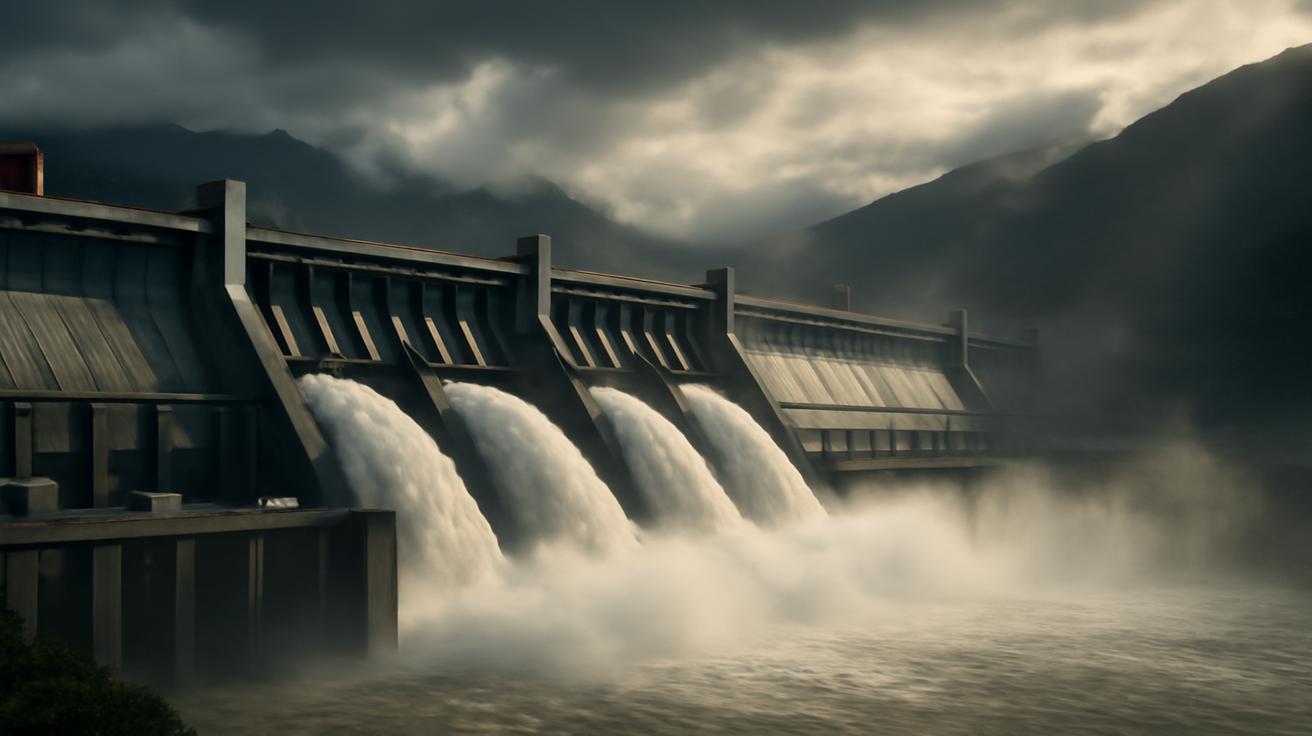
The first time I heard that a man‑made structure in China was powerful enough to slow the Earth’s rotation, I laughed out loud in disbelief. It sounded like the opening line of a sci‑fi novel, the kind of thing you’d hear from a late‑night conspiracy podcast rather than from a sober‑minded geophysicist. And yet, there it was: the undeniable fact that the immense mass of the Three Gorges Dam—bricks, steel, concrete, and billions of tons of water—had nudged the tempo of our planet’s spin by a fraction of a fraction of a second. A human structure, altering the rhythm of days themselves.
That idea lingered with me the way certain strange facts do, like a pebble in your shoe. You go on walking, but you never quite forget it’s there. So when news emerged that China, the same country that had already built this world‑tilting dam, was moving ahead with an even more audacious project, I felt that pebble again. What do you build after you’ve already proven you can, in some microscopic but measurable way, tug at the planet’s rotation?
A River That Can Tilt Time
To appreciate what comes next, you have to return to the river that started this conversation about human power on a planetary scale: the Yangtze. It curls across China like a restless dragon, carving gorges, feeding cities, dragging silt and memory from Tibet’s high plateaus to the East China Sea. Along one of its most dramatic stretches, where cliffs punch upward and mist clings to the ridgelines, stands the Three Gorges Dam—a concrete wall so vast that photographs always feel like they’re lying to you. It’s 2.3 kilometers long; more than 60 stories high at its tallest; a structure that looks like it should groan under its own existence.
When engineers filled the reservoir behind it, they effectively lifted around 39 trillion kilograms of water higher above the Earth’s center. And in the strange arithmetic of planetary physics, that matters. It’s like a figure skater extending their arms during a spin: pull mass outward, and the spin slows. In 2010, NASA scientists calculated that the Three Gorges Dam had increased the length of the day by about 0.06 microseconds. Not enough to notice, but enough to measure—and enough to remind us that our species now plays in a league where our designs brush against planetary mechanics.
It’s a quiet, almost eerie form of power. You stand near the base of the dam and feel it less as an object than as a force. Turbines hum somewhere deep below your feet; transmission towers march away across the landscape; the reservoir stretches upstream, swallowing former valleys and villages. The air has that damp, metallic scent you get near big machinery and big water: part river, part hot wiring, part wet concrete. There is nothing subtle about the place. And yet the idea that it’s strong enough to leave a fingerprint on Earth’s rotation feels almost intimate, like a secret the planet and the dam share.
A New Project That Outgrows a River
So what could be more impressive than that? For China, the answer isn’t simply “bigger” in the old-fashioned sense of taller, heavier, wider. The new frontier is “larger” in a different way, spread out like a network, braided into the landscape—and radiating far beyond the footprint of any one structure. Think less of a single monument and more of a continental‑scale instrument, tuned to the rhythms of sun and wind instead of a single booming river.
Across deserts, plateaus, coasts, and high plains, China is assembling what may become the most ambitious renewable‑energy network on Earth. Colossal solar farms blooming in old coal regions. Onshore and offshore wind arrays lined up in ranks like metallic forests. Ultra‑high‑voltage transmission lines—slender from a distance, like strands of spider silk—carrying power thousands of kilometers from where it’s generated to where it’s needed. Hydropower still matters, but now it’s joined by turbines that chase invisible air currents and panels that drink light from the sky.
All of this is not one project in the traditional sense, but it behaves like a single organism: a vast, coordinated engineering ecosystem sometimes described inside China as a “new energy system” or a “super grid.” It’s less of a building and more of a nervous system, flowing, adapting, routing, balancing. While the Three Gorges Dam pulls on the Earth’s spin through raw mass, this new project tugs on something more ephemeral: our energy story for the coming century.
From One Giant Wall to a Country of Light
On a winter morning in Inner Mongolia, before the sun has fully shouldered its way over the horizon, the cold bites hard. The air is so dry it crackles in your lungs. Step out into one of China’s vast northern wind fields and the landscape feels almost lunar—low scrub, pale soil, and on the skyline, row after row of wind turbines. They loom like a silent procession, each with blades longer than the wingspan of a jumbo jet. When the wind picks up, the sound is less of a mechanical whir and more of a breath, a rhythmic swooshing that syncs strangely with your own inhaling and exhaling.
Hundreds of kilometers to the south, in former coal towns of Shanxi or the deserts of Qinghai, the sensory landscape changes but the scale does not. Seas of dark‑blue solar panels tilt their faces toward the sky, drinking photons that left the sun eight minutes earlier. Walking along the edge of one of these solar farms at midday, you can hear the soft ticking of metal, the faint crackle of inverters humming as they push electricity onto the grid. Heat rises off the panel glass, bending the air into shimmering waves.
Each of these installations might be impressive alone; together, they’re part of something that dwarfs even the Three Gorges Dam in cumulative impact. China is building renewable capacity at a pace that reshapes not only its own energy mix, but the global trajectory of emissions. Entire provinces are being rewired—literally and figuratively—to shift from coal furnaces to fields of silicon and forests of composite blades. Remote plateaus, once only inhabited by herders and desert wanderers, are now hosts to solar geometries visible from space.
The Invisible Rivers in the Sky
Power, of course, is useless if it can’t travel. Here is where the project becomes truly planetary in feeling. Just as the Yangtze once carried the kinetic energy of water through its canyons, the new invisible rivers are electrical—flowing along ultra‑high‑voltage lines that link China’s windy north and sunny west to its industrial coasts.
Stand beneath one of these transmission corridors and there’s an odd sense of exposure. The lines hang above you, thick as a person’s arm, humming faintly when humidity rises. The towers that hold them are steel giants, clearing valleys and striding over ridgelines with a strange, skeletal grace. They redraw the idea of distance: what’s generated in an empty desert can flicker to life in a city hundreds or thousands of kilometers away in less time than it takes to blink.
In a way, these lines are the connective tissue that transforms scattered projects into a single massive endeavor. The wind, the sun, the rivers—each becomes a different dialect in the same language of electrons. The grid has to balance them: smooth the gusts, bridge the clouds, store the excess when a river is in flood but a city is asleep. That orchestration rivals the complexity of any one mega‑dam because it requires not just strength, but timing, prediction, and constant negotiation with nature’s moods.
Numbers That Feel Too Big to Hold
Trying to hold all this in your mind at once can feel dizzying. Human brains are not built for numbers that stretch into gigawatts and terawatt‑hours. Still, it helps to look at them, if only to sense the edges of the thing we’re talking about.
| Project / Element | Approximate Scale | What It Means in Everyday Terms |
|---|---|---|
| Three Gorges Dam | 22,500+ MW capacity | Enough to power tens of millions of homes, while slightly lengthening the day |
| China’s Renewable Build‑out | Hundreds of GW of new solar and wind added in just a few years | Equivalent to adding entire medium‑sized countries’ power systems, repeatedly |
| Ultra‑High‑Voltage Lines | Thousands of km of transmission | Moving electricity across distances similar to crossing continents |
| National “New Energy System” | Ongoing, multi‑decade build‑out | An evolving, country‑sized machine that reshapes how energy is produced and used |
Unlike the simple, blunt spectacle of the Three Gorges Dam—one site, one valley, one deep roar—this new energy organism seeps into nearly every corner of China. It’s there when a village switches from coal stoves to electric heat pumps, fed indirectly by a far‑off wind farm. It’s in the quiet when a coal plant closes and the usual rumble stops. It’s in the softer winter sky as particulate pollution slowly thins.
And here is one of the strangest truths: while the Three Gorges physically tugs at the Earth in a tiny way, a nationwide transition of this magnitude tugs on the planet’s future climate in a far deeper one. Fewer greenhouse gases today mean less locked‑in warming tomorrow; it’s a different form of planetary engineering, less visible than a wall of concrete but arguably more consequential.
What It Feels Like on the Ground
Walk through a rural town where solar panels sprout from rooftops like a second, angled layer of tiles, and you feel the change not in kilowatt‑hours but in small daily details. A farmer checks an app on her phone to see how much power her panels fed back to the grid that day. A former coal truck driver now hauls tower segments for wind turbines, the dust on his clothes changed from black to gray. At the edge of town, a substation hums quietly, its metal fences hot under the afternoon sun.
In coastal cities, office workers might never see a wind turbine in person, yet their phone‑charging, elevator‑riding, train‑taking lives are increasingly braided into those distant machines. Late at night, when half the city is asleep, grid operators in control rooms watch glowing maps of demand and supply, nudging flows of electricity like air‑traffic controllers of an invisible sky. Their screens show none of the romance of mountains and rivers, but the stakes are just as high: avoid a blackout, integrate a sudden gust of wind, store excess solar in batteries or pumped hydro for the long evening peak.
The human experience of such a project is not one dramatic moment but a long sequence of subtle shifts. Fewer smog days. A quieter horizon where a coal plant once stood. A new kind of job posting in local newspapers. People may never know which exact solar field or wind farm powered the train they rode this morning, but they feel the difference in lungs that don’t burn on cold days, in skies where the sunset runs its full palette of colors instead of disappearing into gray.
When Infrastructure Starts to Feel Like Landscape
There is a point, if you spend enough time in these places, when the machinery stops feeling alien and starts feeling like part of the scenery. In a southwestern gorge, power lines and dam spillways become as familiar as cliffs and pines. On the northern steppe, turbines mark distance the way lone trees once did: “It’s three turbines past the old well.” The boundaries between natural and artificial begin to blur, not because one has erased the other, but because they’ve become entangled.
This raises complicated questions. At what point does infrastructure become part of the ecosystem it occupies? When reservoirs replace canyons, when solar panels shade sparse desert plants, when access roads cut through grasslands, the cost isn’t imaginary. Species shift, water tables change, ancient village sites drown under reservoirs. An impressive project, no matter how green its aim, still has a footprint.
Yet it’s also true that climate change itself is now a kind of planetary‑scale infrastructure—an invisible, human‑built system of altered chemistry and trapped heat that wraps the entire atmosphere. Against that backdrop, the logic of mega‑projects starts to look less like vanity and more like triage. The question becomes not “Is it big?” but “Is it big enough to matter?”
China’s dam that can brush against the Earth’s rotation is a monument to one kind of answer: gather a river, tame it, turn it into a mountain of turning turbines. The newer, more diffuse project—the super‑grid, the desert panels, the northern turbines—is a step toward another answer: weave the sun, wind, and water into something that can power a civilization without relentlessly heating the sky.
The Human Imagination, Scaled Up
Perhaps the most astonishing thing, standing in the shadow of all this, is not the steel or the concrete or the cable. It is that every bolt and blade began as a line on a drawing board, a number in a spreadsheet, a decision in a meeting. A species that once huddled around small fires now orchestrates energy at continental scale. The distance between those two realities can be measured in centuries, or in stories.
You could tell one story that focuses on risk—the villages displaced, the species pressured, the carbon still being burned elsewhere. You could tell another that focuses on awe—the scale, the speed, the sheer audacity of reshaping a national energy system in a generation. Both are true, and they overlap in uncomfortable ways.
But there’s a quieter, more personal story too: the first time a child in a remote town sees a wind farm on the horizon and isn’t surprised by it, because to them it has always been there. The first time someone learns that a dam could, technically, make the day longer by a breath of a microsecond—and then learns that their own choices, multiplied by millions, could help decide what the planet’s climate feels like in fifty years. In that sense, these mega‑projects are not just about power; they’re about what we allow ourselves to imagine possible.
Beyond the Dam That Slows the Day
Even though China already built a dam capable of slowing the Earth’s rotation, its newest, more impressive project isn’t about further bending planetary physics. It’s about something subtler and ultimately far more important: shifting the arc of our shared future. The Three Gorges Dam is a symbol of brute strength, of the way humans can marshal stone and water into a single, imposing statement. The sprawling new energy system now emerging across deserts and plains is a symbol of something more distributed, more flexible, and, perhaps, more hopeful.
You can stand at the foot of the dam and feel the rumble in your chest. You can also stand on a ridge in Inner Mongolia, listening to the soft thrum of wind blades slicing the air, and know that both places are part of the same story—a story in which humans realized that if their inventions could nudge the spin of a planet, they might also be powerful enough to keep that planet livable.
In the end, the most profound shifts are not always the ones we can feel in the tick of a clock. They’re the ones that slowly, almost imperceptibly, change the background conditions of life itself: the air we breathe, the storms we weather, the patterns of drought and flood that define our fields. Measured that way, the dam that lengthens the day by a whisper is an impressive feat. But the project that aims to cool those days, to make them less choked with smoke and less charged with heat—that might just be the more astonishing achievement.
FAQ
Did the Three Gorges Dam really slow the Earth’s rotation?
Yes, but by an incredibly tiny amount. By raising a huge mass of water higher above the Earth’s center, the dam slightly increased the planet’s moment of inertia, similar to a skater extending their arms. Scientists estimate it lengthened the day by around 0.06 microseconds—far too small to notice without precise instruments.
How is China’s new project more impressive than the dam?
While the dam is a single, massive structure, the newer project is a nationwide transition toward a vast renewable‑energy system: large solar farms, wind fields, and ultra‑high‑voltage transmission lines working together. Its overall impact on emissions, air quality, and energy systems is much larger than any single dam, even one as monumental as Three Gorges.
Is this new energy system already finished?
No. It’s an ongoing, multi‑decade effort. China continues to build new solar and wind capacity, expand long‑distance transmission lines, and upgrade its grid to handle variable renewable power. Think of it as a living, evolving infrastructure rather than a single completed project.
Does such a huge build‑out of renewables harm the environment?
All large infrastructure has impacts—on land use, wildlife, and local communities. Solar farms and wind projects can disturb habitats, and big grids reshape landscapes. However, compared with the long‑term damage caused by fossil fuels and unchecked climate change, these impacts are generally seen as part of a necessary trade‑off that still needs careful planning and mitigation.
Can other countries build projects on this scale?
Not every country has China’s combination of land area, centralized planning, and industrial capacity, but many are pursuing their own versions: regional super‑grids, large renewable corridors, and cross‑border power sharing. The specific scale and speed will vary, but the underlying idea—linking vast renewable resources with modern grids—is increasingly global.








Leave a Comment