
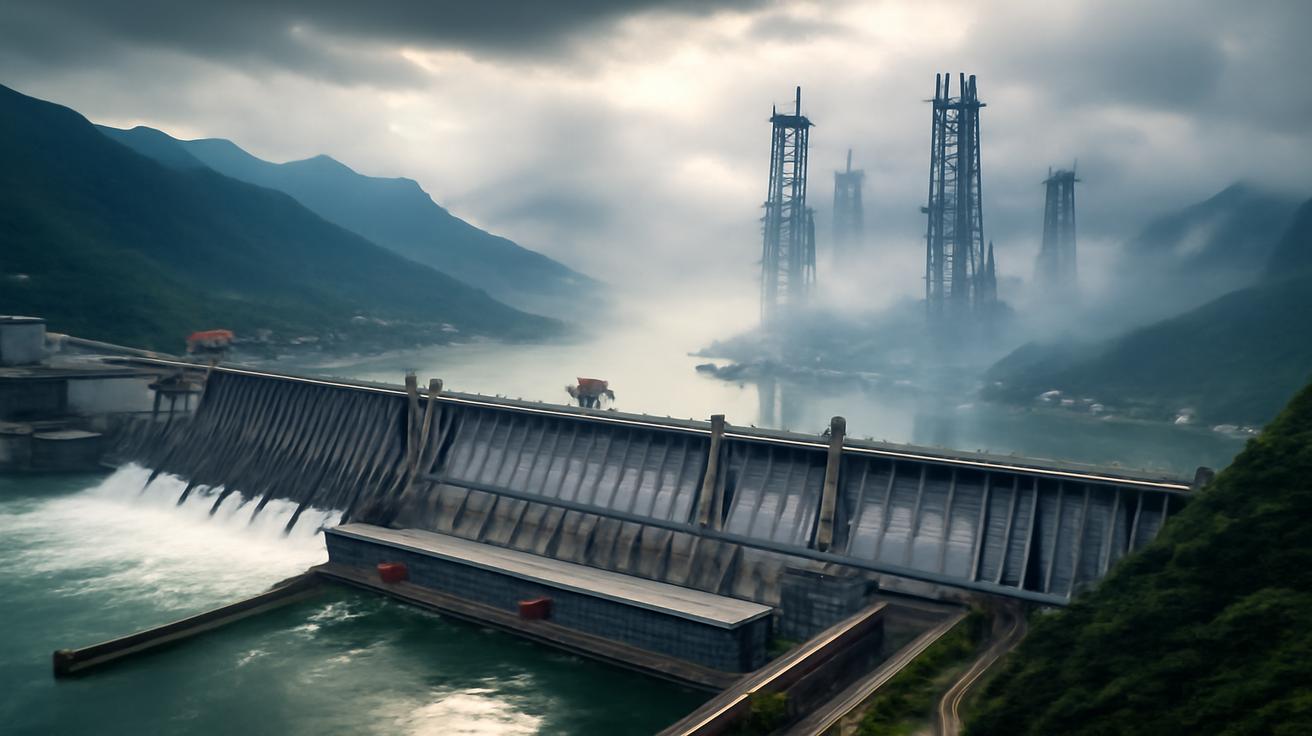
The first time I saw the Three Gorges Dam, it didn’t look like a feat of engineering. It looked like a cliff that someone had poured, piece by piece, out of concrete and steel. The Yangtze River, once a roiling, muscled force pushing east toward the sea, hit that wall and became a long, shimmering lake that seemed to stretch back into the mountains forever. Boats that used to fight the current now glided across a surface as calm as glass. Somewhere in the back of my mind, a thought surfaced—almost absurd, almost mythic: this structure is so massive it can literally slow the rotation of the Earth.
A Dam That Nudged the Planet
That sounds like science fiction, but in the early 2000s, physicists and geophysicists ran the numbers. The Three Gorges Dam, with its 600-kilometer-long reservoir holding tens of billions of tons of water, really does have a measurable effect on how our planet spins. By lifting so much water to a higher elevation and spreading its mass differently around the globe, the dam ever so slightly increases Earth’s moment of inertia—the same way a spinning figure skater slows down when they stretch out their arms.
The effect is tiny. Estimates hover around a change in the day length of microseconds—fractions of a blink, a whisper in the language of time. You would never notice it walking down a street in Shanghai or Chengdu. Your clock wouldn’t shift, your coffee wouldn’t cool differently, and the Yangtze’s banks would still see sunrise when they always have. But the physics are real all the same. By holding back such an enormous volume of water, the dam participates in the subtle choreography of our spinning world.
For many people outside China, this is where the story stops: a colossal dam, huge environmental costs, massive energy returns, a strange footnote about lengthening the Earth’s day. Yet inside China, the Three Gorges Dam isn’t an endpoint, but a beginning—a first verse in a larger song about bending water, stone, and sun to power a civilization of 1.4 billion people. And now, just as this dam has settled into the landscape and into the public imagination, China has quietly launched an even more audacious project, one that stretches not just across valleys but into time itself.
The New Giant: An Invisible Monument
Unlike the Three Gorges Dam, you can’t easily see this new project from an airplane window. There is no single, monolithic wall of concrete, no iconic silhouette etched against a mountain sky. Instead, it’s like a sprawling organism of wires, tunnels, turbines, and shimmering panels, a network humming quietly across deserts, plateaus, valleys, and coasts.
China calls it, in various forms and plans, its grand energy transition: a coordinated system of ultra-high-voltage transmission lines, vast solar and wind bases, and a lattice of pumped-storage hydropower stations that together act as one sprawling, continent-scale machine. If the Three Gorges Dam nudged the planet’s rotation, this new project aims to rewrite the daily heartbeat of energy itself—how it’s captured, stored, and released on a nation-sized canvas.
To understand why this feels bigger than even the world’s largest dam, imagine standing in the Gobi Desert at dawn. The air is so dry it feels almost weightless. The ground, once home to little more than scrub and sand, now shimmers with endless lines of solar panels. They are dark, glassy petals of a new industrial flower, all turned toward the rising sun. A warm hum creeps into the silence as they awaken, catching photons that left the sun eight minutes ago and transforming them into electricity that will, within seconds, start boiling rice in a Guangzhou kitchen or powering a server rack in a Chengdu data center.
But solar and wind are fickle companions. The sun dips behind clouds. The wind stutters, then roars back to life. Traditional grids were built for predictability, not for chasing the moods of the sky. So China is building something else: a giant, flexible spine of energy that can inhale power when there’s too much, and exhale it when there isn’t enough.
The Mountain Batteries
High in the mountains, far from the deserts and dense coasts, there are lakes that aren’t quite lakes—at least not in the old sense. Picture a valley that once cradled a quiet, turquoise reservoir below and a high meadow above. Now, there are two reservoirs: one at the valley floor, one near a carved-out plateau at the top. Connecting them is a hidden artery of tunnels, steel pipes, turbines, and gates.
On windy nights when the turbines on the northern grasslands are spinning like wild pinwheels, and the desert solar farms are at rest beneath the stars, surplus energy surges through the grid. Instead of wasting it, operators flip a switch in a mountain control room. Water begins climbing—pushed uphill by powerful pumps—from the lower reservoir to the upper one. The lake on the mountaintop rises, centimeter by centimeter, storing the night’s invisible bounty of electricity as plain old gravitational potential energy.
Then, on a still, hot afternoon when air conditioners across Shanghai, Wuhan, and Chongqing roar to life and demand for power spikes, the process reverses. Valves open, water drops, and gravity takes over. The upper reservoir empties down through turbines, spinning them furiously, sending electricity screaming back into the veins of the grid. The mountain has become a giant battery you can walk around, paddle a boat on, or watch the sunrise over.
This is pumped-storage hydropower, and China is building it at a staggering scale. New projects, some rivaling small dams in capacity, are being dug into mountain ranges from the eastern seaboard to the Himalayan foothills. Each site is a quiet colossus, trading the brute, singular statement of the Three Gorges Dam for a subtler, distributed power—dozens of reservoirs working together to keep the grid balanced as the nation leans harder into solar and wind.
The Wires That Cross a Continent
Of course, none of this works if the electrons can’t travel. The deserts in the northwest, with their endless winds and clear skies, are vastly far from the megacities on the eastern seaboard. The mountains that host pumped-storage facilities sit in yet another landscape altogether. To knit them together, China is building ultra-high-voltage (UHV) transmission lines—power highways that span thousands of kilometers.
Stand beneath one of these lines and you feel, more than see, their presence. Giant steel towers march across plains and rivers, striding over villages and forests. From their crossbeams, cables thicker than your arm sag in graceful arcs, carrying gigawatts of power at voltages high enough to make a physicist’s pulse quicken. These lines are designed to do something old grids could never manage on this scale: move huge quantities of electricity across a continent-sized country with relatively low losses.
Desert sun can thus become dusk-time light for city apartments far away. A gust of wind in Xinjiang can be felt, indirectly, as a steady hum in a subway tunnel in Shanghai. A cool, rainy week on the coast can be balanced by bright, dry days in the interior. The grid becomes less of a local machine and more of a living, national organism, its lifeblood flowing through wires that span ice fields, deserts, farmland, and karst hills.
| Key Element | What It Does | How It Feels on the Ground |
|---|---|---|
| Three Gorges Dam | Generates massive hydropower, slightly alters Earth’s rotation by redistributing water mass. | A towering wall of concrete, a once-wild river turned into a vast, calm reservoir. |
| Solar & Wind Bases | Harvest sunlight and wind across deserts, plateaus, and coasts. | Oceans of panels and turbines, humming under blazing skies and restless winds. |
| Pumped-Storage Hydropower | Stores excess energy by pumping water uphill, releases it by letting water fall through turbines. | Quiet mountain lakes that are secretly giant, rechargeable batteries. |
| Ultra-High-Voltage Lines | Move huge amounts of power thousands of kilometers with low loss. | Endless procession of steel towers, a faint electric whisper over fields and rivers. |
| Smart Grid Control | Balances unpredictable renewables with demand in real time. | Invisible algorithms deciding when dams release, when pumps start, when lines reroute power. |
Beyond Concrete: Engineering in Time, Not Just Space
The leap from one giant dam to this sprawling, multifaceted system is more than an upgrade in scale; it’s a change in philosophy. The Three Gorges Dam is an object. You can draw a line around it on a map. You can count its turbines, measure its height, photograph it in a single frame. China’s new project is harder to capture, because it’s as much about timing as about hardware.
Think of it as a colossal act of scheduling. At any given moment, the system is answering questions: Where is the wind strongest right now? How intense is the sunlight out west? How low are the reservoirs in the pumped-storage plants? How many people just turned on their air conditioners, electric stoves, or factory lines? Sensing devices relay this data, algorithms digest it, control rooms make choices in milliseconds. Instead of a dam mastering a single river, this new effort tries to choreograph the entire dance between nature’s rhythms and human demand.
It’s engineering tuned to the beat of the day. At sunrise, solar farms start to pick up. Late morning, industrial belts hum with activity. At noon, air conditioning demand builds in cities. On windy winter nights, turbines spin fiercely while most homes sleep. At each shift, something in the system reacts: water is pumped, lines are re-routed, power plants ramp up or down, storage facilities quietly inhale or exhale energy. While the Three Gorges Dam slightly lengthens the Earth’s rotation, this new grid is focused on something else: smoothing the choppy, heartbeat-like spikes of human energy use into a steadier pulse that nature can match.
Winners, Losers, and the Cost of Grandeur
Of course, no project of this scale comes without scars. The story of the Three Gorges Dam is written not only in kilowatt-hours and scientific papers about rotational dynamics, but also in the lives disrupted along the river’s banks. More than a million people were relocated. Ancient temples and villages disappeared beneath rising waters. Sediment flow changed. Fish migrations were disrupted. The dam’s ability to bend a river and nudge the planet’s spin came at a human and ecological price that can’t be brushed aside.
The new wave of mega-projects is no different. Those desert solar seas once hosted fragile ecosystems adapted to extreme dryness. Wind farms alter the experience of open landscapes that used to feel endless and untouched. Pumped-storage reservoirs swallow valleys, and the lines of steel towers cross pastoral scenes that, just a decade ago, were only human and sky. A shepherd might now graze sheep under a humming lattice of wires; a small village in the hills might wake to construction blare as tunnels are blasted into the mountain for another hydropower “battery.”
China’s planners argue that the long-term balance favors action: fewer coal plants, less air pollution, more stable power for hospitals, schools, factories, and homes. Climate change, they say, is a slower, broader disaster compared to the localized disruption caused by dams and grids. But for the family whose ancestral home sits where a new reservoir will rise, that calculus is deeply personal. The trade-off between a decarbonized future and the erasure or transformation of places people love is not easily charted on any official table.
When the Planet Notices
So, does this new energy architecture also change the way the Earth moves? The Three Gorges Dam made headlines for that microchange in rotation, but in truth, any massive reshuffling of water, rock, and air leaves faint fingerprints on the planet’s spin and tilt. Pumped-storage projects raise and lower water every day. Reservoirs fill and empty with rain and drought. Fossil fuels pulled from deep underground are burned and lifted into the atmosphere as gases. Ice melts and flows into the sea. Bit by bit, we are constantly nudging how mass is arranged on this whirling sphere.
In most cases, these effects remain deeply, almost unimaginably small, detectable only with highly sensitive instruments and archives of data. Satellites track tiny wobbles in Earth’s spin, GPS networks record subtle shifts in crustal motion, and geophysicists—quietly and patiently—trace the patterns. The point isn’t that we’re suddenly spinning wildly out of control, but that our species has become a force operating at planetary scales, whether we intend to or not.
The new Chinese project is part of that story. It’s not just about slowing or speeding the planet by a fraction of a millisecond, but about accepting that our infrastructure is now large enough, interconnected enough, and persistent enough to be considered a geological agent. The Anthropocene—the human age—is written not only in emissions, but in dams, grids, reservoirs, mines, and cables.
A Glimpse of a Shared Future
Looked at from far enough away, what China is doing may be a preview of a broader global future. Nations everywhere face the same intertwined puzzles: how to keep lights on and homes warm without stoking the climate crisis; how to weave erratic renewables into grids designed for constant, controllable fossil power; how to move energy across mountains, borders, and seas.
We can imagine, in a not-so-distant future, similar ultra-high-voltage backbones running from the windy North Sea across Europe, or from the Sahara’s sun-baked plains into more temperate regions. We can picture pumped-storage plants tucked into the Alps, the Andes, the Rockies—mountains moonlighting as batteries across continents. We can see smart grids that treat a burst of afternoon sun in one country as an opportunity to let another country’s dams rest and refill, rather than burn fuel.
In that sense, China’s latest project isn’t just national theater; it’s a test case. How do human societies handle infrastructure so big that it changes landscapes, livelihoods, and the quiet math of planetary motion? How do they listen to both the power demand curves on a screen and the voices of farmers, fishers, and towns along the way? How do they weigh microseconds of altered rotation against centuries of climate stability or instability?
Standing again on the shores above the Three Gorges reservoir, with the afternoon sun turning the water bronze, it’s easy to feel small. The dam looms, the water is still, and somewhere beyond the horizon, wires and turbines and reservoirs are working in concert in ways most people will never see. The planet turns, just a hair slower than it once did, and the question hangs in the air like mist over the river: if we can already build a dam that touches the clockwork of the Earth, what responsibility do we carry when we build something even larger, even more deeply entangled with the rhythms of wind, sun, and spin?
Frequently Asked Questions
Does the Three Gorges Dam really slow the Earth’s rotation?
Yes, but by an incredibly tiny amount. By holding a vast volume of water at a higher elevation, the dam slightly increases Earth’s moment of inertia, which marginally lengthens the day by microseconds. The effect is measurable with precise instruments but has no noticeable impact on daily life.
What is different about China’s new energy project compared to the Three Gorges Dam?
The Three Gorges Dam is a single, massive hydropower installation on one river. The new project is a nationwide, interconnected system of renewable energy sources, pumped-storage hydropower, and ultra-high-voltage transmission lines designed to balance supply and demand across vast distances in real time.
What is pumped-storage hydropower, in simple terms?
Pumped-storage hydropower works like a huge, water-based battery. When there is extra electricity, it is used to pump water from a lower reservoir to an upper one. When more power is needed, the water is released back down through turbines to generate electricity.
Why does China need ultra-high-voltage transmission lines?
Many of China’s best renewable resources, like strong winds and intense sunlight, are located far from major cities. Ultra-high-voltage lines can move large amounts of electricity over thousands of kilometers with relatively low energy losses, connecting remote energy bases to population centers.
Are there environmental and social costs to these mega-projects?
Yes. Large dams, pumped-storage reservoirs, and extensive transmission lines can displace communities, alter ecosystems, change river dynamics, and affect wildlife. While they can reduce reliance on fossil fuels and help address climate change, they also create local and regional impacts that must be carefully managed and considered.
Could similar energy systems be built in other parts of the world?
In principle, yes. Many regions have the geography for pumped storage, the space for large solar and wind farms, and the need for long-distance transmission. However, political will, financing, environmental regulation, and international coordination all shape how and where such systems can be built.
Does this new project change the Earth’s rotation like the Three Gorges Dam?
Any large-scale redistribution of water and mass has an effect on Earth’s rotation and wobble, but these influences are tiny. The combined impact of many projects, including dams and reservoirs, is detectable to scientists, yet remains minuscule compared to natural processes and has no direct effect on everyday life.







Leave a Comment