
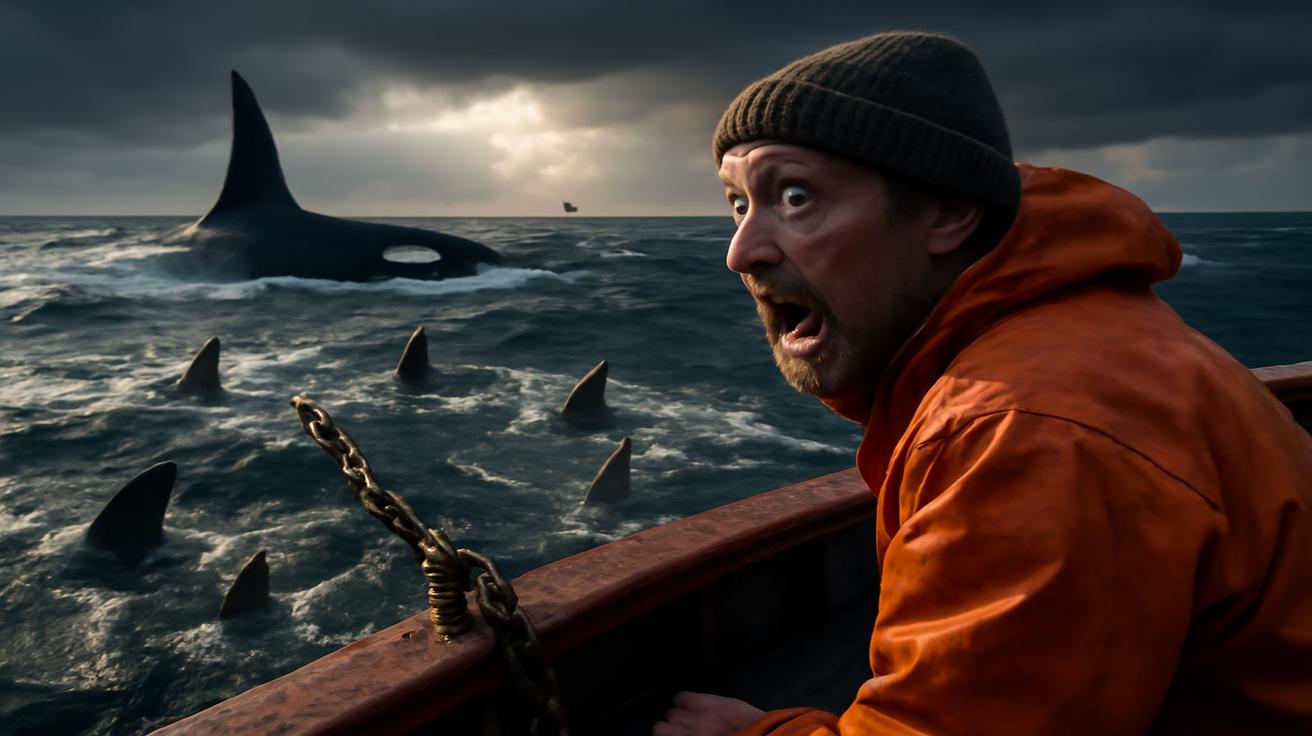
The first inkling that something was wrong was not the siren or the radio crackle, but the sound—low, heavy, and rolling in from the fjord like distant thunder. On the deck of the tiny research vessel, the air smelled of brine and snowmelt, and somewhere beneath the wind’s sharp whistle came a hollow boom, as if the world itself were cracking open. A graduate student from Copenhagen looked up from her notepad, brow furrowing. Another boom followed, then another—like applause from an unseen audience. Moments later, the cry went up from the bow.
“Orcas!”
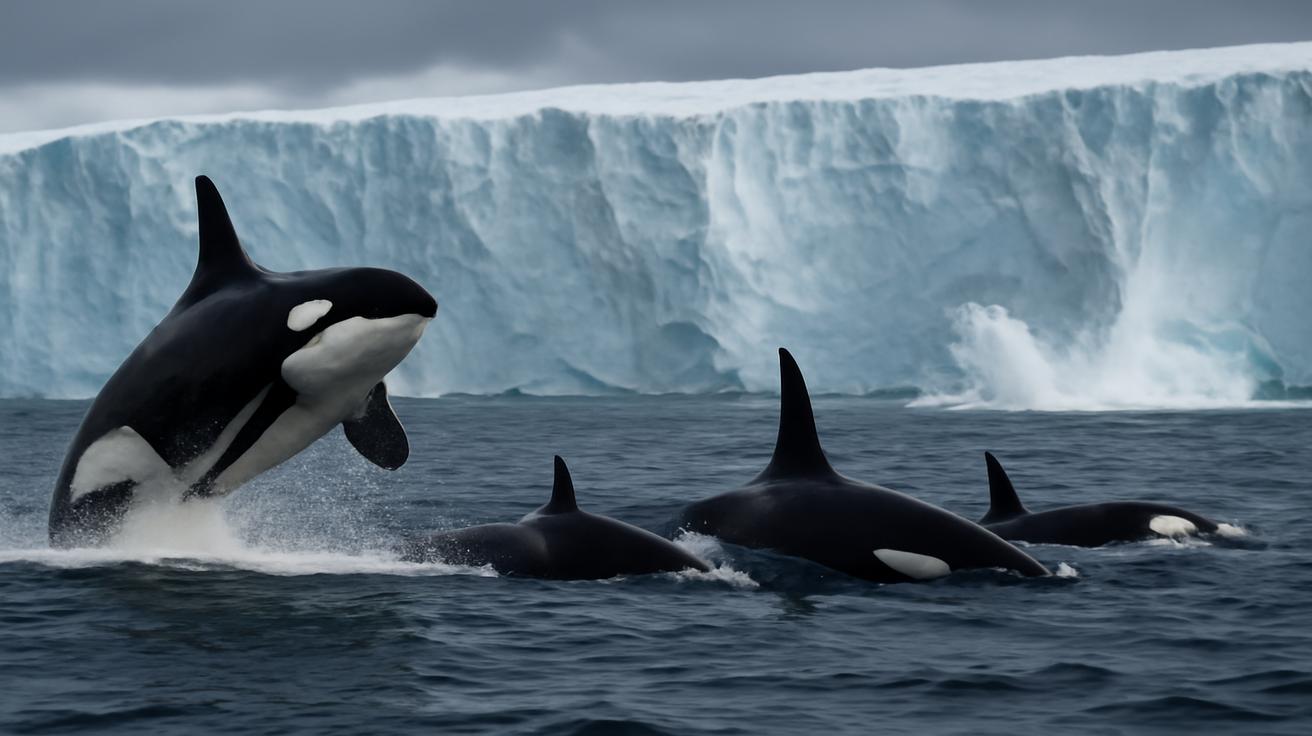
Black fins, tall and knife-like, sliced the steel-blue water near the lip of a disintegrating ice shelf. Just beyond, a jagged wall of ancient ice—white, blue, and ghostly green—was slumping, chunks sloughing off into the sea with each concussive roar. Cameras came out. Binoculars swung into place. Behind them, high on the coastal cliffs of southwestern Greenland, a small settlement watched in uneasy silence.
Within hours, an emergency was declared.
A Summer That Came Too Fast
By the time the midnight sun begins its long, unblinking watch over Greenland, people here are already taking stock of the year’s melt. They read the ice the way others read newspapers: a new crack in a familiar glacier, a darker ribbon of meltwater snaking down a ridge, the unusually early break-up of sea ice in the fjord. This year, the signs arrived faster than anyone remembered.
In April, fishermen in the town of Qaqortoq were talking about thin ice, the way it groaned and flexed under their sleds. By May, satellite data confirmed what their instincts had already told them: temperatures were running far above seasonal averages. The melt season had started early, gnawing at the edges of Greenland’s ice sheet long before the cod runs had even peaked.
On a gray morning in late June, researchers stationed near a series of coastal ice shelves—vast floating tongues of ancient glacial ice—began noticing strange gaps. Aerial surveys showed widening fractures, dark blue lines threading through vast sheets of white. In some places, entire sections of shelf had thinned by several meters in a single season. In others, meltwater lakes, like turquoise bruises, pooled on the surface, their weight pushing fractures deeper into the ice.
What made this year different was not only the speed of the melt, but also the company that arrived with it.
When the Orcas Came Closer
The first orca sighting near the crumbling ice shelves was logged as a curiosity, nothing more. Orcas—killer whales—are no strangers to Greenlandic waters. They have long patrolled these coasts in search of seals, fish, and sometimes even other whales. But they usually stayed farther offshore, away from the dense, grinding pack ice that locked the fjords each winter and lingered well into summer.
This time, they were closer. Much closer.
On that June day, as the research vessel drifted near a calving front, a pod of at least eight orcas surged through the chop at the very edge of the shelf. One enormous male, his dorsal fin as tall as a person, breached so near the ice that his tail seemed to brush the blue-white wall as he crashed back into the water. A female surfaced with a breathy exhale, her neon-white eye patches gleaming against her coal-black head. In the wake of each breach, ice fragments bobbed and rolled like ice cubes in a shaken glass.
“We’ve never seen them this far in, not with this much ice still around,” one of the glaciologists muttered, lowering his binoculars. “They’re following an opening that shouldn’t be here.”
That opening—new stretches of ice-free water carved into the heart of what used to be a locked, frozen coast—was both opportunity and omen. For the orcas, it meant access: to prey previously protected by thick sea ice, to corners of fjords rarely navigable, to routes that used to stay sealed until late summer. For the ice shelves, it meant more contact with warming water, faster breakup, and a new cascade of risk.
Shifting Boundaries in a Warming Sea
The arrival of orcas near melting ice shelves is not a cute quirk of nature; it is the moving punctuation at the end of a long, complicated sentence. It tells a story of a boundary—between ocean and ice, predator and prey, stability and collapse—that is shifting at alarming speed.
Orcas are apex predators, finely tuned to read the sea’s opportunities. They favor edges: the margin of sea ice where seals haul out, the front of fish schools, the wake of calving glaciers where stunned or disoriented prey might linger. As warming waters nibble away at Greenland’s frozen coast, these edges multiply. Where there used to be an unbroken wall of winter ice, there are now leads, channels, and open pockets—blue corridors that orcas slip through with casual ease.
From the deck, the sight is mesmerizing: the sleek black bodies rolling through water stippled with ice shards, the exhale of their breath meeting the chill air in ghostly plumes. They appear and vanish like punctuation marks in a blue-and-white text written over millennia. Yet beneath the surface, the physics of their arrival is anything but poetic.
Warmer Atlantic waters, pushed northward by changing currents, flow against the undersides of Greenland’s ice shelves, melting them from below. At the same time, hotter air above intensifies surface melt, filling crevasses with water that pries the ice apart. As shelves thin and fracture, they lose their ability to brace the grounded ice behind them—the glaciers that rest on land and, when released, flow faster into the sea.
When the shelves go, the glaciers speed up. When the glaciers speed up, sea level rises. The orcas, moving deeper into newly open waters, are the most visible sign of that hidden cascade.
The Moment the Alarm Was Raised
The emergency declaration didn’t come because someone saw a whale. It came because of what those whales revealed.
On the afternoon the pod breached near the ice shelf, monitoring stations lit up with anomalies. GPS sensors anchored in the ice recorded sudden shifts—meters of movement in a matter of hours. Cameras captured a series of dramatic calving events: great chunks of ice the size of city blocks cracking off and tumbling into the fjord, their thunder echoing off the steep rock walls. In the satellite imagery, that once-smooth white shelf now looked jagged, scalloped, and frayed.
In a small operations room hundreds of kilometers away, glaciologists and emergency planners watched the data scroll in real time. The concern was not only the ice itself, but the communities living just beyond the cliffs: fishing towns with docks, fuel depots, boats, and families all perched near the waterline.
A truly massive calving event can trigger what scientists call a “glacial tsunami”—a wall of ice-churned water that can surge into narrow fjords and crash against the shore. As the researchers watched orcas weaving near the base of a severely fractured shelf, they saw not a wildlife spectacle but a hazard indicator. The ice, stressed and cracking, could fail catastrophically. The whales were moving through a minefield.
Greenland’s emergency protocol for such events is still evolving. But on that day, as seismic sensors picked up deeper rumbles within the glacier, local authorities moved quickly. Coastal alerts went out over radio. Docks were cleared. Boats were told to move to safer moorings. People were advised to avoid low-lying areas near the fjord. Researchers were ordered to maintain a safer distance.
In the village nearest the shelf, a teacher led her students up the slope behind the school, just high enough to watch the water without risk. The children’s eyes followed the distant black fins, their excitement tempered by the adults’ unease. In the space between each crack of falling ice, the air seemed too quiet.
What the Data Whispered Under the Roar
Later, when the roars subsided and the emergency alert was downgraded, the forensic work began. Ice cores, satellite altimetry, ocean temperature records, and whale sighting logs were pulled together to see the bigger picture beneath the day’s drama.
One of the most striking patterns was how closely the orca sightings aligned with zones of newly opened water and extreme melt. Where sea ice used to persist until late summer, it was now breaking up weeks earlier. Warm currents were intruding deeper into fjords, carving out circulation loops that carried heat directly to vulnerable ice shelves.
Orcas, far from being an anomaly, were moving like dark arrows along these new, invisible pathways. They were not causing the melt; they were tracing it.
| Observation | Recent Pattern in Greenland | What It Suggests |
|---|---|---|
| Earlier sea-ice breakup | Ice-free waters forming weeks ahead of past averages | Longer open-water season, more wave action on ice shelves |
| Increased orca sightings near fjord heads | Pods moving deeper into narrow, newly accessible channels | Warmer, ice-free corridors reshaping predator and prey ranges |
| Rapid thinning of ice shelves | Meters of thickness lost in a single melt season in some areas | Reduced buttressing for inland glaciers, higher sea-level risk |
| Frequent calving events | More frequent, smaller calving episodes punctuated by large collapses | Structural instability and greater hazard for coastal communities |
For the scientists, the orcas had become unwilling collaborators—living indicators of where the ice/ocean boundary was failing. For the locals, they were a paradox: a symbol of wildness and beauty that now arrived hand in hand with sirens and evacuation notices.
Life on a Thinning Edge
In the days after the emergency was lifted, the village settled into an uneasy calm. Children still walked to school along gravel roads scratched into glacially carved rock. Fishermen still headed out before dawn, the hum of outboard motors bouncing off the cliff faces. The mountains and ice still loomed, powerful and serene, as if the drama of the previous week had been a fleeting mood.
But the conversations over coffee, in the fish-processing sheds, and on radio call-ins had shifted. People spoke of winters that felt shorter, ice that felt less trustworthy, and animals that seemed to be rewriting their own maps. Elder hunters reminisced about the days when sea ice sealed the fjord solid for months. Now, patchy ice and open leads made travel by dog sled riskier, while storms seemed to rise more quickly from the horizon.
In a wooden house overlooking the water, an elderly man recalled the first orca he had ever seen, decades earlier, far offshore. “We used to look for them like a blessing,” he said, his hands tracing the memory in the air. “Now they come to us, and I’m not sure what they’re bringing.”
For researchers, Greenland is no longer just a place to measure climate change; it is a place to witness how swiftly a world can pivot on altered rhythms. The line between “normal variability” and “rapid transformation” has blurred into a gradient of uneasy questions. When is a warm year just a warm year, and when is it the moment a system crosses a threshold it cannot easily return from?
Listening to Whales, Reading the Ice
In a small laboratory near the harbor, recordings from underwater microphones—hydrophones—captured during the emergency week were replayed. The room filled with eerie whistles, clicks, and pulsed calls: the language of orcas navigating through echoing ice canyons, probing the presence of seals and the contours of collapsing walls.
These soundscapes, layered with the crack and rumble of ice, are now part of a growing archive used to map how life is reassembling itself in the Arctic. The calls trace migration routes and feeding hotspots; the ice noise documents the tempo of disintegration. Together, they are a kind of symphony of transition, both hypnotic and unsettling.
For all our graphs and models, some of the most powerful evidence of change comes through the senses. The sweet, mineral tang of meltwater on the wind. The startling blue of a freshly broken ice face, glowing as if lit from within. The heavy, meaty slap of a whale’s tail against unfrozen sea where, not so long ago, there was only silence and ice.
Science, here, is not separate from feeling. The glaciologist watching his instruments spike as an orca’s dorsal fin cuts the surface is also a human whose pulse quickens, not only with awe but with dread. The fisherman steering his boat between drifting bergy bits to avoid a newly unstable glacier front carries both ancestral knowledge and fresh anxiety.
What Greenland’s Emergency Says About the Rest of Us
It is tempting to think of Greenland as a distant stage, its dramas unfolding far from the concerns of city commutes and suburban lawns. But the island’s ice is wired, invisibly, to shorelines around the world. When Greenland loses mass, oceans swell. Beaches shrink. Storm surges climb a little higher over sea walls from Miami to Mumbai.
The emergency declared over a remote ice shelf might feel like a local story, but it is actually a line in a global ledger. Each calving event, each acceleration of a glacier, nudges sea levels upward. The orcas chasing seals deep into fjords where they never used to go are moving along pathways warmed, in part, by emissions from far beyond the Arctic Circle.
To stand on a cliff in Greenland and watch orcas breach beside collapsing ice is to witness, in miniature, the story of climate change. The old protections—thick sea ice, stable shelves, predictable seasons—are thinning. Edges are fraying. Boundaries that once held fast are yielding, and with each yield, new winners and losers emerge in the ecological lottery.
Yet within that unsettling picture lies a rare clarity. Here, the feedback loops we read about in scientific papers are audible, visible, almost tangible. Warmer water eats ice. Less ice means more open ocean to absorb heat and wave energy. More open water invites apex predators into new realms, who then reveal, by their very presence, how far the system has slipped.
Choosing How We Respond
The people most immediately affected by these changes—the Greenlandic communities watching their coasts reshape beneath them—are not the ones who contributed most to the warming that drives it. They are, instead, on the frontline of a story we all helped write.
Responding to that story is not only about distant policy meetings or long-term projections. It’s about the choices that ripple outward from everyday life—how energy is generated, how cities are built, how seriously we take the warnings etched into the ice and sung by whales.
If there is a lesson in that emergency declaration, it might be this: the planet rarely raises its voice in a single, unmistakable shout. Instead, it speaks in layered murmurs—the sag of a thinning shelf, the altered path of a predator, the recalculated probability of a coastal flood. On a certain day in Greenland, all those murmurs rose together into something that sounded, unmistakably, like an alarm.
Out on the water, long after the alert was called off, the orcas kept moving. Their dorsal fins cut the surface with unhurried precision. The ice, newly broken and scattered, bobbed and spun. Above them, the sky glowed with a soft, lingering light that seemed reluctant to admit the night.
We can watch, and measure, and tell the story of what is happening at the world’s icy edges. What we cannot do is pretend we are not part of it.
Frequently Asked Questions
Why was an emergency declared in Greenland when orcas were spotted?
The emergency was not because of the orcas themselves, but because their presence signaled severe ice instability. Orcas were observed unusually close to rapidly fracturing ice shelves. At the same time, instruments detected sudden ice movement and increased calving activity, raising the risk of large ice collapses and glacial tsunamis that could endanger nearby communities and vessels.
Are orcas new to Greenland’s waters?
No. Orcas have long been present around Greenland, but typically farther offshore or closer to the open ocean. What is new is how frequently and how far into fjords they are now traveling, taking advantage of earlier sea-ice breakup and newly opened waterways near melting ice shelves.
How is climate change connected to these events?
Climate change warms both the atmosphere and the ocean. Warmer air increases surface melt on ice shelves, while warmer water melts them from below. As shelves thin and fracture, they become more unstable and prone to collapse. Earlier and more extensive sea-ice loss also opens corridors that allow orcas and other marine animals to move into previously ice-locked areas.
Do orcas contribute to the melting or instability of the ice?
Orcas do not cause the melting or structural failure of ice shelves. Their presence is a response to changing conditions, not the cause. However, they are excellent indicators: by following open water and prey, they reveal where ice has retreated and where new, warmer pathways have formed.
What risks do rapidly melting ice shelves pose to local communities?
Rapidly melting and fracturing ice shelves can lead to large calving events. When huge blocks of ice fall into confined fjords, they can generate powerful waves—glacial tsunamis—that threaten docks, boats, infrastructure, and, in some cases, homes near the shoreline. Longer term, accelerated glacier flow after shelf collapse contributes to global sea-level rise.
Can these changes in Greenland affect people living far away?
Yes. Greenland’s ice sheet holds enough frozen water to significantly raise global sea levels. As more ice flows into the ocean, even small increases in sea level can worsen coastal erosion, flooding, and storm surge impacts in low-lying regions across the world.
Is there anything being done to monitor and mitigate these risks?
Scientists are using satellites, GPS sensors, radar, drones, and underwater instruments to monitor ice thickness, movement, and ocean temperature. Local authorities are developing and refining emergency protocols for calving events and glacial tsunamis. Globally, efforts to reduce greenhouse gas emissions are crucial to slowing further warming and limiting the long-term loss of Greenland’s ice.




Leave a Comment