
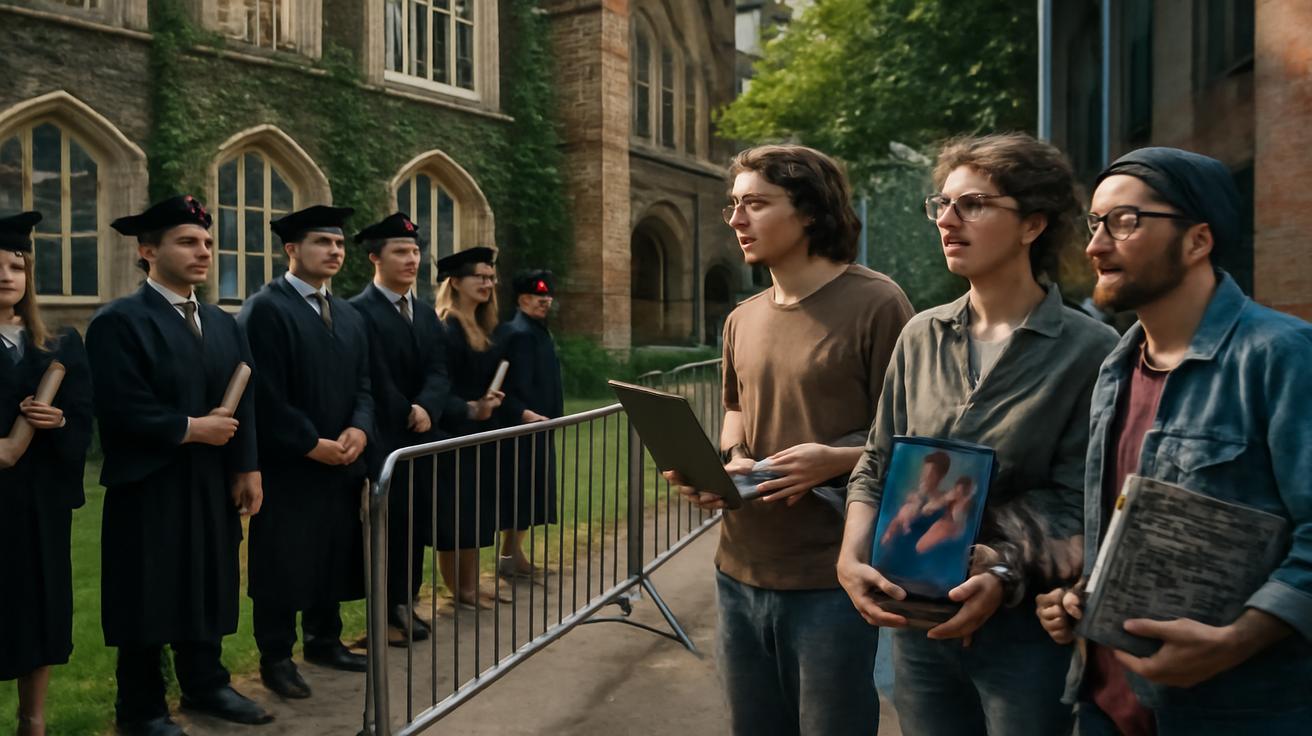
The lawn looks impossibly green in brochure photos—HD emerald under a sky that’s always just after sunrise. Somewhere in the frame, a student in a hoodie branded with an ancient crest laughs, mid-stride, as if life itself has decided to sponsor them. You can almost hear the brochure whisper: This is where the best come to become even better. Parents squint at the image and see security. Teenagers see a door to “making it.” Admissions officers see a funnel of endless applications. And somewhere off-camera, the truly original minds, the kids who never fit the algorithm, are standing outside the gates, staring in, wondering how on earth they ended up on the wrong side of a story that was never really written for them.
The Prestige Machine and the Illusion of “The Best”
Walk across any elite campus during orientation week and you’ll feel it in the air—a low, humming sense of triumph. These are the chosen ones, you’re supposed to think. The future CEO of something, the next Senator So-and-So, the founder of an app you’ll download in five years without knowing where it began. The school merchandise shop sells more than hoodies; it sells a story about deserved success.
But beneath the banners and the vibey string lights of welcome week, something stranger is happening. The more these institutions double down on “excellence,” the more they begin to mass-produce something else entirely: polished, high-performing, deeply anxious mediocrity.
Not mediocrity in the sense of low grades or laziness. Mediocrity in the sense of thought. Of risk. Of originality. A kind of sameness disguised in different majors and different LinkedIn profiles. It’s the quiet flattening of human possibility into one standard issue: the credentialed, hyper-optimized graduate who can slide seamlessly into any consulting firm slide deck.
It’s not that elite universities are empty of talent—far from it. They’re bursting with bright people. But brightness is no longer the point. What matters is legibility. What matters is whether you can be measured, ranked, sorted, packaged, and placed. And the truly talented—the wild thinkers, the obsessive tinkerers, the people who fall down rabbit holes for weeks just to follow a question—often don’t survive, or even enter, that sorting process in the first place.
The New Admissions Alchemy: Turning Fear into Applications
To understand how we got here, you have to watch the admissions process not as a gatekeeper of minds, but as a business model built on fear. Somewhere in a quiet office, far from the blooming quadrangle, there are people reading applications in 8–12 minutes apiece while staring down a spreadsheet that demands a lower acceptance rate every year.
At this point, elite admissions isn’t just selective; it’s performative. It needs to be seen as selective to maintain the brand. That means more applicants, fewer admits, and a public narrative of “record-breaking competitiveness” every cycle. The story writes itself: If you get in, you must be special. If you don’t, well, you probably weren’t.
But look closely at what actually gets rewarded on those applications. Risk-taking? Uncertainty? Deep, unfashionable curiosity? Not really. What plays well is proof—proof you can perform in ways admissions officers recognize. Perfect or near-perfect test scores. Sculpted extracurriculars. Essays that walk the thin line between personal and PR-ready. Teacher recommendations that say, again and again, that you are driven, diligent, leaderly, exceptional.
So families respond rationally to an irrational game. They reverse-engineer their children’s lives to be “admissible.” The quirky middle-schooler who spent afternoons dismantling radios and building strange, useless gadgets? By junior year, that kid is founding a “non-profit” and interning at a think tank they don’t really care about, because those things read better on a Common App than four years spent obsessed with circuitry and failed prototypes.
The result is a generation of students whose resumes are crowded, but whose inner lives have been quietly evacuated—a kind of curated emptiness. They’ve spent so long auditioning that they’ve forgotten what they actually like, believe, or crave. And this is exactly the kind of applicant the modern meritocracy understands: thoroughly documented, easily sortable, and safely predictable.
| What Elite Schools Say They Want | What Often Actually Gets Rewarded |
|---|---|
| Original thinkers | Students who fit familiar success patterns |
| Intellectual curiosity | High-volume, quantifiable achievements |
| Diverse backgrounds & experiences | Diverse packaging of very similar trajectories |
| Leaders and risk-takers | People who rarely take real intellectual or social risks |
Inside the Bubble: How Great Minds Get Sanded Down
Step onto campus as a first-year and the world briefly feels wide open. There are bulletin boards stuffed with flyers for student theater, robotics labs, literary magazines, activist groups, obscure language tables. The course catalog reads like a menu for several lifetimes. For a moment, you might believe this is it: the playground of the mind you’ve been promised.
Then recruiting season hits.
It doesn’t arrive as a single event; it seeps in. Sophomores lining up in stiff blazers outside info sessions. Juniors whispering about internship return offers. Seniors vanishing into spreadsheets and case prep. Career fairs that feel less like exploration and more like a sorting ceremony.
The gravitational pull of a few industries—consulting, finance, big tech—is so strong that other paths begin to feel like eccentric hobbies. You can major in anthropology, sure, but do you have a plan? You can love poetry, but what’s your “angle”? You quickly learn that the language of campus is the language of strategy: networking, positioning, optimizing.
Professors, often trapped in their own publish-or-perish treadmill, don’t always have the time or incentive to disrupt this. Some quietly lament the loss of real intellectual wandering, but the system they work inside rewards throughput—a steady stream of well-scored, well-behaved students who complete the syllabus and move on. Challenging the broader structure is a good way to make meetings longer and careers shorter.
And the students? Many are exhausted before they even arrive. Years of AP classes, nights carved into test prep, summers turned into “enrichment” programs. You can see it in their faces during lectures: they know how to parse what will be on the exam but not always how to sit with a question that doesn’t lead to a bullet point.
The irony is sharp: we funnel some of the world’s most promising young minds into institutions with libraries like cathedrals, then train them—subtly but relentlessly—to think in the narrow grammar of PowerPoints and performance reviews. A place that could be a sanctuary for weirdness and experimentation becomes, instead, a finishing school for polished, compliant ambition.
The Quiet Exile of the Truly Talented
Meanwhile, where are the ones who don’t fit this mold at all? The kid who dropped out of high school because the classroom moved too slowly. The self-taught programmer who spent six years building open-source tools instead of doing group projects. The artist who refuses to brand their work, who can’t explain it in the language of “impact” and “scalability.”
They exist, of course—online, in garages, in small apartments cluttered with experiments. Some stumble into success despite the system; others simply live outside of it, never fully visible to the radar of elite selection. A few apply to top universities and are rejected because their stories don’t look admissible. Others never apply because the entire premise feels alien and faintly insulting.
These people are not “better” than the successful applicants. But they are different in one crucial way: their lives are not easily rendered into the standardized scripts that admissions rubrics rely on. Their brilliance is erratic, nonlinear, often hard to quantify—and the modern meritocracy has very little patience for what it cannot score.
So the system does what systems do: it mistakes legibility for merit. The rewarded are those who can play the game, speak the dialect, hit the metrics. The excluded are those whose gifts, however real, resist being tidily explained.
The Broken Meritocracy No One Wants to Defend
There was a time, at least in myth, when meritocracy sounded noble. Replace aristocratic birthright with talent and effort, and the world becomes fairer, right? Work hard, be smart, rise. That was the pitch.
What we have instead is something more brittle: a system that still talks about merit, but quietly operates on an uneasy fusion of inherited advantage, institutional signaling, and curated performance. It’s a lottery whose tickets are sold as moral achievements.
Inside this world, everyone is a little bit trapped:
- Parents who know the game is rigged but still feel compelled to play it, terrified of what happens if their child doesn’t snag one of the dwindling “good” spots.
- Students who internalize their admission as proof of worth, then live in fear that any slip will reveal them as frauds.
- Faculty and administrators who sense the hollowness but rely on the prestige machine for funding, status, and survival.
Ask someone directly if they believe elite universities are the pure expression of merit, and you’ll hear hesitation, caveats, sighs. Few people, even within these institutions, fully believe in the story anymore. But even fewer are willing to say out loud what that implies: that the credential you receive here is only partly about what you know or can do. Much of its power lies in the brand halo, the social shorthand that says, “Someone important decided I belong.”
This is why defenders of the current system often retreat into abstractions. They’ll talk about the impossibility of perfectly fair selection, the need for some way to sort millions of people, the practical constraints. All true, in a narrow sense. But the deeper issue isn’t that selection is imperfect; it’s that the system insists on wrapping itself in the language of virtue while quietly operating as a sorting tool for a new elite.
Mass-Producing a Narrow Kind of Human
To be clear, top universities do produce extraordinary people. They always have, and they always will. Put enough resources and enough bright minds in the same space, and remarkable things happen almost by accident.
The problem is not that there is no excellence. The problem is that the structure of incentives is gradually steering most students toward a narrow, risk-averse template of life. The system doesn’t need everyone to be brilliant; it needs them to be useful in predictable ways.
So the ideal graduate becomes someone who:
- Thinks fast, but rarely thinks against the grain.
- Executes well, but seldom questions the premise.
- Has strong opinions, but only within the safe boundaries of prevailing narratives.
- Is fluent in the language of diversity and change, but lives comfortably inside the same old power structures.
This is “credentialed mediocrity”: people who can excel on almost any exam you give them, but struggle to ask questions that don’t have an answer key; people whose sense of self is so bound up with institutional validation that they hesitate to do anything truly strange, unrecognized, or slow.
When you mass-produce this at scale, you don’t get a society of leaders. You get a society of managers: highly capable stewards of whatever structures they inherit, but not necessarily the people who will imagine new ones.
What Might a Braver System Look Like?
It’s easy to critique and harder to imagine alternatives—but not impossible. The question isn’t just “How do we fix elite universities?” It’s broader: “How do we stop mistaking credentials for character, and select for deeper forms of talent?”
We probably won’t get a single clean solution. But we could start by shifting where we pay attention and what we reward.
Valuing Evidence of Depth, Not Just Breadth
Instead of fetishizing long lists of activities, what if selectors—schools, employers, grant-makers—looked harder for signs of sustained, self-directed effort? Not “I did 12 clubs,” but “I pursued one thing obsessively for years, through boredom and failure.” That’s a better predictor of genuine capacity than another summer program with a glossy brochure.
Instead of asking, “What did you achieve by age 18?” we might ask, “What have you stuck with even when no one was watching?”
Alternative On-Ramps to Opportunity
Some of this is already happening in fragments: portfolio-based hiring in tech, unconventional fellowships, maker spaces, open-source communities, independent research grants. These bypass traditional filters and look directly at what someone can build, write, debug, or solve.
Imagine if more major institutions—companies, labs, studios—left a meaningful percentage of their slots open to people without elite credentials but with proof of work. Not as charity, but as a hedged bet against the sameness that prestige pipelines tend to produce.
A Different Story to Tell Our Kids
Maybe the hardest shift is cultural. For decades, we’ve told a single, anxious story: get into the right school or risk a life of irrelevance. That story fuels the broken meritocracy. It also flattens our collective imagination about what success can look like.
We need new stories: about the carpenter who builds things that last longer than buzzword-filled slide decks. About the community organizer whose impact never trends on social media. About the coder who learns in public, forks repositories, and quietly makes the internet better without ever standing under a gothic arch. About the artist who refuses to become a brand.
None of this means elite universities have no role. But it does mean they should lose their monopoly on the idea of “the best.” Let them be one path among many, not the mountain peak on every horizon.
Stepping Back from the Gates
If you stand far enough back from those glossy campus photos, the illusion blurs a little. You see not a temple of unfiltered genius, but a very human institution: imperfect, self-protective, sometimes inspiring, sometimes suffocating. You see a sorting system that’s confused its own convenience with justice.
And you see something else, too: a world quietly full of talent that never walked those halls and never will, yet continues to write code, raise children, heal patients, play music, repair engines, and solve problems in places no ranking algorithm ever looks.
Maybe the real question isn’t, “How do we fix elite schools so they finally pick all the right people?” Maybe it’s, “Why did we ever believe a handful of schools could tell us who the right people are?”
Outside the gates, in the unbranded sunlight, there are minds at work—restless, undisciplined, alive. They are not waiting to be admitted. They are already doing the thing we claimed to value all along: making, questioning, breaking, repairing, imagining. No crest on their hoodies. No Latin on their diplomas. Just the stubborn, uncredentialed brilliance of human beings who never got the memo that their worth needed a seal.
In a world like that, the bravest act might be this: to stop treating the stamp as the story, and to start learning how to see talent where no brochure ever pointed us.
FAQ
Are elite universities really “full of mediocre minds”?
No. They are full of capable, often brilliant people. The concern is not about individual ability but about the system’s tendency to favor predictably high performers over unconventional, hard-to-measure talent—and then to channel many of those high performers into narrow, risk-averse paths.
Does this mean going to a top school is pointless?
Not at all. Elite universities offer resources, networks, and opportunities that can be extraordinarily valuable. The point is to see those benefits clearly without confusing them with moral worth or assuming they are the only—or even the best—route to meaningful achievement.
How does the current system shut out truly talented people?
It filters based on standardized metrics, polished narratives, and easily legible accomplishments. People whose talents develop late, don’t fit typical molds, or aren’t easily translated into application language often get overlooked, even if they have enormous potential.
What can students do if they feel trapped in this meritocracy?
They can treat institutions as tools rather than identities: use resources without letting the brand define their value. Pursue deep, self-directed projects that matter to them, even if they don’t optimize their resume. Seek mentors and communities outside the usual prestige circuits.
How can employers or organizations help change the system?
By de-emphasizing pedigree in hiring and selection, looking directly at people’s work and potential, and creating pathways for nontraditional candidates. Inviting portfolios, auditions, trials, and project-based evaluations can diversify the kinds of talent that get a fair shot.








Leave a Comment