
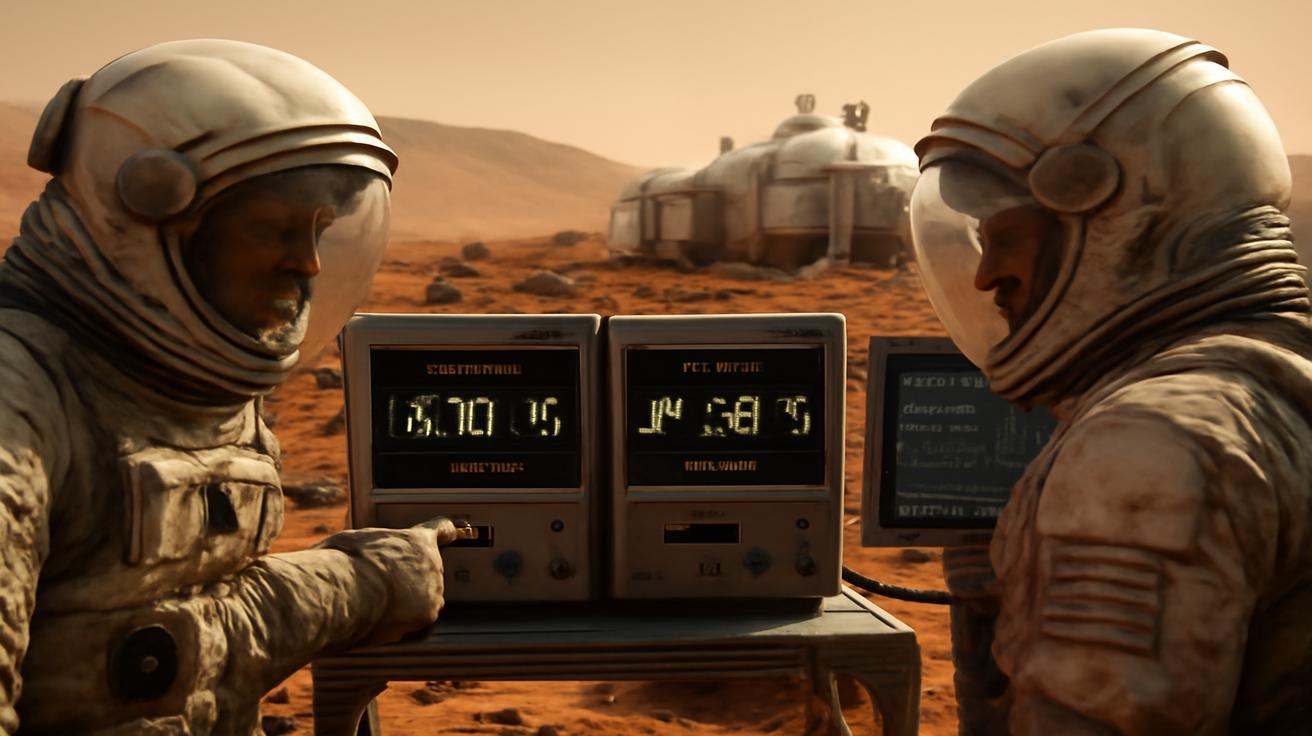
The first thing you notice is the clock.
Not the ochre sky hanging over the rusted horizon, not the distant glitter of Phobos crawling across the pale afternoon, not even the whisper of the Martian wind grinding dust against your helmet. No, it’s the clock on your wrist—ticking, steady, familiar, Earth-made—and the faint, unsettling realization that it no longer tells the whole truth.
You’re standing on Mars, watching a sun that seems too small and too tired, under a sky the color of dried blood. Somewhere, almost imperceptibly, time is peeling away from everything you’ve known on Earth. A day here—“sol,” as the mission planners insist on calling it—isn’t quite a day. The seconds behave, but the patterns they weave into your life, your sleep, your very sense of “now,” have changed.
Einstein once said that time is what a clock measures. On Mars, the clocks still measure. But what they’re measuring has slipped, just a little, out of sync with the world that made them.
The Day That Stretched: Meeting Martian Time
The problem began as a footnote in planning reports, tucked between launch windows and payload mass. A Martian “day” is about 24 hours, 39 minutes, and 35 seconds long—just long enough to ruin every schedule we ever designed for human life.
On paper, it sounds trivial. What’s half an hour stretched across a whole day? But if you’ve ever crossed time zones or pulled a late shift that slid into dawn, you know the body doesn’t negotiate kindly with subtle shifts. Over a few days, you might shrug it off. Over months, it starts to rearrange your life. Over years, it begins to untie what you mean by morning, noon, and night.
For the first Mars rovers, this was a human problem that stayed on Earth. Mission teams at NASA and ESA lived on “Mars time,” shifting their working hours by about 40 minutes later each day to match the shifting Martian sunrise and support their robots. After a few weeks, their lives were chaos. Family dinners happened at 3 a.m., commutes took place in darkness, and people stumbled through daylight like jet-lagged ghosts.
Now imagine that not as a quirky work schedule but as reality—your entire world running on a clock that drifts away from the planet you came from. Every sunrise is a reminder: you’ve stepped into Einstein’s universe, where time is elastic and the rules you carried from Earth only mostly apply.
Einstein’s Ghost in the Martian Dust
Long before a rover’s first track stitched its way across Martian regolith, Einstein had already whispered the verdict: time does not flow at the same rate everywhere. It bends with gravity. It warps with speed. It clings to planets, stars, and black holes like an invisible atmosphere.
On Earth, we already live with this. GPS satellites tick slightly faster than clocks on the ground, because they’re farther from Earth’s gravity and moving at high speed. We slow them down with carefully tuned corrections, or else your phone’s location would drift by kilometers each day. Tiny discrepancies, but critically important.
Mars, lighter and smaller than Earth, tugs on time a little more gently. Clocks on its surface would run just a hair faster than identical clocks left on Earth—so slightly that, for most of human history, the difference wasn’t just negligible; it was undetectable.
Then we did what humans always do when curiosity and technology catch up with each other: we measured.
How Mars Quietly Proved Einstein Right Again
The confirmation didn’t come in a cinematic flash of revelation. There was no “Eureka!” moment on live broadcast, no dramatic countdown to a universe-breaking discovery. Instead, it emerged from what physics does best: years of careful observation, cold patience, and relentless comparison.
Modern Mars orbiters and landers carry atomic-clock-grade timing systems, synchronized with Deep Space Network stations back on Earth. The timing isn’t just for show; it’s essential for navigation, data transmissions, and precise science measurements. Every signal beamed back and forth between Earth and Mars carries with it one silent payload: time.
Over years, mission teams began to notice that the clocks didn’t quite agree in the way Newton’s universe would expect. After compensating for the obvious culprits—the stretching and shrinking delay as Mars and Earth waltzed around the Sun, the motion of the spacecraft, the spinning of both worlds—there remained tiny residual differences. Fractions of microseconds. A barely-there drift.
Stacked up over months, over orbits, the pattern matched the predictions of general relativity. Time on Mars, sitting in a weaker gravitational field than Earth, flows a little faster. The effect isn’t dramatic: we’re talking tens of microseconds per year between a clock on Earth’s surface and one ticking on Mars. But the point is not magnitude. It’s confirmation.
Einstein’s equations, drafted in ink over a century ago, had once again whispered the future with unnerving accuracy. Time on Mars really does move differently than on Earth—subtly in physics, more dramatically in lived experience.
The Double Life of Time: Physics vs. Experience
Two layers of strangeness now define Martian time.
On the one hand, there’s the deep, quiet physics of relativity, where gravity and motion nudge clocks out of agreement. This difference is small but accumulative, and it matters to the machines—the orbiters triangulating their position, the landers syncing experiments, the navigation systems that will someday bring human crews safely down through the thin Martian air.
On the other hand, there’s the psychological clock. The rhythms of sunlight and darkness. The length of a work shift. The timing of meals. Sleep cycles drifting by 40 extra minutes every sol. You might decide Earth’s clock is “right” in some abstract sense, anchored to the world we came from. But on Mars, that clock will betray your body.
This double life of time—precise and mathematical on one side, messy and human on the other—is where the future of space missions will be decided. Because to thrive on another world, we won’t just need to get the physics right. We’ll need to design a new culture of time.
Adapting Our Lives to a 24h 39m World
Future missions to Mars will feel this friction in every hour they plan. Will astronauts live on “Earth time,” synchronized with Mission Control and the home planet? Or will they reset their bodies to the long sol, accepting a growing temporal distance between themselves and everyone watching from across space?
Already, mission architects sketch out living schedules in habitat concepts and human factors studies. Lighting systems that shift gradually to nudge circadian rhythms toward a 24.65-hour day. Work schedules that avoid the slow spiral of shifting hours that nearly broke the Earth-based Mars mission teams. Specialized clocks that show “sol time” and “Earth time” side by side, forcing humanity to glance, every few minutes, at a subtle fracture in reality.
| Measure | Earth | Mars |
|---|---|---|
| Length of day | 24 hours | 24h 39m 35s (1 sol) |
| Days per year | 365.25 days | ~668.6 sols |
| Surface gravity | 1 g | 0.38 g |
| Relative gravitational time dilation | Baseline | Clocks run slightly faster |
| Clock drift vs. Earth (per year) | – | Tens of microseconds faster |
Imagine waking in a pressurized Mars habitat. The walls hum softly with recycled air. Outside, wind combs through dunes sculpted over eons. Inside, your lights brighten at a carefully calculated pace, simulating a sunrise that lines up with the sol, not the 24-hour rhythm your ancestors evolved under.
Your watch shows two times. “Local Sol: 06:12.” “Earth UTC: 03:47.” Somewhere up there, your family is probably asleep. Or maybe just waking. Or maybe it’s yesterday. The separation isn’t only in distance anymore; it’s in the subtle desynchronization of experience.
This is what Einstein really gave us—not just equations, but a way of realizing that “now” is no longer universal. On Mars, you and Earth might share a conversation over a delayed radio link, but you will never fully share the same moment. Your days are literally different lengths. Your clocks tick at slightly different rates. Time itself has become local.
The Engineering of a New Clockwork
To keep missions coherent in this fractured temporal landscape, engineers are quietly learning to become clockmakers.
Future Martian colonies will almost certainly need their own time standard: something like “Coordinated Mars Time,” anchored to a prime meridian on the red planet, perhaps near a permanent base. That Martian standard will need to interface seamlessly with Earth-based time systems, allowing spacecraft, satellites, and communication networks to translate between worlds.
Navigation will depend on it. A cargo lander screaming through the thin Martian atmosphere cannot afford ambiguity in the timing of radar pulses or thruster firings. Relativity corrections—once an esoteric concern for theoretical physicists—will be baked into guidance firmware, software models, and mission planning tools as casually as we now handle timezone conversions on our phones.
Even orbital mechanics becomes a story of time. The precise prediction of where a satellite will be, when a relay will peak above the horizon, or how long a surface EVA can safely last, hinges on clocks that agree—to within billionths of a second—across tens of millions of kilometers and two different gravitational fields.
What was once a purely philosophical question—does time flow differently on other worlds?—has now become a line item in system requirements and astronaut training manuals.
Living Between Two Times
If time is different on Mars, what does that do to a human life?
There’s a quieter revolution brewing beneath the hardware and math: the cultural consequences. On Earth, our languages and stories are soaked in time. We talk about “daybreak,” “high noon,” and “the dead of night.” We schedule holidays, work weeks, weekends, anniversaries, and New Year’s resolutions against the turning of our planet.
On Mars, those signposts begin to blur.
Your birthday arrives according to a calendar that still largely belongs to Earth, yet you’re living through slightly longer days. Are you older or younger than you would have been, had you stayed home? Mathematically, your heart has beaten through a slightly different number of seconds, shaped by weaker gravity and a longer daily cycle. Psychologically, you’ve lived through more sunrises and sunsets per “Earth year.” Which count matters more?
Even simple questions become loaded. Is it “Monday” on Mars? Or does a new world deserve a new week, a new cadence of work and rest? Will “weekends” fall apart when different settlements—and Earth itself—run on incompatible cycles? Will a farmer in a Martian valley, tending crops beneath domes of translucent plastic, speak casually of “third sol” instead of Wednesday?
Time zones on Earth already divide us into patchwork. Mars will add an entirely new layer: time species. Human communities living under different day lengths, different gravity wells, subtly different rates of time’s flow. All part of the same story, the same evolution, but drifting—microscopically, inexorably—out of sync.
Einstein’s Universe Becomes Personal
For over a century, relativity has carried a reputation for abstraction. Curved spacetime. Warped light cones. Equations etched onto chalkboards. But on Mars, Einstein steps out of the textbook and into the habitat corridor, taps you on the shoulder, and points at your watch.
This is his universe, rendered intimate.
The difference in how time flows on Mars compared to Earth will not rip families apart with dramatic aging gaps. It won’t strand astronauts in paradoxes or create science-fiction time travelers. The numbers are small. But like sand in a boot, their power lies in persistence.
Every year, a clock on Mars will drift a little farther ahead of its twin on Earth, even after careful relativistic corrections in global systems. Every sol, human bodies will negotiate with an alien day length. Every decade, as colonies grow and children are born under the salmon sky, the definition of “normal time” will become less and less universal.
Einstein didn’t just predict that this would happen in some abstract sense. He gave us the tools to predict exactly how it would happen. And now, as data from orbiters and landers tighten those predictions with exquisite precision, we face a quieter, more human question:
How do you build a civilization on a planet where time itself is a little bit different?
The Future Written in Two Clocks
One day, decades from now, a child may walk out onto the regolith in a pressurized suit sized just for them. They might glance up at the pale Sun, at the mottled sky, at the distant silhouettes of habitats and communication masts, and feel something you and I can only guess at: the normalization of another world.
For that child, Martian time won’t be strange. It will simply be life. Their body will settle naturally into the extra minutes of each sol. Their birthday will be marked in sols and Martian years, not just in Earth’s inherited calendar. They will learn in school how clocks on Earth tick a little differently, how signals from home carry not only distance but a subtly different beat.
Perhaps, visiting Earth one day, they’ll feel faintly off-kilter—like you or I might after flying to a different time zone. The day will seem too short, the rhythms too hurried, the sky too blue. They will stand under a denser gravity, under a thicker atmosphere, bathed in a faster ticking of time, and know, in their bones, that Einstein was not just right in theory. He was right about their life.
Humanity’s story is, in many ways, a story of learning to read time more clearly: from shadows on stone to mechanical gears, from quartz vibrations to atoms flickering between energy states. Mars is the next chapter. A planet where the length of a day and the flow of seconds conspire to remind us that time is not a monolith. It is not universal. It is a landscape, as varied as any terrain, as rich and strange as the red deserts we’re only beginning to cross.
Einstein predicted it decades ago, writing equations in a world that had never seen a true color photo of Mars. Now, as orbiters whisper their timing data back through the dark and rovers trundle across the dust, that prediction has hardened into reality. Time, it turns out, really does flow differently on the red planet—and if we want to follow it there, we will have to learn to flow differently, too.
FAQ
Does time really pass faster on Mars than on Earth?
Yes, but only slightly. Because Mars has weaker gravity than Earth, clocks on its surface tick a bit faster according to general relativity. The difference is tiny—tens of microseconds per year compared to an identical clock on Earth’s surface—but it is measurable with modern instruments.
Is the main difference just the longer Martian day?
For everyday life, the longer Martian day (sol) is the bigger factor. At 24 hours, 39 minutes, and 35 seconds, it disrupts human sleep cycles and scheduling more than the microscopic relativistic effect does. Both differences matter, but in very different ways—one for biology and culture, the other for precision engineering and navigation.
Will astronauts age more slowly or quickly on Mars?
Compared to people on Earth, astronauts living on Mars would age very slightly faster in the relativistic sense, because time flows a bit faster in Mars’s weaker gravity. However, the difference is so small that it’s effectively irrelevant for human lifespans—far less than the impact of lifestyle, health, or environment.
Why do future missions need to “adapt” to Martian time?
They must adapt for two reasons. First, precise navigation, communication, and scientific measurements depend on accurately modeling how time flows differently between Earth, Mars, and spacecraft—this is an engineering necessity. Second, human crews will need schedules, lighting, and routines tuned to a 24.65-hour day to avoid chronic fatigue and circadian disruption.
Will Mars have its own time zones and calendars?
Most likely, yes. As settlements grow, Mars will need a standardized time system of its own—something like a “Coordinated Mars Time.” That might include Martian time zones, a sol-based clock, and possibly a Martian calendar adapted to its longer year. Over time, Martian society could develop its own holidays and timekeeping customs rooted in the rhythms of the red planet.





Leave a Comment