
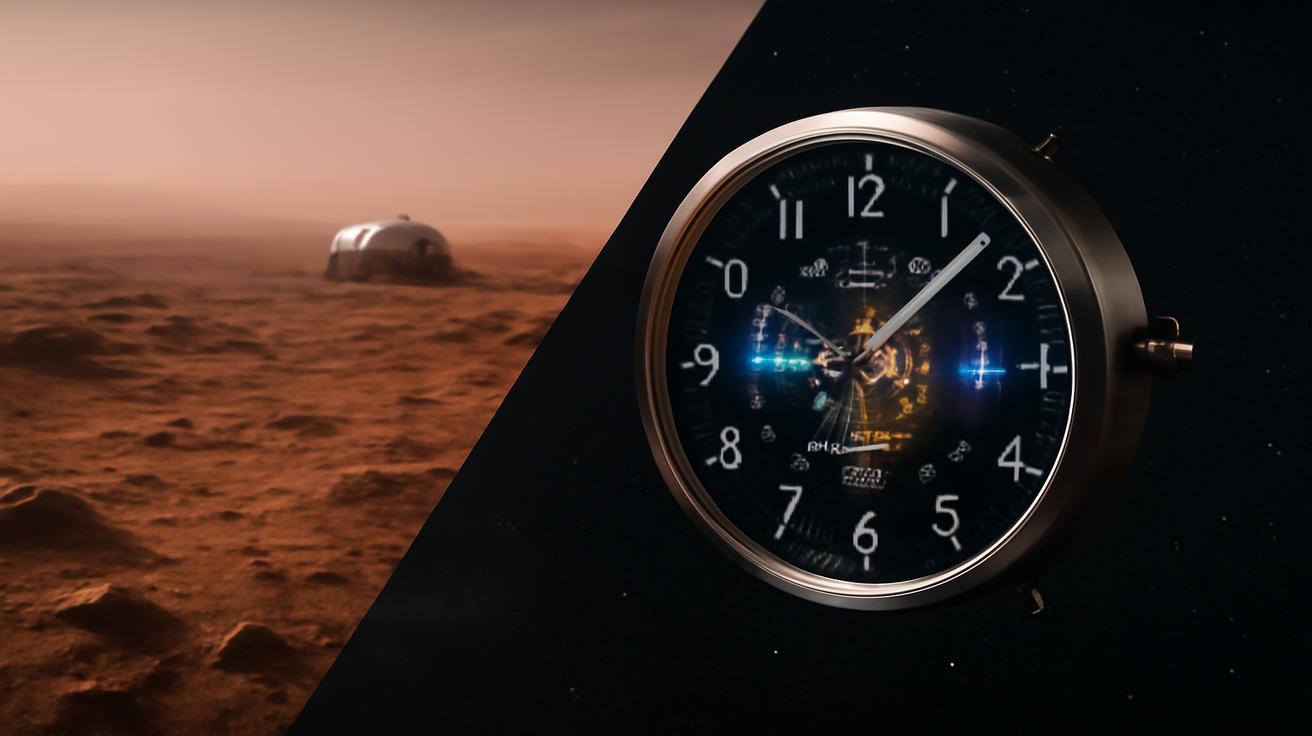
The sky over Jezero Crater is the soft blue of a Martian late afternoon, thin and ghostly, with the sun a small, sharp coin of light. A rover the size of a car vibrates gently as its instruments hum to life. Inside a nearby orbiting satellite, a clock—built with the kind of precision normally reserved for national laboratories—counts off each tick of time. And somewhere, back on Earth, another clock ticks in lockstep. Or at least, that’s what we used to believe.
When Einstein Whispered to the Stars
Over a hundred years ago, long before the word “spacecraft” meant anything more than speculative fiction, Albert Einstein sat at his desk and rewrote our understanding of the universe. Time, he said, was not a universal background rhythm, a metronome marking the same beat for everyone, everywhere. It bent and stretched and slowed, entangled with gravity and motion. Clocks, he claimed, would disagree if you carried them to different planets or launched them into orbit.
At the time, it sounded like poetry disguised as physics. Elegant, unintuitive, faintly scandalous. Time was supposed to be steady. You grew older. Seasons passed. Pendulums swung. But Einstein insisted: the stronger the gravity, the slower time flows. The faster you move, the more your seconds stretch. Not in a metaphorical way, but literally, measurably, with real clocks and real lives.
For decades, this was a thought experiment, a dizzying logic puzzle bouncing between chalkboards and lecture halls. Then came satellites, atomic clocks, spacecraft, and eventually a small convoy of robots bound for Mars. Einstein’s equations quietly rode along, baked into the guidance computers, navigation tables, and timing protocols. They were so thoroughly accepted they’d become invisible—an assumption encoded into the tools themselves.
And now, on a cold world painted in rust and shadow, Mars has calmly answered: Einstein was right. Time really does flow differently there.
The Planet Where a Day Is Almost, But Not Quite, Like Yours
On Mars, a day is called a “sol.” It’s about 24 hours, 39 minutes, and 35 seconds long. At first, that’s where people tend to focus: the extra sliver of time, the almost-familiar rhythm. When the first modern rovers landed, mission teams on Earth tried something curious. They lived on Mars time.
Engineers and scientists adjusted their daily schedule so that their “workday” began at local dawn on Mars. The effect was surreal. Each Earth day, their start time shifted by about 40 minutes. Within weeks, their lives drifted around the clock like a slow-motion jet lag that never resolved. Breakfast at midnight. Meetings at 3 a.m. Commutes under unfamiliar constellations.
This was the human, practical side of time on Mars—a psychological contortion, an experiment in adaptability. Everyone knew the sol was slightly longer, and they felt it in their bones. But beneath that, hidden deeper in the mathematics and instruments, another quieter truth was emerging: Mars’s seconds themselves weren’t quite like ours, either.
Einstein’s Fingerprint in Martian Dust
Einstein’s general theory of relativity predicts that clocks tick differently depending on where they are in a gravitational field. Think of a clock close to a massive body—like Earth—sitting in a deep gravitational “well.” Time there runs just a bit slower than it does farther out, where gravity is weaker. It’s not science fiction; GPS satellites already correct for this effect constantly, or our navigation systems would slowly unravel.
Mars is smaller than Earth, only about half its diameter and with roughly 38% of its surface gravity. That means its gravitational well is shallower. According to Einstein, clocks on Mars should tick a tiny bit faster than identical clocks on Earth, all other factors being equal. For years, we compensated for this in mission planning. The math said we had to, so we did. But we never had the instruments on Mars to test it as directly and precisely as we can now.
Recent missions, equipped with far more stable and synchronized timekeeping hardware, have finally given us an unambiguous answer. Side-by-side comparisons between Earth-based reference clocks and their Martian counterparts, linked by exquisitely calibrated radio signals and corrected for motion, distance, and signal delay, have confirmed the prediction: time on Mars is drifting away from Earth time, exactly in line with Einstein’s equations.
The difference is minuscule in any single moment—a few tens of microseconds over a day, adding up like silent grains of sand. But over weeks, months, and years, those grains turn into drifts. For short robotic missions, it’s a footnote. For long-term habitats and human explorers, it’s a reality they’ll have to live inside.
How Different Is “Different,” Exactly?
The mind stumbles when it tries to grasp tiny differences. But time, relentlessly cumulative, is patient. One way to feel the strangeness is to look at it side by side:
| Aspect | Earth | Mars |
|---|---|---|
| Length of one day | 24 hours | ~24 h 39 m 35 s (one sol) |
| Surface gravity | 1 g | ~0.38 g |
| Gravitational time dilation | Baseline | Clocks tick slightly faster |
| Time offset over one year (combined effects, illustrative) | 0 | Microseconds to milliseconds faster |
| Human perception | Feels “normal” | Feels normal day to day, but clocks drift vs Earth |
The exact numbers depend not only on gravity, but on orbital speed, height above the surface, and motion relative to Earth. A clock in a Martian orbiter, for instance, might tick at a slightly different rate than one sitting on the ground in Gale Crater. Add in the relative motion of Mars and Earth around the sun, and the corrections start to look like a tangled knot of tiny adjustments.
Yet this is not an academic quibble. When you’re firing rockets across millions of kilometers, guiding landers through atmosphere-thin descents, and synchronizing data relays between orbiters, landers, and mission control, each microsecond persists like a whisper in the calculations. Ignore it, and the whisper becomes an error. Let the error grow, and it becomes a miss. In spaceflight, a miss is costly.
When Mission Control Argues With the Clock
Space agencies have never truly trusted time to behave itself. From the earliest interplanetary missions, navigators accounted for both special and general relativity in their trajectory solutions. But as instruments grow sharper and missions more ambitious, the room for approximation narrows.
Imagine a future human expedition en route to Mars. Their ship carries ultra-stable clocks used to coordinate orbital maneuvers, communications windows, and docking with pre-positioned supply depots in Martian orbit. Back on Earth, a corresponding set of clocks at mission control keeps the master schedule. Messages can take anywhere from 4 to 24 minutes to cross the gulf of space, depending on the positions of the planets. Overlay this delay with a slow, persistent drift in how “fast” each side’s clocks run, and you can see the problem.
Over the course of a multi-year program—launch, transit, orbit, surface operations, return—the Martian timeline will gently peel away from the terrestrial one. Not in a dramatic, science-fiction way where explorers return to find everyone centuries older, but in the more insidious form of scheduling mismatches, navigation offsets, and software systems that suddenly disagree on what the word “now” means.
Already, ultra-precise radio science experiments using Martian orbiters have detected the subtle fingerprint of relativistic time dilation. Signals bounced between spacecraft and Earth-based antennas show a sliver of discrepancy that refuses to vanish when every mundane source of error is scrubbed away. What remains is pure relativity: Einstein’s legacy, written into the timing of microwave pulses and carrier waves arcing between planets.
Designing Clocks for Two Worlds
So what does it mean to adapt? How do you build a civilization that spans planets when their clocks won’t quite agree?
The first step is conceptual: accepting that “universal time” is an illusion. There is no perfectly shared, absolute timeline that can stretch smoothly from Houston to a Mars base. Instead, there are local times—Earth time, Mars surface time, Mars orbit time—and a web of corrections that connect them. It’s like global time zones taken to a more fundamental level, layered not just in longitude but in gravity and motion.
Mission Planning in a Bent-Time Universe
Future missions will likely adopt a hybrid system. On the Martian surface, settlers might live by a local standard like “Coordinated Mars Time,” tuned to the rhythm of the sol and meaningful to their sunrises, work shifts, and sleep cycles. Their watches, systems, and daily logs would follow this Martian standard. Meanwhile, mission control on Earth would continue to operate in something akin to terrestrial Universal Time, perhaps with a dedicated Mars-adjusted variant for interplanetary coordination.
Between the two, software would manage the translation—invisible yet constant. A scheduled event might exist in a database as a series of timestamps tagged with their frame of reference: “Mars Base alpha, sol 183, local noon,” cross-linked to what that moment corresponds to on Earth: “Mission Elapsed Time: 2 years, 41 days, 5 hours…” plus a tiny relativistic correction.
Even hardware design will feel the ripple. Spacecraft clocks, already built to extraordinary standards, will be calibrated not just to keep time, but to keep agreement across worlds. Redundant timing systems, each cross-checking the others, will track how far local time has drifted from Earth standards and apply corrections automatically.
The result isn’t just bureaucracy. It’s safety. A tightly synchronized sense of “when” makes navigation, docking, and power management more reliable. Energy-hungry systems like high-gain antennas and landing radars can be staged to power on at precisely the correct millisecond, even when worlds apart.
Humans Living Inside the Drift
There’s also the human layer, subtler but just as important. Picture a child born on Mars, growing up under a salmon-pink sky. Their years stretch longer—687 Earth days per Martian year—but that’s just the orbital period, the swing around the sun. What shapes their experience more intimately is the sol: the rising and setting of their distant sun, the length of their school days, their meals.
For them, the idea that time flows differently back on Earth might feel abstract, even quaint. Their clock works. Their day feels right. Yet in the background, each step they take, each second they laugh or read or dream, plays out on a timeline that is subtly out of sync with the planet of their ancestors. If they one day travel to Earth, their body and mind will adjust to the new gravity, the new sky, the shorter day—but their personal history will have been written in Martian seconds.
Over generations, as Mars-born humans grow into a culture of their own, that temporal separation may become more than physics. It may become metaphor, identity. “We live faster,” they might say with a wry smile. Or perhaps they’ll claim the opposite: that Earth is the one drowning in slow, heavy time, pinned more tightly to the sun’s grip.
The Poetry of Two Clocks
Stand, just for a moment, in your imagination on the edge of a Martian canyon at dusk. The air is thin and cold, tinged with dust that turns the sky from pale blue to bruised violet. Far below, shadow swallows rock and ancient sediment. Above you, a star you used to call the sun slides toward the horizon more lazily than it would on Earth, taking its time to end the sol.
Somewhere in your suit, a small display ticks away local time—hours, minutes, seconds quietly flowing just a bit faster than they would back home. You raise your eyes and know that on the far side of the sky, Earth is turning too, its own clocks humming away in cities and deserts and seas you once knew.
The two worlds are connected by physics and radio, by engineering and courage and curiosity. But they are not synchronized in the way the old philosophers imagined the universe might be. Each planet carries its own tempo, its own slow drumbeat inside spacetime. You are both a traveler and a witness, moving between rhythms.
Einstein may never have seen such a canyon, nor watched a Martian sunset flare on a rover’s panoramic camera. But his equations tell their own kind of story: one of a cosmos where time is not neutral, not uniform, but alive to context. Massive bodies bend it. Motion stretches it. Distance complicates it. And as we step further into that cosmos, turning neighboring planets into places instead of points of light, we discover that his predictions are not just about strange clocks—they’re about what it means to share a universe where “now” is never the same everywhere.
Future mission planners will juggle launch windows, fuel margins, and radiation shielding while quietly wrestling with this deeper reality. Every timeline they draw, from first blueprint to last astronaut home, will arc through a spacetime that refuses to be simple. Time on Mars is not broken; it’s just different. Slightly faster, tied to a weaker pull of gravity and a broader, colder orbit.
Somewhere, in a quiet control room late at night, an engineer watches two streams of data scroll across a console. One is tagged with Earth time, the other with Mars time. They drift, almost imperceptibly, like two musical phrases played in slightly different keys. The engineer doesn’t panic. Instead, they smile, make a small notation in a log, and adjust the model. The universe has, once again, matched Einstein’s prediction.
And out there on the red planet, under a dimmer sun and a slower sunset, a robot goes about its work, its internal clock ticking to Mars’s own silent, slightly swifter beat.
Frequently Asked Questions
Does time on Mars really pass at a different speed than on Earth?
Yes, but only by a very small amount. Because Mars has weaker gravity than Earth, clocks on its surface tick slightly faster according to general relativity. The effect is tiny—measured in microseconds over long periods—but real and now confirmed by precise spacecraft timing.
Will astronauts age differently on Mars compared to people on Earth?
Technically, yes, but the difference is so small it is meaningless for daily life. An astronaut who spends years on Mars would age a tiny fraction of a second differently than someone on Earth, due to gravitational and motion-related time dilation. Emotionally and biologically, they would feel the same passage of time.
How is this different from the longer Martian day (sol)?
The sol is about 39 minutes longer than an Earth day because Mars rotates more slowly. That’s a simple difference in day length. The relativistic effect is deeper: it changes how fast each second ticks, independent of how long the day is. Both effects matter for mission planning, but for different reasons.
Why do space missions need to care about these tiny time differences?
Ultra-precise timing is vital for navigation, communication, and landing on other planets. Even microsecond errors can build into noticeable position or synchronization errors over long distances and durations. Accounting for relativistic time differences keeps trajectories accurate and operations safe.
Will future Mars colonies use a different time system?
Most likely, yes. Settlements on Mars will probably adopt a local standard based on the sol, with their own hours and schedules tuned to Martian daylight. Behind the scenes, software will continuously convert between Mars local time and Earth-based reference time, including relativistic corrections, to keep interplanetary operations coordinated.
Does this mean time isn’t universal in the universe?
Correct. According to Einstein’s relativity, there is no single, universal time shared everywhere. Time depends on your motion and your position in a gravitational field. Different observers in different places and states of motion will measure time differently. Mars is simply our nearest, most concrete reminder of that truth.
Could these time differences ever become large enough to matter for human history?
Over human lifetimes and even many generations, the differences between Earth and Mars time remain very small. Where they matter most is in high-precision systems—communication, navigation, and scientific measurements. As we build a multi-planet civilization, the challenge won’t be people aging dramatically differently, but ensuring our technologies and institutions can gracefully handle a universe where time itself refuses to be perfectly synchronized.








Leave a Comment