
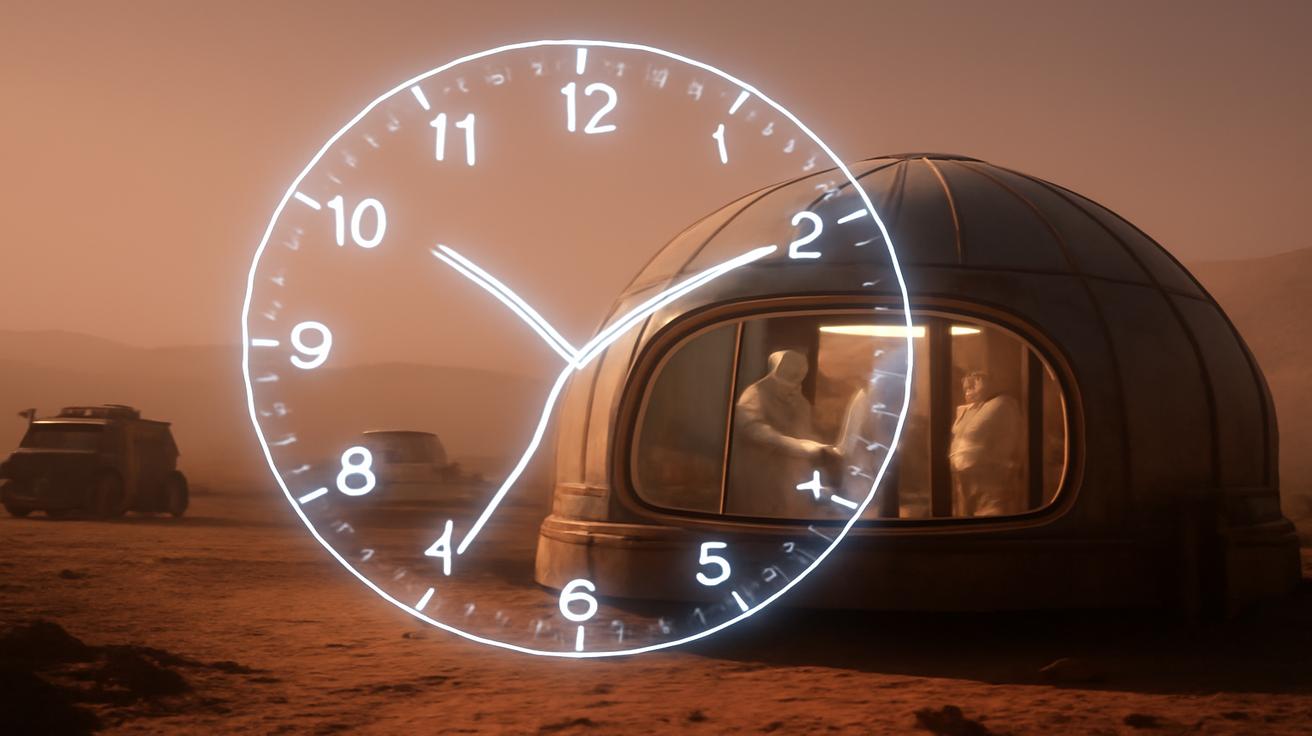
The news broke, as these things often do, in a quiet press release that most people nearly scrolled past. Buried in the familiar jargon of “data calibration” and “instrument modeling” was a sentence that made physicists sit up a little straighter: our latest clocks on Mars were ticking out of sync with the clocks we left back home. It wasn’t a mistake, not a bug in a line of code, not some dusty cable. It was something far stranger, and yet strangely expected. A century ago, a man with unruly hair and a fondness for thought experiments had predicted this very oddity. Now the Red Planet had simply nodded and said, “Yes, he was right. Time really does flow differently here.”
The day Mars slipped out of step
Imagine you’re sitting in a mission control room long after midnight. The coffee is burnt, the fluorescent lights are tired, but your rover is wide awake on Mars, humming along through its scheduled tasks. You watch the stream of telemetry numbers dance across your monitors—voltages, temperatures, positions, timestamps. On Earth, it’s 02:13:46. On Mars, by your best calculations, it should be 02:13:46 in mission time too.
Only it isn’t.
The timestamps coming from the lander are off by a whisper: microseconds at first, then milliseconds as the weeks roll into months. The drift isn’t random. It’s patterned, predictable, stubborn. Engineers comb through the software, looking for bad loops and rounding errors. They check oscillator stability, temperature variations, interference. Everything is nominal. Everything is boringly, infuriatingly normal.
Someone on the science team, half joking, half hoping, says, “What if it’s relativity?” The room laughs the way people do when they secretly want something unbelievable to be true. Then the calculations begin. Gravitational potential. Orbital velocity. Planetary rotation. Reference frames. One spreadsheet turns into ten, then a model, then a simulation. And slowly, the numbers begin to line up in a way that feels like a plot twist and a homecoming at the same time.
Einstein’s general and special relativity, those dense equations that once lived mostly on chalkboards and in university corridors, have quietly emerged in the lived reality of interplanetary exploration. The clocks didn’t break.
They just started telling the truth.
Einstein’s strange promise about time
To follow this story, you have to let go of one comforting idea: that time is a single, universal rhythm. Most of us grow up with a picture of the universe as a giant clock widget, ticking away in perfect, global unison. A minute is a minute is a minute, whether you’re in New York, Nairobi, or a cave on the far side of the Moon.
Einstein dismantled that certainty piece by piece. He showed that time is not absolute. It stretches and shrinks depending on how fast you’re moving and how deep you sit in a gravitational well. Closer to a massive body, time slows down just a tiny bit. Move faster—really faster, a substantial fraction of the speed of light—and time slows further for you, relative to someone staying still.
On Earth, these differences are so small that it took exquisitely sensitive experiments—atomic clocks on airplanes, satellites in orbit—to detect them. But detect them we did. GPS literally would not work if we pretended time marched the same way on the surface and in orbit. Our phones already whisper with corrected relativistic time, even if we don’t think about it.
Mars takes that quiet whisper and raises the volume.
The Red Planet is smaller than Earth and less massive. Its gravity is weaker—about 38 percent of what you feel under your own feet right now. That weaker gravity means clocks deep in Mars’ gravitational field tick, very slightly, faster than clocks in Earth’s stronger field. At the same time, Mars loops around the Sun on a different orbit and at a different speed, adding another tiny twist to the tempo of time.
Human beings have finally built clocks precise enough, and missions long-lived enough, to watch these differences accumulate not as abstract numbers, but as a real, operational nuisance. Time, it turns out, is not the same flavor on Mars as it is on Earth.
Listening to time with machines on a frozen world
For years, our landers and rovers have been the lone witnesses to the Martian clock. Each new mission carried better timekeeping hardware, more stable oscillators, tighter synchronization with ground systems. These instruments weren’t only about punctuality; they were about measuring Mars itself—its rotation, its wobble, its quakes, its whisper-thin atmosphere breathing in frost and exhaling vapor.
In the process, the missions also became accidental philosophers of time.
As signals passed between Earth and Mars, mission teams had to account for light travel time: the simple fact that nothing, including radio waves, outruns light speed. Depending on where the planets are in their orbits, a message can take anywhere from about 4 to over 20 minutes to make the trip one way. That delay is familiar to mission planners. They live with it every day; it’s the reason rovers must make their own decisions on the ground.
But beneath that obvious delay lurked a subtler mismatch—the way each world’s clocks drift relative to each other simply because they sit in different corners of spacetime. At first, this difference was wrapped up inside calibration margins, buried within uncertainties. As our measurements sharpened, the leftover discrepancy stopped being ignorable background noise and started looking like a phenomenon asking to be named and explained.
When the numbers were finally stacked against Einstein’s predictions, the match was unnervingly good. Taking into account Mars’ gravitational field, its orbital motion, even slight variations in altitude of the landers themselves, physicists could predict exactly how much “faster” time on Mars should run compared to the master clocks back home. And the instruments, dutiful and indifferent, confirmed it.
The universe, in its quiet way, had signed off on Einstein again—this time with a dusty red signature.
The way a Martian day actually feels
Even before we got lost in relativistic subtleties, Mars had already been teasing us with strange time. Its day, known as a “sol,” is about 24 hours, 39 minutes, and 35 seconds long. That extra almost-forty minutes creates a small but relentless misalignment with Earth’s days.
Early rover teams did something extraordinary—they shifted human lives to Martian time. Engineers and scientists would go into work slightly later every day, following the wanderings of the Martian sun. One week they’d be starting their shifts before dawn, the next week at noon, then deep in the night, all because the sol and the Earth day refused to sync.
The human body protested. Sleep patterns broke, families and social lives warped, and everyone involved gained a new, visceral respect for what even a small mismatch in daily cycles can do to fragile biological clocks.
Now, layered on top of this visible 39-minute slippage, we have a quieter one: a difference in how fast time itself flows under Martian sky. It isn’t something you’d feel in your bones during a walk on the basalt plains—you wouldn’t age dramatically slower or faster in any science-fiction sense. But if you carried a set of exquisitely tuned atomic clocks with you, and compared them to an identical set left on Earth, the divergence would slowly accumulate, tick by invisible tick.
Over months and years, for spacecraft and habitats that must coordinate tightly with Earth, those ticks become a logistical headache.
When your navigation system lives in another timestream
Space missions are, at their heart, about trust in numbers. You fire an engine for a precise fraction of a second because you trust the clock. You point an antenna at a narrow patch of sky because you trust the predicted position of a spacecraft based on measured time. Orbital mechanics is a language written in the units of seconds and meters, and mistrust of either feels like stepping onto ice you’re not sure can hold your weight.
Now imagine trying to navigate a future crewed cargo ship to a Martian colony, while your onboard clock and Earth’s reference time disagree in ways too large to ignore and too subtle to dismiss. A fraction of a millisecond may not sound like much, but when you’re traveling tens of millions of kilometers and timing small trajectory-correction burns, that difference translates into kilometers of error.
At interplanetary scales, sloppy time is bad geography.
The answer isn’t to panic; it’s to adapt. Just as GPS systems on Earth bake relativistic corrections into their software so no one has to think about them, future Mars missions will need to live within a web of time standards tailored to a multi-world civilization. Mission computers will juggle Earth Coordinated Time, Mars Coordinated Time, spacecraft proper time, and perhaps even local base time on the ground, each flowing at its own slightly different pace, each corrected and cross-checked constantly.
Time becomes less a single river and more a confluence—a braided delta of overlapping flows, mapped, charted, and navigated like any other terrain.
Designing clocks for two worlds at once
The heart of this new problem is old and familiar: the clock. For centuries we’ve been in a slow, obsessive race to make better ones. From sun-shadowed stones to pendulums, quartz crystals, and cesium atoms, our clocks have grown more honest than our senses. They reveal differences in time we could never feel but can no longer ignore.
As we look toward a future where humans will not just visit but inhabit Mars, timekeeping stops being a mere measurement and becomes an infrastructure—something like roads, or air, or language. We will need clocks that can reconcile Martian and Terran time without losing their grip on either.
Think of a habitat dome on the Martian surface, its curve outlined in pale morning light filtered through dust. Inside, people wake according to schedules tuned not only to sunlight but to mission operations beamed from Earth, to orbital windows for communications, to supply ships threading fragile paths through celestial mechanics. Their clocks can’t be ad hoc or improvised. They must hold a unified timeline that acknowledges both the local sol and the relativistic slip between worlds.
Engineers talk, in very down-to-earth terms, about “time transfer” and “synchronization protocols.” Underneath those calm phrases lies a surprisingly intimate question: what does it mean for a scattered species to say, “Now”?
That question is pushing us toward technologies that feel like science fiction but are already in prototype: deep-space atomic clocks capable of marking time with stunning precision on board spacecraft, autonomous navigation systems that let ships know where—and when—they are without waiting for Earth to tell them, and distributed time networks that might one day knit Earth, Mars, and everything in between into a shared, relativistically aware schedule.
A tiny table of big differences
To ground all this in something tangible, it helps to look at a simple comparison of time-related features between Earth and Mars.
| Feature | Earth | Mars |
|---|---|---|
| Length of day | 24 hours | 24h 39m 35s (1 sol) |
| Surface gravity | 9.81 m/s² | 3.71 m/s² |
| Year length | 365 days | 687 Earth days |
| Gravitational time effect | Stronger gravity, slightly slower clocks | Weaker gravity, clocks tick slightly faster |
| Timekeeping challenge | Relativity mainly affects satellites | Relativity affects surface, orbiters, and Earth–Mars coordination |
Those brief lines hold an entire future’s worth of design questions for anyone brave enough to build a working civilization out there.
How future missions will learn to “speak Martian time”
Relativity isn’t new; what’s new is how inescapably practical it’s becoming. Each time a lander’s clock drifts as relativity says it should, mission planners are being gently told: the universe has rules, and your checklists must bow to them.
Future missions will likely launch with time systems that assume from the outset that Mars and Earth inhabit different temporal landscapes. Navigation software will incorporate planet-specific relativistic correction factors. Onboard atomic clocks will maintain “proper time” for spacecraft, while constant updates will translate between that and standardized Earth and Mars reference times.
For crewed missions, the challenge becomes more intimate. Doctors will want precise logs of how long astronauts have spent in particular radiation environments. Psychologists will study the effects of living to a slightly different heartbeat of day, of juggling Earth family time with local base time and mission control schedules that are all sliding over each other like tectonic plates of hours and minutes.
Space agencies are already discussing planetary time standards—what it would mean to have something like Coordinated Mars Time, a baseline everyone agrees upon for operations. Martian cities might one day keep both local “sun time” and standard “network time,” just as we juggle local time zones and UTC on Earth. Children born under a salmon-colored Martian sky may grow up with an easy, unquestioned familiarity: time isn’t one thing. It’s a few.
And somewhere, buried in mission requirements documents and base design specs, you’ll find line items that can be traced straight back to Einstein’s chalkboard. Not as equations to be revered, but as parameters to be filled in and constraints to be respected.
Standing on a shore, watching time fork
There is a moment, if you let yourself picture it, that distills all of this into something simpler than equations and protocol designs.
Imagine a future astronaut standing alone outside a Martian habitat. The sky is a pale orange dome, thin sunlight scattering through airborne dust. The horizon is close, the world curved and small underfoot. In the sky, a bright star—the dot of Earth—hangs low, half swallowed by twilight.
In that moment, there are two “nows.” One belongs to the astronaut: the rhythm of their heartbeat, the tempo of their breath, the seconds counted by the watch strapped over a pressurized sleeve. The other belongs to a person standing on a beach back home, waves folding against their ankles, looking up at a faint red star where Mars glimmers.
Physics tells us those two “nows” are not identical. They disagree, slightly, on how much time has passed since these two people last spoke, last shared a planet. Their clocks are offset by gravity and motion, by the curves and warps of spacetime between them.
Yet they can still call each other, in carefully timed radio windows. They can still share messages, send photographs, celebrate a delayed birthday. Between them runs a thread of trust, engineered by thousands of quiet decisions about how to handle time’s lack of uniformity. Their connection is not magic; it is the accumulated work of people who refused to be frightened by time’s flexibility and chose, instead, to map it.
Einstein did more than predict that time would flow differently on different worlds. He gave us the tools to live with that difference—not by pretending it away, but by building with it, around it, through it.
Mars has confirmed the prediction. Time on the Red Planet slips ahead of ours, just a little, in the deep arithmetic of relativity. The next step is ours: to decide how gracefully we can adapt our missions, our machines, and eventually our lives to a universe where even something as seemingly simple as a second is colored by the gravity beneath our feet.
FAQ
Does time really pass faster on Mars than on Earth?
Yes, but only by a very tiny amount. Because Mars has weaker gravity than Earth, clocks on its surface tick slightly faster than identical clocks on Earth. Over long periods and with very precise instruments, this difference becomes measurable and important for mission operations.
Would a human on Mars age differently than someone on Earth?
Technically yes, but the effect is incredibly small. Over an entire lifetime spent on Mars, the aging difference compared to someone on Earth would amount to at most fractions of a second. It’s significant for precision clocks and navigation, not for everyday biology.
How is this related to Einstein’s theory of relativity?
Einstein’s general relativity predicts that gravity affects the flow of time: stronger gravity slows clocks, weaker gravity lets them run faster. His special relativity also says that moving quickly changes how time passes. Mars and Earth have different gravity and motion, so their clocks naturally diverge, just as his equations predict.
Why does this matter for future Mars missions?
Spacecraft navigation, communication, and coordination all rely on very accurate timekeeping. Even tiny timing errors can become large positional errors over interplanetary distances. Future missions must account for these relativistic time differences to keep ships on course and operations synchronized between Earth and Mars.
Will Mars have its own time zones or time standard?
Most likely, yes. Scientists and engineers are already discussing concepts like a Coordinated Mars Time, similar to Coordinated Universal Time (UTC) on Earth. Martian settlements may use local solar time for daily life while also keeping a standard network time for communication and navigation across the planet and with Earth.








Leave a Comment