
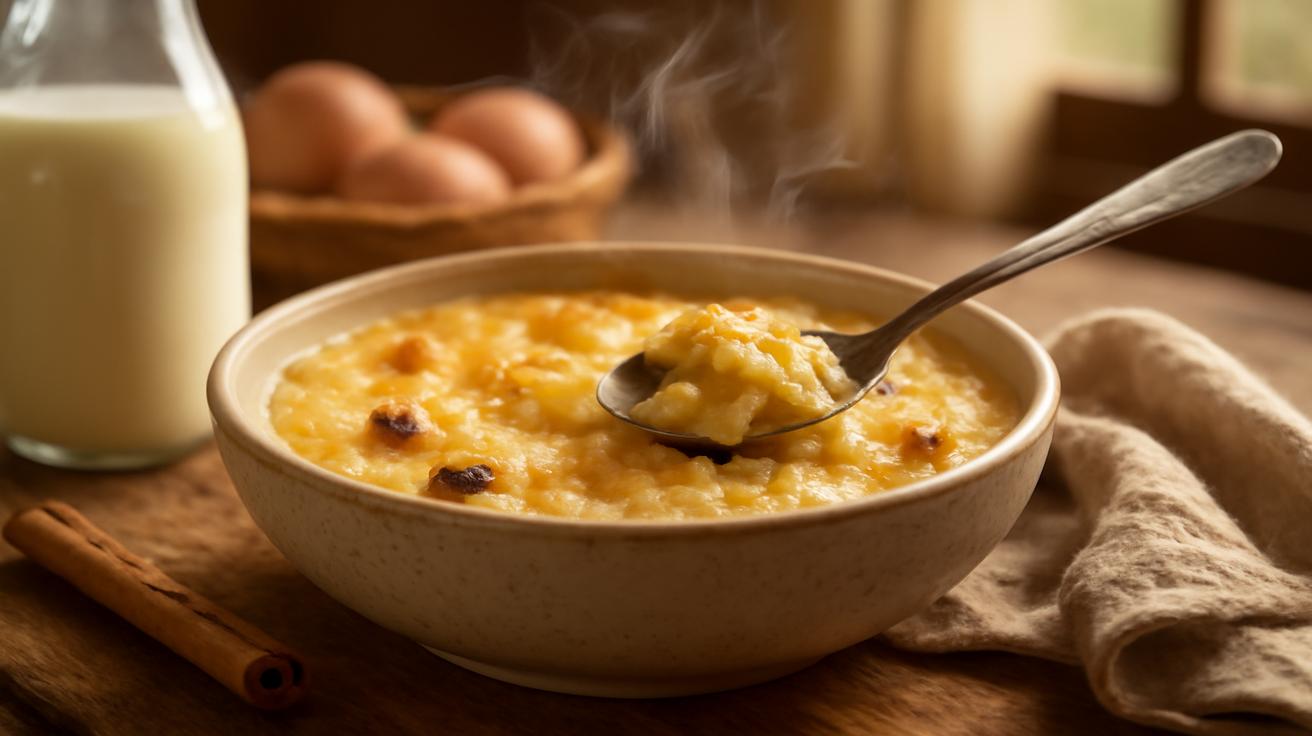
The milk is just beginning to hum on the stovetop, a soft shiver that sends up a cloud of steam. It smells like the start of something small and comforting—like a winter evening, or a grandmother’s kitchen, or the kind of dessert that never makes it into glossy cookbooks but somehow lives forever in family memory. You crack an egg into a bowl, whisk it with sugar, and suddenly you’re not just cooking. You’re time-traveling. In five, maybe ten minutes, there will be a warm, silky bowl of sweetness in your hands: eggs in milk, the simplest of milk desserts, the one that tastes like childhood and quiet afternoons.
The Dessert That Barely Counts as a Recipe
If you’ve never heard of eggs in milk as a dessert, you might wonder what the fuss is about. How can something so basic—milk, egg, sugar—deserve nostalgia, much less its own story?
But that’s exactly the magic. This is the kind of dessert that lives in the “between” spaces of life. It’s not fancy enough to serve at a dinner party, not complicated enough to be called custard, not quite substantial enough to be breakfast. It’s more like a warm, edible hug—a sweet, wobbly pudding that appears when you need a little something and don’t have the patience (or energy) for anything else.
In many households around the world, some version of eggs cooked gently in milk has been the go-to comfort dish: a quick fix when someone has a sore throat, when groceries are low, or when a child wants dessert now and waiting for cake to bake is out of the question. The details vary—some cook it thicker, some sip it like a drink, some bake it until just set—but the heart of it is always the same: a single egg, a splash of milk, heat, and a bit of sweetness.
There’s something honest about a dessert that doesn’t hide behind decoration. No layers, no frostings, no towering presentations. You watch it come together in real time: the milk warming, the egg mixture thickening, the transformation from thin liquid to soft creaminess that clings to the spoon. It’s tangible proof that simple things, treated gently, can still feel like a luxury.
Steam, Spoons, and That Familiar Kitchen Quiet
Imagine this: outside, it’s a gray afternoon. Inside, the house is quieter than usual—no television, just the small domestic sounds of a kettle somewhere and a fridge humming in the corner. You stand at the stove. In front of you, a pot of milk slowly turns from cold and pale to shimmering and fragrant.
You stir occasionally with a spoon, listening to the gentle scrape along the bottom of the pot. The scent of warm milk is unmistakable: a little grassy, a little sweet, like a whisper from the past. Maybe you remember a parent or grandparent doing this very thing—telling you not to let the milk boil over, watching closely for bubbles along the edge.
Now you take your bowl: an egg, a spoonful or two of sugar, maybe a dash of vanilla if you have it, or a pinch of cinnamon if you feel like adding a little warmth. You whisk. The yolk spreads, golden and glossy, until the grains of sugar disappear and the mixture turns pale and silky. It looks like the beginning of cake batter, but there is no oven involved today, no waiting.
When the milk is steaming—just shy of a simmer—you take a ladle and slowly, carefully, pour a little into the egg mixture while whisking constantly. The bowl warms in your hands. This is the moment where everything could go wrong if you rush: too hot, too fast, and you’ll have scrambled egg in your dessert. But a gentle hand and a steady whisk turn it into something else entirely. The egg loosens; the milk thickens; they meet halfway in a pale, creamy blend.
Back into the pot it goes, this time over low heat. You stir. Time stretches and shrinks at once; the seconds are slow, but your senses are busy. The faint beginning of thickening at the edge of the spoon. The first heavy drip, slower than milk, not yet custard, but on its way. And then the quiet certainty that it’s done: when the mixture coats the back of the spoon and leaves a soft trail when you run your finger through it.
Eggs in Milk vs. Custard: Same Story, Shorter Chapter
At this point, you might be wondering: isn’t this just custard? And in a way, yes—eggs in milk is like custard’s little sibling, the one who refused to spend an hour in the oven and instead took a quick turn on the stovetop.
Traditional custards tend to be exact about ratios, temperatures, and sometimes water baths. Eggs in milk is more forgiving, more casual. It doesn’t demand perfection or a thermometer. It’s less concerned with whether it slices neatly on a plate and more interested in whether it feels good to eat from a bowl, still warm, with a spoon you keep dipping back in.
The texture is softer than a set custard. Think of it as a loose, drinkable or spoonable cream—somewhere between a thin pudding and a very thick, rich hot chocolate without the chocolate. If you chill it, it firms up slightly, but it’s never rigid. Instead, it trembles a little when you tilt the bowl. It feels alive, made to be eaten soon, not stored away and forgotten in the fridge.
And that’s another quiet joy here: immediacy. Many desserts insist on patience—cooling, chilling, resting. Eggs in milk respects your craving. From the moment you think, “I want something sweet,” to the moment you take your first spoonful, only a handful of minutes have passed. It’s almost instant gratification, but with the ceremony of real cooking.
The Simple Core Recipe (and How to Make It Your Own)
Every family who loves this dessert seems to have their own version, but the skeleton is remarkably consistent. It doesn’t ask for much, which is probably why it has survived in so many kitchens for so long.
| Ingredient | Amount (Single Serving) | Notes |
|---|---|---|
| Milk | 1 cup (240 ml) | Whole milk gives the richest texture, but any milk works. |
| Egg | 1 large | Fresh eggs give a smoother, brighter flavor. |
| Sugar | 1–2 tablespoons | Adjust to taste; you can use honey or other sweeteners. |
| Flavoring (optional) | A pinch or a few drops | Vanilla, cinnamon, nutmeg, citrus zest, or cocoa. |
From here, it’s all about quiet choices:
- Vanilla and sugar only gives you something very close to a traditional custard flavor, just softer and quicker.
- Cinnamon or nutmeg tips it toward the kind of dessert you want on a chilly evening, especially if you sip it from a mug.
- A spoonful of cocoa powder turns it into a cross between hot chocolate and pudding—rich, cozy, and deeply nostalgic.
- Grated lemon or orange zest makes it brighter and lighter, perfect for late mornings or lazy summer nights.
Some people like it quite thick, almost like pudding. They keep it over the heat a little longer, stirring until it clings heavily to the spoon. Others prefer it to stay just barely thickened, a silky drink to pour into a mug and sip slowly. There’s no correct answer—only the version that feels right in your bowl, on your tongue, on this particular day.
The Quiet Ritual of Making It
There’s an intimacy to the way this dessert is cooked. It’s not a set-it-and-forget-it kind of recipe. You’re there the whole way, watching, stirring, sensing the moment when enough is enough. In a world where so much happens on screens and timers and automatic modes, there’s a small satisfaction in relying instead on your hands, your nose, your eyes.
You don’t need special tools. A pot. A bowl. A spoon or whisk. Maybe a strainer if you want it perfectly smooth. Nothing about this demands precision instruments, and yet it rewards care. If you rush, you get tiny curds. If you’re patient, you get silk.
This ritual fits neatly into the in-between times of the day: after dinner but before washing up, mid-afternoon when you feel like you need a pause, late at night when the house is asleep and you want a small, private treat. The time you spend at the stove is short, but it feels slow in the best way, like a deep breath.
Childhood in a Bowl
Ask someone who grew up with eggs in milk, and their eyes often soften before they speak. They remember not just the taste, but the setting: a chipped bowl, a kitchen table, a parent’s voice nearby. The dessert itself is simple enough that the memory around it takes center stage.
Perhaps for you it was a grandparent who believed warm milk would help you sleep, but knew you wouldn’t touch it unless there was something sweet and special about it. So they whisked in an egg, added sugar, and watched you eat it slowly with a too-big spoon. Or maybe it was the “poor days” dessert in your home, when there wasn’t much in the pantry but there was always an egg, always a bit of milk, always some sugar in the jar.
In that way, eggs in milk isn’t just about indulgence. It’s about resourcefulness—the way people turn the humblest ingredients into something that feels like abundance. It honors the idea that dessert doesn’t need to be extravagant to feel like a gift.
As an adult, there’s a certain tenderness in making it for yourself. You become both the child and the caretaker: the one who craves comfort, and the one who provides it. Every stir of the spoon is a small act of kindness directed inward.
Updating a Classic Without Losing Its Soul
Just because this dessert is old-fashioned doesn’t mean it has to stay frozen in time. The beauty of something so uncomplicated is that it leaves room for playful variations, little flourishes that make it feel like it belongs in your present life as much as it belonged to someone’s past.
You might:
- Top it with fresh berries for a bright, juicy contrast to the creamy warmth.
- Sprinkle over a handful of toasted nuts or seeds for crunch.
- Swirl in a spoonful of jam—apricot, strawberry, plum—leaving streaks of color and bursts of flavor.
- Add a pinch of cardamom or a few drops of rose water for a gentle, fragrant twist.
- Serve it chilled in small glasses, maybe with a thin biscuit on the side, for a more modern, café-style touch.
And yet, even as you experiment, the essence stays the same: milk, egg, heat, patience. No matter how you dress it up, you can still close your eyes and feel that same soft nostalgia thread its way through each spoonful.
Ready in Minutes, Remembered for Years
The speed of this dessert is almost comical when you compare it to how long it lingers in your memory. In the time it takes to scroll through a few posts or watch half an episode of a show, you can stand at the stove and coax egg and milk into a small bowl of something quietly extraordinary.
It asks you to slow down—but only for a brief moment. Long enough to stir without distraction. Long enough to notice the smell of warm milk, the way the surface glosses over, the faint steam curling up into your face. Long enough to decide, with the authority of someone who has just cooked themselves something gentle and good, that you will sit down to eat it instead of eating it on the run.
When it’s done, you have choices: eat it hot, blowing lightly on each spoonful; let it cool to lukewarm, when the flavors seem to settle and deepen; or chill it, turning it into a soft, spoonable dessert that waits quietly in the refrigerator like a small secret treat.
In a culture that can sometimes turn food into spectacle, eggs in milk is a reminder of something simpler: that dessert can be a whisper instead of a shout. That the most comforting dishes are often the ones no one outside your home ever hears about. That a simple, quick milk dessert can hold entire stories inside it—stories of childhood, of care, of making do, of treating yourself with an uncomplicated kind of kindness.
Bringing It into Your Kitchen
If you’ve never tried it, the next quiet evening might be the perfect time. No need to announce it, no need to prepare. Just notice, at some point, that the house feels a little still, that you’re in the mood for something sweet but gentle, that you have an egg and some milk waiting somewhere.
From there, it’s easy:
- Warm the milk gently until steaming but not boiling.
- Whisk the egg with sugar and any flavorings in a separate bowl.
- Slowly pour a little hot milk into the egg while whisking.
- Return the mixture to the pot and cook on low, stirring constantly, until slightly thickened.
- Pour into a bowl or mug and enjoy, warm or cooled.
And as you stand there, spoon in hand, steam rising in soft curls, you might find yourself thinking less about recipes and more about moments. About how a few basic ingredients can open a small doorway back to the gentler parts of life. About how sometimes, the quickest desserts are the ones that stay with us longest.
Eggs in milk doesn’t need garnish to be special. It just needs a quiet kitchen, a few minutes of your time, and a willingness to let something so simple be enough.
FAQ: Eggs in Milk Dessert
Is it safe to eat eggs cooked this way?
Yes, as long as you heat the mixture until it thickens and coats the back of a spoon, the egg will be cooked through. If you want extra assurance, you can use pasteurized eggs and avoid undercooking by keeping the mixture hot but not boiling while you stir.
Can I make it without sugar?
You can reduce or replace the sugar. Honey, maple syrup, or a sugar substitute will all work. Just add a little at a time and taste as you go, keeping in mind that warm desserts often taste slightly less sweet once fully cooled.
What kind of milk works best?
Whole milk creates the richest, creamiest result, but any milk—semi-skimmed, skimmed, or even plant-based alternatives—can be used. If using plant-based milk, choose one with some natural creaminess, like oat or cashew, for a softer texture.
Why did my eggs scramble in the milk?
This usually happens when the egg mixture is heated too quickly or the milk is boiling hot. To avoid it, temper the eggs by slowly whisking in hot milk, then cook over low heat, stirring constantly, and never let the mixture boil.
Can I make it ahead and chill it?
Yes. Once it’s thickened, pour it into small bowls or glasses, let it cool to room temperature, then chill in the fridge. The texture will firm slightly as it cools, becoming more like a soft pudding.
Is this suitable for children?
Absolutely. This dessert is gentle, mild, and comforting, often made for children because it’s soft, easy to eat, and not overly rich. Just be sure it’s cooled to a safe temperature before serving.
Can I double or triple the recipe?
Yes, you can scale it up easily. Just maintain roughly the same ratio of milk to eggs and sugar, and use a slightly larger pot. Stir well to prevent sticking or curdling, and allow a bit more time for the mixture to thicken evenly.








Leave a Comment