
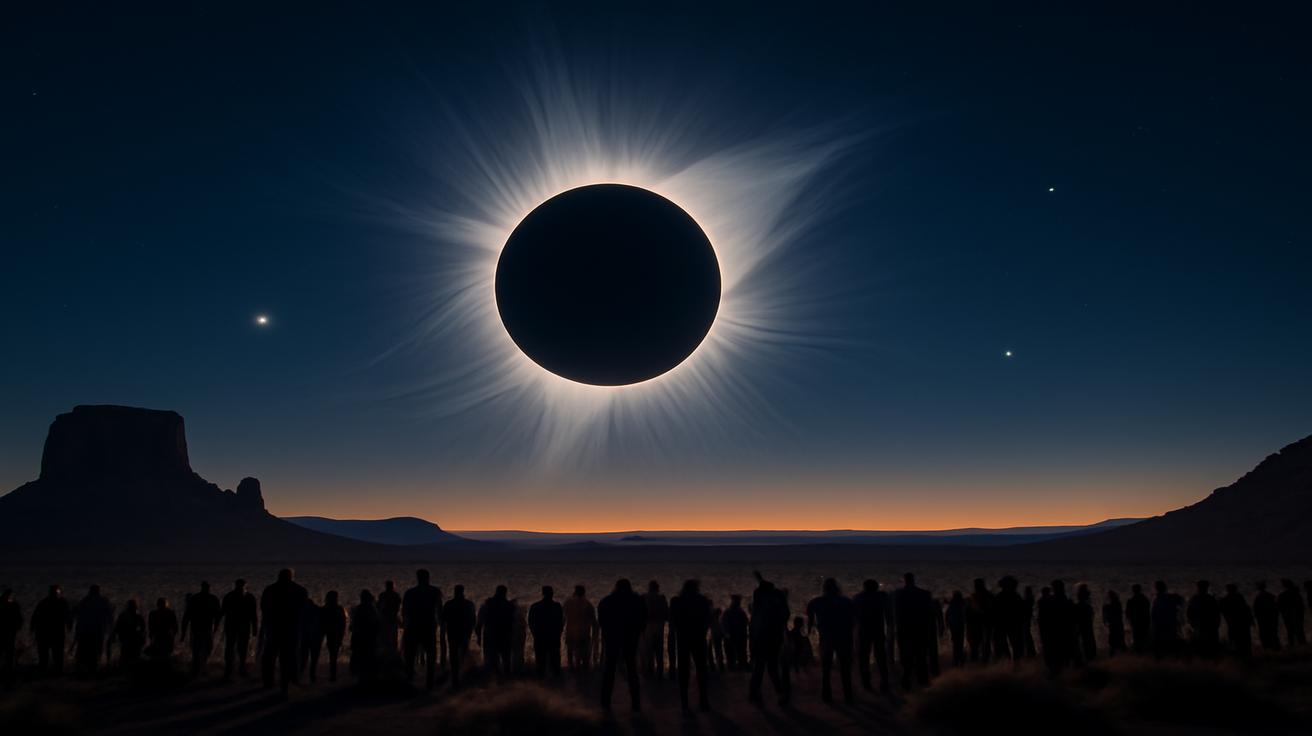
The first sign something is wrong is the birds. One moment they are chattering in the treetops, stitching sound across the sky; the next, they fall eerily quiet. Shadows sharpen, then stretch, then grow oddly bluish, as if someone has slipped a strange filter over the world. People raise cardboard glasses to the sky, their voices dropping to whispers. On the horizon, a 360-degree sunset begins to smolder. And then, with a soft, collective gasp that ripples across continents, daylight breaks—into darkness.
The Day the Sun Will Disappear
A “once in a lifetime” eclipse feels common enough if you follow the news. But astronomers are already whispering about something that lies beyond the ordinary shadow shows we’ve grown used to: an eclipse so long, so perfectly timed, that it’s being quietly called the “eclipse of the century.” Six full minutes of darkness. Six minutes in which the Sun’s brilliant face will be wholly erased and replaced with a ghostly white crown. Six minutes in which our home star reveals itself as something wild and alive.
This unusually long total solar eclipse is expected to occur on July 16, 2186. That date may look like a far-off science fiction title, but in eclipse terms, it’s already etched into the precise choreography of celestial motion. The orbits of Earth and Moon are so regular that astronomers can calculate such events centuries before they happen. And this one is special: a totality lasting just about six minutes and thirty seconds at its longest—and more than six minutes for a generous stretch of its path. In human terms, that’s long enough to feel the darkness settle, to let your heartbeat slow, to forget for a moment that this is “just” an alignment of spheres.
If you’ve seen a partial eclipse before—the Sun bitten by a jagged black arc—it’s tempting to think you already understand the spectacle. You don’t. A total solar eclipse is not the same thing on a bigger scale; it’s an entirely different animal. The sky doesn’t simply dim; it transforms. Bright planets flare into existence. The solar corona, usually hidden in the Sun’s blaze, spills out in tendrils of pearly light. Temperatures drop. Winds shift. Animals behave as if an invisible hand has fast-forwarded the day toward night.
Now, imagine that eerie twilight not as a fleeting two-minute shiver, but as a long, deep, six-minute immersion. Long enough to explore, to notice, to really feel.
Why This Eclipse Will Be So Long
Total solar eclipses happen when three things line up with improbable precision: the Sun, the Moon, and the Earth. The Moon’s shadow, thrown upon our planet, carves a narrow path where totality can be seen. Most total eclipses grant only a brief visit—two, three, maybe four minutes of darkness at most.
For an eclipse to reach the kind of duration we’re talking about in 2186, a cascade of cosmic luck has to fall into place.
- The Moon must be close to Earth. Its orbit is elliptical, not circular. When it is closer (perigee), it looks slightly larger in our sky and can block the Sun a bit longer.
- Earth must be near its farthest point from the Sun. At aphelion, the Sun appears slightly smaller, giving the Moon “extra coverage.” July 16, 2186 lands near this solar shrinkage.
- The alignment must be almost perfect. The more precisely the Sun, Moon, and Earth line up, the longer the Moon’s darkest shadow—called the umbra—lingers in one place.
- The path must cross near Earth’s equator. Our planet spins fastest there, effectively sweeping the surface beneath the Moon’s shadow more slowly, adding seconds to the show.
When you add those factors together, you get something rare even in astronomical terms: a jaw-droppingly long totality that edging past six minutes for a broad region along its track. For some eclipse chasers, this is the holy grail: a slow-motion eclipse, long enough for deliberate observation rather than rushed awe.
Tracing the Shadow’s Path Across Earth
On that far-off July day, the Moon’s shadow will first kiss Earth somewhere over the Pacific Ocean. From there, it will sweep across northern South America, then surge over the Atlantic, cross northwest Africa, and finally drift off into the eastern horizon.
The exact track is a ribbon only a few hundred kilometers wide, but within that ribbon lie cities, coastlines, jungles, and deserts that will all experience the same strange mid-day night. Here’s a simplified look at the approximate path:
| Approximate Region | Notable Viewing Area | Estimated Local Time of Totality | Approx. Duration |
|---|---|---|---|
| Central Pacific Ocean | Open ocean & possible expedition ships | Late morning | Up to 6+ minutes |
| Northern South America | Regions of Colombia & Venezuela | Around midday | About 5–6 minutes |
| Atlantic Crossing | Ocean-based observatories & ships | Midday to afternoon | Longest totality, near 6.5 minutes |
| Northwest Africa | Regions of Morocco, Algeria, & nearby areas | Afternoon | Around 4–6 minutes |
The absolute maximum totality—around six and a half minutes—is expected somewhere over the Atlantic. But long totality will also bless parts of land, making this not only an astronomer’s dream, but a traveler’s.
For now, the specifics are paint on a sketch. Atmospheric conditions, political borders, and the shape of human civilizations will all look different in 2186. But the shadow track itself is already written into the geometry of the Solar System, as rigid and reliable as the gears of an antique clock.
The Best Places to Watch: If You Could Time-Travel
If we could send future you a travel brochure for July 16, 2186, it might highlight a few particularly tantalizing options.
1. Offshore expeditions in the Atlantic Ocean. For those chasing the absolute longest totality, ships stationed along the line of maximum eclipse would be the ultimate platform. Imagine a vessel drifting beneath a blazing mid-ocean Sun that, minute by minute, is swallowed whole. Scientists will likely pack these decks with telescopes, cameras, coronagraphs, and spectrometers—this is prime time for data. But even for a non-scientist, standing at the rail and watching a sudden twilight flood across an empty ocean could be profoundly surreal.
2. Northern South America’s lush landscapes. The path sweeping across parts of Colombia and Venezuela offers a rich sensory setting: humid air, the chorus of insects, the possibility of watching animals respond in real time. In a patch of Amazonian forest, howler monkeys might announce the sudden darkness. Fish in shaded rivers might rise, thinking night has come. Eclipse chasers today already speak of the wild atmosphere of tropical totality; lengthen that darkness to six minutes, and you get something closer to a ritual than a spectacle.
3. Mountains and deserts of Northwest Africa. On the opposite side of the Atlantic, the shadow crosses arid highlands and rugged plains. Watching an eclipse from a desert is a lesson in pure contrast: a world of blistering light and mirage, suddenly snuffed into soft pearlescent twilight. The air cools. Heat shimmer vanishes. The corona burns white above a flat, unobstructed horizon that glows burgundy in every direction, like a ring of distant fires.
Every eclipse path writes its own story in landscapes and weather. This one drapes that story over water, forest, and sand—a roaming performance, shifting with each mile of the Moon’s traveling umbra.
What Six Minutes of Darkness Really Feels Like
For many people, the experience of a total solar eclipse compresses into a breathless rush. The Sun is there, then not, then back—over before your brain catches up. Six minutes changes that. Six minutes invites contemplation, detail, and a slow sinking into the strangeness of the event.
The lead-up begins long before totality. The first “bite” out of the Sun—called first contact—comes as a subtle notch through eclipse glasses. Over the course of an hour or so, the Moon’s silhouette grows, turning the Sun into a waning crescent. Light grows thin and metallic. Colors drain from the landscape. Your own shadow sharpens into something unnaturally crisp, its edges razor-fine.
About ten minutes before totality, the world begins to feel wrong in a way your body notices before your mind. A chill steals through the air, even on a summer day. Wind patterns shift, temperature gradients scrambling the usual breezes. On the ground, if you look closely at a pale wall or a white sheet, you might see crescent-shaped patches of light fluttering—sunlight passing through tiny gaps in leaves, acting as hundreds of pinhole cameras broadcasting the shrinking Sun.
Then comes the moment people try to describe and always fail: the plunge. The last sharp sliver of sunlight breaks into shimmering beads along the Moon’s topography—called Baily’s beads—and then a final, radiant “diamond ring” flares, as if the Sun is wearing a jewel. When that winks out, totality begins. Glasses off. Eyes up. Day into night.
The corona—an enormous, streaming veil of plasma millions of degrees hot—spills outward like a silent explosion. It is not flat white; it shimmers with subtle structure, with loops and arcs shaped by the Sun’s magnetic field. Stars appear, along with bright planets like Venus and Jupiter, hanging oddly bright in a sky that still clings to a twilight glow along the horizon. For six minutes, that ghostly crown hangs in the sky, steady, impossible, made of light we never see at any other time.
With so much time, your attention can wander in ways it never could during a three-minute eclipse. You can study the delicate tips of the corona. You can scan for pinkish prominences—eruptions of solar plasma—licking out from behind the Moon’s limb. You can turn and watch the reactions on others’ faces, the tears streaming down cheeks, the stunned silence, the sudden laughs that sound too loud in the quiet. You can also simply stand there, not analyzing, not even thinking, just letting the primitive part of your brain feel what it means for the Sun to die, however briefly.
And then, like a reversed spell, the diamond ring returns on the opposite side. Glasses back on. The world brightens. Colors swell. Birds, finally convinced that morning has come again, resume their songs—hesitant at first, then bold, then exactly as they were a few hours before, as if nothing at all has happened.
The Science Wrapped Inside the Spectacle
The poetic side of an eclipse is obvious. But for scientists, a six-minute total eclipse is not just a gift—it’s an extended laboratory experiment that the universe happens to run right over our heads.
The corona, visible only during totality (or with specialized instruments), is still one of the Sun’s best-kept secrets. It is hotter than the Sun’s visible surface by a factor of hundreds—something that makes no intuitive sense. Unlocking why this tenuous, wispy outer atmosphere blazes at millions of degrees requires better observations, subtle measurements of its structure, temperature, and magnetic fields, all of which benefit from more time in the dark.
During a long eclipse, astronomers can:
- Track fine changes in coronal streamers and loops over several minutes.
- Collect high-resolution spectra of the corona to study its composition and dynamics.
- Test sophisticated equipment under rare real-corona conditions instead of relying purely on models.
- Observe how Earth’s atmosphere and ionosphere respond to the sudden removal of solar radiation, using sensors on the ground and in aircraft.
In 2186, assuming we’ve continued our habit of pointing ever-better instruments at the sky, the eclipse of the century will almost certainly be laced with airborne observatories, high-altitude drones, sea-based telescopes, and perhaps even space platforms positioned to watch Earth’s shadow racing across its face.
Yet, for all that hardware, the startling thing about an eclipse is how little you actually need to experience it on a visceral level. A pair of simple eclipse glasses, a good location, and a willingness to witness—the rest, the sky delivers on its own.
Preparing for an Eclipse—Whenever You Live
Most of us reading this will not stand beneath the 2186 eclipse. But total solar eclipses happen often enough somewhere on Earth that there’s a real chance you might choose to travel for one in your lifetime. The “eclipse of the century” is a kind of north star for imagination—and a reminder that each shorter eclipse we do experience is still part of the same cosmic dance.
If you decide to chase any total solar eclipse, a few principles apply, whether it’s a two-minute dazzler or a six-minute epic.
- Start with the path. Totality occurs only within a narrow track. Partial eclipses are interesting, but they’re not the same. To feel the full plunge into darkness, you must stand in the umbra.
- Check historical weather. Some locations may offer the longest totality on paper but have a high chance of cloud cover. Sometimes a slightly shorter totality in a drier region is the wiser choice.
- Think about your setting. Do you want a remote mountaintop, a crowded festival-like gathering, a patch of forest, a boat at sea? The backdrop shapes how your memory of the eclipse will feel.
- Protect your eyes. Eclipse glasses or certified solar filters are non-negotiable for all partial phases. Only during totality itself—when the Sun is fully covered—can you safely look with the naked eye, and then glasses go back on the instant the first diamond ring appears.
- Sometimes, skip the camera. It’s tempting to try to capture everything, but the most vivid eclipse images are the ones burned into memory. Take a few pictures if you must, then put the technology down and let the sky do its quiet work on you.
Perhaps the most important advice: leave room for wonder. The scientific explanation of an eclipse is simple geometry. The experience of it is not simple at all.
A Long Shadow Across Generations
There’s something almost tender about knowing the exact date of an event most of us will never see. July 16, 2186. People not yet born will stand where we stand, look up at the same Sun and Moon, and feel their world go dark at midday. Some of them might read words written decades or centuries before, describing what we thought they might see, how we imagined it would feel.
The “eclipse of the century” is less a spectacle reserved for 2186 than a reminder of continuity. We live in a universe where orbits are so steady we can predict the exact second of a shadow’s arrival centuries from now. Yet inside that predictability is a human moment that refuses to be tidied into numbers: the moment when the Sun disappears, and all our stories, beliefs, and emotions surge to fill the sudden dark.
Some future child in Colombia, in Morocco, or on a research ship in the Atlantic may raise their eyes during those six minutes and feel very small and very large at the same time. They may become an astronomer, a storyteller, a philosopher, a poet. They may remember the cool wind on their skin, the stunned silence of the adults around them, and the way the corona looked like a luminous crown over a black, hollow Sun.
Our role, perhaps, is simply to pass the story along. To tell each other that such things are possible. That once in a century, the Sun itself pauses for a heartbeat, and we—if we’re lucky enough to be watching—get to pause with it.
Frequently Asked Questions
When will the “eclipse of the century” happen?
The extraordinarily long total solar eclipse often called the “eclipse of the century” is predicted to occur on July 16, 2186. At its maximum, totality will last about six and a half minutes, with more than six minutes of darkness along a broad stretch of its path.
Why is this eclipse so special compared to others?
Its uniqueness comes from the combination of a very precise alignment, the Moon being relatively close to Earth, the Earth being near its farthest point from the Sun, and the path crossing near the equator where Earth’s rotation favors a longer duration. All of these factors stretch totality beyond what we usually see.
Where will the best viewing locations be?
The path of totality will cross the central Pacific Ocean, northern South America (including parts of Colombia and Venezuela), the Atlantic Ocean, and northwest Africa (including regions of Morocco and Algeria). The longest totality will occur over the Atlantic, but many land areas along the path will still see more than six minutes of darkness.
Is it safe to look at a solar eclipse?
It is safe to look at the Sun only during the brief period of totality, when the Sun is completely covered by the Moon. For all partial phases—before and after totality—you must use proper eclipse glasses or solar filters. Looking at the Sun without protection outside of totality can cause serious, permanent eye damage.
Will people alive today be able to see this eclipse?
Most people living right now will not be alive in 2186, so this particular eclipse is mainly of interest as a scientific and historical landmark. However, total solar eclipses occur somewhere on Earth roughly every 18 months, so there are good chances to travel and experience other, shorter total eclipses within a normal lifetime.
How can I prepare to see any future total solar eclipse?
First, find out when and where the path of totality will be. Then choose a location within that path with historically favorable weather. Arrange travel and lodging early, bring certified eclipse glasses, and consider simple viewing gear like binoculars with solar filters. Above all, plan to spend at least part of totality just watching with your own eyes, without worrying about cameras or equipment.
Do animals really react to eclipses?
Yes. During total eclipses, observers commonly report birds going quiet, bats appearing, farm animals heading for shelter, and insects beginning nighttime behavior. The sudden change in light and temperature confuses many species into thinking dusk has arrived, offering a fascinating, if brief, glimpse into how closely life on Earth is tuned to the Sun.




Leave a Comment